

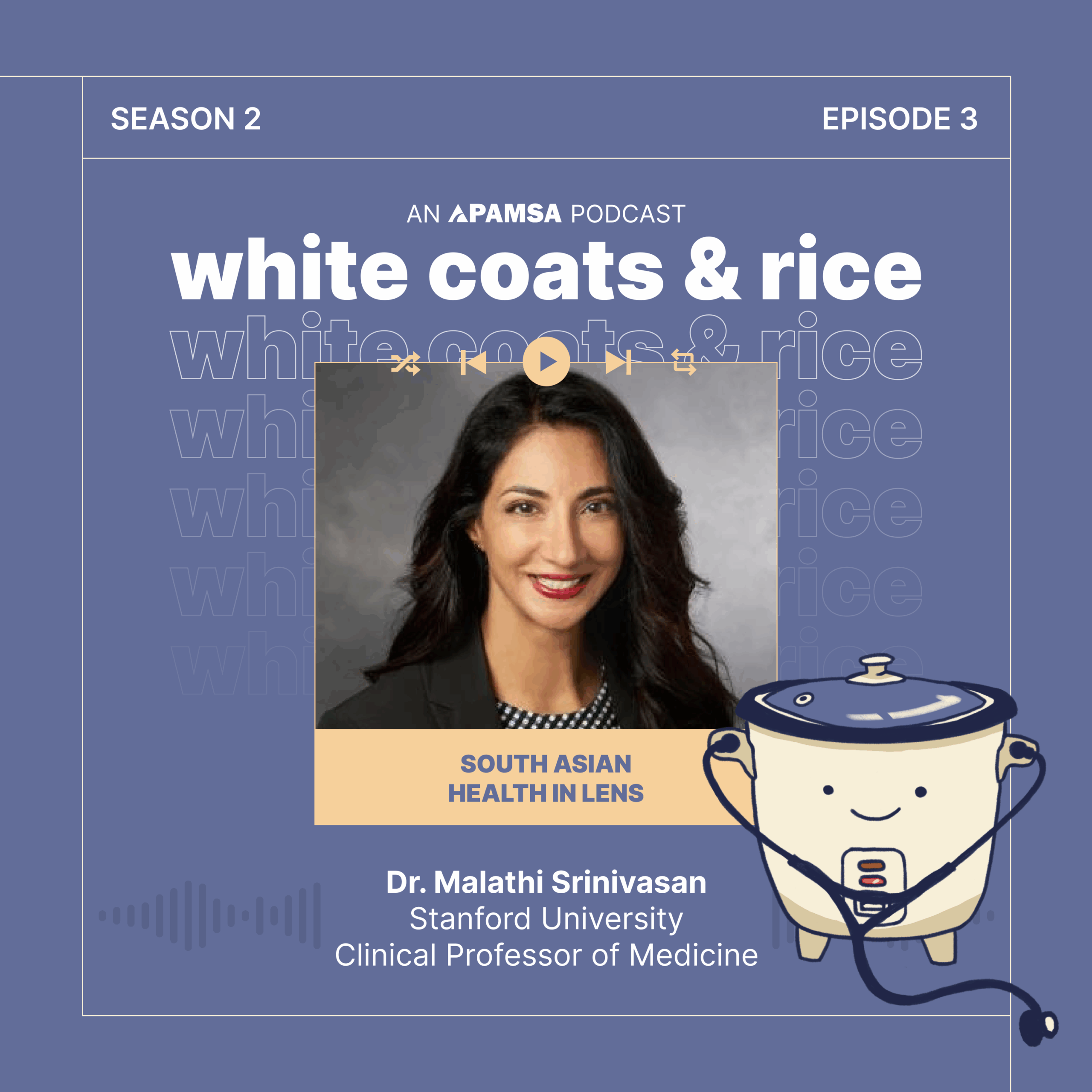
Dr. Malathi Srinivasan is a Clinical Professor of Medicine at Stanford University and Associate Director at the Stanford Center for Asian Healthcare Research and Education (also known as Stanford CARE). Dr. Srinivasan brings her skills as an educator, physician, health services researcher, and entrepreneur to shed light on crucial topics in South Asian health, including crucial health trends, preventative health for South Asians, and Stanford CARE’s efforts in researching Asian health.
Listen here:
YouTube
Spotify
Apple Podcasts
This episode was produced by Nikitha (Nikki) Sheth and Grace Kim, hosted by Nikitha (Nikki) Sheth, and graphic by Callista Wu.
00:00 Introduction
01:27 Dr. Srinivasan’s early life and immigrant childhood
04:23 Discovering identity and path to medicine
07:15 Journey into Asian health research
09:03 Common misconceptions: the model minority myth
13:41 Lifestyle choices for South Asian health
18:50 Pharmacogenomics and South Asian patients
24:17 Nutrition, diet myths, and healthy adjustments
37:17 Screening guidelines for South Asians
40:50 Building trust and rapport with South Asian patients
47:37 Opportunities to get involved with Stanford CARE
51:18 Advice for South Asian medical students
54:19 Finding supportive mentors
58:28 Audience question: relying on professors in residency
01:01:09 Closing
00:00 Introduction
Nikitha: Hi everyone, welcome to APAMSA White Coats and Rice’s new series South Asian Health in Lens, or SAHIL, where we delve into critical topics in South Asian health ranging from advocacy to cultural competency with distinguished health care leaders. My name is Nikitha Nikiseth, first-year medical student and third year in the University of Missouri Kansas City’s six-year BA/MD program, and the current vice president of UMKC APAMSA and member of the South Asian Committee here at National APAMSA. And I’ll be your host for our SAHIL series.
For today’s episode, we’ll be speaking with Dr. Malathi Srinivasan, who is a clinical professor of medicine at Stanford University and Associate Director at the Stanford Center for Asian Health Care Research and Education, also known as Stanford CARE. She also serves as Director for the Stanford CARE Scholars Program and Stanford Implementation Sciences Fellowship. Dr. Srinivasan is active in the Stanford Humanities and Arts Program and brings her skills as an educator, physician, health services researcher, and entrepreneur to shed light on crucial topics in Asian health. Let’s welcome Dr. Srinivasan. Dr. Srinivasan, thank you so much for joining APAMSA White Coats and Rice and for being our first guest on our South Asian Health in Lens series. Let’s start off with talking a little bit about yourself and your journey, and how it’s led you to become the Associate Director of Stanford CARE.
01:27 Dr. Srinivasan’s early life and immigrant childhood
Dr. Srinivasan: Niki, that’s such a pleasure to be with you here today. And thank you to you, your audience, and to APAMSA for inviting me. I’m so excited to share with you a little bit about things having to do with South Asian health today. And if you had asked me when I was a young girl growing up in the Chicago suburbs if one day I would be a clinical professor at Stanford working in South Asian health and in Asian health, I would have completely not believed you. Because my parents, like many other people in the United States who are Asian, had immigrated from India to Canada and then to the United States when I was a very young child. So I was actually born in Canada and I grew up in the Chicago suburbs. My brother was born when my dad was doing his postdoc at Notre Dame. And we had a very interesting immigrant childhood. In the sense that we had faced in this white collar, blue collar area that we grew up in a lot of overt discrimination when I was growing up. People didn’t really, hadn’t seen a lot of people who were South Asian and they didn’t really have a good cultural base. There’s a lot of prejudices that were held over about what it meant. To be not white in America. So when I was growing up, there was a lot of issues surrounding being bullied because of ethnicity, being called dothead, and other types of things in a questioning and Midwestern environment. But at the same time, that was counterbalanced by a very rich expat and immigrant culture. Of all of our friends and families with whom we would interact. So the home life was very rich with culture and great foods and science and music and art at a very elevated level. And then the outside culture was a Midwestern area where we were, you know, generally grossly misunderstood and in many cases actively discriminated against. You know, my parents had been PhDs in Canada. My mom was a nuclear physicist and my dad was a radiation chemist. So, you know, our friends and family were sort of along those lines. And when I had gone to high school, you know, my parents had dressed me up like a young South Asian girl, which meant like a pigtails with ribbons in my hair, which you can imagine didn’t go over particularly well when people were trying to be cool and trying to be styling. By the time I had gotten to college and was really finding my own voice at our state school, University of Illinois in Champaign-Urbana, I was really beginning to understand what it meant to have two identities. And being bicultural was a wonderful experience and also a scary experience because there was no navigation pathway. And there at the time there weren’t that many Asians and certainly South Asians in the United States, you 5.4 million people that we have right now.
04:23 Discovering identity and path to medicine
Dr. Srinivasan: So I went to medical school at Northwestern and then did most of my training in the Midwest, including after my medicine residency. I did a three year research fellowship that was focused on health services research as well as on medical education and had joined the faculty at UC Davis. And there I was doing a lot of work around education, asking questions about how do you train a great doctor? How do you build programs that are going to help physicians and allied health professionals all around the world train clinicians better and make them more compassionate, make them better decision makers. And so my early work at UC Davis was focused both on medical education as well as on health services research, which is how we deliver care. And I was teaching internationally a lot with one of my colleagues, Dr. Michael Wilkes, who he and I would go to different countries and we would teach about capacity building around education and educational leadership. And then through my work in Asia became much more interested, certainly in Asian health. And at the same time, as we were growing up, a lot of our family friends began having problems. They develop breast cancer more so than I would say in other groups. They develop cardiometabolic diseases, started having heart attacks. Early my grandfather died when he was around 60 of a heart attack, which given how active he was and the fact that he was eating a very good South Indian diet, which we thought was terrific for him, but was very surprising. And so when I had moved in 2018 from UC Davis to Stanford and joined the faculty, there were a couple of colleagues who have become fast friends who had started the Stanford Center for Asian Health Research and Education. And the goal of the center was to be able to improve the health of Asians everywhere. And you might say, well, that sounds pretty ambitious. And it is a very ambitious goal. And what we’re trying to do is take aggregated Asian data within the United States and then disaggregate it so that we can actually understand what’s happening with the health of Asians. Now, you might say that seems like pretty much of a no-brainer, right? Asians are 60% of the globe. There are 67% of the US population right now. But there are only 0.17% of NIH funding, and this is with prior NIH funding. We’re not quite sure what’s going to happen with funding given priority changes now federally. But it’s a very understudied group of individuals and we know that there’s differential health risks. So when I had joined Stanford and Dr. Latta Palaniippan and Dr. Bryant Lynn had started Stanford Care, I had joined to teach within a very small research program that they had started for undergraduates and we grew that program up into the current Care Scholars Program.
07:15 Journey into Asian health research
Dr. Srinivasan: Where we’re doing a lot of training around precision medicine for Asian health and training about 24 young people per year and also doing work with the team science fellowship that we built to support the Care Scholars Program. And so, you know, the pathway, and at the time when I was growing up, there was no such thing as Asian health research. In fact, there was a lot of work around African American health and Latino health and LGBTQ health, Native American health, and minoritized populations that didn’t really have a voice. But there wasn’t so much about South Asian health and or about other Asians comprising the big six, Chinese, South Asians, Filipinos, Koreans, Vietnamese, et cetera. So the opportunity to be able to do work in this area was not there. And as a health services researcher who had training on understanding how to think about vulnerable populations, it was something I never thought I would be able to do. And it was really an honor to be part of the center and now to be associate director, one of the associate directors of the center.
Nikitha: It’s truly inspiring to hear your story because I have a similar situation where I’m daughter to Indian immigrants. I grew up in the Chicago suburbs and to hear about the adversity that you faced while growing up in that situation and getting more involved in ways to bring more light to these issues and kind of the lack of awareness that Asian health trends are certainly prominent and should be addressed and cared for as many as the other minorities and other health trends. So I sincerely appreciate the work that you do. Just kind of.
09:03 Common misconceptions: the model minority myth
Nikitha: Leading into that, you recently led an insightful discussion on Asian health in America, and that delved into the model minority myth of Asians, as well as differences and causes of death across several groups of Asians, as well as mental health. So what have you found to be common misconceptions about the South Asian community and South Asian health?
Dr. Srinivasan: Well, I think we should start with what the model minority myth is and how it came to be. The model minority myth is this idea that one group of immigrants or a population is so much better than all the other groups. And in fact, that they’re a model because they’re so hardworking, they don’t speak up, they put their heads down and are successful. And what that does is several things. Now that sounds great, sure, you are the model minority, everybody wants to be like you, but that’s actually not true. But the model minority myth is used as a wedge to be able to set one group against the other. And by obscuring differences that are within a group, it actually leads to people ignoring important issues that happen for all of the people within the groups. For instance, the Asians generally, and Indians and Chinese people, Chinese groups in particular, are often held up as model minorities. If you are a South Asian, even though the South Asians generally may have a high overall income compared to other groups within the United States. There’s about 10% of people who are below the federal poverty limit. If you are South Asian, one in five people, 20% of individuals have mental health concerns like a depression or anxiety. And we don’t even know the rates of schizophrenia or some of the other important psychiatric disorders. It means that people then become, are not asked about issues around their health or mental health or problems that are very important to the community. And because of this, they also don’t seek help and they don’t end their stigma against being able to show your concerns. Right? So in many Asian cultures, you’re really taught that you have to present yourself in a certain way that is a very polished and together, but in essence, even if you are going through individual and personal struggles, because of the stigma associated with mental health disorders and with other health conditions, you may not actually seek help. And so that leads to things having to do with increased rates of depression, especially among older Asian adults who may have also language issues and with abuse and neglect or social isolation. There’s not a lot of pathways for things having to do with intergenerational conflict. South Asian youth who are suicidal might actually not present by saying, oh, I’m depressed. They might just have academic difficulties or have risky behaviors or just have a stomach ache or a headache. And so the issues around being a model minority where everyone expects you to be perfect show up in lots of ways that actually are detrimental to health and well-being of the entire group. So rather than personalized care and using a precision medicine approach, these stereotypes actually lead to these things that people may consider a positive stereotype actually lead to very negative consequences.
Nikitha: Yeah, absolutely. I think the model minority myth definitely needs to have more attention in how it can feed into negative thoughts and feelings and misconceptions around especially Asian subgroups where that may cause people to not feel like it’s worth bringing up very important health problems. Like you said, a lot of research still has to be done on a lot of different trends like psychiatric disorders and other treatments that should be worked on to bring more light into what Asians may go through and their health trends. And yeah, those misconceptions are definitely some things that we want to tackle in the South Asian health in land. I do appreciate the work you do with Stanford Care because I think it does help push us towards more knowledge and that knowledge is something that we can utilize to bring a lot of advocacy to these problems. And with the work that you do, you recently published an article on the association of sleep duration and cardiovascular disease among Asian Americans. And it highlights how suboptimal sleep duration had a higher relevance of cardiovascular disease.
13:41 Lifestyle choices for South Asian health
Nikitha: So in addition to sleep, what are some lifestyle choices South Asian Americans can consider to promote heart and metabolic health? Because like you mentioned, it’s pretty common in the family to hear of someone having either hypertension or diabetes. I know definitely people in my family suffer from it and I’m sure it’s a very common instance. So to bring more light to this type of lifestyle, what are some different choices that South Asian Americans could consider so that they’re able to promote those aspects of health?
Dr. Srinivasan: Yeah, so I want to spend a moment on sleep. You probably know that the American Heart Association has recently, about two years ago, has adopted sleep as the eighth healthy lifestyle step. Poor sleep and poor quality sleep is considered as a bad or risk factor as smoking. And the other thing of course is that sitting is the new smoking also because we know that exercise dramatically changes your cardio metabolic risks. South Asians have about twice the heart disease risk and about twice to two and a half times the diabetes risk as someone who is non-Hispanic white. If you can imagine India over, say, the last 10,000 years has gone through periods of feast and famine, of low water resource, of time where there was a lot of food scarcity. And the same way that in Africa, if you had specific mutations that made you less likely to die of malaria, namely having sickle cell disease, with oxidative stress, these cells become sickles, and then it’ll kill a parasite also. There was a survival advantage to being able to someone who stored fat and who was able to not and because fat is a food storage that lets you release sugar when there’s no food. Okay. So what has become a survival advantage in times of food scarcity is now a survival disadvantages when you come to longevity. So the that paradox is really important. And one of the things that you’ll notice is that there’s also something called the obesity paradox, where you have people who are actually normal weight. And if you look at them, they look just like a normal, healthy person. But in fact, they are metabolically unhealthy and they are metabolically obese. And because South Asians in particular store fat around their organs and it’s called visceral fat. And for the same body mass are going to have less muscle. We actually have much higher rates of heart disease and diabetes. And in fact, it’s a combination of cardiometabolic health where you have fat deposition in your liver, around your organs, you don’t build as much muscle, and muscle, believe it or not, is actually a major component of your metabolic health. And because South Asians don’t build as much muscle, and most Asians don’t in comparison to non-Hispanic white, and you build muscle really until your 30s and kind of your 40s, and then it’s harder to keep, and then you start to lose it after that. can actually, and having low muscle mass later on in life is one of the biggest predictors of whether or not you age healthily and whether or not you’re gonna die. Because people have falls, are unable to, they get hip fractures. So this combination and also fat, excuse me, muscle uses glucose independently of insulin. And so if you have someone who is unable to process and store sugar in the most healthy way, if you can actually reduce your blood sugar by having more muscle, you do better. Okay, so there was a study called Masala that was produced, that was published in 2010, which is the mediation of atherosclerosis in South Asians living in America that had really shown the higher incidences of cardiometabolic disease in Indians. And so in fact, it’s so bad that the World Health Organization and the Indian Ministry of Health have reclassified what it means to have a healthy weight for people who are Asian. And if you are Asian, whereas the body mass index, which is a measure of how tall you are compared to how much you weigh, if you take a look at that, the body mass index of 25 is considered the upper limits of normal for someone who’s Caucasian or Hispanic or African-American, but it’s actually 1.5 points lower for people who are South Asian and Asian. So at every point in time, whether you’re thinking of obesity at a BMI of 30 or morbid obesity at a BMI of 40, because of our differences in cardiometabolic health, the numbers are 1.5 less. So it’s really important for us to have an understanding of the foundations of this and also understand that there’s pharmacogenomic differences that are also driving how we treat these issues.
18:50 Pharmacogenomics and South Asian patients
Nikitha: Could you delve into the pharmacogenomics because I think that’s also a really critical topic to kind of delve into to provide more context on that foundation.
Dr. Srinivasan: Right. So in every country where people have grown, have lived for tens of thousands of years in a specific location, there will be variations from what’s studied. I want to make two points. The first one is that Asians in general and South Asians in particular do not participate in very many research trials. If you take a look at the number of people who are Asian in the world, it’s about 60%, the number of people who are participating in clinical trials is about 10%. So all of the decisions that are made about Asian health are for the most part done with non-Asian data. When it comes to genomics. So there was a study in 2016 that was a meta-analysis of about 2,500 studies that looked at genomic data for 35 million people, so including people from China. Only 19% of all of the genomic data is done on Asians. So what that means is that you have a mission aggregation, an extrapolation of data from other populations to the Asian population. And what does that mean for South Asians? Well, we know a lot of stuff, right? So already what we do know is that there’s, let’s just kind of stay on cardiovascular issues since we’ve been talking about that. If you take a look at things like metabolism of drugs for treating heart disease and heart attacks, or someone who’s had a stint, you might use a medication called Plavix, which is, you the generic is clopridogrel. And if you’re Asian, a South Asian you are more likely to bleed if you’re given Plavix. And why is that? It’s because you have something called a gain-of-function mutation. And what that means is that a particular enzyme, I, without getting too technical, the enzyme name for those of you, since there’s a pre-medical audience here who might care, is CYP2C19-star-17, okay? I know that’s a mouthful. But that gain-of-function mutation takes a protigrel, which is a prodrug, and translates it into its active form. And because that enzyme system in the liver is more active, you make more of it. So you’re going to be more likely to bleed because it’s an anticoagulant, right? So if you have a medication that we use for atrial fibrillation called warfarin, you actually need to have less of a dose because you’re going to be more likely to bleed because there’s an enzyme system called V-Core C1, which is different in Asian Americans and in South Asians. And you should be giving someone a different dose than you would because you’re going to be more likely to bleed. If you look at statins, which we use to be able to treat high cholesterol, then you also want to, it’s important to know that statins aren’t metabolized as well for people who are South Asian. And in fact, you need less of it because you might actually have more side effects. So for people who are South Asian, for all of you blood and cardiologists out there, if you have a South Asian patient, start at a lower dose and then ramp up slowly and monitor for side effects. And if you start getting side effects, back off on the dose and you can add second and third drugs like Zetia or the PSK9 inhibitors. But it’s important to kind of think about these differences. And that’s the first point. The second point is that in many cases, we actually don’t even know why we’re having differential outcomes. Breast cancer rates are increasing significantly in South Asian women. And when you do genomic profiling against the things that we know are hereditary breast cancers for people who are Caucasian, like the BCARA 1 and 2 genes, they may not have those. But when they do whole genome sequencing, we have things that are in that same area which people are calling variations of unknown significance, right? So there are variations that may be very common in South Asians, but we actually don’t know what they mean because they haven’t been studied. So it’s very important for people who are South Asian and people who are Asian in general to join clinical trials so that we contribute their genomic data so we can begin to understand what’s happening in our populations.
Nikitha: Yeah, definitely. And learning more about the foundation of why these trends are what they are, rather than just knowing that they exist, I think is crucial, especially for aspiring physicians, that they can gain more perspective and kind of awareness from that pharmacogenomics, just so that they have more understanding going into when they treat these patients. I think what you said about statins also resonated with me a lot because it’s such a common form of treatment but something as simple as a statin you have to consider the nuances when you have a South Asian patient because it may not present the exact same way they may have more side effects and so the dosage has to be adjusted accordingly so that is really important to know so I appreciate you mentioning that and.
24:17 Nutrition, diet myths, and healthy adjustments
Nikitha: With those lifestyle choices as well. So knowing that foundation is really helpful. So with the building muscle might also help. So I know oftentimes we just say that exercise is great because maybe with diabetes that tends to be the trend if they’re more obese. But when it comes to Asians and South Asians, that’s not always the case. They may be a smaller frame but still have diabetes just because of those environmental aspects and the genomics. And so things like maybe building muscle might be helpful to consider in addition to what they may consider as other exercise like walking and simpler exercises like that. So it’s good to know that maybe building muscle is another thing to keep in mind for those lifestyle choices.
Dr. Srinivasan: Nikitha, you’re so correct. And in fact, Dr. Palaniapin had done a study called Strong D. So it was a strength training versus cardiovascular training program. Take a look at what happened to people with diabetes. And in fact, strength training for South Asians was more important than cardiovascular exercise to address diabetes. And I think it’s in large part because of the visceral fat issue and then the building of muscle issues with sarcopenia that we talked about. There’s a lot of other things that people can do also to be able to improve their sleep. And some of it is the standard advice that you’re going to get. So, you know, make sure you’re paying attention to your sleep. You know, don’t smoke. Ideally, we used to think that some amount of alcohol was safe in terms of long-term health, but we know now that really, you know, all alcohol is bad alcohol for your health. And so if you’re going to drink, you know, just make sure that you’re being very moderate and use it as something that’s occasional, not every day. We could talk a lot more about diet and fats too. I know a lot of people are always asking me about what cooking oils to use and.
Nikitha: How to think about their food choices. Yes, that would be a great thing to touch upon because it is something that’s quite common with cooking. At least from my perspective, I would hear from family members or family friends that the amount of cooking oil is playing a big role, but they don’t really know how to adjust things. They’ve just kind of heard a lot of bits and pieces here and there, but don’t know what to do with it to help improve their health. So definitely talking about that would be wonderful.
Dr. Srinivasan: Indians and Asians love to eat. And in fact, I don’t know about you, Nikitha, but my fondest memories are of our family gatherings and everyone, you know, cooking together and eating together. And in fact, much of our conversation would usually center on what we had eaten, what we were eating and what we were going to eat. And the deliciousness of the foods is unsurpassed, I think, amongst all of the Asian groups. And of course, I’m very biased. But if I could have my mom’s gulab jamun every day, I’d be very, very happy. So what does that mean for our health, though? So knowing what we know about cardiometabolic health in South Asians, the things that we have to know about are sugars and fats, right? So we have our energy comes from either carbohydrates, which can be simple, complex or fibers, proteins, and then also from fats. And so I’m going to touch briefly on all three of these. So let’s kind of talk about the protein issue. So for people who are vegetarian, which many South Asians are, finding adequate protein is a little challenging. And you have to be pretty meticulous about making sure that you’re having balanced protein so that the essential amino acids that you need come from both legumes as well as from grains. And when you’re choosing grains, you want to choose more complex carbohydrates, which take a little bit longer for your body to digest and metabolize into sugar. For proteins, the general recommendation is that you want between 0.8 to say maybe two grams of protein per kilogram. It depends on how much you weigh. And I would encourage all of the APAMSA students who are listening to this podcast to really go out and take a look at food labels because I think that getting familiar with food labels is very important. So every plant or food group has all of the essential amino acids. It’s just the proportions of them and having them available to you in a way that’s useful, that’s important. And so if you’re a vegetarian and you have either eggs or milk products, it becomes much easier because there’s both protein supplements that you can take as well as, you know, dolls and excuse me, as well as eggs and milk that are available to you that have complete proteins. But if you’re vegan, then you have to be a lot more careful with your protein intake. So, you know, just please become a little bit more educated about that and then read your food labels and think about how you can get the right amount of protein. And it should be about 30 grams per meal. You know, usually less than about 20 grams per meal. The protein is not necessarily going into building muscle. It’s often just used and or stored as fat. So we don’t have a form of protein storage. We only have a form of carbohydrate storage and carbohydrates, of course, are stored as fat. And so all the excess protein that you eat, if you eat a lot in a meal, is just going to get converted to fat if you’re not going to be using it right away. The carbohydrates, as I’d mentioned, come as simple, which are just things like sugar, like glucose, fructose, and other simple sugars, or things that are more complex carbohydrates that are longer chain sugars, and then things that are fibers, which are really fairly either soluble or insoluble. the insoluble fibers are the ones that are used by bacteria to be able to support your metabolism in your GI tract. What’s important about carbohydrates is carbohydrates are metabolized, are digested by your stomach and by some of the enzymes in your intestine, and then they’re absorbed. And when you think about people who have diabetes, the rate at which those sugars are absorbed into your blood system in the intestines and the baseline amount of blood sugar, of sugar that you’re making from your liver are the two things that determine your blood sugar level. So when you’re eating, what you want to do is try to reduce the spike by slowing down digestion. And that can be done by several things, by having fats and complex carbohydrates, like salads and things, at the beginning of your meal. So salad with a really good salad dressing, having vinegar, which will slow down about two tablespoons or so, which will slow down your gastric emptying. So again, going back to that really great salad at the beginning of the meal, and then having more complex carbohydrates, which your body has to work harder to digest. And so a carrot that is baked has a different glycemic index, which is kind of a rate of if you have 100 grams of carbohydrates, how fast does your blood sugar rise? The, you know, an hour or so, the type of food and the food composition becomes very important and the order in which you eat also becomes important. So understanding that about carbohydrates that you can actually choose things that are lower glycemic index, meaning how fast the sugar is absorbed and how much your blood sugar spikes when you have that type of food, right? So a glycemic index of 100 is if you have like 100 grams or so of glucose and what happens to your blood sugar. But a baked potato has a glycemic index of 110, whereas a broccoli is gonna have a glycemic index of maybe 20. So in general, we wanna try to keep most of our foods having a glycemic index of less than 55. And then when it comes to things having to do with fats, there’s a lot of misconceptions about dietary fats. In our blood, the good cholesterol is called HDL and the bad cholesterol is called LDL. South Asians also have a higher incidence of a very bad type of lipoprotein called lipoprotein A. And if you don’t know if you or your family have it, you should get checked out. And the things that drive up the bad cholesterol, the LDL, are saturated fats and trans-saturated fats. Things like the seed oils are actually not that bad for you. And there’s a lot of villainization of individual food groups that comes from a lot of food misinformation. And the seed oils in general are just fine, even if they are refined at a slightly higher temperature. When you cook, you’re also cooking at a slightly higher temperature. The so things that we love that make our food really, really tasty, like ghee and clarified butter or a coconut oil are actually really bad for your health. They will drive up the bad cholesterol and make you more prone to having heart disease. And the good fats are things that are liquid at room temperature, which are the omega-3 and omega-6 fatty acids. The omega-3s are anti-inflammatory, and they’re found in things like nuts, avocados, fish, and also canola oil and a lot of the seed oils. So there’s things like omega-3s are really important for you in terms of your brain health as well as your cardiovascular health. And so paying attention to the types of fat is really important, less so than the amount of fat, although we tend to, because our food is so delicious, eat a lot of it. And so I would just say that, you know, the amount of total fats that we eat, especially saturated fats, should be reduced. There’s a couple other food groups that you should be careful about, particularly in South Asian food. One of them is milk products. We use a lot of yogurt and cheese, particularly in the northern part of India. And cheese. And milk products are very inflammatory, and they contain some sugars and things like that that are just not great for your gut health. In general, I don’t really recommend milk products, although if you can take it, it’s just fine. We use a lot of rice, as you know, and white rice has a very high glycemic index. So if you can, try to have more either brown rice or you can have white rice, but eat a lot of protein and vegetables and fat with your white rice to try to slow down the absorption of the sugars into your bloodstream. The other thing is that we love potatoes and we love a lot of root vegetables that tend to have higher glycemic index and can cause that sugar spike. So, you know, don’t eat those things in isolation. I wouldn’t eat a huge pile of potatoes, but if you’re eating a small amount of potatoes, eat some vegetables and eat some protein, like chickpeas and other things, along with it so that you don’t get that sugar spike. And then try to have more salads and leafy greens and things like that as well as fruits and vegetables in your diet. So in general, I think that the rules of thumb are eat in the right order. So that means vegetables, protein, and then carbohydrates last. That will help you with a glycemic load, not just with the glycemic index of a particular food group. Two, reduce the amount of saturated fats that you eat and increase the amount of healthy fats that you eat, especially things like the nuts and the avocados. Three, don’t eat so much rice. Four, try to incorporate some kind of strength training exercise in your life, even if it’s just walking a lot with, you know, a very light weight, but it’s important for you to get out there and get some exercise.
37:17 Screening guidelines for South Asians
Nikitha: Yeah, definitely. I think the diet misconceptions, I think that’s a big thing because people have just heard what they should do, but they don’t really know why they’re doing it. Like you mentioned with the rice, people know that white rice isn’t that great, but they don’t really know that they should eat something alongside it to help with that absorption, like you mentioned. And just understanding that foundation, I think is really helpful. You also mentioned, since a lot of the South Asian population are not studied in clinical trials, what are some recommendations for routine screenings for South Asians, especially when we talk about things like breast cancer, heart disease, and those cardiometabolic issues? What are some things that people should keep in mind in terms of screenings?
Dr. Srinivasan: Right. So in general, I think you should still follow the standard guidelines. So for cholesterol, for diabetes, for hypertension, all of those things you should follow the standard guidelines. So your family doctor is going to start checking you for some of these things around age 40 or so. Now, if you are a South Asian American, you might want to start thinking about it earlier in your 30s. And especially if you’re a male, you might want to consider doing a calcium score, a coronary calcium score, which is a scan of your arteries to see if there’s any plaque deposition, just as a way of being able to get a baseline on where you’re at and whether or not you might want to consider going on a statin earlier than you would otherwise. The other thing is that, you know, there’s no official recommendation, but I would highly recommend for South Asians to get their lipoprotein A measured. Now, this is not a routine lab that your doctor will be ordering for you, but it’s an important risk factor that’s been implicated. And so I would ask your physician to order it just for your own purposes, right? It’s not part of the standard lipid panel. So when you get your cholesterol panel, you’re going to get an LDL and HDL and a triglycerides and a total cholesterol, but you’re not going to get the lipoprotein A. In terms of breast cancer, there’s still a lot of debate on how often you should be getting a mammogram, whether it should be yearly or every two years, and what age to start. But in general, I would say to you that the best rule of thumb is a woman should probably get her first mammogram by age 40 and then do it yearly after that. And if you have a family history, you might want to start in your 30s. And that’s something you should probably talk with your doctor about. But the earlier the better in terms of diagnosing breast cancer, particularly because rates are increasing in South Asians, as well as in other women in the United States. In terms of mental health, it’s very important to ask your doctor if you’re having any issues with mental health. If you feel down or blue or if you’re having a lot of anxiety and you’re not able to sleep, it’s really important for you to be able to talk about those things. You know, we don’t really have a cultural base that makes it easy to talk about some of our mental health issues, but it’s important to be able to talk about it with a professional. So I would just say that for all of our listeners and all of you, particularly young people who may be listening to this podcast, if you’re having those issues, please go and seek help. A physician, your physician, is your ally in this case.
40:50 Building trust and rapport with South Asian patients
Nikitha: Building trust and rapport with South Asian patients. That is something that, like you said, can be very difficult at times, just due to the cultural nuances and some of those stigmas that we mentioned that may be prevalent. So how do you approach building trust and rapport with your patients, especially when you encounter some of those topics that may be deemed sensitive?
Dr. Srinivasan: Well, I think the first thing that a physician, a health care provider, can do is to just ask a patient what’s important to them. So, you know, when you go into a room, if I ask a patient, you know, what’s a family life like? What do you do for fun? How do you have fun? What are your hobbies? What are you interested in? And I try to learn about the people who are in my waiting room. I try to, you know, greet them in a way that, you know, I show them that I’m interested in their culture, you know, maybe ask them, you know, what’s your family background? And when they tell me, I’ll say, oh, you know, what’s your language? And I’ll try to find some words in their language and try to do that. And you can just see patients light up when you’re interested in them as a person and not just as a medical problem. So I think that that’s the most important thing to do. You know, for many South Asians, we’ve come from countries and we’ve been, you know, in the diaspora for a number of years where we’ve also had different types of health systems. Some of them are not as patient-centered and you’re not used to a doctor asking you, you know, what’s wrong with you? Or, you know, how are you feeling? It’s more of a very professional and formal relationship. And so I think that for many people who come from that environment, it’s a little bit jarring to hear someone ask about your personal life. But in general, I think the vast majority of our patients really appreciate that. And it’s important for them to know that you are a partner in their health. You know, there’s a lot of issues that we see in our health system in the United States, but one of the beauties of our health system is that patients are supposed to be partners in their care and their doctor is supposed to be an advocate for them. And that’s something that may be a little bit different from where people have come from and their personal upbringing. In terms of culture, I think that, you know, it’s just really important to kind of be sensitive, know that, you know, we, you know, that patients may not want to talk about their mental health issues in front of their family. If you are seeing someone who is, say, a young woman, and she comes to the office with her parents, and you want to be able to ask her about, say, reproductive health issues or about her mental health, you might just ask the patient to step outside for a moment and just ask her questions in a private way. And, you know, that might be seen as a little bit of a cultural taboo, but I think that it’s important to kind of find a way to navigate these types of issues and just do so with a lot of grace and dignity. And know that it’s okay to ask patients about some of these things. And then if they don’t want to talk about it, then you can just step back and say, okay, well, if you change your mind, I’m here for you and I would be happy to discuss some of these things with you. And I think that that shows a patient that you’re an advocate for them and that you’re an ally for them. And that you’re also respecting them and their privacy and their personal issues. But I think it’s important for us to kind of remember that as doctors, our duty is not just to our patients, but it’s to the health of the entire community and that we’re supposed to be asking people about things that we know are important to their health and well-being. And just being able to find a way to introduce it so that it’s not a taboo subject. I mean, it’s not normal in our culture. You know, we don’t just sit down with a family and say, oh, you know, how are you feeling? And you know, what’s going on? And, you know, are you having problems in school? And, you know, you can do that in a kind of a friendly way, but a lot of these things are considered private subjects, especially around things like fertility issues and mental health issues. But a doctor’s job is to just ask about them. And sometimes just asking about it gives a patient license to talk about something that they might have on their mind that they don’t know who to talk about. And you’re giving them an opportunity and an opening to be able to talk about it. And so I would say just, you know, lean into it. Don’t be afraid.
Nikitha: I think that’s such a great approach because I think it can be so difficult when you’re in a situation as a physician and you have a patient that may have family members that accompany them. And you’re in that situation where you’re not sure how to have that conversation where you might be asking about more private issues. But what you said about asking the patient to step outside for a moment, I think that is a wonderful approach because it shows that you’re being accommodating and you’re providing the best care possible that may be needed for that situation. So I appreciate you mentioning that.
47:37 Opportunities to get involved with Stanford CARE
Nikitha: Just kind of going into our next question, since you are also a professor, I think it’s important for a lot of our listeners who may be undergraduate students to hear about opportunities that they may have with you at Stanford Care. I know you mentioned the scholars program, but what are some other ways that students can get involved with you?
Dr. Srinivasan: Well, I think that, you know, we always are looking for research projects. If you have, if you are a young person who is listening to this, and you have ideas for research, we have a number of different faculty that are interested in projects ranging from the arts and humanities to health services research, to data science and to the hard sciences. So we have a lot of interest. The best thing to do is to just email one of us and ask us about opportunities to participate in our research. Now, that being said, we get a lot of emails. So I would say that it’s important for you to be pretty specific about what you’re interested in. You know, it’s not helpful to say, you know, I’m interested in working with you on anything. You should probably say, you know, I’m very interested in working on a project having to do with say, South Asian health or maybe with breast cancer or with diabetes, whatever your particular interest might be. And that would be helpful. The other thing is that we have a program called the Care Scholars Program. We’re going to be having our fifth class next summer. It is an intense summer program that you can get a research project, a mentor, get a lot of professional development, and also get some stipend support as well as a journal club. And a lot of other activities. So that’s another way that you can, you know, apply for that particular program.
Nikitha: Perfect. So I do appreciate you mentioning that because it’s always great to have more opportunities to get involved. So I appreciate you mentioning that.
Dr. Srinivasan: You know, for many of your listeners who are pre-med, I think that what you can do is start getting involved in research projects at your home institution. Now, I will say that a lot of people think that, you know, the most important thing is to do a research project with someone who has a big name at a big name school. And I would say that that’s not always the case. If you have a professor who’s an educator or a health services researcher at your home institution, and they’re really, you know, well funded and they have some project that’s kind of big, that can be a really great way to get involved in research and show some publications that you might have. You know, some of the projects are a little bit smaller at smaller institutions, but they can be a wonderful learning opportunity.
Nikitha: And just kind of getting the ball rolling with that. I think that’s a very valuable advice because like you said, you don’t always have to go to a prestigious institution to get that kind of experience. You can get that at your home institution, and sometimes the professors at your home institution are a little bit more accessible, and you’re able to connect with them better to build a stronger relationship and a stronger mentorship.
51:18 Advice for South Asian medical students
Nikitha: And you also, since you are a clinical professor and you also have a lot of experience with students, what would be your advice for South Asian medical students, especially those who may be interested in a career in academia, like yours?
Dr. Srinivasan: I think it’s always great to find a mentor. And a mentor doesn’t always have to be your professor. A mentor can be someone that you, you know, that you admire in terms of their career pathway or their personal life. I have been very fortunate in my career to be able to find a lot of mentors who’ve been so supportive to me and who’ve been, you know, really great to ask questions to. And I don’t really know that a career in academia is for everyone. In terms of a career in academia, I think that a lot of it is just luck. It’s about being in the right place at the right time. But I think you make your own luck, especially if you, you know, continue to do hard work. A lot of the academic medical centers that are out there, like Stanford, like you know, Northwestern and UC Davis and things like that, you know, are very supportive of students of all backgrounds and all ethnicities and all genders. And I think that if you are a student and you’re looking for, say, a particular medical school or a particular residency program, you should look for places that support diversity, equity and inclusion because they will also support you as a person and as a medical student. So if you’re looking at a residency program or a medical school, I would say look for those things. Look for people who have been, you know, in that institution, whether they’ve been there for a year, two years, or three years, and find out what their experience has been like, because you can be, you know, you can say, oh, you know, this institution is so supportive, and then you get there and you find out that, you know, there’s not a lot of, you know, people who are of your background, or there’s not a lot of support for people from different backgrounds. And so it’s always good to be able to find, you know, someone who can advise you in those spaces.
Nikitha: I would agree. So I think mentorship is crucial in a lot of different aspects of our career, so I appreciate you mentioning that. I’m going into medical school myself, and so I definitely appreciate that advice in terms of what I should look for in my mentors.
54:19 Finding supportive mentors
Dr. Srinivasan: Well, one of the things about mentorship that is always surprising is that you can have multiple mentors, right? So you might have a mentor who’s at your home institution, and then you might have a different type of mentor that you have at your academic center. That can be more of a personal mentor. And sometimes you may need a mentor that can provide more career-oriented advice that may not be available within your institution, that may be more of a personal mentor that may be a family friend that you can reach out to, or that’s maybe more of a personal friend that you have as a mentor. I think a lot of people think that, you know, they need to have one mentor who can serve as an advisor, as a friend, as a guide, and as a research mentor, and that’s not necessarily true.
Nikitha: Right. And you may have different people who may serve different purposes and may serve to guide you in different ways. And I think that’s why it’s so important to build a strong professional network so that you can have different people you can reach out to for different aspects of your life.
Dr. Srinivasan: And as I said, you know, you are a professional, but you’re a person first. And so it’s important to find people who can support you both professionally as well as personally. And so, you know, you might be a medical student or a pre-med student at your university and find, say, a professor who’s interested in your career goals, but then you may also have, say, a close friend or a family friend who’s already gone through that process that can kind of help you with some of the personal issues that come up with being a medical student.
Nikitha: That is a wonderful point. And I think that brings up the idea of a sponsor, which is someone who goes out of their way to advocate for you.
Dr. Srinivasan: Right. And sponsorship is something that is, you know, it’s very important. And in fact, I would say to you that, you know, for people, especially from minority communities that, you know, it’s really important for you to be able to find someone that can sponsor you and go out on a limb for you.
Nikitha: I appreciate you touching on that because I think that’s a very important aspect of networking and building professional relationships. In addition to that, what would be your advice on finding a supportive mentor? So how can students kind of approach that?
Dr. Srinivasan: So I think, you know, first of all, you know, start, as I’d said, at your home institution, and don’t be afraid to go up to a professor and just kind of express your interest. And as I’d said, you know, in this conversation already, you want to be specific about what your interest is, right? You don’t want to just go up to them and say, you know, oh, you know, I’m really interested in your career, which is also fine, but, you know, I would just kind of say that, you know, you should have, you know, something a little bit more specific in mind so that you have some sort of an opening that you can engage with the professor about. And as I said, you know, a lot of the faculty are very open to these discussions, right? And I think that, you know, a lot of people are also shy. And if you don’t know someone who’s a physician or a professor, it may be a little bit intimidating to go up to someone and ask about these things. But in general, I think that most people will take the time to answer a well-formulated question or a kind of a direct question, you know, to give a lot of good advice. So, you know, and I would also say that, you know, just as you’re in life, you want to try to be as supportive and nurturing to others as others have been to you.
58:28 Audience question: relying on professors in residency
Nikitha: Awesome. So we have one audience question. So this is more tailored to medical students who are in their fourth year, going into residency. So the question asks about how much you can rely on the professors in your residency. So Dr. Srinivasan, you have so much experience. What would be your opinion on this?
Dr. Srinivasan: Well, as I said, a lot of it is about finding a mentor, finding a professor in your residency that is going to, you know, have some interests that are similar to yours. So if you’re interested in research, if you’re interested in patient care, if you’re interested in education, you know, go up to a professor and just say that you’re interested and ask them what the opportunities are at their home institution for that. You know, I don’t really know that there’s a good way of being able to say that, you know, this program has this amount of support. You kind of have to do your own research by asking students who are in the programs already about what their experience has been like and how much the faculty are available to them.
Nikitha: I would agree. So I think it’s important to not just look at the program on paper, but also look at the faculty as well as the students who are currently in the program to get a better feel of the culture of the program. And I think it’s also important to not just rely on one person, but rely on different people as mentors. And finding a mentor outside of the institution can be a good resource that can be more tailored to what you want to discuss or talk about, whether it’s something that’s more applicable to the institution’s program versus something that’s more personal and career oriented. So I definitely agree about that.
01:01:09 Closing
Nikitha: All right. So thank you so much, Dr. Srinivasan. That was everything that we wanted to cover. And so thank you so much for taking the time to discuss so many critical topics. I think it’s so important for people of any background to learn more about South Asian health and how nuanced it can be when it comes to the different health trends we see, but I really appreciate how you touched upon the why behind some of them and like how our culture and our environment, both in the Indian subcontinent and South Asia in general, to being immigrants, how different things can kind of factor in to what we see on paper and how some things we’ve yet to discover and different trends that we’re still working towards. Why the research is so important. So thank you so much for taking the time today. I really appreciate it.
Dr. Srinivasan: Thank you, Nikitha. And thank you to APAMSA and to your audience for letting me share some of these ideas. It’s really been an honor to be with you.
Nikitha: To our listeners, we hope you enjoyed today’s episode and learn more about the beauty and nuance that is South Asian health in America. Don’t forget to tune into the rest of our series and until next time, take care. Thank you.