

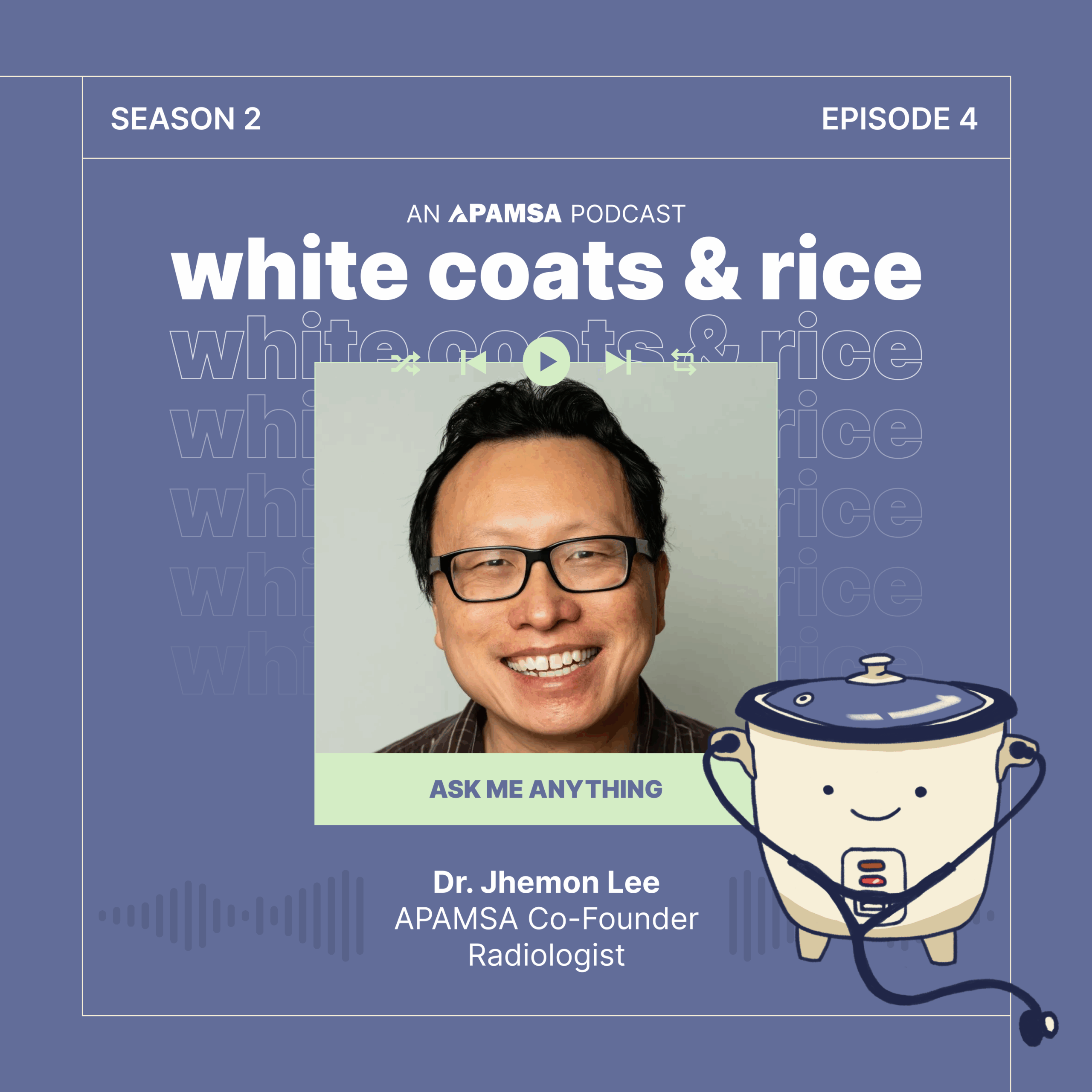
Dr. Jhemon Lee is one of the original founders of APAMSA and currently a radiologist at UCI Health. Recorded from part of National APAMSA’s Interbranch Week, this was a unique opportunity to connect with a trailblazer in AANHPI medical student leadership, ask candid questions, and gain insights into our own journeys in medicine.
Listen here:
YouTube
Spotify
Apple Podcasts
This episode was produced by Annie Nguyen, Elton Tong, Grace Kim, & Xueying Zheng, hosted by Elton Tong, and graphic by Callista Wu.
0:00 Introduction
1:42 Dr. Lee’s Current Life
3:15 A Day in the Life of a Diagnostic Radiologist
5:21 Journey to Medicine and Specialty Choice (Radiology)
8:33 East Coast to West Coast
12:05 The Choice for Private Practice vs. Academics
14:46 Balancing Being a Radiologist and Business Owner
17:54 Advice for Students on Private Practice
20:01 Improv Comedy
23:59 The “Yes, And” Mentality and Support Systems
26:02 Co-Founding APAMSA
31:19 APAMSA’s Greatest Potential for Impact
33:25 Rapid Question: Advice to Your Younger Self
34:31 Hopes for the Next Generation of AANHPI Physicians
36:55 The Billboard Lesson and Closing
0:00 Introduction
Elton: Welcome everyone to a new episode of the Asian Pacific American Medical Student Association podcast. From round table discussions of current health topics to recaps of our panels with distinguished leaders in the healthcare field to even meeting current student leaders within the organization. This is White Coats and Rice. My name is Elton Tong, an M2 at the Boonshaw School of Medicine at Wright State University and a member of the National Leadership Committee at APAMSA. I’ll be your host for today. This is our Ask Me Anything series. Each month, we spotlight an extraordinary physician who shares their insights on medicine, life, and everything in between. This is your chance to ask questions, hear their stories, and learn from their incredible experiences. Whether you’re curious about their journey, their day-to-day, or their views on the future of medicine, nothing is off the table. Let’s dive in.
Elton: We have a very special guest, Dr. Jhemon Lee, who is the department chair of diagnostic imaging at UC Irvine Health, Los Alamitos. Now, Dr. Lee obtained his medical degree at the University of Maryland before completing radiology residency at the University of Chicago and fellowship in abdominal imaging at Brigham and Women’s Hospital, Harvard Medical School in Boston. But not only is he a practicing physician, but he’s actually one of the co-founders of APAMSA. And he’s been involved in building this organization from the ground up and has seen it grow into what it is today. So tonight we’ll be able to, well, we’ll get a chance to hear about his journey through medicine, his role in starting APAMSA and how his improv comedy gigs keep him laughing through it all. So it’s a real honor to have him here to share his story and welcome Dr. Lee.
Dr. Lee: Hi there.
Elton: Hi everyone.
1:42 Dr. Lee’s Current Life
Elton: So Dr. Lee, could you just first tell us a little bit about where you’re calling in from and where you’re currently based?
Dr. Lee: I’m in Southern California. I’m in Los Alamitos, California, which if you know like the Southern California, it’s right in the border between LA County and Orange County. Kind of where the 605 freeway meets the 405 freeway. It’s like South of Cerritos, like North of Seal Beach, East of Long Beach, West of Cypress. Again, this is if you know Southern California. If you don’t, it’s basically, you know, it’s sort of in the suburbs of the LA area. And yeah, I’m at work right now. Originally this call was supposed to be scheduled when I was done with work at five. I guess there was a clerical error. So I’m actually officially on duty. So hopefully they don’t call me while this happens.
Elton: Well, know, since you’re talking about Southern California, can you tell us, is this kind of like your dream location? Is this, you know, is this kind of somewhere you kind of unexpectedly ended up?
Dr. Lee: Well, you know, I don’t think we ever unexpectedly, you know, unexpectedly end up anywhere. You know as a physician, know, if you don’t interview you somewhere, you know, you’re not gonna go there. So obviously I must have had some intent in coming out here. You know, I’m originally from the DC area and then you know I went to school like Boston and Baltimore Chicago and you know, like I wanted to try something different when I actually finished my fellowship and so I said, know, let’s go to the West Coast. And you know, I you know interviewed out here and decided like yeah, let’s come out to LA. And here I am, you know, I’ve been here now for like 25 years. So yeah, evidently can’t hate it too much, right?
Elton: Absolutely not. I mean, to go from coast to coast, especially throughout in the, you know, for medicines taking you, I think it speaks volumes to kind of maybe just how you, your values and just, you your experiences kind of shaped your time, which we’ll definitely dive into.
3:15 A Day in the Life of a Diagnostic Radiologist
Elton: But another question I wanted to ask, and I think a lot of folks wanted to ask is just kind of what is your typical day in your professional life look right now? And, you know, what kind of practice or clinical work are you doing these days?
Dr. Lee: Well, in my case, I’m a private practice. And you know, radiology, I mean, if you’re in diagnostic radiology, it’s mostly just reading like, like a whole bunch of imaging studies, you know, like x-rays, CAT scans, MRIs, mammograms, nuclear medicine, PET CT, ultrasound, you know, and kind of like at a very simplistic level, it’s basically me sitting in front of computer and basically looking at images all day. You know, I am at the Women’s Imaging Center. And I’ve been, you know, I’ve done mammography and women’s imaging for years, but I think I’ve been primarily at this site, the woman’s imaging section. Historically, it’s because the pandemic happened and the other people that did mammography, they all had like small kids. So during the pandemic, they had to basically be at home to babysit and I don’t have kids. So then they’re like, well, could you, you know, could you sort of be at the woman’s imaging center since you have to be onsite to do breast procedures? And also at our woman’s imaging center, we actually talk to patients about the results of their diagnostic mammograms or breast ultrasound. So you have to be on site for that. And in a way, it’s kind of fortuitous because I have to admit, I was kind of getting little burned out of just sitting in front of computers all day and just reading one study after another. So I actually kind of liked the fact that I could break up the sessions by actually talking to patients about the results. I never thought I would actually like that, but I actually did like that. And I think one thing about medicine is that sometimes you’ll be surprised about how your practice will evolve. You know, if you told me like when I was a resident that sometimes someday I’d be doing primarily mammography, I would have laughed and said, no, there’s no way I’d ever do that, you know, but here I am. And I liked it.
Elton: So it kind of sounds like you’ve gone through a lot of change. I mean, geographically, but even just medically in your own kind of career and your trajectory, right? It sounds like a lot of life things have, have kind of moved you towards that. Since you’re kind of on the topic of just your journey in medicine, maybe you could like walk us through it a little bit in terms of, know, we talked about where you went to medical school, but just how you kind of ended up where you currently are.
Dr. Lee: You mean in terms of like, in terms of like why I became a doctor kind of thing, or like how far back are we going?
5:21 Journey to Medicine and Specialty Choice (Radiology)
Elton: Yeah, I mean, as far as, as like, you know, how committed were you to medical school? Was it something you’re always, you know, determined about? And then just about your journey, like going through DC and then all the way to Southern California.
Dr. Lee: They ceaselessly say, way back when, when I was like five, my parents said, you should be a doctor. you know, like classic Asian parents, like Asian parents, like we want you to be a doctor or a lawyer or an engineer. But my dad was an engineer, so he didn’t want me to be an engineer because he hated being an engineer. And he was worried that my verbal skills were strong enough to be a lawyer. So doctor it was, you know, and you know, I didn’t think of anything else I wanted to do. So here I am, you know. I mean, that said, I mean, being a doctor, being a physician, I think is a really good choice. You know, there’s a lot, gives you a lot of options in life. It’s very secure. And all the things your Asian parents wanted you wanted for you, which is kind of like secure, you know, successful, respectable and all that stuff, these things, things, things are true. But I do think it’s also a very gratifying field because you get to actually help people just by doing your work. You know, I think there are other jobs in this world where you’re not actually helping people or you may actually be kind of hurting people, but this is a good job. And I never really thought of something else I wanted to do. And, you know, it is something where if you’re kind of academically or intellectually oriented, it’s a good choice, you know? But here I am, you know? So I was always kind of on the pre-med track. I mean, like at college, I went to Harvard for undergrad. You I was an engineering major, but that’s just because I was good at that kind of stuff. But I was always pre-med and I went to med school. you know, I remember my first week of med school, like one of the fourth year med students came in and looked around my room and said, you know what? I think you’re going to be a radiologist. And I’m like, really? What makes you think that? And says, no, no, I can tell. Um, probably because I had all these like technical posters up on the wall, you know, so, you know, very, very sort of technical things. So it’s like, okay, yeah, like, and there I am, you know, it’s I did, you know, I’m gonna try it. You know, they always say that you shouldn’t, you shouldn’t overcommit to a specialty choice right off the bat. And I think that’s true. You know, she keep an open mind about what you want to do because you may change your mind. I kind of thought it’d be radiology, especially since I was an engineering major and What’s the right choice for me? Not as much because of the engineering part. I mean, I think when you look around at a lot of the radiologists, a lot of them are not necessarily computer savvy or, you know, say engineering types, but you some are. And, but the thing I like about radiology is that it’s definitely a very analytical kind of field. It’s the kind of field where you can sort of analyze things and, you know, you have time to think about things. It’s not like some other fields, like say ER or surgery where things can get very catastrophic right away and you have to be able to make split-section decisions. And I think in my case, even with the most dire of circumstances, I still have at least a little bit time to think about what I’m saying, you know? So I do like that. I like that puzzle solving aspect as well. Yeah. Radiology is a good fit for me. Not for everybody, but it’s a good fit for me though.
Elton: Yeah, I mean, it kind of sounds like it’s funny when you’re talking about earlier how your parents kind of gave you, it’s like the one of three career choices, I kind of think of like that, you know, maybe our generation knows now. especially if it’s like, you know, start that first Pokémon game and it’s like you have one of three starter Pokémon. It’s like that, right? It’s kind of just those choices. And those are the classic three, I feel like in our Asian upbringings.
8:33 East Coast to West Coast
Elton: But, you know, I wondering if you could actually talk a little bit more about just your geographical um you location. Like I’m someone who actually also spent some time in Ellicott city. So I’m sure you’re very familiar with the DMV area and I loved it. Um, but it kind of sounds like you bounced around, right? Like you started in the DMV and then, you went to college up in Boston, spent some time in the Midwest in Chicago and then returned back and then only to go all the way to the other side. Like, could you just tell us a little bit about that? How that was for you?
Dr. Lee: If you asked me in 11th grade, where I was going to go for college, would have said like University of Maryland, you know, state school, because that’s kind of where my dad wanted me to go. But then my granddad got involved and he said, you know, I have grandkids that went to Stanford, but none of them had gone to Harvard. It’d be great if he went to Harvard. And that was the one thing that sort of convinced my dad to let me at least apply there. I guess my grades were good enough. So I guess, you know, it’s like, so I went up there. And I think the nice thing is that I think if you stay in one place, like if I’d stayed in Maryland, I think I would have stayed in the DC area for the rest of m y life, because kind of like your universe is that area. But you know, once you actually go away, suddenly your universe is bigger. And then you’re open to like, oh, okay. You know, I did just like, it was actually nice going somewhere else. So maybe where else can I go? I mean, I go back to Baltimore because you know, that’s against the school, know, cheaper that way. But after that, it’s like, yeah, let me try a different city. And you know, when I was looking for residencies, I looked all over the place. And University of Chicago is one my top choices. And I went there and you know, again, went back to Boston. But after that, it’s like, I really just wanted to try something different. I mean, sometimes from a personal standpoint, we make decisions. Like, it’s not just, it’s not just about like, say, going to the absolute best training program in the nation. Sometimes it’s also matter of like, well, where do I want to live? You know.
Dr. Lee: Um, I mean, this is not meant to be a ding. I remember that, uh, when I was in med school, you know, I did apply to Johns Hopkins, which is a top notch school. And remember thinking like other people interviewing here, they’re going to rank it first. They said that upfront that I’m going to rank Hopkins first. And I’m like, I’m not going to rank it first. I really want to get out of Baltimore. So, you sometimes that is part of the equation. What do you want to live for four years as a resident? know? And likewise, when you your first job, it may be different if you’re academics, by the way, because in academics, want to go wherever you’re, sometimes you want to go where your career opportunities are best. But, you know, if you’re doing private practice, you do have to weigh the options, which is like, like for example, I remember when I came out of a fellowship, you know, I different choices. I could live in Southern California and make X amount. Or I could live in a different city, like Indiana, make this amount. You know, money is relevant, but you know, kind of like you have to live there. So sometimes it’s kind of like you sort of make that decision choice. Like, well, if I make X amount to live in LA or live in New York or someplace like that, but I can make more if I live in like say, I know some other places less desirable, you know, which is more important to you, you know? And yeah, like I want to live in a place I want to live. And the funny thing about Southern California is that, you know, like everyone thinks about the beaches and the weather. That’s not really as important to me. What I really like about this series, how diverse it is, know, diversity of people, diversity of cultures, diversity o f food, you know, so it’s like, it’s, it’s nice, you know?
Elton: As someone who’s spent some time in Southern California and Orange County and San Diego, it’s, I very much resonate with what you’re saying. It’s kind of like a place where you can get what you want, right? And there’s access to everything and every, everywhere. And there’s so many beautiful cultures, people of just different, you know, ethnicities, backgrounds, upbringings, who just all come together. And that’s really the beautiful thing. And I think we’re kind of seeing that hopefully in other areas too, right? As we kind of, you know, as our world and stuff progresses, hoping that that can be more of reality for other places as well.
12:05 The Choice for Private Practice vs. Academics
Elton: You know, since we’re kind of on the topic of your private practice group, I wanted to ask, was private practice something that you always envisioned? Or was it kind of something that just kind of came about?
Dr. Lee: I don’t think it was something that of came about in the sense that if, you know, like in fellowship, I was kind of convinced I was going to end up in academics. Not that really Like not like I’m a big researcher like that, but I kind of like the academic kind of, you know, like you’re teaching, you’re on the cutting edge of things and so forth. So I interviewed at a lot of a number of academic places, but I mean, just to round it out, I did interview at a few, a couple of practice places and kind of like halfway, halfway through, through my interviews, I kind of had an epiphany, which is again, like a matter of prioritizing what’s important to you. And you know, kind of personality wise, said, you know, I like academics, but at least at that time, you know, private practice made twice as much money as academics. So I’m like, well, you know, money is not that important to me. But at the same time, if I flip it around, you know, would I write it to private practice? Do I like academics enough to take a 50 % pay cut? And I’m like, I don’t like it that much, you know? [chuckle] Oh, so that was kind of why I’m like, maybe I should do academics, you know, again, because, you know, if the salaries were the same, you know, that, yeah, I would do academics, but you know, this much of a difference, like I don’t like being academician that much, you know? So therefore I said, you know, let’s maybe I should do private practice then. You now by the same token as I said earlier you make X amount in Montana and you make X amount in LA. You know, am I willing to go to LA for 50 % pay cost and the answer is okay. Yes, I will do that. So my priorities, know other people are you know, me the money and you know, I’d rather you know live out in the out and you know, we’re hunting and fishing is great, you know, but yeah, that’s what ended up happening and it’s and it’s practical realities. I think idealistically, you know, we should do absolutely what we want to do. And I think for lot of people academics is the right, is absolutely the right choice. But you sometimes these practical considerations come in also and it’s okay. It’s okay to say, you know what, I do want to make more money or it’s okay to say I want to work less or I want to live in a certain area, you know?
Elton: Yeah, I think, you know, obviously as someone in medical school now, I always feel that we always think we want to do academia just because we’ve literally just grew up in it, right? That’s how we get our training. That’s just what we’re kind of honestly born into. And that’s just the only world that we know. And to be honest, I think I can only envision myself in academic center. But as I talk to more and more physicians who’ve been in the field doing the work for so long, I realize that there’s so much out there. Private practice, but there’s also industry, pharmacy. And there’s so many opportunities. Think about even just legislation stuff. There’s so much that so many physicians can do. I mean, think that’s a really beautiful thing that we have.
14:46 Balancing Being a Radiologist and Business Owner
Elton: You know, one thing I really wanted to ask you was, know, you’re essentially a radiologist, but you’re also a business owner. So that’s, that’s, that’s a lot to handle at once. How do you balance the two?
Dr. Lee: I’ve been avoiding this the whole time. I’ve been a part of my radiology group for like 25 years, you know, and. Like it wasn’t until like about like a little maybe like a year, like a year, like a year and a ago where the past, the last president like, uh, like, uh, left her group to go somewhere else. Like basically I was next in line. So I kind of had to take over. I mean, it’s been a very, it’s a very, very educational experience for me because, you’re sort of dumped in the deep end of like, you know, handling all of the stuff, like personnel stuff and like financial stuff and looking at the books. And I’d kind of looked at these things before. It’s one thing if you’re kind of like nodding along while other people are looking as well. But if you’re the one who’s now in charge of running the ship, you actually have to fully pay attention. You can’t just coast on trusting someone else to do it. You have to do it yourself. It is hard. I think the hardest part about being president of a group, especially this is a small group. It’s a small group of like six radiologists, is that you still have to do the work of a full-time radiologist on top of it. You know, it may be different if you’re president of a group that has like 80 physicians where they probably have a lot of like say administrative time for you to do your administrative stuff. But for me, it’s kind of like I got to pull the same weight as everyone else does. And plus I have to do all this admin stuff on top of it. So it is hard in that respect. I said I’ve learned a lot and I think this is true no matter what you do is that as you progress in your career, be in academics or private practice or say pharma or anything else, know, like ideally you’re always going to be progressing. and doing new things that are challenging you. And, this has definitely been a challenge. You know, like, for example, one of the biggest challenges right now is that there’s a nationwide radiologist shortage and our group of short staff. So basically it’s been like, it’s, you know, I’ve had to learn how to like recruit, you know, how to interview and how to try to convince people that, you know, like, Hey, come join us, you know, stuff like that. So yeah, it’s definitely, it’s definitely learning curve for this. It’s not for everyone. And, you know, honestly, you know, I’m not sure. For your, you for all of you, I’m not sure how many private practices will still be around because I think more and more there’s consolidation with, you know, like, with large uh medical groups, like, sort of dominating the landscape, you know, especially with private equity coming in and basically snapping up groups and creating these national networks. oh We’re essentially doctors become employees, like, basically working for someone else, you oh I think it’s a challenge for our field, you know, especially when we’re working for. corporations where the main motive is not helping people but really just like making money. Right.
Elton: You probably see this honestly truthfully, right, especially in Southern California, where a lot of the UCs are, you know, they’re, really, they’re essentially investing right into a lot of the local businesses, a lot of local hospitals, for better or for worse. But I think we see a lot of that. And that always brings up another, I guess, another bag, right, of questions as to whether or not. you physicians are happy, like, what are the lifestyles become like that? And even just other things like day to day life within, within those systems.
17:54 Advice for Students on Private Practice
Elton: I think for our students and for aspiring entrepreneurs listening, they kind of like to know what advice you would give to someone who’s curious about private practice.
Dr. Lee: Well, I think the easiest thing to do is to ask doctors, ask them to actually talk to doctors in private practice. I’m obviously the majority of doctors are in private practice in one form or another. So, you know, as a med student, I mean, you do have access to a lot of doctors, not just at the academic center. But I mean, you know, honestly, we all see doctors, you know, it’s like as patients, you see doctors, you could ask around, you know, ask, you know, for example, if you want to know more about what life is like as the private practice as sociologists or pathologists or OBGYN, ask around, you know, ask the academic attendings like, hey, do know people in private practice? I’d love to tap their brains about this, you know, ask within APAMSA, you know, we do have a network of alumni, and I know that. You know, as an organization, we haven’t quite exactly like, sort of like made the full, be made it super easy for med students to connect with the alumni, but eventually we’ll do that. And, you know, I think it’s a great opportunity to sort of take people’s brains about what they like and what they don’t like about their fields, you know, and their practice situations. So it’s also worth talking to someone about like some people are perfectly happy actually working for one of those big mega corporations because then it’s like, you know, I just walk in and I clock out and I just sort of focused on care. You know, during the, during my shift, I don’t have to worry about anything else afterwards. Other people want something else, know? Right.
Elton: So it’s, it’s like the importance of continuously being inquisitive and curious about, know, what’s, what’s, what’s, what’s on the horizon is essentially right? I’m kind of what, what, could my life potentially look like? I think that’s important. And especially as you were talking about kind of expanding our network and just you know, connecting students. That’s one of the greatest things about the Ask Me Anything series, right? And that we’re currently on. This is our chance to ask you literally anything. So yeah, thanks for that.
Dr. Lee: I was gonna say one thing is that even me interviewing like current residents and fellows, it’s actually I learned stuff. I mean, like our field is constantly evolving. So, you know, whatever I know, like I think I know, but you know, things keep on changing, you know? So it’s a two way street.
Elton: For sure. Lifelong learner is what we always consider ourselves. I mean, I think that’s so true.
20:01 Improv Comedy
Elton: So Dr. Lee, you’re not only diagnosing patients, but you’re actually also delivering punchlines. Let’s switch gears a little bit and let’s talk about your improv comedy.
Dr. Lee: You know, like I’ve always liked the arts. know, I’ve always been a part of Asian American organizations. And that included going to like say theaters in Los Angeles that specialize in Asian Pacific American stories and acting and so forth. You know, I just want to kind of get more involved in that, just like left brain versus right brain kind of stuff. And I realized I didn’t really have the time to do like, I first thought like maybe playwriting or something like that might be a fun hobby, but I realized I didn’t have the time for that. So I just want to do something. And I basically got involved in an Asian American improv group, which is offering improv classes. If you know improv, improv comedy is like, it’s like, whose lines in any, whose lines in any way, you know, where, you you throw out suggestion. And then have to do something with it. You have to do a scene with it off, you know, off the top of your head, you know, no preparation, no homework, just do it, you know? And it’s been really fun to do that. And I’ve done it for a long time. And then when I met my wife, I got her involved in what as well. So that was a really fun activity for us to do for several years. Admittedly, we haven’t done improv since the pandemic. You know, it’s kind of hard to do improv over Zoom. It’s possible, but it’s kind of much better when you get to do it with people. And I think the great thing about improv is that it definitely loosens you up. You know, one of the key tenants of improv is to like, you know, to say yes to things, you know, like in real life, a lot of times someone will say something outlandish and you’ll say no to it, you know, but in improv, like one of the key tenants just embrace that, to embrace, you know, the unknown, to embrace, you know, crazy suggestions and see what explore it and so forth. And, you know, to sort of say, you know, whatever decision you make, it’s a good decision, you know, and let’s go with it. And I think that’s very freeing for someone, who in medicine, especially within Asian American upbringing where it’s kind of like, we’re so regimented, we’re afraid of making mistakes, that it’s, we’re almost liberating to sort of get into the mindset of like, you know, it’s okay if you make a mistake because when you make a mistake, it’s kind of a different avenue that you can explore in your scene. So yeah, I think it’s a really, and I would say to everyone on the call, if you have a chance to do improv, I think it’s fun. I think you’ll learn a lot about yourself about thinking on your feet and so forth. But even if you don’t do it, I think it’s important to have hobbies outside of medicine, to do stuff that is completely different from medicine. It makes you a more well-rounded person, makes you more interesting person. And I think the other aspect is you meet people from a different line of different walks of life. I do think that a lot of times as physicians, our friends, of course, a lot of our friends are going to be physicians as well. So then it becomes almost like an echo chamber where we just sort of keep on bouncing the same complaints off of us, off of one another. It’s sometimes really good to talk to people from a completely different walk of life. Like in my improv class, there were a lot of actors and there are a lot of things that we take granted or granted as physicians. know, like here’s a really good example. I remember that as a radiology resident, like in my residency, like I would take call like every 10th night. And you know what? You tell that to anyone in any other field and they’ll just laugh at you, right? You tell the… the person in peace residency or the person in intermedicine residency, they don’t call Q3, Q4, Q5, right? And they’re like, okay, you have it easy. I talked to somebody who’s not in medicine, they’re like, oh my God, that’s terrible. It’s like, okay, thanks. know, so, so sometimes it’s nice to, really get other people’s perspective. It also gives you appreciation for things that we take for granted. Like, you know, as a physician, you know, I have a steady job, I can pay my mortgage. You talk to actors. They never know where the next gig is. It’s hard for them to think about a mortgage because acting is so haphazard. It gets wrecked rich if you end up on a really big TV program. But for most people, they’re going to hundreds of auditions just to book one gig.
23:59 The “Yes, And” Mentality and Support Systems
Elton: Yes. One of our questions that we have from the chat is, what you do to get better with the yes and type of mentality? Could you share some of your favorite improv memories as well?
Dr. Lee: What are my favorite improv memory? What do you do to get better at this? Basically just to sort of accept it. know, like when you take improv classes, they often start with some really basic, simple exercises. You know, like one line stories or, I mean, it’s like, we don’t really have time to sort of do all the improv stuff, you know, here, but they start with really basic exercises that seem really simple, but it’s kind of just sort of get you like out of your usual constrained thinking load and to kind of free you up a little bit, you know? And you know, I think what’s really important. is that you do it with a set of other people that are supportive of one another, or you’re playing improv games. And as long as the other people are role with it, you know, and you support one another, I think this is probably true, not just in improv, but I think in life in general, it really helps when you’re working with people, interacting with people that support one another, that makes life a lot easier, as opposed to just everyone nitpicking, because you know, improv, you know, there’s like right and wrong. You know, like in improv, the right choices are the choices that are more interesting, are more fun for the audience to watch. Those are right. But again, like there’s no right or wrong per se. There may be choices that are more entertaining or less entertaining. But I think what is really good in improv is that when you’re with a group of supportive teachers and classmates, that even when you pick a maybe a less entertaining choice that no one gets on your case about it, I think that frees you up to make those bolder choices, you know? when you’re not ready because people supporting you.
Elton: That importance of having that support system that kind of empower you to encourage you really to explore more, right? And I think, you know, since we have you on, especially speaking of just having that supportive system, I know for me, selfishly, I think of APAMSA for me has been one of that, that opportunity, right? Where you’re able to connect with other people of honestly, pretty similar backgrounds, similar interests, and obviously similar hopes and dreams.
26:02 Co-Founding APAMSA
Elton: And you’re obviously a co-founder for APAMSA. So I think, you know, we just naturally have to ask, you come about co-founding APAMSA? Like, was there an aha moment? And what’d you kind of realize the need for it?
Dr. Lee: Well, sometimes it’s kind of just bei ng in the right place at the right time, to be honest. You know, like I’ve always, like in college and in med school, I was always involved in local, like Asian, Asian-American groups. I was always surprised that there wasn’t like, at that, like, when I was, and you I was a med student from like 1990, 1994. And I was always surprised that there wasn’t some sort of national, you know, Asian Pacific American medical student group. Cause you know, you have like, know, Latinx and African American groups that like SMA, for example, that are out there. And why isn’t there an Asian one? And of course the answer is always because, well, you’re not an underrepresented minority. But you know, even though like, you know, APIs are not underrepresented, you know, their starch are unique challenges for being an API med student and you know the API communities also have the unique challenges as well. So I remember that way back when you know I did. You for example, like I knew I knew someone who was an officer officer at AMSA. No American Medical Student Association and he said that well maybe there’s some you know some there’s some movement to have like a Asian Asian students section within like the margin. think it was called the minority affairs. I forget the name of. the acronym, but within AMSA there’s a minority affairs section. I guess like the other minorities weren’t really interested in APIs having their section in AMSA just because they felt that they wanted to focus on underrepresented minorities. But kind of within that, you’re talking to other people, organizers, and they pointed me to B. Lee, who I think many of you are familiar with as well, because he goes to the conventions every year. And he was trying to start something nationally. There have been multiple other attempts in the past to create some sort of national API medical student network. But in the past, it was really hard because if you think about before the early 90s, you know, how did you communicate with people who weren’t at your school? Because they didn’t have email back then. I mean, there was email, but it only like really nerdy people who had access. Yeah, like I was an engineering major. So like I knew how to use email, but you know, average, you know, most people didn’t have access. So back then you had to either. handwrite letters and mail it, or you had to get onto the phone back in the days when it cost like $2 a minute for long distance. I know this is foreign to all of you. Back in the old days, we had rotary phones and I’m kidding. No, we did have some rotary phones back then. But at any rate, it was so expensive and difficult. But then in the early 90s, people are starting to get email. I think that was the key. I think they leveraged off of that and created an email list server for API med students. And that that wasn’t a way to connect med students from across the country. And I got involved in that. wanted, basically he actually organized an organizational meeting to see if we could create a natural organization off of this. And perchance he was hosting it at his home at Columbus, Ohio. Cause back then he was a professor at Ohio State University. And it happened that that weekend, the weekend that he was putting it together was the weekend that I was graduating from, I graduated from medical school. I was driving from DC to Chicago from med school to residency. And just happened that that weekend, that’s when the meeting was. And I was driving from point A to point B and halfway there is Columbus, Ohio. So, hey, why not? So that’s why I went. And pretty much I participated in that sort of organizational meeting. You know, then kind of like we all agreed that we would start an organization. We also had to decide where the first convention was. And of the people that were interested in the meeting, one guy didn’t show up because it was too far away and he was in New York. So we all voted that he would be in charge of the first convention in New York since he wasn’t there to say no. So. His name is John Cho. And I think at that point he said, okay, sure. And yeah, first national convention in. in New York in January 1995. Admittedly, I kind of dropped off at the APAMSA for a couple years because I felt at that point, you know, as a resident, it didn’t make sense for me to be a part of a med student organization as a resident. But then I got back involved in 1997 because I heard about the APAMSA convention in 1997, again in Ohio State that year, and that there was talk about maybe creating an advisory board. So I said, okay, you know, like maybe it would be great to get involved in something like that. So I got involved with the advisory board when it was first started in 1997. I got plugged back into APAMSA and I’ve been a part of APAMSA’s advisory board ever since then.
Elton: This is awesome to hear about because I think especially, you know, as times continue to change and quite frankly, technology, right, does its wonders. Talk about, you know, email listserv kind of being the kind of like the vehicle, right, through which APAMSA was able to kind of grow. I think nowadays, like there’s so many social media channels, right, that quite frankly, that national APAMSA runs on, but just our whole society seems to run in and, know, again, for good or for bad. But I think that type of ability to kind of connect with other people throughout the world is something that’s really special. And I think, you know, you’re one who’s seen APAMSA literally grow from what it was just from the roots to what it is now.
31:19 APAMSA’s Greatest Potential for Impact
Elton: I think something that our audience is kind of interested in is kind of this question, you know, there’s so much going on in the world currently in terms of socially and politically, where do you see APAMSA having the greatest potential for impact?
Dr. Lee: You know, I think if you look at the mission, you know, the mission, it’s, you know, it’s supporting API communities. It’s supporting the professional development of API med students. And that’s probably where, where we, where APAMSA has the most impact. I mean, you know, I think by serving API communities, that gives us a focus, but at the end of the day, where APAMSA makes the biggest difference is with all of you. that it’s part of your experience as med students. know, like you’re all students and you’re learning how to be physicians, but it perhaps it gives you a different perspective on, you know, on like, you know, what the kinds of things that you can do as a doctor has more of a focus on serving the community. gives you awareness of, you know, like API health issues and so forth. And I think probably the biggest thing that’s helpful is that gives you hand on experience, actually leading an organization, running an organization. uh when you do that the local level, at the national level. And these are skills that translate to being a good physician someday. Because someday in academics and private practice, wherever you go, you’re going to be leading people. You’re going to be directing staff members. You’re going to be a part of your department or your company and trying to make important decisions. And you’re practicing it here on APAMSA. And I think that’s where we make the biggest difference. The biggest difference is really with all of you helping. one another, sure.
Elton: Yeah. kind of sounds, kind of sounds like the importance of, of, of having that support system. Like we talked about earlier, connecting with people who have the same vision and goals. then honestly, just being kind of like an encouragement to one another, I think is really vital, especially when times do you get tough and, when, you know, things going around the world just seem to be falling apart. There’s no better way than to kind of regroup and reconnect, I think with people who have pretty similar goals in mind. Unfortunately, as we kind of wrap up tonight’s session, and I feel like we could go on about everything forever, we have some rapid questions that we kind of wanted to ask you about.
33:35 Rapid Question: Advice to Your Younger Self
Elton: And so, you know, if you could go back and give your younger self one piece of advice at the start of medical school, what would it be?
Dr. Lee: It gets better. You know, I think when you first start med school, I mean, it’s so challenging, you know? I mean, I think the thing is, for example, if you think about like, say, to get to med school, you you start off as being, you probably will want the top students in high school. So then you got to a good college and you’re probably one of the top students in college, you know, and now you’re in med school. And you know what? Everyone else in med school was a top student in their college. So you can’t always be at the top. It’s like, sure. Making way to the Olympics, you know? And so it could be so stressful. There are a lot of aspects of med school that are so stressful, but it’ll be fine. You know, as long as you get past, you pass the boards one way or another, somehow get out of med school, you’ll be fine. You’ll be fine no matter what happens. Heck, even if you drop out of med school, at least you’ll have this experience. I don’t encourage you to drop out, by the way. But either case, no matter what happens, you’ll be fine and you’ll get better one way or another.
Elton: That’s honestly really encouraging to hear. think as someone who is still in the earlier years of medical training, that’s honestly really encouraging.
34:31 Hopes for the Next Generation of AANHPI Physicians
Elton: I wanted to also ask you, what are your hopes for the next generation of AANHPI physicians?
Dr. Lee: think the hopes are that, and you know, it’s interesting, I’m also on the board of the National Council of API Physicians. And it’s so interesting that within CAPM, that there’s a lot of older physicians, their greatest fear is that the next generation won’t care about API communities, that they just will, you know, exactly. you know, I don’t have that fear. I see all of you on this call. I’ve seen everyone at APAMSA. I know you all care. I may almost feel that your current generation cares more than… cares more than any other recent generation about activism, about doing right with the community and so forth. So I think my hope is that everyone keeps up with it. I think the one advice I would give is that, or two minor pieces of advice is that don’t be too hard on other people with different views. I mean, it’s a very divisive time right now where people have very strongly held views about right and wrong. I would say it’s important to recognize that uh people who have views that seem completely 100 % wrong to you, give them a little bit of grace, you know, and hope that they do the same for you, that we can always agree on stuff. This is something that’s important for being a doctor. You know, as a doctor, you’re gonna treat all sorts of patients, many of whom, you know, like you really don’t know where they’re coming from, to be honest, you know, they’re so different. But as a physician, have, you know, it’s important to be able to provide care to everyone. So at least be somewhat open-minded. That doesn’t mean that you give up on your principles. It’s still important to your principles and your ideas about what you think is important. And number two, it’s a tough world out there. There’s so many bad things that happen out there. know, try not to let that get you down. I think the Dalai Lama, I’m going to paraphrase, I don’t know the exact quote. He basically says that don’t feel obligated. You have to save the entire world. Just leave the world in a better place than you found it. You’ll make those incremental improvements where you can. You’ll do your best to alleviate rather than create suffering along the way, you know, and then you know that you’ve had a positive impact. So I think these are relevant.
Elton: Yeah, I think that’s something really important, especially, you know, as you’re saying during these types of times to keep in mind is that everyone’s always going to have different views. But I think, you know, there’s some beauty in learning to respect that and to maybe see it from their perspective too. There’s always validity, right, on different views. And hopefully that can kind of enrich our perspectives and our own lives as well.
36:55 The Billboard Lesson and Closing
Elton: Here at AMA, we kind of like to wrap up as we start this new season with a new signature type of question. And it’s the following. If you could put one lesson from your life or your career on a billboard in every medical school in America, what would it say?
Dr. Lee: I think the lesson I would probably say is probably like learn from your mistakes, but don’t beat yourself up over them. I think that’s probably good advice. I’ve seen a radiology, like in radiology, it’s impossible not to make mistakes. Like we make mistakes all the time. I shouldn’t say that out loud, but you know. I mean, think there’s some, some, some stats, something like we make, like we, like typically radiologists make mistakes 20 % of the time, you know, key of course, you don’t want to any huge mistakes, but you know, it’s human to make mistakes. You want to learn from them. They’re learning opportunities, but I’ve seen radiologists get really, especially when they go through a lawsuit, if they’ve been sued, they get really gun shy. They become very cautious and they end up sort of generating reports. that are very, very equivocal, that have a lot of like sort of, you well, you know, not sure, not sure about that. You know, it’s important not to lose your confidence because we will all make mistakes and it’s more to keep on going, you know, and not beat yourself up over it.
Elton: Right. And I think, I think that’s some powerful words to kind of end on, um, send towards and realizing that, you know, we’re all still human at the end of the day. We’re in a literally life and, know, kind of life and death type of field where we’re kind of, our hands are kind of, uh, you know, just kind of dictating kind of, you know, someone’s life. And I think that’s a lot of pressure, honestly. And honestly, I guess as growing up in Asian households, right, we’re continuously taught and encouraged to not make mistakes. But the reality is that they occur all the time. So it’s learning to kind of cope with that, to learn from them and to continue chugging on. I want to thank everyone and especially Dr. Lee for joining us this evening on our first AMA event. We’re so happy to get things back up and rolling. Hope you can join us in our next month’s session. And thank you again, Dr. Lee.
Dr. Lee: Of course, thanks for having me.
Elton: And that’s our latest installment in the Ask Me Anything series. If you have a specific physician or specialty that you’d love to hear from, let us know. You can reach us at professionaldev@apamsa.org. We hope you enjoyed today’s episode as much as we did, and don’t forget to tune in next time. Thanks everyone!