

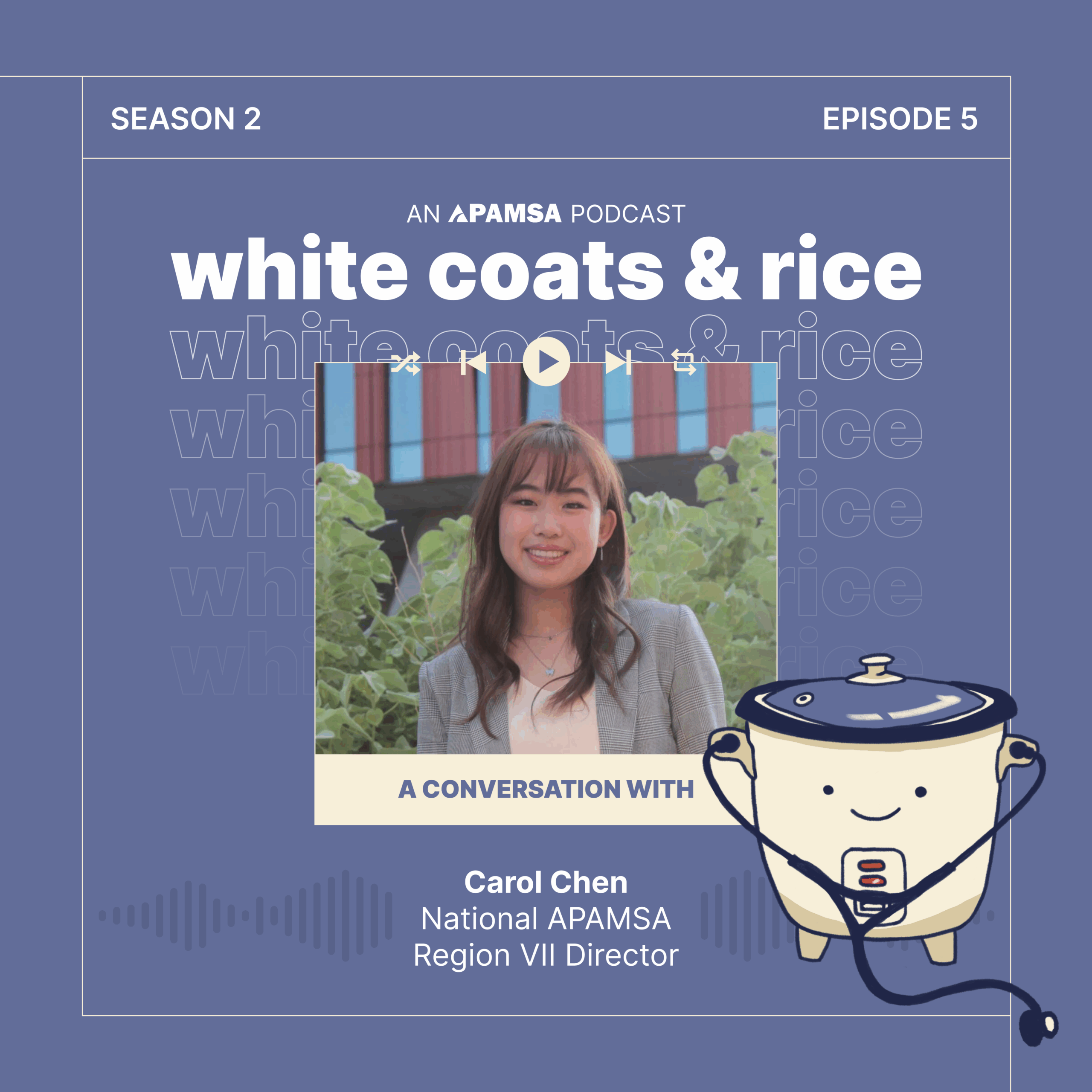
Beyond APAMSA, Carol is involved in research on mild cognitive impairment and Alzheimer’s disease and serves as Co-President of the Asian Pacific American Student Council, where she advocates for the interests and visibility of the APA community on campus.
Listen here:
YouTube
Spotify
Apple Podcasts
This episode was produced by Kevin Gaw and Xueying Zheng, hosted by Kevin Gaw, and graphic by Callista Wu.
00:00 Introduction
01:35 Early Life and Cultural Identity
05:55 Joining APAMSA and Finding Community in Arizona
15:06 Developing Leadership Drive
19:59 Serving on National Board
22:03 Leadership Challenges and Growth
25:06 Career Aspirations and Research
31:19 Mentorship and Role Models
34:24 Imposter Syndrome
37:30 Looking Ahead
41:52 Hobbies and Finding Balance
44:39 Closing Remarks and Outro
00:00 Introduction
Kevin: Welcome everyone to White Coats and Rice, an APAMSA Podcast. From roundtable discussions of current health topics, to recaps of our panels with distinguished leaders in the healthcare field, to even meeting current student leaders within the organization, this is White Coats and Rice. My name is Kevin Gaw, and I’m a first-year medical student at the California University of Science and Medicine in Colton, California, and I am one of the podcast committee members. I will be your host today.
I’m excited to introduce our guest, Carol Chen. Carol is a third-year undergraduate student at the University of Arizona – Tucson and is one of our Region 7 directors. She has previously served on the Executive Board of the University of Arizona Pre-Health APAMSA Chapter, starting as an intern and served as the Director of Volunteer Outreach last academic year, and is now the president. She is currently involved in research focused on mild cognitive impairment and Alzheimer’s disease and serves as one of the Co-Presidents for the Asian Pacific American Student Council, advocating for the best interests of the APA community on campus. Outside of school, she enjoys rock climbing, crocheting, baking, traveling, painting, exploring cute cafes and restaurants, and spending time with family and friends.
We’re so glad to have you here today, Carol. How are you doing?
Carol: Thank you so much for that wonderful introduction. I’m doing great today. What about you?
Kevin: I’m doing well. I’m excited that it’s the start of fall already—sweater weather—so I’m just really looking forward to colder weather. Okay, well, I’m so excited to get to know a little bit more about you.
01:35 Early Life and Cultural Identity
Kevin: So I guess to start, can you share who you are—maybe like a brief introduction that wasn’t covered—and how your AANHPI identity played a role in your upbringing, who you are today, and how it continues to play that role in who you are?
Carol: Okay. Yeah. Okay, great question. So I mentioned before, I’m Chinese American. So both my parents—they were born in China, they grew up in China, and then they moved to America, and then I was born here. So, growing up, there was this kind of struggle with identity that I think is so common with people in my situation or like a lot of other Asian Americans, where you don’t feel super—like, you don’t feel like “Chinese enough” to be with the Chinese people, or not “American enough” to be with Americans.
I think I’ve heard this so many times and it’s cliché, but it’s true. I feel like that’s the way that a lot of us feel when we’re growing up. And I remember when I was younger, I was pretty, I guess, ashamed of my cultural heritage just because I was surrounded by a lot of people who did not speak Mandarin, did not eat the same foods that I was eating as a child. And I think that really created a lot of self hate. But I think as I was getting older and getting more involved with the Asian community—through my Chinese school and especially through the COVID pandemic—I really realized the importance of my Chinese heritage to me. And I’ve been trying to continue to keep this connection, which I think is hard now that I’m not living with my parents anymore.
When I talk to my parents, I usually speak in Mandarin, but now that I’m living away from them, I don’t use Mandarin as much as I used to. And I guess one of my biggest fears is like losing this language completely. I know for a lot of Chinese Americans, speaking, like, listening is usually fine, but reading [and] writing is where a lot of difficulties lie. And that’s the same for me—I can’t read, I can’t write very well, but I can usually speak and listen pretty well, like understand pretty well. But I’m scared of even losing that connection with my cultural heritage. So I’ve been trying to call my parents a little more, call my grandparents, make sure that I’m still keeping that connection sound—even if I can’t be there physically as much as I was able to when I was younger.
And I think food is a huge thing in the Asian community. For Chinese, like, for me, I’m vegetarian, so a lot of the foods that my family really likes to eat at huge celebrations contain a lot of meat. So it’s also something that I’ve dealt with, where a lot of the cultural foods that are very important to my family and like celebrations is something that I can’t really eat. So that’s something that I’ve been trying to figure out—how I can mend that relationship between that gap between not being able to experience the same, consume the same type of foods and have that same type of connection, while also still meeting my dietary needs. I think I’ve been able to kind of work on that a little bit because my parents have been really understanding. So whenever they do make something that has meat, they usually like to incorporate a different version that’s vegetarian, and there’s a lot of vegetarian dishes out there—like, Chinese vegetarian dishes, but just the one specific to my family, they usually do contain a lot of meat, so they’ve been trying to incorporate something to accommodate me, and I think that’s been really helpful as well for navigating identity.
Kevin: Yeah, thank you for sharing that. I think that it’s really important to kind of highlight that because it just kind of goes into this topic of, like, you know, representation does matter because you kind of need that space where you do feel like you belong. And I’m hoping that APAMSA has kind of become that for you in some way, shape, or form. And I think that, you know, it’s almost like this—obviously, you have your family, and you have another family within all of these AANHPI communities. Yeah, just thank you for sharing that. I think it’s really important.
05:55 Joining APAMSA and Finding Community in Arizona
Kevin: Next, can you share a bit about your journey into APAMSA and what motivated you to get involved?
Carol: Yeah. So my story begins in my freshman year of college. So when I first joined—when I first came to the university—the University of Arizona is a large public university, so there’s a lot of clubs on campus. And I was trying to figure out what clubs I should join and then, like, how would I find my place on this huge campus? And I went to a couple different club meetings, but I didn’t really see myself fitting in as much as I wanted to. So I impulsively decided to go to an APAMSA meeting. I just saw an Instagram story on someone’s page about the first general meeting, and I decided to go. And I think from there, I was really struck by how welcoming everyone was. Even though it was my first meeting and I didn’t know anyone, people came up to me and talked to me and asked about how my school year was going—which I didn’t really have, like, I didn’t really experience through the other clubs. And I felt like everyone in the club made an effort to get to know me. And, like, through the events, I got really integrated in that community. And I think I just was able to find such an amazing group of people that really inspires me to do better.
Kevin: Yeah, that sounds amazing. I’m glad that you’re part of APAMSA and that APAMSA welcomed you with open arms. I guess, a little more broadly regarding your experience in Arizona and growing up in Phoenix and Tucson—how has your experience in Arizona kind of shaped who you are and your college experience?
Carol: Yeah. So Phoenix—for people who aren’t very knowledgeable about Arizona in general—so Phoenix, the large public university that most students in Phoenix go to, is ASU, just because it’s closer in location. And then Tucson has, like, the University of Arizona at Tucson, so a lot of people from Tucson end up at the UofA. So, like, in Phoenix, I grew up not in Phoenix proper, like, in one of the suburbs, so in Chandler, Arizona, actually. But a lot of my classmates ended up going to ASU, and then only a couple of people that I went to high school with went to Tucson. So it was a little different because I didn’t really know that many people coming in, and a lot of the people that I did know had different interests.
But I think something that did help with the transition was I did go to a pretty large high school, so it’s not super unfamiliar to me to not know everyone on campus. I know it was much harder for some of my friends who went to a small high school, but I think it was also a great experience for me to go from somewhere that was really close to home—where I saw my parents every day and my family—to somewhere that I got a little more independence, but I could still rely on my family if I needed to, since Tucson and Phoenix is only about two hours away.
Kevin: That’s great. Yeah, I had a very similar experience, so I completely understand kind of being close to family but not too far, where you can still rely on that connection, which is almost essential in your college experience. So I’m glad you had that. Regarding, like, the AANHPI community and your connection to that—how is that, or was that, like, growing up in Arizona? And was it different in comparison to Phoenix versus, like, Tucson?
Carol: Yeah, for sure. So I think something that really surprises people who aren’t from Arizona is there’s actually a pretty large and robust immigrant—like, Asian immigrant population—here in Arizona. So where I’m from, especially in the Chandler-Gilbert area, there’s a pretty big Chinese American population. So growing up, I went to Chinese school on the weekends, and my family was pretty involved in the local Chinese community.
So I grew up with a lot of Asian influence in my life, which is not the same case for a lot of people. So I was always able to, like, kind of rely on that, and I was pretty close to my culture growing up. But, in college, it was a little different, since Tucson also has a pretty big Asian community. However, it’s much different from the one that I grew up with, since I wasn’t really familiar with any people here—none of the community was completely new to me.
So how I got involved with the community here was through college clubs. So, APAMSA was my introduction to the Asian community on campus, and then through that, I got involved with—formerly known as APASA. So through that, I was able to meet a lot of different people from the AANHPI community through APAMSA, and then, like from that, it just kind of snowballed into meeting more people out in the community.
Kevin: That’s great. I love that you kind of had, you know, that AANHPI community to rely on as well. Like, no matter where you went, whether it was bigger or smaller, you kind of could rely on that and have them as someone you can turn to. In terms of—you kind of touched on regarding APAMSA—and, like, you saw this event or this ad on Instagram, or people were inviting you, and you went to this meeting and everyone was already welcoming you. Is there anything else that maybe, like, drew you to APAMSA or maybe made you stay?
Carol: Yes, that’s a great question. Because the UofA is known as, like, the pre-med college for like Arizona people. So we have three main public universities: ASU, NAU, and UofA. So UofA is typically considered where all the pre-meds go. As someone who was pre-med in my freshman year, I was looking for a lot of these pre-med clubs to try to find opportunities and people who are interested in the same profession as I was. And there’s a lot of those clubs on campus, and a lot of them have great resources.
But I think APAMSA really helped find that bridge between my identity, my cultural identity, and also my professional goals. And I think the people in it—it’s the people that make me stay. I think the people have great aspirations, and they’re accomplishing great things. And being able to see all of that with people who are really close to me—that really inspires me and makes me feel like I’m part of this community that is doing good. And I think what’s really special about APAMSA to me over the other pre-med clubs that I’ve been a part of, is that, the connections between people—like, just to give a little more context, UA Pre-Health APAMSA—we have no membership requirements. So, no dues. You don’t have to attend a certain number of club meetings in order to be considered an active member, which a lot of the other pre-med clubs do have. So I think also this promotes inclusivity, which is something that really stood out to me.
Kevin: Yeah, I think that’s great, because membership dues is such a hindrance for some clubs and organizations. I know it was hard to want to be part of something that maybe had over $100 dues or anything like that. So I love that your organization and the club is doing that as part of that inclusivity practice. Do you have any specific memory or core memory being part of APAMSA—maybe an event or project that really stuck with you—that you’d like to share?
Carol: That’s a good question. It’s hard to just pick one. But I think what really stood out to me was like doing my internship program in my freshman year. So, a lot of clubs have like, you can be an intern to an executive board member, and then that kind of puts you on the right path to eventually be an executive board member. So I did that, the internship program, my freshman spring semester, and that really let me see what goes on behind the scenes of a college club to kind of keep it running. And it was super different from what I was used to in high school. In high school you had positions—they were doing things—but a lot of it’s still managed by, like, if you’re a school organization, a lot of that was still managed by a teacher or an adult. But now, in college, it’s completely student-run. And it was really fascinating to see how much work goes behind everything. I think being an intern helped me make connections between e-board and other interns in my cohort, and then it gave me a lot of opportunity to just grow as a person—both professionally and socially. And I think the internship program really led me down a lot of other opportunities that APAMSA brought me. But yeah, definitely, the internship program was the highlight.
15:06 Developing Leadership Drive
Kevin: That’s good to hear. And kind of segueing into your roles through APAMSA—whether it is at your local chapter or at the national level—I kind of want to know where this drive is coming from. You know, you said you started as an intern, you went to Director of Volunteer Outreach, and now the President, alongside being Region 7 Director. So what is keeping you, like, going? I guess this drive to want to do more, to give back to APAMSA, or just help lead others within the organization?
Carol: Yeah, that’s a great question. So I think what really drives me to continue giving back is all that the organization has already given me. I think joining APAMSA was one of the most defining decisions I’ve made in undergrad—which seems really extreme—but I think it really did have a snowball effect. And I think it’s got me a lot of opportunities; it made me a lot more confident in my abilities as a leader. So I think the drive comes from being able to help other people experience the same type of welcoming love that APAMSA gave me when I was in their shoes as a freshman. And I love being able to know that I’m making a tangible difference in people’s lives. I think being able to hear confirmation from members or other people in the organization that we are doing great work really inspires me to keep going, because I know that my work is not unseen and it has an impact on people.
Kevin: I love that—great to hear. And I think I can definitely agree with that as well. I, unfortunately, was not part of an APAMSA chapter during my undergrad. To my knowledge, I don’t believe we had one. So this is kind of like my first time entering into the APAMSA realm. And honestly, the way you describe it is exactly how it feels—like everyone is just very welcoming and so ready to uplift others, share their experience and network, just get to know each other, be friends. And even if it is someone across the country, it’s just an amazing feeling. So I can definitely agree with that.
So, in terms of your leadership at the national level as Region 7 Director, one of the goals you had set out was to strengthen relations across all the chapters within the region. How do you see yourself approaching, you know, building those stronger connections, not only between those chapters but maybe even among the members within those chapters?
Carol: Okay, yeah, good question. So Region 7 spans a pretty large landmass—it has a lot of states under its region—but a lot of the chapters are focused centrally in Arizona. So, in order to start making that change or start making stronger connections, I think it was best to start locally. So what I was doing as UA Pre-Health APAMSA was to try to increase connections from there. I know there’s another Pre-Health chapter that recently started in Region 7—Pre-Health ASU—so we’re trying to do collaborations between both of our pre-health chapters. And then also, we have a sister medical school chapter—like COM-T and COM-P, College of Medicine – Tucson and College of Medicine – Phoenix—so we’re trying to do collaborations between these schools as well, since a lot of the events we’re doing require a medical student.
So, just building connections from like a very chapter level, I think that will have a ripple effect through the other chapters throughout Region 7. And I think the other Region 7 Directors and I have similar goals; we all want to increase relations. So we’ve been emailing, we created a spreadsheet that allows people to share contact information with others in case they are interested in hosting collaborations. And I think trying to engage people through newsletters, our Instagram, and really spotlighting each of our individual chapters is how we can start building stronger connections.
Kevin: Yeah, amazing—starting at the local level and just increasing from there. That is something that I will obviously take into my own account. I’m trying to re-establish, or we have just re-established our own chapter at our medical school, and we’re trying to find the connections—kind of like you kind of just suggested and recommended—and build our relations within the chapters in our region and then go from there. So amazing., I love that.
19:59 Serving on National Board
Kevin: Regarding your time serving on National Board, has there been any kind of—like you shared earlier with a specific moment or core memory—is there something that you would say was the most rewarding part so far serving on National Board, or maybe a core memory as well?
Carol: Yeah. So for like the main job, I’d say, of a Region Director, is to plan and host a region conference. So for us this year, we’re combining with Region 8, so we’re going to do a joint Region 7 and Region 8 Conference on October 18, 2025. And I’ve been helping alongside other Region Directors—or other Region 7 and other Region 8 Directors—and UCI members or, like, APAMSA members. We’ve been working on planning this conference for the past couple of months and we are so close to actually having the conference. And I think it’s been really rewarding to work towards this huge goal. Since I attended last year’s Region 7 Conference and this year being able to work behind the scenes and do all the planning behind that—I think that’s super rewarding for me, especially since my chapter is planning on taking a bunch of our undergrads to attend the conference. I think being able to experience both sides is really rewarding for me.
Kevin: Yeah, I’m so excited. I am actually going to be going to the Region 7 and 8 Conference as well. I don’t know if you will be there, but if you are—or even some of your chapter members—I would look forward to meeting you guys in person. We’re planning on taking a few of our members as well, so I’m really looking forward to it. Everything looks amazing. I’ve already seen parts of the schedule, and I’m super excited for it as well. It’ll be my first regional conference, so I’m really looking forward to it.
Carol: Yeah, I will be there, so…
Kevin: Okay, amazing. Yeah, I would love to—you know, after this, we’ll connect even more and try to meet up and plan a time. I’m sure we’ll run into each other regardless.
Carol: Yeah.
22:03 Leadership Challenges and Growth
Kevin: So, a little bit more on the challenges you might have faced—is there a specific challenge that’s specific to your leadership, whether it is as president of your chapter or Region 7 Director, that you faced and how you might have worked through that?
Carol: Good question. I think probably one of the biggest challenges I’ve faced is kind of overcoming my own fear. I think naturally, I’m a very shy, very introverted person—which surprises a lot of people because I’ve been in so many of these leadership positions where I’m very outgoing, but that’s not naturally who I am. I think I’m also, like, I have a lot of doubt, I guess, especially taking on a Region 7 Director position as an undergrad when I’m working alongside a lot of medical students. It’s pretty intimidating. And I almost did not apply for this position, but I’m really glad I did. I was encouraged by Thy, the current Membership Vice President to just kind of apply because she—she had faith in me. I think that was really helpful for me to be able to hear that. It was really reassuring because I did have a lot of doubt on whether I would be able to carry it out as well as a medical student, since medical students do have a couple years of experience on me. So I had a lot of that worry of whether I would be able to be a good Region Director, and then same thing with President—because that’s, a leadership position is not really what I expected myself to, like… I wouldn’t really expect myself to have so many leadership positions, but it’s something that just kind of worked out that way, and I’ve been really grateful for that. And I think, yeah, just having encouragement from my members and then really working to the best of my ability really helped with overcoming that mental challenge.
Kevin: I will just say, you are doing an amazing job. You are carrying yourself very well. And honestly, when I was setting this meeting up, I didn’t know that you were, like, in undergrad—not that that should be a hindrance or anything—but I just want to note that what you’re doing, especially as an undergrad, like you mentioned, alongside other medical students, you know, it can be intimidating and imposter syndrome is obviously a huge thing that most pre-health students go through. And I, you know, I think I just want to applaud you for all that you’re doing, all that you’ve given back to the APAMSA community, the AANHPI community thus far. And I’m just really looking forward to what’s to come for you in the years. Yeah, it’s just amazing, in my opinion.
Carol: Thank you so much! Yeah, that means a lot.
25:06 Career Aspirations and Research
Kevin: Of course. Kind of on that note, if you could dream big—like, looking towards the future within APAMSA, or maybe even just the broader AANHPI community aspect—is there something that you have, I guess, the impact… what impact would you like to make in the next few years?
Carol: Interesting question. I think, I guess, impact-wise, I would like to see what we are doing right. Like, I like all the work that APAMSA is doing right now—I think we are doing great work. But if I could dream big, I think, just like, if we could increase our scale while also maintaining this close relationship between all the chapters and all the members in APAMSA, I think that’s what I would really wish that we could transition into in the next couple of years. I think APAMSA has done great things, and I really wish that everyone who’s interested could be able to be a part of it. And I just really hope that we can continue our mission and impact several other—like, a bunch of other—people.
Kevin: Yeah, I completely agree. I believe APAMSA is not, like, crazy new, but relatively new as an organization—especially at the national level overall. And I’m just really looking forward to seeing the growth that we have and, obviously, the impact that all of us and the members and just the community in general can play in that. Yeah, yeah. And kind of gearing or navigating towards you as an individual—your career aspirations and your interests—I kind of want to go a little deeper into that. So, I know right now you’re doing some research in Dr. Ying-Hui Cho’s Brain Imaging and TMS, or Transcranial Magnetic Stimulation Lab. What is something that is exciting about this research that you’re doing, and what brought your interest toward this?
Carol: Yeah, so I love talking about my lab. I joined my freshman year, which is pretty early, but I was just really fascinated by the work that Dr. Cho is doing in her lab. So she focuses on Alzheimer’s disease and mild cognitive impairment. I was originally really interested in neurodegenerative diseases just because my grandmother has Parkinson’s. So I was like, that brought me to a very natural interest in learning more about neurodegenerative diseases, which is why I’m a neuroscience major. And I think her lab really hit a lot of the interests that I was looking at—a lot of brain stuff, neurodegenerative disease research—and something else that was really cool was the technology.
So, transcranial magnetic stimulation—I read up a little bit about it before joining the lab, and I thought it sounded so interesting. It’s already being used in so many different cases, and the lab is exploring it in Alzheimer’s disease and memory impairments, which is something that’s not quite FDA-approved yet but has been used in research. I think it’s just so interesting to look at this novel—not really that novel, the technology has been out for a while — but the application and how we can use this non-invasive technology to help a lot of people with memory impairments.
And I think it’s just been really rewarding to talk to the participants in the study. I think that’s my favorite part too. I really like that I can work with people in this lab. I think being able to talk to the participants and learn about their day and how this study is helping them in their daily life—I think that that’s like, really exciting to me.
Kevin: Yeah, the patient interaction is a huge part of this whole experience in healthcare. And I think it’s great that you’re already interacting with those participants one-on-one or face-to-face, because it really makes an impact. For our listeners and myself, honestly, do you mind explaining what exactly TMS is?
Carol: Yes, so TMS—transcranial magnetic simulation—basically it’s a big magnet, and you’re going to place it on someone’s head. And then, through the magnet, you can create electricity, and then that can change the electric [activity] that goes on in your brain. So you can upregulate or downregulate certain parts of your brain, depending on what you want and what the intended effect you want. And that can cause different outcomes. So like it’s used in depression, it can help with that, and then memory, it can improve cognition and memory. So it has a bunch of different uses. But yeah, it’s basically just a big magnet that you can put on someone’s head.
Kevin: That’s amazing, wow. Yeah, I guess, like I’ve never heard of it, and so I think it was interesting to kind of learn more about it here. So I’ll probably look more into it now. I’m glad to hear about that. Do you see yourself—you know, you’re bringing up that you are a neuroscience major and you’re kind of interested in neurodegenerative disorders—do you see yourself in a specific, like, neuro field? Okay, I know it’s really early.
Carol: Yeah, this is the question that I’ve been thinking about a lot, especially since I’m planning to apply next cycle. I don’t really know if I have a certain specialty or an interest I want to pursue in medicine yet. I am leaning towards neurology just because the research I’m doing is kind of aligned with that. But again, I really have no idea but I’m really open to anything.
Kevin: Yeah, very, very early. I just wanted to see, like, where you are. I just love asking people that to see where their interest lies. So glad to hear. I love—you seem very passionate about the whole field, and so it’s already amazing what you’re doing.
31:19 Mentorship and Role Models
Kevin: Okay, so kind of looking towards, you know, maybe some mentorship and your experience through undergrad or beyond—have you had any mentors or even mentees who shaped your path, whether it is in the pre-health field or your leadership positions?
Carol: Yes. Yeah. So I mentioned Thy earlier. Thy is currently the Membership Vice President, but in my freshman year, she was our chapter president. And I think she’s been monumental in my growth as a leader. And then same goes for the president last year, Tom Pham. I think both of them have really inspired me and shown what a good leader looks like. And I think they also were really encouraging of me—so every time I had an idea, even as a freshman, they were super supportive of it. And then they were really happy to help with anything. I think having those people to look up to, and since they’ve accomplished such amazing things, it really helped me figure out what I want—like, what type of leader I want to be, what type of premedical student I want to be. And it really helped a lot in my professional development.
Kevin: No, yeah. I love that you had that mentorship and guidance almost to—to get to where you are and that they kind of instilled this passion in you for this, because, again, I think it’s just amazing that you are here in all that you’re doing. And in terms of your leadership and just everything that you’ve learned thus far, is there anything that you would like to share or pass down to any of our listeners, any of the APAMSA members, or even your chapter—anything that you think is worth mentioning?
Carol: Yeah, so I think the most important lesson I’ve learned as a leader is that, as a leader, you’re representing the best interests and the needs of the people you’re representing. So it’s not really about you as a leader and what you want—it’s what the people want. So a lot of, in UA APAMSA, Region 7, and even my role on the APASA Board, I think a lot of that as a leader is representing what—like, you want to make sure you’re representing the best interests of your people and trying to get opportunities that will help them, even if that’s not what personally interests you the most. You just have to make sure you’re centering yourself around the people that you serve. And I think once you do that, it’s really rewarding to see the people you’re trying to help grow, too.
Kevin: Yeah, completely agree. And I think, obviously, the representation matters. You are, as the leader, the sole person that is representing that chapter. And whatever leadership or organization, you are basically the face of the members in most situations. So I think that it’s an important lesson to carry into leadership.
34:24 Imposter Syndrome
Kevin: We kind of touched on imposter syndrome earlier, and it’s a huge issue. I’m sure people go through it—you know, combat it, defeat it—it comes back. Have you ever encountered imposter syndrome in your life? Of course, and how did you navigate that, in terms of whether it be leadership or academics?
Carol: Okay, yeah. So definitely, I feel like I’ve navigated imposter syndrome. I think it probably happens pretty often, to be honest. I think as a pre-medical student, I’m seeing all the amazing things that the other students around me are doing, and I’m like, “That’s so cool!” But also, I’m not doing that. Like, am I gonna be able to be able to be enough? So I think that’s something that I think about pretty often. But I think what really helped me is reaching out to my support system. So for me, that’s my parents. Sometimes when I am feeling a lot of imposter syndrome or self-doubt, I give them a call, and they usually reassure me that I am doing everything—the best that I can—and that’s enough. And also, they also remind me that sometimes I’m just overthinking things, I’m thinking too much, and that what I am doing is enough. Comparing doesn’t really have a purpose—people are their own individuals. What they’re doing does not take away from what you’re doing; it’s just a different way of doing something.
I think being able to recognize that has been very helpful. Something else that really helped me navigate this, as well—in my freshman year, a senior student in the same scholarship organization I’m in mentioned how it’s difficult seeing other people have the successes that you want, right? She mentioned, like, perhaps someone got an internship that you were really dying to get. But she told me to remember that your time will come. It’s great to celebrate other people’s successes, and it’s okay to be sad that you didn’t get the opportunity you wanted—but your time will come, and when it comes, it’s going to be so much more worth it.
Kevin: I love the story that you provided at the end. I think it’s really important to keep in mind, because imposter syndrome, like we said, is a huge deal that a lot of people unfortunately have to encounter. And it’s hard, like you said, to see other people succeed when maybe you wanted to have that same level of success. But it’s important to remember that everything—I always tell myself that everything that will happen, or everything that is meant to be, will be if you really are putting in the passion, love, and dedication into whatever you want to happen. Your time will come.
And kind of reiterating what you just said, I just think it’s a really important thing to keep in mind and to consider. So I appreciate that.
37:29 Looking Ahead
Kevin: Looking toward the future—I know you talked about maybe neuro, you know, we don’t know yet—but where do you see yourself maybe five, maybe ten years from now, in terms of career or advocacy work?
Carol: Okay, interesting question. I guess in terms of career, I hope to at least be in medical school—or, I guess, in ten years, maybe hopefully residency. But yeah, I hope to have achieved the career goals that I’ve been trying to achieve as a pre-medical student. I really hope that the work I’m doing now I can continue in the future—continuing to have this impact on the AANHPI community—and hopefully give back to the pre-med community.
Side tangent—but I think the pre-med community gets kind of a bad rap sometimes. Everyone says it’s pretty toxic, and I’ll agree there are toxic people out there. But I think, on a large scale, people are really supportive. Without people who have been pre-meds—like medical students who want to give back to the pre-med community—there’s no way I would be where I am now, and I’m sure it’s the same for others. So I really want to give back to the pre-med community, and also locally, I hope to give back to Arizona. I’ve lived in Arizona my entire life, so I hope to see the AANHPI population of Arizona really thrive. I think we’re gaining a lot of recognition and visibility now compared to when I was much younger, but I hope this momentum continues. I would really like to see Asian Americans really thrive here.
Kevin: That’s great to hear. I’m glad that there has been that momentum, and I hope it does continue. And I know that there are some initiatives going on with APAMSA and the larger organization. Is there anything at your local chapter—or maybe UC’s national APAMSA—that you think can collaborate with the larger healthcare system to make a lasting impact on AANHPI healthcare?
Carol: Yeah. So I think something that our chapter is trying to work toward is increasing the number of health screenings we’re doing. That’s something we started up last semester, and I think it’s been really successful in engaging the community. We’ve been mostly doing our health screenings at this local Vietnamese church—primarily Vietnamese—and that’s allowed us to provide healthcare to a lot of people who might have trouble navigating the American healthcare system. A lot of the patients we’ve seen so far might only speak Vietnamese, might be elderly, and don’t go to American doctors that often simply because they don’t really know what they’re supposed to be doing.
So I think our health screenings’ goal is to plug them back into the system—to give them a way to know how they should proceed further. We try to get Vietnamese speakers at these screenings so they can understand in their own language. National APAMSA has been supporting us immensely—there are grants out there to support local chapters doing initiatives like this. I know a lot of schools—COM-P, for instance—did one for Hepatitis B screening. So I think the fact that a lot of schools are doing screenings like this and engaging the AANHPI community is already creating a pretty big impact. As long as we can continue this into the future, I am hopeful to see a huge impact.
Kevin: Yeah, that’s also an initiative that I would like to start at my local chapter. So hearing you talk about it, I’m hoping maybe I can reach out to you and your chapter for some advice to see how we can start that, since we are relatively new and want to get some of these things up and running.
41:52 Hobbies and Finding Balance
Kevin: On a more fun note—I know you mentioned you love baking. You have a lot of hobbies, actually. Well, first, I want to see: how do you balance the time of all these leadership positions and still have time for these hobbies? Or maybe you don’t—I kind of want to see how you balance all that out.
Carol: Yeah, so there is a lot on my plate, and I think something that’s really helped is time management. Using my Google—like, Google Calendar is my best friend. I always have that tab open; it’s never closed. Just being able to plan out my day and budget time for that has been really helpful because being able to see that has helped me visualize how much time I’m spending on each task and each commitment.
Something else that I’ve learned through the past couple of years or months is that there are periods where I get more busy and consumed with my commitments, and then there are periods where I can have more time enjoying my hobbies. I think that’s something that I’ve just had to accept. It’s knowing that it’s not permanent—how busy I am isn’t permanent. There’s always going to be another period of rest where I can engage in the stuff that’s a little more fun to me and more relaxing. That has really helped, too—like, there’s light at the end of the tunnel.
Kevin: Setting that time aside and just having something to look forward to is something I always tell myself as well. That light at the end of the tunnel—just look towards it and focus on it.
Carol: Yeah.
Kevin: So one of your hobbies was baking. I kind of want to see—if you could bake something to represent APAMSA, what would it be and why?
Carol: I think it would be a bagel. Okay—one, I really love bagels. But two, I think circles represent unity, and that’s something that the APAMSA community really has. I think it’s really wholesome. So there’s a hole in the middle.
Kevin: That’s—I love that. Are you the type of person to put cream cheese on your bagel? And do you like your bagels heated up or specific? You know, like, they have the “everything bagel.” This isn’t related to APAMSA stuff, but just you on a personal level—what is your preference for that?
Carol: Yes, so I like things toasted. I like my bread toasted almost to the point where it’s burnt—but not quite—very crispy. And then I like cream cheese. I also like avocados on my bagels.
Kevin: Oh, okay, yeah, that sounds good. I’m not a huge bagel person, but I will always still eat a bagel—I’ll never turn it down.
44:39 Closing Remarks and Outro
Kevin: I think that’s pretty much all the questions that I had, but is there anything—any last final thoughts or anything else that you might want to share with our listeners?
Carol: Yeah, thank you so much for having me here today. It’s been a pleasure talking to you, and hopefully, for the listeners, I hope this is engaging. But yeah, thank you so much for having me on here.
Kevin: Yeah, of course. I’m glad to have gotten to know you a lot more and just learn more about who you are, and I’m excited for everything that’s to come for you. Good luck with that and, I’m looking forward to seeing you at the upcoming conference—hopefully. Yeah, that’s something we have to look forward to. Thank you so much, Carol!
Carol: Well, I hope to see you at conference soon!
Kevin: Yes, yes. All right—thank you to all of our listeners for tuning in to White Coats and Rice. Be sure to follow us on social media @nationalapamsa and stay connected with APAMSA for more episodes, updates, and community stories. Until next time, take care.