

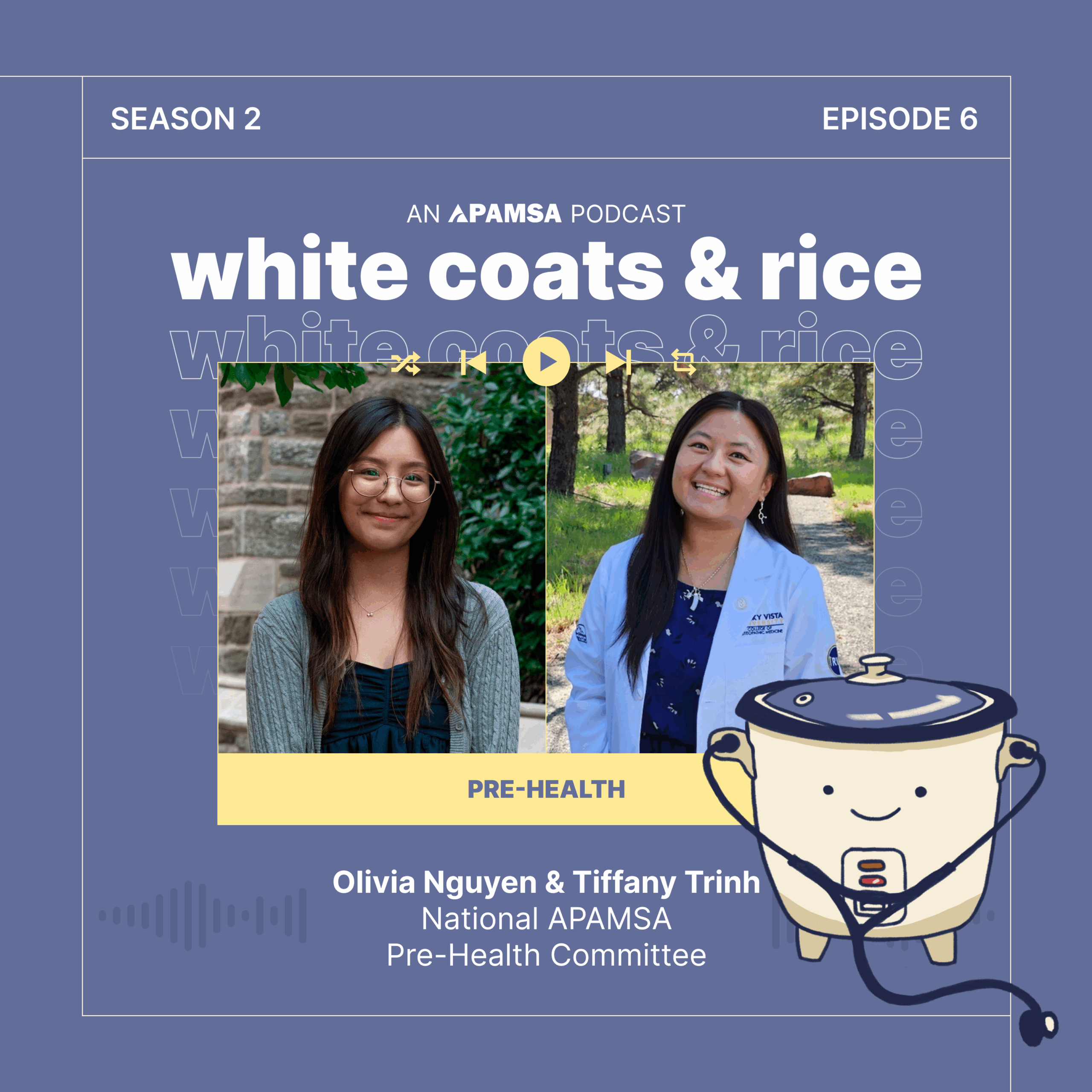
In this Pre-Health Series episode of White Coats and Rice, APAMSA Pre-Health Directors and hosts Angeline Yu and Ryesa Mansoor sit down with Livy Nguyen, a senior at Temple University currently applying to medical school, and Tiffany Trinh, a second-year osteopathic medical student at Rocky Vista University. Together, they share thoughtful and candid reflections and lessons from their pre-med and medical journeys: navigating tough coursework and finding mentorship to handling gap years, choosing the right school, and adapting to medical training.
Listen here:
YouTube
Spotify
Apple Podcasts
This episode was produced by Angeline Yu, Ryesa Mansoor and Kevin Gaw, hosted by Angeline Yu and Ryesa Mansoor, and graphic by Callista Wu.
00:05 Episode Introduction
01:09 Speaker Introductions
03:02 Finding Your Path to Medicine
04:57 Deciding Your College Major
05:48 Handling Difficult Pre-Med Courses
08:10 Extracurriculars
10:28 Reflections About the Med School Application Process
15:02 Finding and Maintaining Mentorship
21:13 Gap Year Experience as a Medical Assistant
25:45 What Surprised You About Medical School
28:21 Choosing a Medical School
33:38 Differences between College and Medical School
36:30 Closing Remarks & Advice for Future Healthcare Students
41:00 Outro
00:05 Introduction
Angeline: Welcome to another episode of the White Coats and Rice podcast, this time brought to you by APAMSA’s pre-health team. From roundtable discussions of current health topics to recaps of our panels with distinguished leaders in healthcare to even meeting current student leaders within our organization, this is White Coats and Rice. Today, we’re super excited to have a pre-health takeover. This episode will be hosted by me, Angeline Yu and Ryesa Mansoor, APAMSA’s 2025-26 Pre-Health Directors. My name is Angeline, and I recently graduated from Stanford University with my bachelor’s and master’s degrees, and I’m currently in my pre-med gap year. This is my fourth year with APAMSA, and I’m super excited to kick off this series as one of your Pre-Health directors.
Ryesa: And I am Ryesa. I’m currently a fourth year medical student at George Washington University School of Medicine, and I’m applying into pediatrics currently. And I am your other Co-Pre-Health director this year, along with Angeline. And we are joined today by two amazing guests who are actually from our own pre-health committee, Livy Nguyen and Tiffany Trinh. Thank you both so much for being here and talking with us on our podcast episode today!
01:09 Speaker Introductions
Ryesa: We’re going to get started with some quick introductions. Livy, we can start with you and then move to Tiffany. But if you both can just tell us and tell us and our listeners a little bit about who you are, where are you currently studying and where are you kind of at in your pre-med or your journey to medicine?
Livy: Yeah, I can start if that’s okay with Tiffany. My name is Livy. I’m one of the pre-health committee members. I’m also on the Southeast Asian Committee Board, which is really great. I’m a current senior at Temple University as a bio major, and I’m pursuing medicine. This cycle I’m applying right now, so I’m in the midst of it. But if not, I am preparing for a gap year if needed. And I’m the current president. This is my second year being president of the pre-health university chapter at Temple University. So that’s why I took a step further by joining the committee board, and I’ve loved it so far.
Tiffany: Hi, everyone. My name is Tiffany Trinh. I’m born and raised in Denver, Colorado. I’m currently an OMS2 at Rocky Vista University. I am also president of the regional APAMSA, or yeah, I guess the chapter in Region 7 APAMSA. And then I also heard that there were positions open for the National APAMSA as well. And so I was like, I really loved just being a part of just the Asian community and wanted to take that one step further and take it nationally and kind of bring awareness to everyone. And yeah, so I am currently almost done with my first semester of second year and we’re studying for boards, so that is not fun at all.
Ryesa: You are really in the thick of it. Well, thank you both so much for introducing yourselves and for taking time out of your very busy schedules to be here and talk to us today for this podcast episode.
03:02 Finding Your Path to Medicine
Ryesa: So we’re going to get started. And our first segment here is going to be more kind of starting from the beginning about finding your path to medicine. So we can start with you, Livy, since you are still kind of in the pre-health part of your journey to medicine. When do you or when did you first realize that you wanted to go into medicine, or was there a specific moment or experience that really sparked that interest?
Livy: Yeah, so fortunately, I do come from a family of a lot of free health professionals—ranging from physical therapy, pharmacy, nursing. My mom is a nurse and she works in the OR, so she’s been a great factor of that influence. And then my sister ended up going into medicine as well—she’s in her fourth year of medical school. So definitely them influencing and pushing and coming back home with just like the satisfaction of being able to give back every day and in the profession, I thought that was really inspiring.
In my senior year of high school, I was given the opportunity to do an allied health program. I was actually in the hospital half of my week for a whole year, doing many rotations, getting to experience all the different floors and departments of a hospital, which I thought was going to be the great finalizer—whether or not I really wanted to commit to this in college—and I definitely did; it definitely sparked interest.
I did an internship my senior year in the hospital that my mom worked out with one of her co-workers, who was a general surgeon, and I just absolutely loved the OR so much so I definitely thought like this is definitely something I wanted to do. I love the teamwork, I love the energy, and just the organization of everything, so I definitely think that sparked an interest as long as the influence from family and friends. So yeah, that was definitely something that I really wanted to do specifically in the OR too.
Angeline: That’s awesome that you were able to have so many early experiences and kind of looking at different pathways in order to really cement that interest. So it’s super cool that you found that really on.
04:57 Deciding Your College Major
Angeline: I guess like kind of following up on that, like once you enter college, how did you decide what to major in? Like, I know that you’re a bio major, like how did you kind of land on that?
Livy: Yeah, my sister was also a bio major at Temple University. I did go enter college as a biophysics major, but then I soon realized that if I wanted to do a work-life balance with also like social clubs and organizations, including APAMSA, I thought the bio department major was a really good track to, in order to allow me to have that balance and still commit to other priorities, such as like shadowing and volunteering and also, like I said, commitment to clubs. So I thought that biology would be the best pathway for me to do that.
Ryesa: Yeah, definitely. And that was really great that you kind of early on realized that and made that decision to really prioritize that work-life balance and kind of change your major to suit that.
05:48 Handling Difficult Pre-Med Courses
Ryesa: And along with your biology major, and I’m sure even pre-health students out there who aren’t necessarily doing STEM majors or doing other different types of majors, there still are the pre-med courses and the pre-med coursework that are required before you apply to medical school. And as we all know, those pre-med courses can be pretty brutal. I am looking at you, organic chemistry and biochem and physics.
So, Livy, I’d love to know, along with kind of prioritizing that work-life balance, what were some of your best strategies or study habits for handling those pretty tough, quote unquote, weed out classes like orgo or physics?
Livy: Yeah, I would definitely say if you would ask me, I would have definitely answered with orgo being that. When I was in high school, I did a lot of independent studying, keeping to my own course and study schedule. But once I started Organic Chemistry 1 and 2, I took it with the honors program and I took it with the same teacher that taught both courses back to back for my entire sophomore year. That was definitely the most brutal class I’ve ever taken in my entire academic career.
And I was so grateful—I thought the best way that I kind of changed my study habits, I made really close friends in those classes where we would stay up together and like using a whiteboard and studying together, utilizing all of our brains and combining them. I would be good at one topic and grasping it and I would be totally lost in another. And my friend would teach it to me in the way she thought it was best way to learn. And because sometimes professors aren’t the greatest as you know, teaching students that don’t really, have never heard of organic chemistry before. Everything I feel like for foundations of that is completely new to college students.
So I thought that being able to combine our work and our mindsets with other students and my friends, it really brought us closer together and also like, build a relationship, like very non-toxic, which I really, really appreciated. And I don’t think I would have passed that class without them. So yeah, I think it’s good to have independent studying, but also being able to work with other people is also just really great too.
Angeline: Yeah, I would definitely agree with that. I think having a community is really important, not just in teaching each other how to study, but also really supporting each other. And so I definitely really resonate with that. And thank you for sharing that perspective as well.
08:10 Extracurriculars
Angeline: So it sounds like obviously you are a very stellar student in the classroom, kind of life outside of the classroom. How did you kind of choose your extracurriculars? And I know that you’ve done a lot of like very like pre-med related extracurriculars, like shadowing and stuff like that. Maybe do you have any other like non pre-med extracurriculars that you decided to pursue? And what kind of those experiences teach you about both yourself and about medicine and like your future in that?
Livy: Yeah, of course. In high school, actually, I started in middle school. My mom actually put me, without telling me, into martial arts with my brother in hopes that we could build a better relationship with each other, and it definitely worked. So I did karate for almost eight years. And with that, I did start volunteering and working there as a high schooler, being one of the teachers. So I was teaching from the ranges of early as 3 to 4 years old to even adults or parents that decided to join afterwards with their kids. So I continued that and I loved working with kids. And then from that, I was inspired by my mom who eventually started working at CHOP at the Children’s Hospital of Philadelphia. So I started volunteering with them. Although that is technically pre-med, I mean, I felt like it was more like volunteering, just getting to know kids, not as just patients also.
And some other stuff, I did volunteer at my local arboretum. Growing up, my mom took us to a bunch of museums, gardens, and arboretums in the Philadelphia area, and I just loved it so much. So I went to my local one and during the summer time, I would just pot plants with them and weed with them. And I was definitely bringing the mean age down because everybody else was like above the age of like 65 and retired. But I just thought it was really good to, you know, give myself an opportunity to connect with my community, not just at my age range, but also those that are younger and those that are older, just to broaden my experience and really understand their perspective. I feel like that’s also really important for the health field, not just shadowing, like you said, or getting clinical experience. So I thought that those have definitely influenced my inspirations as being a physician too.
Angeline: Yeah, totally. And even being able to interact with people of all ages, I mean, you’re going to have patients of all ages as well. And so like kind of having those experiences, even if they’re not health care related, can help you so much in that future, too. So that’s really, really cool.
10:28 Reflections About the Med School Application Process
Angeline: And I guess now like that you’re kind of in the thick of application season, kind of like maybe what did what made you decide to apply this cycle versus taking a gap year, and also like how are you preparing for that medical school application and like anything you wish you could start earlier?
Livy: If I’m going to be completely transparent, I truly did get a lot of feedback from other med students, my sister included, and her friends to really push me to take a gap year. And I genuinely really wanted to. I do think gap years are really logical, give yourself a break from school because undergrad is really stressful and all of that. So I really wanted to take a gap year, but unfortunately, not everything can go my way. So like many others, which I assume my parents really pushed me to not take a gap year, they do think time is money. And they said they really influenced me to like if I have the confidence to do it now and I felt confident enough in my resume to do so or in my GPA and other things like that, they said it doesn’t hurt to try. And I’m very fortunate that my parents are supporting me financially and emotionally through this process. So I think that’s definitely other factors, but for people that are taking gap years or planning ahead of time, I would definitely encourage it. I think every type of pathway is different for everybody.
But yeah, I decided to pursue with that and applied to a few med schools that I thought was best suited for me, putting all my eggs into like, a few baskets instead. So yeah, I’m in the thick of that, like right now, like you said, and right now I’m trying to pursue osteopathic medical schools right now, influenced by my sister as well. So we’ll see how that goes. But yeah, that’s where I’m currently standing.
Ryesa: Amazing. Thank you so much for your transparency about that as well. And it’s kind of some of the decision process behind you pursuing a gap year or not. Similarly, I took two years off as my gap year. Angeline’s currently in her gap year, so I think over the years, it’s definitely become a lot more kind of of a normalized path to take that. And it’s more normal, I would say, even in my own medical school class. I would say a majority of people have more of this “non-traditional” path. So it definitely is really open for what people can decide to pursue before they make that decision into applying.
Livy, one last question for you before we move on to our next segment, but I would love to hear maybe some of your reflections or thoughts now that you are kind of in the thick of the application season. If you could go back and maybe change one pre-med decision over the last few years or even from high school going into college, maybe a class you took or maybe something that you were overstressed about that in hindsight, maybe you didn’t have to stress so much about or maybe how you approached a certain experience. What do you think that would be?
Livy: I would say like a lot of people told me the application process is very overwhelming and overstimulating. And I tried my best to not listen to that, but obviously it still got to me. And a lot of people told me to really block out a lot of time to commit to the application process because it’s so time committing. I didn’t really listen to them and I feel like I should have. I did try to really squeeze in. I just came back from studying abroad. In part with being a bio major I changed that because I wanted to be able to fit study abroad into my academic plan, and I decided to study abroad while studying for the MCAT and I took the MCAT the weekend I arrived home in June, so I definitely tried really had a time crunch in that. And I feel like if I could go back in time, I would hope to plan ahead of time, being a little bit more realistic in that process and that pathway that I took. Maybe taking, like, really finalizing, putting my foot down and a gap year to commit to that time to study for the MCAT. And then while also enjoying my study abroad time, because studying abroad and studying at the same time is not as easy as it sounds and what I thought it would be. So I definitely would have tried to be a little bit more realistic in that.
Ryesa: Yeah, definitely. It all comes down to the timing sometimes with things, but I appreciate your very thoughtful answer and reflection there. Okay, so I would love now, thank you so much, Livy, for answering all those questions, especially from more of the pre-health perspective. But now we can move on into our second segment. So hearing a little bit more insight from the medical school side. So we can shift over to Tiffany, who is currently an OMS2 student and in medical school.
15:02 Finding and Maintaining Mentorship
Ryesa: So Tiffany—one thing we’d love to know, and I’m sure our listeners would also love to know—when you were in the application process of applying to different medical schools, who did you turn to for some mentorship or guidance during that process? Were there particular people like professors or advisors, family members or friends, maybe any people or even programs that helped you navigate that process?
Tiffany: Yeah, so at the time when I was applying, I was actually still working full-time as a medical assistant. And so a lot of people that I turned to were the doctors, the nurses, and then the other medical assistants that I worked with. And they helped a lot with just kind of technicalities of the application, and what to look for, how to answer certain questions, like what med schools may be looking for.
Aside from that, I also really relied on my outside friends, like my childhood best friends, and then people that I used to work like in retail with. And I wanted them to read my application as well, just because they have a totally different perspective of like what they’re looking for in an essay. And so I think just having many different perspectives looking and editing my application was really valuable during that time. And then it also gave the close people around me a chance to kind of be like, “Hey, like, remember, you also did this!” And I was like, “Oh, you’re right, like, totally phased that out.” Like, there’s just so many, like, just things that they filled in for me without, like, meaning to. And so that really helped.
Ryesa: Yeah, that’s awesome to hear that you had kind of those support systems or that guidance and help during the process in so many different avenues. And I agree, especially with the personal statement as I kind of on the other end of it just finished my application process for residency. And it’s the same thing. I had to write a personal statement, which is more difficult than it should be, I feel like. And I had so many people, from people who didn’t know me as mentors to people who have known me for 10, 15 years. And so just having all those perspectives to help with something that is supposed to be as significant as a personal statement is really so helpful.
On that note, Tiffany, I’m curious to hear. So once you had maybe these mentors or other people that you look to for help during this application process, how did you stay in touch with them? I feel like especially as a pre-health student and something that we’re even trying to help bridge the gap for with APAMSA with our own mentorship program, really keeping in touch with those mentors and continuing those connections and keeping those relationships genuine can be a little challenging. So how did you kind of maintain that communication, especially after submitting your applications?
Tiffany: Yeah, for sure. And I think that’s something that I kind of still struggle with, especially being in med school, the schedule is just so chaotic and it’s hard to keep up with everything. But one thing, especially with like the clinical providers that I kind of…I got really close with because I worked at this clinic for four, four and a half years. And just like when I’m in med school, sometimes they pop in my head and I’m like, oh, like this concept reminds me of what we did in our clinic. And so when I have those moments of like, oh, this is reminding me of my time at the clinic, I just shoot them a quick text and I’m like, “Hey, I’m like in school. It’s been chaotic. We’re in like renal or something, but we were learning about this and it reminded me of our clinic and I really miss you guys.” And I’ll just shoot them that text. And I know they’re just as busy too, but I mean, obviously I don’t expect a reply, but just me sending that out, I think just puts them, puts me on their radar still.
And then with my friends, they’re constantly always messaging me and they understand if I don’t reply in like three days there’s an exam that Friday, and then when suddenly I start mass texting everyone they’re like she’s free the exam is done so just like setting the expectation with the close people around me like, hey this is my schedule take no offense, but I will be in contact and they kind of like after two years, they picked up on the pattern, and then they’re like, okay, we got it, there’s an exam. So, yeah, I think prior communication with the people, especially people who are not in this field, I think that’s super important for them to just, for us to be transparent, and then they know, and they can check in and be like, “Hey, like, hope you’re doing okay, no need to reply, just checking in on you,” and then I’ll kind of do the same thing, and If I know there’s an exam coming up, I’ll like shoot my friend a text and just be like, “Hey, stressful exam coming up. I’ll text you like after I’m done and we can catch up and lunch.” It’s a lot of just like spontaneous like, oh, I thought of those quick texts and then moving on with studying.
Angeline: Yeah, Tiffany, those are such great pieces of advice. I think not even just like in med school, but just like in life in general. Like I think that communication piece is really important and especially in maintaining those supportive systems. Like it’s really easy to, you know, see someone every day and like chat with them. But once you kind of like move on from that era in your life like maybe you don’t see them every day but like you still really value them as like a mentor or a friend like maybe you moved away from medical school and your friends are like several states away now like kind of navigating that like right now even after graduating like three months later like I’m kind of still learning that balance as well. So it’s really cool to see that, like, you know, you can just shoot a quick text and be like, “Hey, just thinking of you,” like, you know, like no harm, no foul. And so just really being able to keep that like support and that like connection there, even if you don’t see each other every day, I think that’s super important and super valuable too.
21:13 Gap Year Experience as a Medical Assistant
Angeline: I guess I’m really interested in hearing more about your medical assistant position. Like, did you decide to take a gap year to be a medical assistant before starting med school? How did you decide to do that versus like being like a scribe or like a volunteer or something else like that? What kind of went into that decision?
Tiffany: Yeah, that one, it’s kind of weird. It kind of happened like serendipitously in a way. I knew, so I started in junior year of college to just start applying to kind of more healthcare-related positions. Because I knew, you know, when we apply to med school, we need a little more experience in that realm. And so I just, I think I was looking on like LinkedIn or something like job search. I just searched up like medical assistant. And then I didn’t even know the criteria for Colorado to be a medical assistant. I just thought, oh yeah, you can be a medical assistant equivalent to like CNA and stuff like that. So I applied to this clinic. And they were, I guess I applied when they were very understaffed. And so I got an interview and everything and they’re like, yeah, so this is your like job role. And I wasn’t even certified to be a medical assistant, but I guess that wasn’t a requirement for the clinic or for Colorado technically in a way. And so I kind of just stumbled upon this job. So the clinic was an OB-GYN clinic associated with CU Anschutz, but it was like an outside clinic. But doctors like attendings, fellows, residents, and med students all rotated around in this clinic, which I knew nothing about until I actually started working there. And then I was like, oh my gosh, like I started to learn all of this as I was working there.
And so I wasn’t anticipating to stay as long as I did. I definitely wanted to apply to med school soon after I graduated college. I thought the perfect path was to graduate college and get straight into med school, but I kind of struggled a little more academically in college. There were just a lot of life things going on and just figuring out how I study. And so I unintentionally took a little longer just because I really enjoyed working at the clinic. I love patient experience. There was a lot of good exposure that I was getting in that position. And then I also decided, I think my third year in being a medical assistant there, I decided to start applying to med school, taking the MCAT.
And then I would definitely agree with Livy on this aspect—I started studying for the MCAT while I was working full time as a medical assistant. That was not a good idea at all. And then I also kind of procrastinated on applications, even though I knew like submit it early and all the advice. And so that being said, I definitely stayed there longer just because the medical application didn’t turn out how I wanted it to turn out. And my MCAT score was not like where I wanted it to be either. And so that kind of made me stay at this position a little longer just to be like, okay, like at least I still have a job. I’m still having some decent income. But like in retrospect, I probably should have just quit the job and dedicated three months purely just to studying MCAT and then applying to med school. But yeah, so my four years as a medical assistant was definitely very unintentional, but very, very valuable in the end.
Angeline: Yeah, definitely. Thank you so much for sharing those perspectives. I think sometimes when we’re in the thick of things, sometimes we can be like, oh, we had this very linear path that we wanted to follow, but sometimes life doesn’t work out that way. So I think it’s really helpful to look back and be like, yeah, maybe that wasn’t what I thought was going to happen, but I learned so many important life skills and experiences that I never would have had without it. And so it’s kind of like a blessing in disguise to be able to you know, have these unexpected things come up, but also like gain a lot from it. So thank you so much for sharing those perspectives as well.
25:45 What Surprised You About Medical School
Angeline: Kind of along those lines of serendipity, like once you, we fast forward to when you started medical school, what’s kind of something that surprised you, or something that you didn’t expect about medical school life?
Tiffany: That is a tricky question. I feel like med school always surprises us with whatever, like we, I feel like as med students, we like to know what’s happening. And it’s kind of a dichotomy because technically the next like four years of our life is planned out for us, but at the same time, we have no clue what’s going on. And I think what surprised me is I thought that once I got into med school, I would know exactly why like I wanted to be a doctor. Like I do have an idea of why I want to be a doctor, but I keep surprising myself in like finding out more reasons or like interconnecting things together to add to my “why”. Because originally my why started with just like my grandma being really sick and wanting to like be that person to take care of her, but also just be a reliable person for other people. And so that was my main reason.
But as I’ve gone through med school, just being in APAMSA in and of itself and volunteering like in the Asian community in Colorado, I’ve also found that like that community has also integrated into my “why”. Like community is a very, very big reason for my why. And I’m surprised that med school and like being in clubs have provided me that opportunity to learn that about myself. So yeah, that really surprised me. I’m just like, oh, there’s a lot more that I can add to my why. It’s not a stagnant like, yeah, I got into med school because it’s my why. And that’s just what you continue with. Like it’s continuously growing.
Ryesa: I absolutely love that kind of connecting and bringing it back to that “why” purpose, because especially that’s something during the med school application process you have to think about. You’re sitting there kind of pouring your heart out on this personal statement and your whole application and in these interviews about why medicine, why are you going to medical school and again on the other side I’m currently in the process of doing that with residency and even now I think going on into residency your why is going to continuously change I would say my purpose now and what I’m talking about on these interviews is not exactly the same as it was four years ago when I was applying to medical school, so I think that’s kind of the beauty of going through this process and having all these experiences.
28:21 Choosing a Medical School
Ryesa: But Tiffany, I would love to know when you were in that process of applying to medical schools, what were some of the criteria, or I guess some of the factors that you were looking into when it came to making your school list, and how did you kind of approach that? And again, similarly, I know how with residency, I’ve almost had to kind of learn a new language about all these different things to look for in residency programs. But with medical schools, what were factors that were most important to you? Whether it was location, was it maybe the curriculum style and the exam scheduling, the culture of the school, diversity, anything like that?
Tiffany: Yeah, a big, I think the one that was top of my list was definitely diversity. And I also looked a lot at affiliated clinics with certain hospitals and with the med schools. And so I wanted to see a lot of just like underserved kind of goals. And then I looked at also clinics that were associated with different diversity like different ethnics and cultures like whether it was immigrants or Asian or African American like diversity was really important to me, and still is, and so that was at the top of my list um so I kind of I started off just thinking what is number one? What is the most important, and then I started there. And then I kind of made my way down the list. I knew that location was important because it does contribute to diversity as well, but it also just contributes to like, if I see myself living there and just lifestyle wise. And I know, I guess point number two seems a little weird, but I wanted a location that was pretty cold because I do not function well in warm weather. I just like, I get, chronic migraines and warm weather does not help with that. And it really affects my functioning. And so that was kind of number two in a way. It’s weird, but definitely cold weather.
And then after that, I did look at if they had master’s programs or like pipeline programs into med school. Just because I knew that there’s a chance that I might not get accepted with my med school application, so I wanted to know would they have other programs that I could possibly apply to in a non-traditional route in order to get to that med school if I couldn’t do the direct route. And I think like the majority of us, I did the non-traditional route and I actually found a master’s program at Rocky Vista as like a post-bac program. And then doing that actually led to a pipeline program into the med school itself. And so I did not have to worry about MCAT again. And I did not have to worry about like the whole application process. So that part was also serendipitous.
And I think everything about med application and med school is so serendipitous. Like you have a plan for everything, and then all of a sudden like you’re in a different path. And so, yeah, I looked at diversity, weather, I guess, in the location, post-bacc programs, and then also just faculty support and how teachers are, how available, like the ratio of teacher to student. I like more one-on-one, like close environment. And surprisingly, Rocky Vista also provided that because for some reason, I thought the campus would be extremely large and huge, but I got there and I was living in one building and I was like, oh, this is so small. But I grew to really, really appreciate that because once again, it built a really close community. And so community was also a part of that list. Like, do I want a huge, huge campus where I don’t know anyone, or do I want a smaller campus where wherever I go, people are like, oh, hey, Tiff, like, how’s it going? And that’s exactly what I got at Rocky Vista. And so I’m a big person on just community, environment, and connections. So that’s what I looked for in these medical schools.
Angeline: Yeah, definitely. I think those are all really important, especially because you’re going to spend like at least four years there. So I think location and weather definitely is one that is kind of like understated. Like everyone’s always like, you know, like faculty, like kind of like the different specific fields that they specialize in. But no one really talks about like location and like outside of med school and you’re just like hanging out. Like, do you like the town that you’re in? Do you have places that you want to go and enjoy outside of school? So I think those are definitely really important considerations that I also didn’t really know until I got to college and I was like, oh, wait, these are really important to me. So really appreciated that you brought that up.
33:38 Differences between College and Medical School
Angeline: I guess now just kind of thinking on a reflection piece, what do you think is the biggest difference for you between your medical school experience and your college experience? From anything from like studying to like kind of like lifestyle, work-life balance, all of that different kind of stuff. What’s kind of like the biggest difference in your opinion?
Tiffany: I think the biggest difference is gonna be study style, because in college, what worked a lot for me was reading from the textbook, taking notes, making sure I go through each chapter and taking notes on that. But with medical school, I don’t use any textbooks at all and I focus on the professor’s lectures. And I’m still kind of experimenting with how exactly I study, but a lot of what I do is like whiteboarding. So I’ll watch the lecture and then I’ll look through the professor’s slides and then I kind of just write on the whiteboard—like straight recall, whereas college was more of just like reading the textbook, making sure that you memorize certain things, but med school is more of like, you have to integrate a lot of things.
But second year, for sure, I am using more textbooks—but they’re more like board textbooks, like First Aid and stuff. But for the most part, I focus a lot on the professor’s content and their lecture and how they approach things. And undergrad was more of, like, I did not pay attention to what the professor’s style was. It was more of just, like, “What’s the chapter I have to read?” and I’m going to take notes on that. So, totally different style. And I think if I knew more about active recall and just, like, using that method in college, I probably would have been like better off—but yeah, it’s just things that you just learn as you go on with med school.
Ryesa: Yeah, that’s such good reflection about just the different study habits that I feel like medical school almost forces you into, just with how much information that you—especially during the pre-clinical years—that you’re expected to learn and know. I think another thing to your point, that I personally experienced, is that your style of studying is also going to change and adapt so much depending on like which block you’re in, versus in college. I think, exactly like you said, you kind of had the way that you studied, you stuck with it for all of your classes, and it was for the most part enough to get through. But I remember from our cardiology block to our infectious disease block, you really had to change up how you were studying depending on the information. And so that also was its own challenge and that adaptation. But really appreciate your thoughtful insight, Tiffany, for all of those questions.
36:30 Closing Remarks & Advice for Future Healthcare Students
Ryesa: Kind of moving on into our last segment. And so kind of thinking about the future and advice for our next generation of healthcare professionals. So before we’re kind of wrapping up for this section, we kind of want to ask you both the same question, one that we think every pre-med or every pre-health student should hear. So Angeline, take it away.
Angeline: Yeah, so this is for both of you. So whichever one of you want to answer first—if you could give one piece of advice for someone who is thinking about applying to medical school, or maybe just starting their pre-med journey, what would that piece of advice be?
Livy: Do you want to go first, Tiffany? Or do you, I don’t mind.
Tiffany: I’ll let you go first since I’ve been talking.
Livy: Okay, sounds good. Yeah, if I were to just tell anyone—whether it be like other undergrads or even high schoolers that are considering this very vigorous and long pathway—I would just constantly remind them to be open-minded and to try to, I know it’s really hard, but not to compare yourself to anybody else.
I think it’s really important to remember that everybody—like we’ve all been mentioning—has very different non-traditional, traditional pathways, whether it be the amount of gap years you take, your experience, when you decide you want to even pursue medicine. I know even people that are changing their majors in their junior or senior year of college. It’s very important to just stick to your own path and really have confidence in what you can bring and why you want to pursue this future.
And then also along with that on that pathway, even though I say not to compare, I think it’s really great to really work with others and to find a really strong support system, because it can be a very emotionally dragging and affective process. And I think it’s really good to keep up your mental health and to find the people that are going to be there for you rather than stressing you out or making the process a lot more difficult than it should be. So definitely finding other undergraduates that are going through the same process or even mentors like in mentorship programs with other med students, other undergrads. I think it’s really important and definitely think all those factors have really helped me in this whole pathway. So I really appreciate it and would definitely tell others to do the same.
Tiffany: Yeah, I would definitely agree with Livy. Echoing everything that she has said, it’s definitely valuable to just be open-minded and just know that there’s going to be a lot of things that change throughout your process—from when you decide to be pre-med to when you apply and when you’re actually in med school. And then even when you’re applying to residency and everything, you’re constantly going to be changing as a person.
And I think…one advice that I would definitely give people is to kind of step out of your comfort zone and be involved with your community. I know with medical school, we get wrapped up in like our MCAT scores, our GPA, how well we need to do in undergrad and everything. And those things are important, but I think what’s just as important is knowing what you love. Like just keep doing the things that you love, whether it’s hobbies or going out into your community, volunteering. And like, those are all things that people look for on applications, but it’s also, it makes everything a little easier if it’s something that you love to do. Like if you just love to volunteer in whatever you do, it’s easier to talk about in an application, whether like, instead of just finding a medical volunteer just to do it. Like it’s better just to do things that you love. And it’s easier once you get accepted into medical school to know, like, this is what I love to do. And this is what I’m going to keep doing to keep myself sane during stressful times. And so I would definitely advise, put yourself in uncomfortable situations because that’s how a lot of us grow and that’s how we find our way through life. Yeah, helping out, finding things that make you happy.
Ryesa: Amazing. Those are both such great pieces of advice. And I love how both of you really still came back to and touched on that topic of community and like those support systems because it really takes a village. And we all have our people and our systems for getting through this very, very rigorous process field and career that we’ve chosen.
41:00 Outro
Ryesa: That really wraps things up for us. Thank you both so much for taking the time to talk with us today and share your stories and your insight. It’s so encouraging hearing from both of you and people who’ve been through the process, both from this, the current pre-med student perspective and also a current medical student perspective.
Angeline: And to all of our listeners, thank you so much for tuning into White Coats and Rice: Pre-Health Takeover. Stay tuned for more episodes where we’ll continue to unpack the pre-med journey and spotlight Asian American voices in medicine. Until next time, I’m Angeline.
Ryesa: And I’m Ryesa.
Angeline & Ryesa: And this was White Coats and Rice: Pre-Health Edition!