

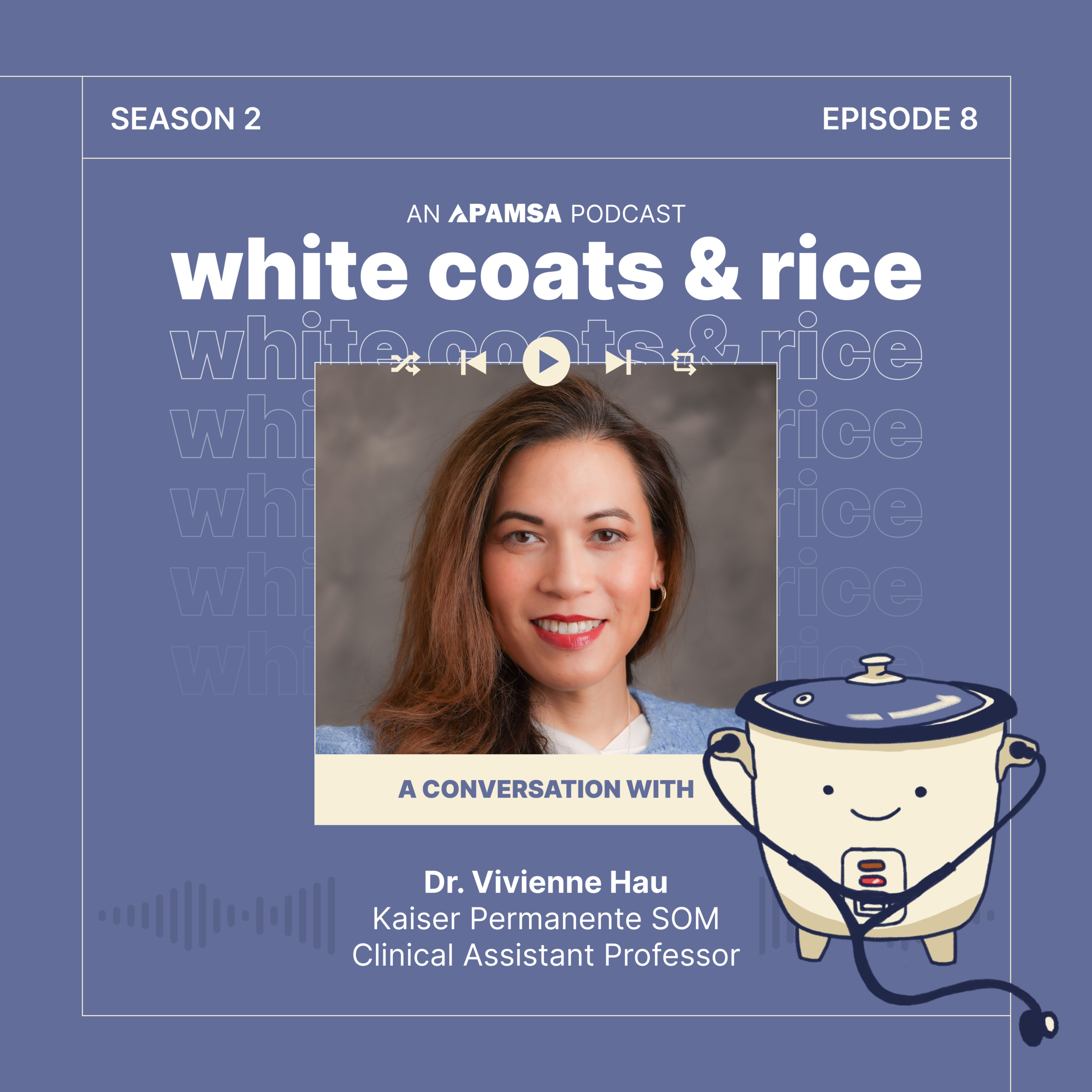
In this episode of White Coats and Rice, APAMSA Podcast Committee member and host Kevin Gaw sits down with Dr. Vivienne Hau, a Clinical Assistant Professor at the Kaiser Permanente Bernard J. Tyson School of Medicine and a surgical vitreoretinal specialist, for a reflective conversation on leadership, identity, and legacy in medicine.
Dr. Hau shares her journey through APAMSA—founding her medical school’s chapter at the University of Arizona, serving as Region VII Director, and later leading the organization as National President in 2001—while reflecting on how student advocacy continues to shape her work as a physician and mentor. The conversation also explores Dr. Hau’s experiences as a transgender woman in medicine, her path into ophthalmology and vitreoretinal surgery, and her perspective on building a more inclusive and sustainable future for both patients and providers.
For listeners who would like to continue the conversation or reach out, Dr. Hau can be contacted at vivienne.s.hau@kp.org
Listen here:
YouTube
Spotify
Apple Podcasts
This episode was produced by Kevin Gaw, hosted by Kevin Gaw, and graphic by Callista Wu.
00:06 Introduction
03:08 Medicine, Career, & Growth
20:30 History in APAMSA
24:36 Leadership in APAMSA
34:33 Intersectionality: Transgender, Asian American, Physician
48:12 Advocacy, Leadership, & Reflection
59:59 Closing Remarks
00:06 Introduction
Kevin Gaw: Welcome back to White Coats and Rice, an APAMSA Podcast. From roundtable discussions on current health topics, to recaps of panels with distinguished leaders in health care, to conversations with student leaders across the organization, this is White Coats and Rice.
My name is Kevin Gaw. I’m a member of the APAMSA Podcast Committee and a first-year medical student at the California University of Science and Medicine in Colton, California, and I’ll be your host today.
I’m really excited to introduce a very special guest for this episode, Dr. Vivienne Hau. Dr. Hau is a Clinical Assistant Professor at the Kaiser Permanente Bernard J. Tyson School of Medicine and a surgical vitreoretinal specialist, where her work focuses on complex retinal disease and restoring vision through advanced microsurgical care. She has played a formative role in APAMSA’s history—founding her medical school’s chapter at the University of Arizona, serving as Region VII Director, and later becoming APAMSA’s National President in 2001!
We’re grateful to have you with us today, Dr. Hau. How are you doing?
Dr. Vivienne Hau: I’m doing very well. I just want to say I’m truly really honored to have been asked to be part of your podcast. And I love that fact that, what, almost a quarter century later, I’m still involved with APAMSA. I’m being asked to be a part of it. It’s something that is part of my own identity and is something that holds a very special place in my heart. So I’m excited to be here.
Kevin Gaw: I’m excited as well, and the honor is all ours.Thank you so much. And I know I gave a brief introduction for you. Is there anything else you might want to add to let our audience know just a little more about your background before we get started?
Dr. Vivienne Hau: Well, you pretty much encompassed most of it right there. You know, I can also add I’m on faculty at your medical school too—that’s how we had met. So thank you for you and your APAMSA local chapter inviting me to come speak. One of the newest medical schools in the country, and not too far from where I practice at Kaiser Permanente in Riverside.
One of the other things that I have a passion for is clinical research. I have an MD and a PhD, and my work is looking at the latest treatments and clinical trials for the treatment of macular generation and diabetic retinopathy, two of the leading causes of visual impairment in patients. And so I lead our largest clinical trials program at Kaiser doing things like gene therapy and stem cell implants for some of our patients as well. And then on top of that, as you know, I just love mentoring and helping out students. It’s increasing representation within our field through various, you know, diversity, equity, inclusion programs, or working with our LGBTQ communities and ensuring they have a voice and a platform that sometimes can get overshadowed, and just just trying to really make a difference in a lot of people’s lives. So, those are just some of the additional things that I really have a passion for.
03:08 Career, Medicine, & Growth
Kevin Gaw: Absolutely amazing and truly inspirational work. So I’m really excited for our audience to hear about you and learn more about what made you who you are today and what led you to where you are today as well. So, before we dive more into APAMSA leadership, I kind of want to get started on what initially drew you to ophthalmology, and specifically vitreoretinal surgery.
Dr. Vivienne Hau: Yeah, that’s a good question. You know, people often ask me, like, when did I know I wanted to become a doctor? You know, as far as I can remember, I’ve always wanted to be a doctor. And I think part of that is because my parents, they implanted that in my head and basically repeated it multiple times when I thought it was part of my own thoughts, but maybe it was just really their voice telling me what I wanted to do. I’m sure many of you guys can probably relate out there in APAMSA land. So anyways, but I was always drawn to science and non-fiction and all that kind of stuff. I was that nerdy kid in elementary school, always asking the teacher, “How do you do a bibliography for a nonfiction book?” because everybody else was reading fiction, nonfiction. Although I feel like in your generation, more kids are kind of nerdy like me back then. Back then in the 80s, there wasn’t too many like me. So I was always drawn to that and always thought it’d be so cool to do science and research and had an opportunity as a junior in high school to work in a NIH-funded lab at the University of Arizona, because that’s where I grew up, in Tucson, Arizona—University of Arizona, go Wildcats! Currently number one in the country in basketball, so going to go all the way.
Anyways, so I went there for, I was there in high school, got placed in a research lab, specifically in neuropharmacology, investigating drug delivery across the blood-brain barrier. Well, little did I know, that experience that summer as a junior would lead me to eventually become a vitroretinal surgeon. Those experiences in that lab, doing that type of research, I thought was just the coolest thing and always thought that doing more stuff in regards to the brain and neurobiology and all that stuff would be where I would want to do. And so when I eventually got into the MD-PhD program, I thought I was going to do neurology and I had it all planned out all the way until my third year of medical school. I was about to apply, it was like spring and then I had like two weeks of elective time and I thought, “What should I do?” Well, there’s this thing called ophthalmology. I didn’t know what the difference was between ophtho or optometry, but I thought there’s a lot of things in there about the brain, a lot of neurology. So I’m just going to go and do that and learn more about neurology so I can become a better neurologist someday. Well, I did that after the first day. I said, “Oh my gosh, this is my future; I found my tribe.” You know, your vibe attracts your tribe. And that’s basically what happened.
I just connect with everyone and I could do all the neurology I wanted to, but I could actually fix it too. And by working with my hands and doing the really high precision surgeries that I loved as part of my research doing small animal surgeries, extracting the brains of rats and mice and extracting the blood-brain barrier from the meninges and all that kind of work. You know, it’s very similar to doing surgeries within the eye because it’s very microscopic and high precision as well. And all my research that I did in blood-brain barrier drug delivery applied to the blood-retina barrier; there are a lot of similarities there. And in ophthalmology and specifically retina, I got to be the primary care doctor where I got to see my patients on a long-term basis. In fact, I get to see them more often than your primary care doctor because some of these patients have diseases where I’m literally seeing them every month and I get to know their families because a lot of them are hereditary as well. So I love that kind of primary care aspect for the eye that I get to do, these long-term relationships that I get to build with them. But I can also work with my hands and actually do surgeries and get to cure blindness in some cases. And how cool is that? Most patients, they fear getting cancer. Their second biggest fear is going blind, and I can actually fix them, for some of them, from going blind as a retina surgeon.
And then finally, in retina and ophthalmology as a whole, we get to work with a lot of cool technologies. You probably remember during my presentation to you guys, one of the coolest things is I get to shoot lasers out of my eyes, which is just one piece of technology that I get to do and how I can treat patients. And on top of that, I can apply all my research background to doing clinical trials within retina, because retina is one of the hottest areas of research. There’s a ton of companies that are supporting research and I get to be involved in all of those different aspects. And so that is how my story led to retina surgery.
Kevin Gaw: I love the passion and just the story of how you got to where you are, because especially as just an MS1 right now, trying to figure out where I want to be and where I want to go. It almost…it makes me feel like, you know, I don’t have to worry about it now. And like you said, your vibe is your tribe. Like what I find will find me and I shouldn’t worry too much because you’ll just ultimately come across what you need to and I absolutely love that.
I kind of want to ask as well, because you did mention you are MD-PhD—did you always know that you were going to pursue a PhD as well? And also, you are so passionate about all the research you do. And I kind of want to hear about what is the current research that you’re doing? Anything new?
Dr. Vivienne Hau: Okay. Well, in terms of the PhD, I got that first experience working in a research lab as a high school student. I thought it was so cool. And maybe I should consider it just a career as a research scientist. Well, I continued on in that same research lab. My mentor at that time, who still is today, Dr. Thomas P. Davis in pharmacology at the University of Arizona, gave me that experience to work in a lab and really show me how much of a difference I could make by doing this work in this lab, and how it could connect eventually to translational research and also in patients. But the problem is just working as a research scientist, it just stopped in the lab. Like I pass it on to others and others would take it on from there. I want to be part of the whole process. And plus, to be quite honest, no offense to my PhD friends, I could not see myself in a research lab surrounded by rats and mice all day. You know, I’d go crazy trying to talk to them when I was bored. And I’m just a very people person. I love connecting with just different people from all walks of life and learning from them, hearing their stories, and just the richness of the diversity of all the people that you see as a physician in the people. I just loved that. And so then I knew I didn’t want to give up the research because I loved that; it was fascinating. And I wanted to work with the patients themselves that I would eventually be treating. And so ultimately that’s why I combined the two and continued on as part of the MD-PhD program.
And I was very fortunate. My mentor helped me get into the program at the University of Arizona, where I stayed at for medical school. So I’ve been a Wildcat for 12 years—undergrad, med school, and PhD in that neuropharmacology lab. Now, I did give up working in a basic science research lab to transition to clinical research. And that was because I just, I really liked working in the clinics. I mean, I just wanted to spend the majority of time working directly with the patients and doing the surgeries. It’s kind of hard when you’re also trying to manage a research lab, and trying to chase down grants, and trying to support a whole team. It just wasn’t for me, although it is for a lot of other people and I certainly admire those who do do that. But I could still do research as a clinician through clinical research. And so when I had joined Kaiser Permanente, they had promised me that they would give me the support to build a program from scratch because nothing like that existed at Kaiser in the field of ophthalmology. And so through a lot of perseverance, blood, sweat, and tears, making a lot of connections and convincing people to believe in my vision for doing clinical trials at Kaiser, we finally were able to nab ourself our first study, which looked at a drug to extend drug delivery within the eye for macular degeneration. And so that taught us how to do trials and showed us, or showed the world and the field that we could do studies at Kaiser. And eventually from then on, it just kind of built and built and built. So now we’re doing some of the latest, most innovative studies that are only be done at mostly academic institutions.
So most recently, we implanted the 17th person in history with stem cells for geographic atrophy. It’s basically where advanced age-related macular degeneration lose their retina photoreceptors. And so we’re attempting to regrow those with stem cells. And we just implanted the very first patient at Kaiser, 17th in history, last summer. And I’m pleased to report the patient is doing well. When the patient came to us a couple months afterwards and had told us that for the very first time she was able to see her husband when she walked back into the waiting room from her visit, whereas before she’d always have to remind her husband, “Make sure you yell my name because I can’t see you when you’re waving at me.” For the first time, she actually saw him wave at him; that was incredible. And it’s just like advances like that that you’re seeing and that you’re involved in, that you’re able to maybe bring back vision that was lost, that’s never been done before in medicine. And here we are, we’re on the cusp of doing that. And what’s cool about doing stuff in the eyes is that it’s an enclosed space. There’s less chance for systemic side effects. So a lot of times these innovative kind of research has done first in eye diseases and then can expand out or teach us how we can apply it to other diseases in the rest of the body, as Dr. Glockenflecken would mention, body medicine. But I get to focus just on the eye itself.
And then finally, the other thing is we’re also heavily involved in gene therapy studies. We were part of three different gene therapy trials where we’re, again, for the first time in human history, we’re able to program the human body, the eye itself, to make its own medicine, to make a therapeutic that didn’t exist in nature before, but now we’re able to do it. That is just some really cool, fascinating stuff. And that’s why I love doing what I’m trying to do, what I do today as a clinician researcher, as a retina specialist.
Kevin Gaw: Thank you for sharing everything. I think one of the things that I love hearing you speak about is just, well, I mean, anything. And I think I remember the first time you spoke with us, I was in our master’s program and you were speaking about your career. And it was the first time I truly considered ophthalmology, just based on the way you spoke about it and the way you really… talked about the patients and the care that you provide. And I always enjoy it, especially the story like that you talked about with the research and, you know, bringing the sight back. It’s, it always like it gives me chills, honestly, like just hearing what you can do as a physician and a clinician and a researcher. And you get to see the…there’s like that average time of bench to bedside. I don’t know how many years, but you kind of get to see that as both the researcher and the clinician implementing that. So I think that is what is something so special about your career right now. And I really love that. So thank you for sharing that.
Dr. Vivienne Hau: Those are really kind words, but thanks for saying that.
Kevin Gaw: Of course.
Dr. Vivienne Hau: I have folks ahead of me, mentors, people that I’ve met that did that for me and so I’m happy that I can kind of contribute some of that to some of the folks in APAMSA.
Kevin Gaw: Thank you. And I know you kind of mentioned already some of your mentors that shaped your trajectory in your career in meaningful ways. Was there anyone else that you kind of wanted to give a shout out right now or played a big role in, in where you are now?
Dr. Vivienne Hau: Oh my gosh. There’s so many mentors. It’s, I mean, you think about it in life, you have mentors for different aspects about your life. So if you’re just talking about my career in getting involved in research, then I already mentioned Dr. Thomas P. Davis, who was a big, big person. Later on, when I got into residency, Dr. Kang Zhang, a retina specialist, helped guide me there. And eventually in fellowship, I had folks like Dr. Robert (Bob) Wang and Dr. Rand Spencer, Dr. Dwayne Fuller, Dr. Rajiv Anand, Dr. David Callanan, Wayne Solley—those are all folks that kind of helped shaped my career as a retina surgeon and doing more specific clinical trials within the retina field. Dr. Karl Csaky was instrumental in helping me do that and now I get to be on trials with him as well, which is pretty neat as a colleague, not just as a student or trainee.
But other parts in your life, APAMSA, for instance, I learned about the importance of advocacy through Dr. Art Chen, who was one of the keynote speakers for APAMSA way back when, when I was a medical student. I remember hearing from him and what he did with Asian Health Services and the contributions that he’s done for ensuring our Asian American, Asian Pacific American communities are not forgotten about on both sides of the coast and all the awards that he received. That was very inspiring for him to tell me stories about him growing up and along with Dr. B Lee, who was a co-founder of APAMSA, about how they wanted to inspire a new generation of medical students, Asian Pacific Islander American medical students that made sure that they were socially conscious, that they made sure that folks didn’t forget about them simply because they were a quote, “model minority,” that they were bringing up stuff that nobody had really talked about at that time when I was going through training about how a lot of Asian Pacific American students were, you know, very kind of quiet and, and just didn’t stir the pot a little bit or didn’t speak their mind because that was how they were taught. And Dr. B. Lee and the other co-founder for APAMSA, Dr. Jhemon Lee both taught me to make sure to not quiet my voice, to speak my mind and make sure you contribute just like my other, just like the other med student colleagues that were not Asian. Because in that way, people will see you, they’ll respect you more, and you’ll have opportunities for advancement.
So, I mean, all of them played such a large role. Dr. Anthony So also was on faculty at Duke, now at Johns Hopkins, also a strong person in advocacy. I learned how important it was to ensure that, to not forget about where I came from and to ensure to elevate those after me. And so that’s why I continued to stay on as a mentor through APAMSA with those folks.
And then other mentors, you know, I have to say my parents, they taught me the way. They were Vietnamese boat immigrants in 1975. They risked their life to come here to America. And I was born a few months later here. But I mean, to see what they went through, their hardships, but for the hope and support of their future child and their future family, I mean, doing everything for that and ensuring we don’t forget the loved ones and make sure we always support our family where we can and inspire them like my parents did for me. I mean, they were great mentors too. Same with my brother who I, even though he’s younger than me, I look up to him and everything he’s done and his contribution. So, so many different people. I could go on and on and do an entire podcast about it, but just a few.
Kevin Gaw: Yes, and thank you for sharing that. I love hearing about all the mentorship throughout someone’s life, you know, from childhood to career to everything. And I think, like you said, it’s very important that we acknowledge all of that and continue also everything that they taught us, like you are continuing to mentor and continue to just be a speaker and everything like that. So like now, and I appreciate you being here.
20:30 History in APAMSA
Kevin Gaw: You briefly mentioned APAMSA, and I kind of want to know, because you’ve held nearly…a lot of every leadership position, right? You were Chapter President, you went on to become a Regional Director, and then National President. So when you think back to that time of leadership, at any stage of that, what stands out the most to you?
Dr. Vivienne Hau: That’s a good question. I think what stands the most out of all…those connections, relationships that I was building back then would become such a valuable part of my life today, quarter century later. And how all those connections helped shape my career direction as well. You know, I just wanted to, when I got into medical school at University of Arizona, and I had been a pre-med at the same place, I really wished that I had some med students that I could reach out to that would be really open about showing me how I could get into medical school. So while there were some that were very helpful, but I wish there was something more, something that I could get involved in. And so I knew that when I got into medical school, that I would start the chapter or reinvigorate the chapter that existed. And so when I did that, I made sure to elevate those after me. And so that’s why we started the first pre-med chapter, well, we invited pre-meds to be involved. So today, what I was excited to see when I was asked to be the keynote speaker a couple of years ago, that there are some very strong and vibrant, even stronger than some of the med school chapters of pre-meds. And that really warmed my heart to see because that was something I just had a vision for when I was just a med student, wish that I had, and now it continues on today on a so much greater level. So that’s something I’m really proud of. But I didn’t realize how little things like that could make such a large impact on so many different people at that time. I didn’t realize how the people I was meeting at that time the Dr. Jhemon Lee’s and Dr. B Li’s and Art Chen’s and Anthony So’s would still play a large role in my life today. I get to hang out with Dr. Jhemon Lee here on a regular basis, just trying out some cool restaurants here in Southern California, because we live next to each other. And Dr. Jhemon Lee is like, he does this comedy improv and I get to watch him be this like really funny version of himself aside from his other life as a serious radiologist.
Um, but that all stemmed from those first experiences back then. And, and who knows, Kevin, maybe in 25 years, we’ll be hanging out, you know, sharing a boba or something like that. Um, uh, just talking about, you remember that time when you invited me for that podcast? So it’s just, the thing is, take in these moments and, you know, maintain those connections you have with everyone, because you never know where that’s going to take you. And it just only makes your life so much greater and grand when you build this network, some amazing people, because we all have a similar type of interest. We’re all here in APAMSA together because we all have a drive to do more than just, than beyond just becoming a doctor. We want to contribute so much greater to our community and specifically to our Asian Pacific Islander American communities.
Kevin Gaw: Yeah, I love that. And if anything, I hope earlier than 25 years, you know, maybe we will stay connected and grab boba and look back, you know, to the first time we interacted. And I think that would just be amazing. I also agree that everyone that you meet, whether small, like someone who plays a small impact or a large impact in your life, is in your life for a reason. And I feel like that is testament to what you’re saying. You’re still connected with all these people that you met because they came into your life for a reason. And that’s something I hold in my life as well. So I’m glad you said that.
24:36 Leadership In APAMSA
Kevin Gaw: In terms of your time as chapter president, I kind of want to see like how…when you were chapter president at University of Arizona, what were the challenges that Asian American or the Asian American Pacific Islander community was facing at that time, and how does that compare to, you know, the advancements that we may have made now today?
Dr. Vivienne Hau: You know, a lot of things that I, that we struggled with back then are still the same today. So probably one of the hardest things that we had to deal with—II was president in 2001, and 2001 is most notable for one major event that we think about and that affects a lot of the stuff that we do today. And that was 9/11. So I was president during 9/11 in 2001. And our national meeting happened to be in New York City. New York University, NYU, had won the national conference bid and they were planning…and I was working with them planning this amazing national meeting at NYU at the end of October. And then 9/11 hit, roughly about a month prior to the national meeting.
So well one, we had to make a decision. Are we going to still continue with this conference? If you guys weren’t aware at that time, we’re still trying to figure out what happened, you know, terrorism, we were still uncertain as to where the next terrorist act could be. Is the country safe now? Could we travel safely? Because remember, it was planes that flew. Would our membership be okay with getting on a plane, a plane a month later after the worst terrorist act to happen on the soil of US, and fly to a national meeting for APAMSA?
And so we decided, you know what, we would continue with it. We were still going to plan and go forth with it. Even if only two people showed up or a hundred people showed up or 400 people show up, it’d still be worth it for all those involved. And I’m so glad that we did. It was a powerful moment to go to the, to go there and to also visit, um, Ground One where everything went and to also understand how, as Americans and, and how we need to support each other in the face of adversity, like at that time. And what came from that though, was also how a lot of our darker skinned colleagues, especially our brown brothers and sisters, were then all of a sudden being accused of being terrorists, even though they had nothing to do…they had no connection with the ethnicity of some of those that were found to be involved with the terrorism act, but simply because they had a similar color skin and they were deemed as foreigners, even though they could have been born and raised here in America.
You know, a lot of our membership, our colleagues as part of APAMSA, we deal with that all the time. And that discrimination became very rampant right after 9/11. And so one of the things as the organization, we collected people’s incidences of racist acts and created a database that we could share with each other. And we found guidance and support within one another to let people know that even if there was nothing we could do about that individual act, at least they knew that there was a greater group somewhere that was willing to listen and that was willing to try to help and fight for them. And so that’s something that we also did at APAMSA. And unfortunately with today’s current political environment, a lot of that stuff has come forth. During COVID, a lot of Asians, in here, in the U.S. were targeted. And unfortunately, sometimes with violent acts as well. And today, too, you know, there’s a lot of, sort of this, even though all of us are Americans born, raised here, naturalized, whatever, but it’s just being put into question because we just look different from a certain minority of group that happened to be in our today.
So more than ever, those lessons that we had to learn back then are still needed today. But what’s important is that we are larger, we’re more connected, and we didn’t have the sort of national presence that we didn’t like back then. And our membership was not aware of things like we do today, especially the advent of social media. So I think from that standpoint, we were so much stronger than we were before. But those same issues are still happening today. They haven’t gone away.
Kevin Gaw: I agree. And I think that community, like you mentioned as well, is one of the most important things in all of this, you know, just banding together, putting our voices together and standing up for what we need to make a change. And, you know, now more than ever, especially like if we’re dealing with the same issues, it’s really important.
So how do you feel that your leadership in APAMSA maybe changed or helped you understand what advocacy in medicine meant?
Dr. Vivienne Hau: You know, seeing folk who were strong Asian Pacific American role models showed me that I could be like them. At first, I always looked at folks like that, advocates like the Dr. Chen’s and Dr. Lee’s of the world, that I could never do what they would do. But after I got to meet them and realize that we’re more alike and we’re different, that I could be a strong leader like them if I put my mind to it and and develop the courage like they did, which they fostered and supported in me, that I could make a difference like they did. And so because of that role modeling and the mentorship, that’s what I’m doing today.
So today I co-chair several diversity, equity, and inclusion programs. Of course, some of them we’ve had to change the name because of the divisive political connotations of some of those terminologies, but that’s what I’m doing today. I’m making sure that we increase representation within our various fields of medicine and also in other aspects of society to ensure that they’re not forgotten. And I also learned the importance of support with one another, not just a focus only upon Asians, but also those other underrepresented minority groups and banding together and supporting one another because there’s more power in numbers. That’s something I also learned from my mentors back then.
And then today, unlike back then, I was not openly trans. I was not openly a member of the LGBT community like I am today. I was still trying to figure myself out, even though I’ve always known this about me since I could just remember. But it was a hard time back then, you know, with the way society was and how people understood folks that were transgender and non-binary. And finally, I came to terms with who I was or who I am and became more open about it. And so today, I get to be an advocate for this community as well. And so I regularly do talks on supporting the transgender and non-binary community, also doing talks on supporting the LGBTQ community. And at that time, LGBTQ members for APAMSA were not as readily visible because I definitely knew that there were some and there was not it was also at a time when you know you could…you felt like you couldn’t do that because you might dishonor your family or something like that, whereas today, I’m so glad with the with all you guys in your generations, that you guys feel more safe to be able to live your authentic life that I wish I could have done back then. But today, at least I get to be a role model to some of you guys, because I didn’t have any back then. So I just had to become the role model that I wish I had. Just as I did as an APAMSA chapter president for the pre-meds, and now today, as an APAMSA alumni for the LGBTQ community. So I learned those first skills back then, and I continue to build upon them today.
Kevin Gaw: Thank you for sharing that, and thank you for just being a champion for the community, the APAMSA community, the LGBTQ+ community, just everything, all of your, like the intersectionality of all of your identities. I think that that was something that I always wanted to be growing up, having dealt with my own, the issues surrounding my own identity as well. And growing up in a family that wasn’t necessarily accepting. I’m technically not openly out with family, but I get to be as my authentic self because of everything that has come generations before, whether it be at school, whether it be just with my friends and just in the community. So I think…it’s just a great message and I’m just grateful for everything that has come before me. So thank you for that. Thank you for all the advocacy work that you do and continue to do—have done and continue to do, I should say.
34:33 Intersectionality: Transgender, Asian American, Physician
Kevin Gaw: And I kind of want to talk about those identities as well, the intersectionality, right? But first, I want to be mindful and kind of let you guide this part of the conversation in whatever way feels right for you. How do your identities as a transgender woman and Asian American intersect in medical spaces?
Dr. Vivienne Hau: Thank you for that question. But before I get started, I want to just commend you on being open and vulnerable on this podcast for all of our membership as well. That takes a lot of courage. I have to tell you, when I was a student and at your age, I was not as courageous as you. I know some of you may see me now, I’m on the podium, your former keynote speaker doing talks all the time, but when I was a medical student like that, there was still a part of me that was definitely afraid about others finding out about this part, this identity of me. And so I also, even though I’m older, I also learn and I’m inspired by the younger generations like you as well. So we’re helping out each other and it goes both ways. So thank you, Kevin, for sharing that.
Kevin Gaw: Thank you, I appreciate that.
Dr. Vivienne Hau: Now, your question again, you wanted me to kind of talk about how my various identities have come together and shaped me to be to do what I do today.
Kevin Gaw: Yeah, just how those identities intersect in the medical space and how you have encountered that, whether it be challenges or some new insights, new perspectives and everything..
Dr. Vivienne Hau: That reminds me of a story. When I was struggling whether or not to come out to try to live my life authentically as who I was, as Vivienne Hau. This was right around 2016. I just learned that the Trump administration had just been elected. And of course, as we all know, it’s very transphobic. And so the concern was that a lot of rules and things would change where I could not change my name or transition and things like that. And I felt like I needed to do this before it became too late because I knew I wanted to live my life more authentically.
And on a side note, the reason why I really wanted to do it at that time, aside from those political, because of the political situation, was also because of my daughter. When my daughter was born, I knew I wanted to be the best version of myself, the best role model I could be to my daughter. I made that promise to her when I held her in my arms for the very first time. And I realized that I could not be what I made that promise to her without being fully open and living authentically, showing her that the world will be okay and that she gets to know the real me, not this facade of what everybody wants me to be or thinks I should be. And so then I also came out because of that; I wanted her to know me as Vivienne, as a little child and watch her grow up as Vivienne as well.
So all that in combination inspired me to come out as an openly transgender woman. And when I was going through that process, a friend of mine who’s also Asian and had transitioned a few years prior to me had shared with me some advice. At that time, I was already holding some leadership roles with the American Society of Retina Specialists. This is the largest organization of retina specialists today. And my hope would be someday I could move up the ranks of leadership and be part of their board and executive leadership. And I shared with my friend, her name is Alison, I thought all those opportunities would go away, that maybe it’d be better if I just gone “stealth”. And for those of you that understand, stealth means some of us who are transgender, we transition into our authentic self. We try to hide from the world, you know, our former identity and all that and try to just play the role and not bring attention to yourself.
But my friend told me, “You know what, you could do that. And you could maybe try to continue on and build your opportunities and leadership within your field,” but she said “There are other people that can be a leader within the same society. There’s plenty of other retina specialists that could do a good job as well.” I’m not saying that they were better than me or whatever, but there’s others that could pick up that opportunity and do well. But she said to me, “There was only one person in the entire field, in the entire society, in your world, that can be an example of an openly transgender woman and teach them who the community is,” and that we’re not all those people that you see on TV or whatever the conservative politician is claiming that we are, that you could be a great representative of the field with a strong voice and platform that people will instantly respect because nobody can take away the fact that you’re an MD-PhD, vitreoretinal surgeon badass. And I was like, you know what, you’re absolutely right. I could make so much more of a greater impact if I was open about who I was. I could be a better role model to my daughter and incorporate that as part of my identity in my future leadership roles within the field of medicine and also to my patients as well because they’re going to meet somebody like me and some of them they have no idea. I’m very fortunate that it can pass for most part, but a lot of them do know because I’m open about it or maybe they knew me as my former identity, and now they get to know the real me. And so for a lot of them I’m the first transgender person they’ve ever met and I’ve changed their minds about our community just simply by existing. And also all the friends and family members around me too have learned what a transgender person is, and it’s definitely not what a lot of times social media or politicians say who we are. I can humanize what it means to be a trans or non-binary person versus all these people trying to demonize us.
So that intersectionality about being a vitreoretinal surgeon, clinician, researcher, who just happens to be transgender, I think a lot of times blows people’s minds and that I am not like anything they thought I would be. And so I feel like that’s part of the contribution and part of my mission and role in this world and part of my legacy to lead. And if I can share some of that also with APAMSA and the membership, then that’s fantastic because I don’t think there’s too many people like me here that can do that.
Kevin Gaw: And all of us truly appreciate just everything that you stand for and just being you and your authentic self. I think that’s just the most important thing and something I remind myself every day. And I just love hearing it from you because it’s just another reminder of how I should be living my day-to-day life and being able to just be me, right? Everyone has their own journey and whether or not they are ready to share it with the world, maybe they just need to hear another story. Maybe they need to hear another person and how they kind of combated that as well. And I know I’ve needed that growing up and in my childhood. So I really, really am grateful for you sharing that. It means a lot especially for someone who is part of the community and had a very similar experience having to deal with, you know, everything that’s going on in the world and maybe some family matters and just the the idea of not fitting in and the acceptance that you “need to seek or get from you know society.” So, thank you for that, thank you for sharing.
How do you think that APAMSA has supported, or maybe could better support transgender and gender diverse members?
Dr. Vivienne Hau: Well, you guys are doing a great job about it already and inviting me to come back. I mean, back in 2001, when I was National President, there is no way that I could have ever dreamt about one, being asked to be a keynote speaker, because the people we were inviting to be keynote speakers back at that time were, I just thought, these amazing people that I could never be on the same level. So, to be invited back to be a keynote speaker was a huge deal, but to be invited back as a keynote speaker because of me being who I am, living my authentic life, was such a special realization for myself. It came back full circle. I come back as a keynote speaker, but not as who I was back then, but as who I truly am today. And that is amazing for you guys to not just invite me to come back as a speaker in one of the breakout sessions where only, let’s be honest, sometimes when you do those breakouts, only the people, it’s like you’re preaching to the choir because only people interested or are going to go to that. No, no. You’ve put me in front of the entire membership and everybody, whether they liked it or not, had to listen to me and had to hear my story. And maybe I changed a few people’s minds at that time or maybe opened their minds, more likely. I know APAMSA is very progressive, so maybe more open their minds is more of an accurate term as well, but definitely move some hearts at the same time. That’s incredible that APAMSA did that on a national level. That says a lot about the progressiveness of APAMSA and has showed me that that sort of openness and inclusivity that Dr. B. Li and Dr. Jhemon Lee started back in 1995 continues on today into things which I’m sure they would have never have guessed and grow into, to become, it’s like their baby has grown into this amazing, amazing organization and so I love that.
So, you guys are already doing incredible things just continue doing what you’re doing. I mean I’m not sure what more that you can do. You’re inviting us, you have openly LGBTQ members. I think you have even a subsection, one of your former members, Dr. Michael Nguyen, who’s now an ophthalmology resident at Vanderbilt. You know, he invited me to do a webinar as part of the LGBTQ subsection. I was so blown away like, you actually have a subsection? That’s so cool! And he led that at that time. And now he gets to be one of my colleagues now as an ophthalmology resident. And I actually just invited him to be a part of the American Academy of Ophthalmology LGBTQ Executive Committee as well. So he’s working with me directly in trying to make the entire field much more open to the LGBTQ community. But he started there at APAMSA, just like how I started at APAMSA years ago. So you guys are really building and inspiring future leaders.
Kevin Gaw: Yeah, and that just goes back to the whole thing we talked about, like connections and kind of, I like to think of like the string theory of, I think it’s like a red string theory of like someone who’s in your life will continue to be there and you’ll always find a way back. And the impact that they made is there for a reason; they’re in your life for a reason.
Dr. Vivienne Hau: Absolutely.
Kevin Gaw: Yes, exactly. Like I said, I’ve heard your story, I think, probably three times now because I heard you speak at our school twice and I’m hearing it now and I’ve, you know, read articles as well. And I can, I will just say I can never, I always learn something new and I’m always so enamored and captivated by the story that you tell. Even if it’s the same. It’s just something that I truly enjoy and I feel like I…it’s just something about it I just always love hearing. And I think it’s really important and that’s why I wanted to share it with all of our audience and I just want everyone to get to know you in that sense.
Dr. Vivienne Hau: I’m giving you a virtual hug right now Kevin, and all of you in APAMSA-land.
Kevin Gaw: Haha, thank you!
48:12 Advocacy, Leadership, & Reflection
Kevin Gaw: And so now I kind of want to talk about, I know you’ve touched before about advocacy and we’ve kind of spoke about it as well previously. What does advocacy look like in your day-to-day work?
Dr. Vivienne Hau: I have always loved this quote, “Your existence is a form of resistance.”
It’s just living every day fully and unapologetically yourself and just doing the things that make the world go round and round. I mean, that’s a huge contribution in itself. And I want to remind everybody. That is an amazing form of advocacy too, just being yourself. For some people, they’re in a position where they are uncomfortable doing what I do or you do, or maybe they just haven’t gotten there yet in their life where they can do, or maybe they just don’t have the kind of support that they do. I mean I have it now so I can do it safely. I’m at an organization that I know that’s not going to fire me talking about this part of my life, so I feel very safe but I know not everybody has that. So, if all it is is just being you that’s good enough.
But in terms of further advocacy, if there are opportunities and you’re willing to kind of just maybe take a little step out of your safe zone and challenge yourself, you’ll find that there’s plenty of folks that will mentor you and support you and give you guidance along the way. Because you’re never alone, that’s the other part of it. Oftentimes we forget that. There’s always people out there that are willing to give you a lending hand. I found that myself too, as I got involved in my leadership roles, because there was always somebody that was willing to help me become the leader that I wanted to be, even when I didn’t think I could do it or I wasn’t good enough. There was always somebody there that was going to inspire me or help me get to that point.
Kevin Gaw: And I think I’ve had those encounters of trying to, you know, get out of your comfort zone. And that happens a lot in just anyone’s life. And I think it is just trying to push yourself past that barrier to find other people, you know, go out to wherever you need to go. And, you know, you will find other people there who are passionate about the same thing. And they might have more experience and they’re just there to guide you and then soon you’ll be the mentor for someone else. So, yeah.
In terms of just advocacy, I know you’re very involved for just a bunch of different things. So, how do you find that balance of, you know, being a mentor, being a clinician, being a researcher, and just avoiding this, like, how do you find the time for all of it, I guess?
Dr. Vivienne Hau: Yeah, it can be tough sometimes. And I have to be honest, I’m not always perfect at it. But it’s really important to prioritize those things that need to be taken care of and not lose track of that. And for most, that priority will be your family. And so, I always ensure that no matter what I do, that I always place my daughter first. And if some of the things that I do beyond that can somehow maybe help her life and make things a better place for her when she’s ready to take on some leadership roles or just kind of just grow into being the wonderful woman she will become someday, my 11-year-old daughter will have that. And so I have a passion for doing all this type of work because I feel like I’m ultimately contributing to what is the most important person in my life, and that’s my daughter.
And so that’s why, to me, a lot of this stuff is not like work. It’s actually just part of my passion, part of my goals, but I also have fun doing it. As you can tell, I’m a very extroverted kind of individual to kind of want to jump up there on the podium and speak. And that’s not for everybody but for me, it’s actually fun, like I volunteer for that stuff. So, I make time for that, I make it happen, and over time, you get to the point where it’s kind of like second nature. You don’t have to prepare for it as much. And so then it’s easier to do things like that because you no longer have to have to prepare so much for it. So that’s why it seems like I’m doing a lot but a lot of what I’m doing is just adding on or building upon things I’ve already done before, so it’s like second nature for me.
But you also have to learn to say no. I know that’s kind of cliché. But is it going to really bring you, at this point in my life, as I’m getting into the second part of my career, as my daughter is getting older, I know I only have a finite amount of time with her. There are certain things that I do just have to prioritize and say, “No, I can’t do it all.” And that is going to take away from those things that are most important to me, then you have to prioritize those things over you. And then finally, you need to prioritize yourself and your mental health. That is the most important thing, because if you’re not there for those others that you find that are really important, then you’re not going to be there completely for all of them. And so we never have time for exercise; we never have time for self-reflection; we never have time for meditation, but you have to make time for that stuff because that allows you to become the best version of yourself for those other things that you deem important. So that’s something I always have to constantly remind myself too.
Kevin Gaw: Yeah, and I also feel the same way of the, you know, I think a lot of pre-meds and even med students still face the issue of learning how to say no and not being able to balance things that you want to pursue, but then also, you have to study, but you also have to take care of yourself. So, I like that good reminder of, you know, learning to say no, prioritizing yourself and even prioritizing family first of a lot of things.
As we’re closing out, I kind of want to ask just like a little reflection regarding, you know, you were National President, you took a lot of like leadership positions in the past. So, for all of the leaders who came after you and everyone that is still to come, what guidance would you want to pass on in terms of leadership, whether it be in APAMSA or in a broader aspect?
Dr. Vivienne Hau: To always lead with both courage and care. While the work is urgent, the people are sacred. You need to protect the heart of the organization by investing in those relationships, listening deeply and making space for others to shine. You’re always trying to connect with others, but trying to build others at the same time and also understanding your limitations—don’t feel pressured to do everything yourself, but find the ability to build those teams. I remember one of the best pieces of advice I was always given was, the mark of a good leader is somebody who’s always fostering the next leader to take over for you. Trust those boards and colleagues and other leaders within the organization, that they will also be able to build something just as good and maybe even something beyond what you’re capable of doing that. And just remember that leadership isn’t about perfection, it’s about consistency, integrity, and showing up when you’re needed. And that’s the hardest part. It’s about knowing when to show up, about having that courage to show up and be able to speak up when others can’t. So those are the things that I want to ensure that are being passed on.
And remember, it doesn’t end once your term as a leader in APAMSA finishes; it doesn’t end when you graduate medical school; it doesn’t end when you become the doctor or whatever—it is a lifelong journey. And it’s okay to take breaks every once in a while. I did, because you never know, you just need to work on what you need to do for yourself. And when you’re ready, they will call you back and then you’ll be ready to serve. Just like what APAMSA has done for me most recently and you’re calling me back at the right moment when I feel like it can make a bigger difference for all of your leadership. If you had asked me 10 years ago, I don’t think I would have been as ready or be able to share the same kind of message that I’m able to do today. So, when it became time and I was ready, somehow the universe knew it was ready for me. Then all of a sudden I’m back and here I am.
Kevin Gaw: Thank you for that. And if you could speak directly to your younger self at the start of this journey, what would you want to say?
Dr. Vivienne Hau: It may sound a little cliché, but I think it’s very true, is that your biggest enemy is yourself. When I think back on my younger self, all the things which I had struggles with was my own self-doubt. And today, when I look back upon then and see what I’ve been able to achieve today, I would have never thought it was capable or even possible, but it happened. And that’s because I continue to challenge myself and try, and learn to not listen to that voice all the time that was trying to hold me back; that was basically the voice of fear. And just as an example, I thought that people would ostracize me, people would kind of forget about me once I transitioned and became an openly transgender woman. But if anything, people have elevated me to leadership roles and positions which I never thought were possible. It’s because once I became the most authentic, confident version of myself and was no longer scared about what other people thought about me, and I was no longer having all those self-doubts about what I was capable of, then I was able to kind of blossom and become who I am today.
And so I wish I had known that earlier. I wish I had recognized that as the younger form of myself, because I’m living the best life I am today. But if I could have started that journey 25 years ago, when I was APAMSA president, who knows what I could have been capable of doing today. If anything, I’d have a larger network of just some pretty awesome people that I’ve met recently. So that’s what I would tell myself.
Kevin Gaw: Thank you. And a great message and an amazing story is.
59:59 Closing Remarks
Kevin Gaw: Is there anything else that you wanted to add, or maybe we wanted to talk about before we end?
Dr. Vivienne Hau: I think probably the biggest message that I find that really helps with everything that’s going on today is, if you want to change people’s minds, you do it through their hearts. When you connect with people and you show them that you’re more alike than you’re different, then people see that likeness that you have in each other—that’s what they prioritize over your differences. They no longer fear you; they’re no longer scared of potentially who you are because you’re different from them. And once you find that connection, then I think people then learn to respect and love one another in ways which we’re currently not doing. So, rather than trying to chastise people because of their differences, trying to connect with them over your more similarities and likenesses. And so I think if all of us could do that more often in everything that we do, I think the world would be a better place.
Kevin Gaw: I love that, yes. And I think that’s just an amazing way to end this conversation for now. I hope that we continue to talk more in the future. Maybe have you on in the next season and the next season. I think you have so much to share and so much to offer and I know that there’s just always so much more to learn from you. So thank you, Dr. Hau, for being with us today and sharing your journey, all of the reflections with our listeners. I think that…your story is a powerful reminder of, you know, the impact that APAMSA and just community in general can have, not just during medical school, but across your entire career and your entire life. So thank you again for being with us today.
Dr. Vivienne Hau: Well, thank you, Kevin. I look forward to meeting with you again, you know, either through this podcast, but just, I warn you though, under one condition that the boba is on me, okay?
Kevin Gaw: Haha we’ll see about that. I mean, we’ll see in a couple years, right? But no, I will hold us to that boba.
Dr. Vivienne Hau: Sounds good.
Kevin Gaw: Thank you so much again. And to our listeners, thank you for joining us for this episode of White Coats and Rice. Be sure to follow the podcast and stay connected with APAMSA. Is there anywhere that maybe our listeners can reach you if you’re willing to?
Dr. Vivienne Hau: Yes, feel free to post my email address (vivienne.s.hau@kp.org). Anybody’s more than welcome to reach out to me, to connect with me. I’m still trying to figure out my plans for the national meeting in San Francisco. And so, hopefully if I am able to make it, then maybe we can connect over there. Plug for the National Conference in San Francisco, what was it, February 20th to 22nd?
Kevin Gaw: Yes, that’s correct.
Dr. Vivienne Hau: Right. So I’m sure, James Chua, right? He’s the president right now?
Kevin Gaw: Yes!
Dr. Vivienne Hau: Okay. Yeah. Shout out to James Chua and the National APAMSA leadership, in San Francisco! So maybe I’ll get to connect with some of you out there in APAMS- land individually there. If not, email me and we can always talk. I’m always happy to take any of you guys out for boba—there you go, the offers out there.
Kevin Gaw: Always making connections, that’s the most important thing.
Dr. Vivienne Hau: Sounds good.
Kevin Gaw: All righty, thank you again, Dr. Hau. and to our listeners until next time, take care.
Dr. Vivienne Hau: Take care, bye bye.