

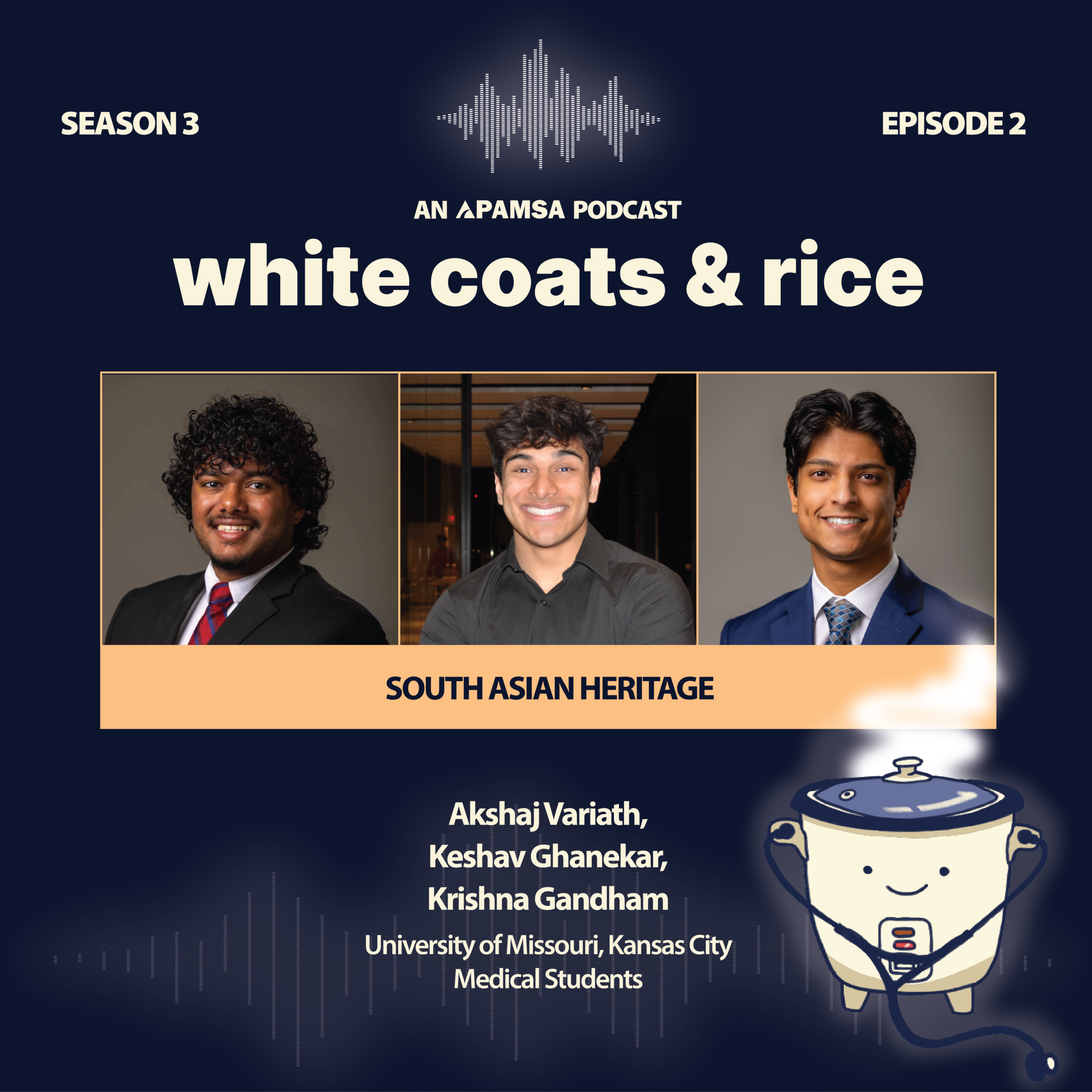
Welcome to Season 3! This episode of White Coats and Rice features Akshaj Variath, Krishna Gandham, and Keshav Ghanekar, three South Asian medical students at the University of Missouri-Kansas City. In celebration of South Asian Heritage Month, the panel reflects on what being South Asian means to them. They also share their journeys into medicine and other paths they considered before committing to UMKC’s accelerated six-year program. The guests dive into how their communities shaped their upbringing and how they serve as role models in medicine for the younger generation back home. The episode highlights how important their culture is in their lives as they navigate medical school.
Listen here:
Spotify
Apple Podcasts
YouTube
This episode was produced by Grace Kim, hosted by Herbie Villaflores, and graphic by Romi Sheng.
00:08 — Introduction to the episode and guests
00:50 — Why medicine
02:30 — Why UMKC
05:00 — Community’s Influence
06:01 — Keshav Ghanekar
06:28 — Keshav’s Why Medicine?
08:12 — Community Influence
10:24 — Impact on younger community members
15:33 — Being South Asian at UMKC
19:39 — Advice for Younger Generation
23:10 — Fun Qs
00:08 — Introduction to the episode and guests
Herbert Villaflores: Welcome everyone to a new episode of the APAMSA podcast. From roundtable discussions of current health topics to recaps of our panels with distinguished leaders in the healthcare field to even meeting current student leaders within the organization. This is White Coats and Rice. My name is Herbert Villaflores, and I’m an M1 at the University of Missouri, Kansas City, and a current national podcast committee member at APAMSA. I’ll be your host for today. I’m here today joined with two of my fellow medical students.
Akshaj Variath: My name is Akshaj Variath I’m from Saint Louis and I’m a current M1.
Krishna Gandham: My name is Krishna Gandham and I’m also an M1 and I’m from the Kansas City area.
00:50 — Why medicine
Herbert Villaflores: This month’s theme is South Asians in medicine. So I’m gonna start with asking them how they came to their careers in medicine.
Akshaj Variath: So I kind of had a semi interest in medicine in middle school. You know, I knew it was a field that I was definitely considering. And I didn’t really solidify that interest until high school, where I started shadowing more, started seeing what doctors were actually doing. And I think one experience that really solidified it for me was I shadowed at the JFK clinic at Mercy in St. Louis and It’s where they serve like impoverished people who don’t have health insurance or have very bad health insurance, or could be immigrants, stuff like that. And kind of just seeing the help that could be provided and the help that I could do in the future kind of more or less inspired me to go into medicine.
Krishna Gandham: I actually started off being surrounded by my parents who were involved in engineering. My mom was a professor at OSU, so I spent a lot of time seeing what She was teaching her students. So I actually grew up thinking that I wanted to do engineering or something involved with technology. And then I got older and realized I wasn’t as big of a fan of the whole computers thing and like physics and all that stuff. So I moved on to look around at the world. And my parents really gave me the opportunity to discover what field I want to do. And one thing that really resonated with me growing up is my dad always saying health is wealth. and seeing some of the other health issues in my family, I knew that what I wanna do with my rest of with the rest of my life is to make other people’s lives better. And that’s why I decided to go into medicine.
02:30 — Why UMKC
Herbert Villaflores: With that, one thing about our program that is different from many other medical schools across the nation is that we come here directly from high school. So my next question is why did you specifically pick this program and what mentors or experiences helped you choose medicine at a young age?
Akshaj Variath: Well, I’d say the reason why I chose this program it’s kind of weird. Initially I actually didn’t even really want to come to UMKC. I had been interested in UMKC sophomore year. And I decided junior year, maybe I want to go with the traditional four and four, because I kind of was iffy about medicine at that point. And then senior year, I kind of just applied to see what would happen, got in. And honestly, I haven’t regretted it since I got here. But I’d say throughout high school, I heard both sides of it. I heard that the fact that it’s accelerated, you finish med school in six years, you don’t have to take the MCAT, that’s nice. And at the same time Going to traditional four and four is also a very valuable experience. And you know, you can gain a lot from both aspects. And so I mean it’s definitely important to consider both. But in terms of mentors, I wouldn’t say that I had any single one mentor. I’d say it was definitely a plethora of people helping me and guiding me towards, you know, where I am today.
Krishna Gandham: Yeah. For me, I think my decision in picking UMKC as Where I want to go for school, specifically for the six-year program, came down to really like, is this what I want to do for the rest of my life? And I know that’s a pretty tough decision to make in high school. I mean, we’re all teenagers, we’re all trying to figure out our place in the world. So at the time, I feel like it was a pretty big decision. But during high school, in my junior and senior year, I spent a lot of time interning and shadowing at the North Kansas City Hospital. And in there, I learned that. Being a physician isn’t about just knowing the body systems and understanding how to treat disease, but it’s about treating people and being another human to people and understanding what they’re going through, feeling their pain and making sure that you can do everything in your power that to ensure that they have a better life. So the second I got exposed to that, it was almost like a light bulb going off. And I was like, This is this is it. I this is what I want to do with the rest of my life. So at that point it felt like a no brainer. to go into something where it’s like I’m fully committed for the next six years.
05:00 — Community’s Influence
Herbert Villaflores: Okay, for my next question, since this is South Asian Heritage Month, did your community have any role in or influence in your decision to into choosing medicine?
Akshaj Variath: Honestly, so growing up and being away from my family, I have basically all my grandparents, cousins, aunts, uncles, they’re all in India. And so here I had my parents and my sister. And I think the biggest relief kind of growing up was the fact that there was another Malayali community in St. Louis that I could that could essentially, you know, raise me in the same way as being surrounded by what essentially was at that point my family. And honestly, I’ve met some of my best friends there. And even now, you know, I see whenever I can and, you know, we just have the best time. But so I’d say it was definitely wonderful having that community to grow up with and they were a big reason why I’m able to be where I am at now.
06:01 — Keshav Ghanekar
Herbert Villaflores: I’d like to welcome another member to the discussion. This is Keshav. He’s an M2.
Keshav Ghanekar: Hey guys.
Herbert Villaflores: Keshav a little bit about yourself. Where you from?
Keshav Ghanekar: Yeah. my name is Keshav Ghanekar I grew up in Quincy, Illinois. I transferred into the program. that’s pretty much about it, I feel like. Yeah.
06:28 — Keshav’s Why Medicine?
Herbert Villaflores: I asked the other members, how how did you find your path to medicine and why did you specifically choose this program?
Keshav Ghanekar: Yeah. you know, I think medicine’s been a part of my life for a very long time. Both my parents are physicians. So I feel like in that aspect, it’s always kind of been around, especially I feel like when you have a parent in medicine, it’s always kind of in the background throughout your entire life. but then I wasn’t really sure on medicine. I knew I wanted to do a specialty that really helped people. I was actually thinking law for a while. and then went from law to politics. But then one thing that I noticed as far as like some of those other professions besides medicine. Is that whenever you help someone in some of these other specialties, it feels like a lot of times another person kind of gets burned a little bit. Like if you’re a lawyer, if you help one client win your client win a case, someone else has to lose. Or like if you’re a politician, if you pass a bill, some funding gets cut, someone else is losing something. But then I feel like one of the very, like I think one of the gifts of medicine is the fact that it I feel like it’s a truly altruistic profession. Like when you’re helping someone, you’re not taking away from another person. So I think that kind of drew me into it. And then then once I had medicine figured out, I was like, what’s the point looking at other stuff if I know what I want to do? So then six year direct med program sounds pretty good. So yeah.
Herbert Villaflores: That’s a great story. Thank you for that input.
08:12 — Community Influence
Herbert Villaflores: Since this is the South Asian Heritage Month episode, did your community have any impact in you choosing medicine?
Keshav Ghanekar: You know I would say, especially growing up, my hometown, I was actually like in my grade alone. It’s like Quincy’s kind of a smaller town. So I was in my grade, I was one of three Indian kids. So there was a community there. It wasn’t as large, I think, typically, when you hear about South Asian communities, I like they’re not usually that small. But I would say that because it was smaller, there was more focus on each individual person. So I think there was definitely like Your typical sort of, like your friend’s kind of looking at medicine. Are you what what are you kinda looking into? Like that sort of attitude a little bit. And then I think it was kind of kind of like just kind of hinted at. Like they’re just like, Hey, like, what do you think about medicine? That’s kind of the it was a little hush hush, but yeah. I thought it was pretty good.
Krishna Gandham: For me, I was actually born in Oklahoma and I lived there for eight years and there was a very prominent Telugu community there. And it like that is honestly how I grew up. Like my parents raised me and I would spend a lot of time with my sister. And then every Sunday would be going to temple to go to class and pray and then as well as just interacting with the rest of the community. And one thing I really picked up is a a lot of our ideals was more altruistic and spending more time helping the other person. So there was a lot of food given out to people and a lot of donations and everything. That’s probably like one of the most important things I remember about growing up in my community. So it was always not forced on me, but I was always surrounded by people wanting to help other people. So I kind of grew up thinking that this is how all people should live. And I can definitely say that that influence – not only my career choice but how I interact with individuals on a day to day basis.
10:24 — Impact on younger community members
Herbert Villaflores: Yeah, those are some great reasons. my next question is after you’ve been in this program for a little bit, how do you see that your being in this program, it’s it’s it’s pretty competitive. And how do you think it’s affected the younger generation back at home, if any?
Akshaj Variath: well, so like as I was mentioning earlier, there’s a pretty decently sized St. Louis Malay group. And kind of like a big help to get into this program was that there were very few, I will say, but there were some people that were already in the program. They’d help me. You know, you you could reach out to them and they would provide their mentorship. And, you know, I’ve like I feel that I’ve also kind of put put that out there for like people in that same community, younger people. I put that same help out there. And so yeah, I think that’s
Best way that’s impacted them.
Krishna Gandham: I would say that I mean, we haven’t been here really that long. It time seems to fly when you’re just spending every day just going to class and just studying and then just sleeping and repeating. But it’s weird being the person that people ask questions to. Cause I used to be that kid that was like, Hey, what do I need to do to like stand out? Or like, is this what I should do? Is this even worth it? Is this what I want to do with the rest of my life? Do you find this rewarding? So having those questions being asked to me now as someone in the program, it it’s been a really interesting change. And I mean, most of the things I say are positive in regards to the program, but it’s been interesting to see how I’ve changed my mindset towards things because now I don’t Whenever somebody asks me questions, it’s no longer about how stacked is your CV, like how good is your resume. It’s more like, do you really have it in you to like commit to this? Cause at this point I truly believe that like I I’m I can say for sure I am not the smartest in the class. I’ve struggled multiple times, but I know I can get things done if I ask for help and I also like put my head down and just work on it. And if this is like really what I want to do, I know that I can succeed. So that’s been my new like outlook on this whole entire program is less how competitive are you? What’s your ACT? What extracurriculars are doing? It’s more are do you actually want to do this for the rest of your life? And that that’s been a big awakening. And I think that’s also made me appreciate the field of medicine a lot more.
Keshav Ghanekar: Yeah, so as far as like the impact of for people like back home, I think I was one of the first people actually from my hometown to get into this program. So I didn’t like know too many people involved in it. I think some of the neighboring towns had other people come in, but they were a lot older. So as far as impact I’ve seen, I know of people who have came after me in this program from my hometown. And I’m not saying that I had an impact on that, but I think maybe that generated an idea in their head. and people have talked to me about it, just kind of like looking interest in the program or just like med school in general. And then I think as far as I like to convey it, because I’m always a very like, what is the minimum you have to do for excellence? You know, sometimes, you know, people like to maximize excellence. There’s a minimum you can do and still be kind of Excellent. So I’m a very much in that kind of mindset. And for them, I tell them, like, you know what? I’m gonna be honest with you. I this is my outlook on the program. I think that if you’re a very driven individual, like you’re very, very much like you know the type of person, like you see them and you’re like, this person’s gonna go very far. I tell them that if they think if they don’t want a path that’s necessarily easier, but something that might be able to get them in positions that might have an easier access to then probably a typical four way, four year university, four year pathway is the better option. And then I think for other people, if you kind of know what you want to do and you want to get to it and you have interest that align with the school, I think I recommend the six year program. I tell them that. I think that’s the thing. Like for me personally, I think the six year was the best thing I could have done. And then for other people, I think, wow, they would have done insane in the four four. Yeah.
Herbert Villaflores: Yeah, that’s great. I think coming to this program it’s kind of non-directly makes you a role model for younger people back in your community, especially us being Asian Americans. It’s it’s kind of a a big thing to achieve success like this at an early age. And I think it’s interesting how you three have seen that in your own communities.
15:33 — Being South Asian at UMKC
Herbert Villaflores: My next question is going to be about how being South Asian has affected your experience at UMKC in college and how you found community or how your identity has affected you being in school.
Akshaj Variath: I would say being especially in the UMKC six year, it’s a predominantly South Asian community. I mean, from I think what the stats are, it’s like sixty percent Indian, you know, stuff like that. And so sometimes it can be a little hard to distinguish yourself, especially when there’s so many of these like South Asian groups out there. But I think the most important thing that I’ve seen is to be friends with like a diverse set of people. Like don’t be afraid to talk to people and definitely make those new experiences, which, you know, like, just say yes. That’s kind of what I’ve seen.
Krishna Gandham: But yeah, I can actually relate to you with my high school experience. I was one of two Indian kids in my class. And it was a class of 500. So a lot of us like we genuinely did not look into our own individual cultures that much. I can say that we kind of all like assimilated to like one common group. And I think there’s benefits to that as in We all got along, but then at the same time I lost a lot of the stuff that I was talking about earlier growing up in Oklahoma, that sense of community. So coming back to a place, as you mentioned, that’s predominantly South Asian, it it was really refreshing to see people who looked like me and understood where I came from and I could talk to about things that I experienced in my life and they’d be able to relate, if not just empathize with me. So that’s been pretty nice to have. And I other than talking to my parents in my native language, I really didn’t have anyone else to talk to. So it’s been nice to like see that. And our school does a really good job of hosting events that focus on just cultures in general, but for South Asian culture with it being such a predominant group, like things like Indus and stuff like that and chakra really shine light on the South Asian community. And I this is honestly something I haven’t experienced as a teenager. So experiencing it now is
a somewhat adult is refreshing and it’s honestly nice to feel like I’m part of something bigger.
Keshav Ghanekar: Yeah, I I agree with you as well, actually. I feel like leading up to before UMKC, I I mean, not even because of lack of trying, but just lack of people. There wasn’t a lot of I didn’t really have a lot of South Asian friends. And then even but getting here, it was kind of like a culture shock. It was like, whoa. Like there’s a lot of South Asian people here. And I think it took me getting used to, but I feel like right now where I’m at, I’m been I’m more in tune with my culture and I’ve been having more conversations about my like culture identity, what it means to be a South Asian, what it means to be a South Asian male in just, you know, today’s world. And those were questions that kind of I never thought were super important. But then since I’ve been reflecting on them, I’ve realized like this is something I haven’t really experienced before. So I feel like being in UMKC and having access to it, it’s a very, very, I’m very grateful for that opportunity. Cause I feel like it’s given me, it’s given me the ability to really explore my own identity and a part of me that, you know, I grew up with, a part of me that I haven’t been able to really share with other people. Cause I think there’s cultural things that
You can’t really explain, even if you have like a best friend who is from another culture or something, like you guys are you’re gonna be extremely close, but there’s some stuff just growing up that, you know, someone of your cultural background can relate to more than other people can. So I think that’s been a very interesting sort of coming from that similar similar background has been very interesting to see and seeing how that affects our conversations, our day to day and our ideals and values.
19:39 — Advice for Younger Generation
Herbert Villaflores: What advice would you give to a kid maybe five years younger than you guys who grew up the same way you did, maybe with not a lot of South Asian influences and is just honestly looking for some way to identify
Krishna Gandham: honestly, I think I I I feel like I’m I am blessed because coming into this program, I didn’t come in knowing that there was a a large South Asian community. I didn’t come because I could see other people like me. I came for what I wanted to do with my career, and this was just a beautiful thing that happened alongside it. So I wouldn’t actually say that I have much input on things to do, but now being a part of it and seeing what other people do to be part of a community is I would say opening yourself up to other people. And it doesn’t have to just be people in the same culture as you. And if you feel like you’re disconnected, it doesn’t mean that you have to go find someone who speaks the exact same language as you at home or anything. But just Talking like how Akshaj said, just like talking to other people and just surrounding yourself with a diverse group of people, you’re gonna learn so much more about the world. And at the same time, you’re gonna learn so much more about yourself. And I feel like that’s really helped me build my own identity. And I would always tell everyone to just keep an open mind because the more you learn about other people, the more you learn about yourself. And in the it at the end of the day, it’s a win-win situation.
Keshav Ghanekar: Yeah, I think my advice for someone younger is, you know. your cultural identity doesn’t have a defined point. Like there’s nothing saying like, if you’re Indian, you have to know this, this, this, and this. Your cultural identity is, you know, what you grew up with. And no one can tell you that you’re I one thing that I hate is whenever you hear terms like, you’re not Indian or like you’re whitewashed or something like that. And like, yeah, maybe to a degree, like that is the thing. But You know, your cultural identity is something that’s personal to you and something that you live and you identify with. So I just say, like, you know, understand your culture. Don’t be afraid to do things in your culture, but never feel like you don’t know your culture. Like you everyone has everyone has room to continue to learn more, but you are a part of your culture and don’t let anyone take that away from you.
Akshaj Variath: Yeah, I mean, I kind of grew up with a lot of South Asian influence, given that I grew up in like a bigger community with more Indian people. And so I can’t really contribute to that aspect of the conversation, but I will say that there are difficulties just growing up in a predominantly South Asian community because like they look at you more as like a s a checklist, you know, based off your achievements and your rewards, more than kind of your personality and experiences. But like coming here, I’ve kind of seen that, you know, there’s an algorithm for success. Like there’s a way to be successful academically, you know, do what you need to do, do your Ankis, get your research done, join the extracurriculars, you all that stuff. But then there’s like another side of it where like go out and have those experiences, you know, over the summer, still taking hard classes, but there was the World Cup, there was Fan Fest, there was all these other things that you could do. And so seek out those experiences and don’t be sheltered. I think that’s very important.
23:10 — Fun Qs
Herbert Villaflores: Thank you guys. Those are some great answers. to wrap up. I just have a few a little lighthearted questions. first first off, I’m gonna ask, what is everyone’s favorite restaurant in Kansas City?
Keshav Ghanekar: Ooh, you know, that’s tough, man. Shoot. you know, I’m gonna say my like the best restaurant I’ve been to, and I’ve been saying this to everyone in general, like just like in my life, was Anjin. Anjin was, is – I’ve been twice now insane. Like you gotta try it out. Just the way – like not just the food, but what like everything going into it, the atmosphere, everything. I think it’s a great date night spot. I think it’s a great solo spot if you’re like that. Like, all power to you. Also special shout out to Wagwan, the oxtail and the Jollof rice is phenomenal too. So yeah.
Krishna Gandham: I’m kind of a chud. I don’t really eat at restaurants like that. And I try to like cook as much as I can, but I will say that like Baramee’s is probably like one of the places I go to a lot. I love some pad thai and some tea. That’s my go-to. But up north, actually like around where I grew up. There is this place called Sahara Now and they serve some pretty good Indian food. And I kinda get the default like garlic non and chicken tikka. And I feel like it’s a pretty default take, but I mean it’s pretty good.
Akshaj Variath: Yeah, kind of the same stance. I don’t really go out to restaurants like that, but you know, late night get some pizza shuttle, something like that. Yeah, that’s I know what I prefer. But Baramee’s good. Aha in Overland Park, they serve some pretty good Indian food.
Herbert Villaflores: What are you guys’ hobbies outside of school?
Keshav Ghanekar: Yeah. So recently, one of our teachers started a medical improv group. I think there’s some members of it today. So, you know, that’s been really fun. Also recently been put onto rock climbing. Shout out to Ethan Nguyen that’s been fun. I also box, so that’s a lot of fun too. Just staying healthy. You know, it’s important to have hobbies, especially in this program.
Akshaj Variath: I mean, I enjoy golfing. I’d say that’s my biggest hobby, outside of you know, outside of school. besides that, did join the medical improv group. So that’s been fun.
Krishna Gandham: I think I’m the odd one out here because I’m the only person, I think, not in the medical improv group. So I should probably get on that. But I would say going to school in Kansas City has been really nice because it’s right in the middle of everything. It’s a city, but it’s not a big city. So you kind of get that personal feeling with everything. So you’re always trying new things. We had the World Cup come here, going to Fan Fest was super enjoyable. Going to Power and Light was fun. I know we all love the Chiefs here, I think. Right. Okay. What was that? So it I mean, just trying new things all the time. And then my other hobbies are I mean, I’ve been trying to pick up golf. I’m really not that good. And at this point it just feels like a money pit for me. But I’m gonna keep sticking to it. But my other hobbies are like snowboarding and soccer.
Herbert Villaflores: Well, thank you guys so much for joining me on the APAMSA podcast. You have some really great answers, and I look forward to the next episode.