

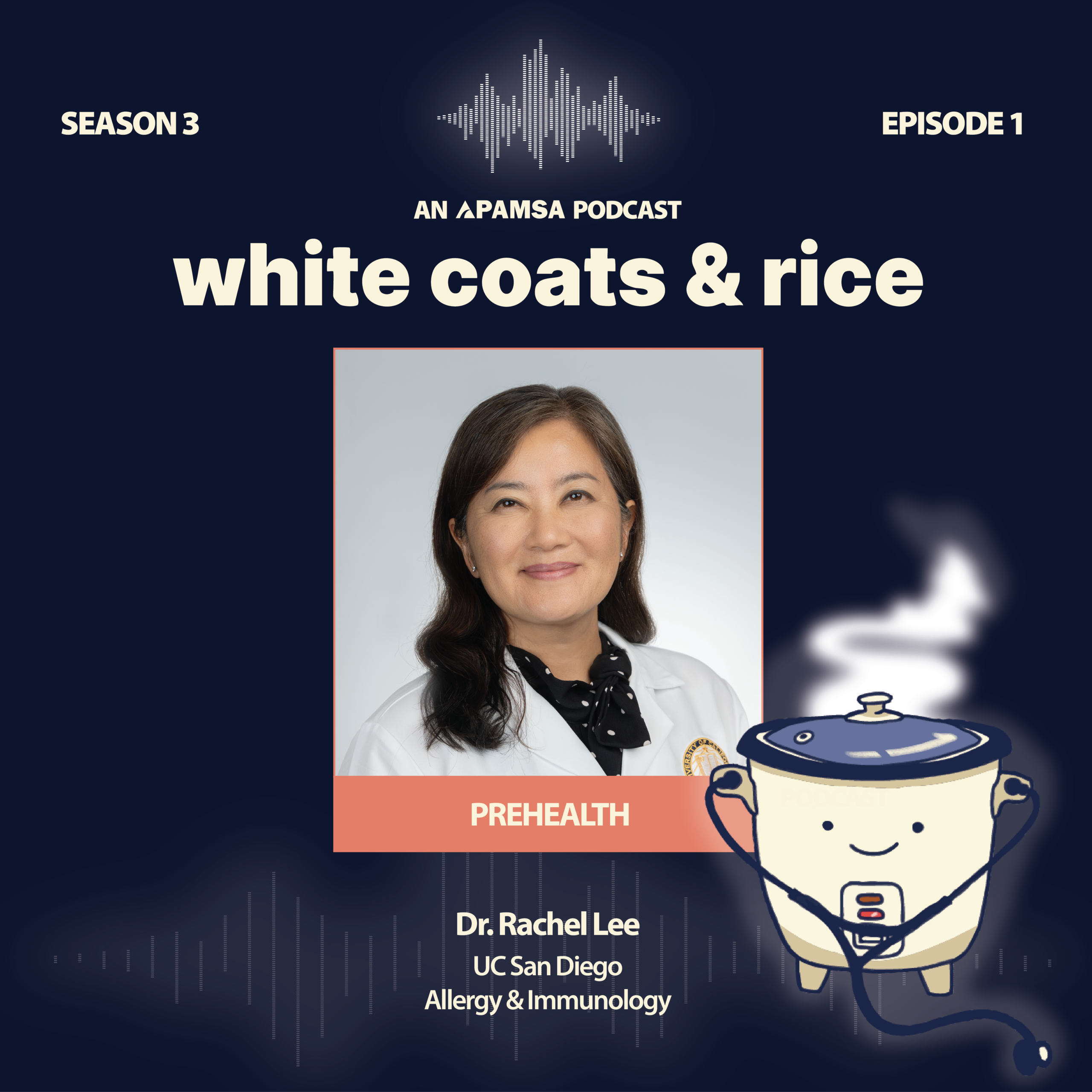
Welcome to Season 3! This episode of White Coats and Rice features Dr. Rachel Lee, a board-certified allergist, immunologist, and internal medicine physician who is a professor in the Department of Medicine at UC San Diego School of Medicine and a professor of medicine at the Uniformed Services University of the Health Sciences in Bethesda, Maryland. As a retired U.S. Navy medical officer, Dr. Lee reflects on her 20+ years in military medicine through the HPSP pathway, her transition into allergy and immunology, and her experiences balancing clinical practice with military leadership. She also shares insights on mentorship, resilience, and navigating identity as an Asian woman in academic and military medicine, emphasizing advocacy and support for trainees. This episode highlights her perspective on building a meaningful, adaptable career across service, academia, and specialty practice.
For listeners who would like to continue the conversation or reach out, Dr. Lee can be contacted at ral026@ucsd.edu
Listen here:
Spotify
Apple Podcasts
YouTube
This episode was produced by Grace Kim, hosted by Madeline Pan, and graphic by Romi Sheng.
00:07 — Opening
01:38 — What led Dr. Lee into medicine and HPSP
03:48 — How the Health Professions Scholarship Program works
07:05 — Branch options and different paths into military medicine
09:00 — What to consider before choosing military medicine
12:22 — Advice about purpose and preventing burnout
14:16 — Unexpected opportunities from the Navy
17:46 — How the Navy shaped Dr. Lee personally and professionally
21:14 — Choosing allergy and immunology
24:59 — Identity, bias, and navigating stereotypes
29:36 — Advice for women advocating for themselves
31:55 — Myths about allergists
33:45 — Closing remarks
00:07 — Opening
Madeline Pan: Welcome back to White Coats and Rice and the APAMSA podcast from roundtable discussions on current health topics to recaps of panels with distinguished leaders in healthcare to conversations with student leaders across the organization. This is White Coats and Rice. My name is Madeline Pan, and I am the Woman in Medicine Director this year and a fourth-year medical student at the University of Texas Medical Branch. I am joined today with one of my committee members.
Carolyn Vo: Hi, my name is Carolyn Vo. I am currently a second-year at Touro Nevada. We will be your host today.
Madeline Pan: We are really excited to introduce a very special guest for this episode, Dr. Rachel Lee. Dr. Lee is a board-certified allergist, immunologist, and internal medicine physician who started her medical school journey as a part of the Health Professions Scholarship Program. After completing residency training at Naval Medical Center San Diego and fellowship training at Scripps Clinic, she served for over 20 years as a medical officer in the United States Navy before retiring as a captain. Today she is a professor in the Department of Medicine at UC San Diego School of Medicine and a professor of medicine at the Uniformed Services University of the Health Sciences in Bethesda, Maryland. We are grateful to have you today with us, Dr. Lee. How are you doing?
Dr. Lee: I’m doing well. Thanks so much for inviting me to speak on this forum here.
01:38 — What led Dr. Lee into medicine and HPSP
Madeline Pan: Since we are filming this episode with the pre-health audience in mind, could you start by telling us what initially inspired you to pursue medicine and when did the Health Professions Scholarship Program, or HPSP, first come onto your radar?
Dr. Lee: Yeah, so I will say that when I was younger, this is way back before Google and social media, so back in the nineties when I was finishing college. I was really, you know, everybody goes through that journey of figuring out what do we want to do when we grow up, right? And I definitely wanted to do something in healthcare.
03:48 — How the Health Professions Scholarship Program works
Madeline Pan: For students who may not be familiar with the program, can you explain how the Health Professions Scholarship Program works and what it offers to aspiring healthcare professionals?
Dr. Lee: Yeah, so the Health Professions Scholarship Program is a military-sponsored program where they are training future medical officers. For medical school, they offer a full scholarship for all four years of medical school, and during that time you get a stipend for living expenses and they pay for all your books and supplies and everything.
07:05 — Branch options and different paths into military medicine
Carolyn Vo: Do students have preferences for different branches, or is it kind of like a self-finding journey about which branch?
Dr. Lee: Yeah. So there’s actually several ways into military medicine. Mine was before med school I applied and I got accepted before starting med school. Some people are already in residency and they realize they have all this debt, and they’ve actually joined during residency.
09:00 — What to consider before choosing military medicine
Carolyn Vo: For pre-health students interested in this program, what are the biggest considerations that they should keep in mind when deciding if it’s a good fit? And you may have already answered this previously, but what was the deciding factor for you?
Dr. Lee: So I think personally it was really just not having a huge debt at the end and just having that burden. But looking back and looking at current students and residents and fellows and kind of young junior staff attendings, I think everybody in medicine is very like probably type A personality. The military really will say they don’t really care too much about your plans. It’s mission first.
12:22 — Advice about purpose and preventing burnout
Madeline Pan: Looking back on your journey, what is the most significant piece of advice you heard as a pre-health student that has shaped your journey the most?
Dr. Lee: I think one of the biggest things that helped me figure out what I want to do and going into medicine and figuring out my career and various jobs that I’ve had along the way really is choosing a career where we can serve our community. I think that even though it sounds very obvious in medicine, there are a lot of people in medicine as you’ve probably seen that that’s really not the reason they choose it. But choosing a career that ultimately gives you a reason to get up every day helps prevent burnout.
14:16 — Unexpected opportunities from the Navy
Madeline Pan: I’d love to hear about some of your experiences in the HPSP program. Were there any unexpected opportunities or perspectives that came from being in the Navy that you would not have had otherwise?
Dr. Lee: There are so many, I don’t even know where to start. My whole family, my parents and relatives and all the people I knew, I never knew anybody in the military. And I didn’t know anybody in medicine actually growing up. But along the way, the military is going to offer a lot of opportunities that you just never even knew existed.
17:46 — How the Navy shaped Dr. Lee personally and professionally
Madeline Pan: How did your experience in the US Navy shape you both professionally and personally?
Dr. Lee: Professionally, I spent my entire early medical life in the military. So I did my internship, residency. I was an internist for a while and then I went back to fellowship and did my fellowship in allergy. The military is very big on education and they will pay for almost any kind of educational opportunity if you want it.
21:14 — Choosing allergy and immunology
Madeline Pan: I also really liked hearing about your personal life and different roles in your family. Your advice and your experiences are going to help a lot of students who are considering the program. So just to change the topic, I’m curious about your specialty. How did you decide on your specialty?
Dr. Lee: I knew nothing about allergy when I went into allergy. I had initially planned to go into infectious disease. But when I was an internist for a few years, I really wanted to be able to go home for dinner every night, or at least most nights. The more interesting thing was why some people got really sick from the same pathogen, whereas other people never got sick.
24:59 — Identity, bias, and navigating stereotypes
Madeline Pan: How has your identity as an Asian woman shaped your experience in medicine? How did you encounter stereotypes in medicine and navigate them?
Dr. Lee: Everybody has biases, right? We all have whether implicit or explicit. As an Asian woman, people didn’t always see a military officer or a doctor. I used to be very mad when I was younger, but now I don’t take it personally.
29:36 — Advice for women advocating for themselves
Carolyn Vo: With being in the HPSP program and the US Navy, what advice would you give to women in medicine advocating for themselves in environments where they may feel outnumbered or less represented?
Dr. Lee: Always making friends, networking, getting advocates, advocating for other people. I think all those create a network of people who will support each other. Ultimately you’re there. Fitting versus belonging. We belong wherever we are.
31:55 — Myths about allergists
Carolyn Vo: As we’re nearing the end of the episode, we had one more fun, lighthearted question for you. What is one myth about allergists that you’d like to debunk?
Dr. Lee: There’s a myth. But I will say several times when I’ve actually talked to other doctors and when they find out I’m an allergist, they are surprised. There are very few allergists out there, and allergy is a very small field, but it’s a great field if you’re interested in it.
33:45 — Closing remarks
Madeline Pan: Is there anything else that you might want to add before we end?
Dr. Lee: Well, I know we have very little time left, but I want to focus on one last thing: the four pillars of well-being in medicine and life — physical, intellectual, emotional, and spiritual. Keeping those in balance can help prevent burnout and keep you grounded.
Madeline Pan: Thank you so much for sharing. You gave us a lot to think about today, and I’m really grateful that I got to hear your advice and listen to your stories. And to our listeners, thank you so much for joining us for this episode of White Coats and Rice. Be sure to follow the podcast and stay connected with the APAMSA.
Dr. Lee: Yeah, so my I can send my email address to you if people want to send me an email if they have questions about HPSP or other things about allergy in general. So I’m happy to respond to emails.
Madeline Pan: Thank you so much again. I think that concludes the session. And to our listeners, we hope you’ve enjoyed today’s episode as much as we did. Thank you for tuning in and keep an eye out for future episodes. Until then, take care.