

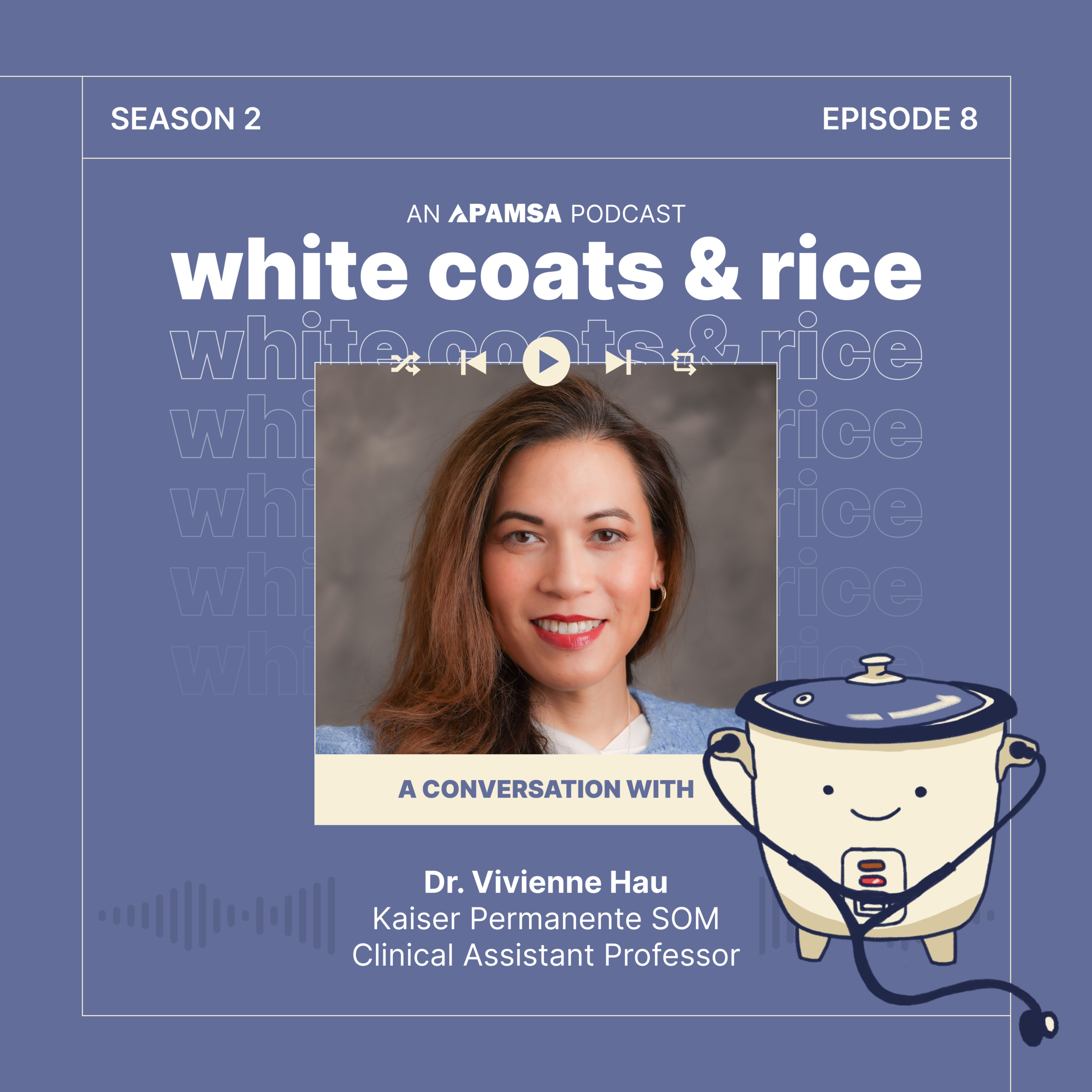
A Conversation with Dr. Vivienne Hau
In this episode of White Coats and Rice, APAMSA Podcast Committee member and host Kevin Gaw sits down with Dr. Vivienne Hau, a Clinical Assistant Professor at the Kaiser Permanente Bernard J. Tyson School of Medicine and a surgical vitreoretinal specialist, for a reflective conversation on leadership, identity, and legacy in medicine.
Dr. Hau shares her journey through APAMSA—founding her medical school’s chapter at the University of Arizona, serving as Region VII Director, and later leading the organization as National President in 2001—while reflecting on how student advocacy continues to shape her work as a physician and mentor. The conversation also explores Dr. Hau’s experiences as a transgender woman in medicine, her path into ophthalmology and vitreoretinal surgery, and her perspective on building a more inclusive and sustainable future for both patients and providers.
For listeners who would like to continue the conversation or reach out, Dr. Hau can be contacted at vivienne.s.hau@kp.org
Listen here:
YouTube
Spotify
Apple Podcasts
This episode was produced by Kevin Gaw, hosted by Kevin Gaw, and graphic by Callista Wu.
00:06 Introduction
03:08 Medicine, Career, & Growth
20:30 History in APAMSA
24:36 Leadership in APAMSA
34:33 Intersectionality: Transgender, Asian American, Physician
48:12 Advocacy, Leadership, & Reflection
59:59 Closing Remarks
00:06 Introduction
Kevin Gaw: Welcome back to White Coats and Rice, an APAMSA Podcast. From roundtable discussions on current health topics, to recaps of panels with distinguished leaders in health care, to conversations with student leaders across the organization, this is White Coats and Rice.
My name is Kevin Gaw. I’m a member of the APAMSA Podcast Committee and a first-year medical student at the California University of Science and Medicine in Colton, California, and I’ll be your host today.
I’m really excited to introduce a very special guest for this episode, Dr. Vivienne Hau. Dr. Hau is a Clinical Assistant Professor at the Kaiser Permanente Bernard J. Tyson School of Medicine and a surgical vitreoretinal specialist, where her work focuses on complex retinal disease and restoring vision through advanced microsurgical care. She has played a formative role in APAMSA’s history—founding her medical school’s chapter at the University of Arizona, serving as Region VII Director, and later becoming APAMSA’s National President in 2001!
We’re grateful to have you with us today, Dr. Hau. How are you doing?
Dr. Vivienne Hau: I’m doing very well. I just want to say I’m truly really honored to have been asked to be part of your podcast. And I love that fact that, what, almost a quarter century later, I’m still involved with APAMSA. I’m being asked to be a part of it. It’s something that is part of my own identity and is something that holds a very special place in my heart. So I’m excited to be here.
Kevin Gaw: I’m excited as well, and the honor is all ours.Thank you so much. And I know I gave a brief introduction for you. Is there anything else you might want to add to let our audience know just a little more about your background before we get started?
Dr. Vivienne Hau: Well, you pretty much encompassed most of it right there. You know, I can also add I’m on faculty at your medical school too—that’s how we had met. So thank you for you and your APAMSA local chapter inviting me to come speak. One of the newest medical schools in the country, and not too far from where I practice at Kaiser Permanente in Riverside.
One of the other things that I have a passion for is clinical research. I have an MD and a PhD, and my work is looking at the latest treatments and clinical trials for the treatment of macular generation and diabetic retinopathy, two of the leading causes of visual impairment in patients. And so I lead our largest clinical trials program at Kaiser doing things like gene therapy and stem cell implants for some of our patients as well. And then on top of that, as you know, I just love mentoring and helping out students. It’s increasing representation within our field through various, you know, diversity, equity, inclusion programs, or working with our LGBTQ communities and ensuring they have a voice and a platform that sometimes can get overshadowed, and just just trying to really make a difference in a lot of people’s lives. So, those are just some of the additional things that I really have a passion for.
03:08 Career, Medicine, & Growth
Kevin Gaw: Absolutely amazing and truly inspirational work. So I’m really excited for our audience to hear about you and learn more about what made you who you are today and what led you to where you are today as well. So, before we dive more into APAMSA leadership, I kind of want to get started on what initially drew you to ophthalmology, and specifically vitreoretinal surgery.
Dr. Vivienne Hau: Yeah, that’s a good question. You know, people often ask me, like, when did I know I wanted to become a doctor? You know, as far as I can remember, I’ve always wanted to be a doctor. And I think part of that is because my parents, they implanted that in my head and basically repeated it multiple times when I thought it was part of my own thoughts, but maybe it was just really their voice telling me what I wanted to do. I’m sure many of you guys can probably relate out there in APAMSA land. So anyways, but I was always drawn to science and non-fiction and all that kind of stuff. I was that nerdy kid in elementary school, always asking the teacher, “How do you do a bibliography for a nonfiction book?” because everybody else was reading fiction, nonfiction. Although I feel like in your generation, more kids are kind of nerdy like me back then. Back then in the 80s, there wasn’t too many like me. So I was always drawn to that and always thought it’d be so cool to do science and research and had an opportunity as a junior in high school to work in a NIH-funded lab at the University of Arizona, because that’s where I grew up, in Tucson, Arizona—University of Arizona, go Wildcats! Currently number one in the country in basketball, so going to go all the way.
Anyways, so I went there for, I was there in high school, got placed in a research lab, specifically in neuropharmacology, investigating drug delivery across the blood-brain barrier. Well, little did I know, that experience that summer as a junior would lead me to eventually become a vitroretinal surgeon. Those experiences in that lab, doing that type of research, I thought was just the coolest thing and always thought that doing more stuff in regards to the brain and neurobiology and all that stuff would be where I would want to do. And so when I eventually got into the MD-PhD program, I thought I was going to do neurology and I had it all planned out all the way until my third year of medical school. I was about to apply, it was like spring and then I had like two weeks of elective time and I thought, “What should I do?” Well, there’s this thing called ophthalmology. I didn’t know what the difference was between ophtho or optometry, but I thought there’s a lot of things in there about the brain, a lot of neurology. So I’m just going to go and do that and learn more about neurology so I can become a better neurologist someday. Well, I did that after the first day. I said, “Oh my gosh, this is my future; I found my tribe.” You know, your vibe attracts your tribe. And that’s basically what happened.
I just connect with everyone and I could do all the neurology I wanted to, but I could actually fix it too. And by working with my hands and doing the really high precision surgeries that I loved as part of my research doing small animal surgeries, extracting the brains of rats and mice and extracting the blood-brain barrier from the meninges and all that kind of work. You know, it’s very similar to doing surgeries within the eye because it’s very microscopic and high precision as well. And all my research that I did in blood-brain barrier drug delivery applied to the blood-retina barrier; there are a lot of similarities there. And in ophthalmology and specifically retina, I got to be the primary care doctor where I got to see my patients on a long-term basis. In fact, I get to see them more often than your primary care doctor because some of these patients have diseases where I’m literally seeing them every month and I get to know their families because a lot of them are hereditary as well. So I love that kind of primary care aspect for the eye that I get to do, these long-term relationships that I get to build with them. But I can also work with my hands and actually do surgeries and get to cure blindness in some cases. And how cool is that? Most patients, they fear getting cancer. Their second biggest fear is going blind, and I can actually fix them, for some of them, from going blind as a retina surgeon.
And then finally, in retina and ophthalmology as a whole, we get to work with a lot of cool technologies. You probably remember during my presentation to you guys, one of the coolest things is I get to shoot lasers out of my eyes, which is just one piece of technology that I get to do and how I can treat patients. And on top of that, I can apply all my research background to doing clinical trials within retina, because retina is one of the hottest areas of research. There’s a ton of companies that are supporting research and I get to be involved in all of those different aspects. And so that is how my story led to retina surgery.
Kevin Gaw: I love the passion and just the story of how you got to where you are, because especially as just an MS1 right now, trying to figure out where I want to be and where I want to go. It almost…it makes me feel like, you know, I don’t have to worry about it now. And like you said, your vibe is your tribe. Like what I find will find me and I shouldn’t worry too much because you’ll just ultimately come across what you need to and I absolutely love that.
I kind of want to ask as well, because you did mention you are MD-PhD—did you always know that you were going to pursue a PhD as well? And also, you are so passionate about all the research you do. And I kind of want to hear about what is the current research that you’re doing? Anything new?
Dr. Vivienne Hau: Okay. Well, in terms of the PhD, I got that first experience working in a research lab as a high school student. I thought it was so cool. And maybe I should consider it just a career as a research scientist. Well, I continued on in that same research lab. My mentor at that time, who still is today, Dr. Thomas P. Davis in pharmacology at the University of Arizona, gave me that experience to work in a lab and really show me how much of a difference I could make by doing this work in this lab, and how it could connect eventually to translational research and also in patients. But the problem is just working as a research scientist, it just stopped in the lab. Like I pass it on to others and others would take it on from there. I want to be part of the whole process. And plus, to be quite honest, no offense to my PhD friends, I could not see myself in a research lab surrounded by rats and mice all day. You know, I’d go crazy trying to talk to them when I was bored. And I’m just a very people person. I love connecting with just different people from all walks of life and learning from them, hearing their stories, and just the richness of the diversity of all the people that you see as a physician in the people. I just loved that. And so then I knew I didn’t want to give up the research because I loved that; it was fascinating. And I wanted to work with the patients themselves that I would eventually be treating. And so ultimately that’s why I combined the two and continued on as part of the MD-PhD program.
And I was very fortunate. My mentor helped me get into the program at the University of Arizona, where I stayed at for medical school. So I’ve been a Wildcat for 12 years—undergrad, med school, and PhD in that neuropharmacology lab. Now, I did give up working in a basic science research lab to transition to clinical research. And that was because I just, I really liked working in the clinics. I mean, I just wanted to spend the majority of time working directly with the patients and doing the surgeries. It’s kind of hard when you’re also trying to manage a research lab, and trying to chase down grants, and trying to support a whole team. It just wasn’t for me, although it is for a lot of other people and I certainly admire those who do do that. But I could still do research as a clinician through clinical research. And so when I had joined Kaiser Permanente, they had promised me that they would give me the support to build a program from scratch because nothing like that existed at Kaiser in the field of ophthalmology. And so through a lot of perseverance, blood, sweat, and tears, making a lot of connections and convincing people to believe in my vision for doing clinical trials at Kaiser, we finally were able to nab ourself our first study, which looked at a drug to extend drug delivery within the eye for macular degeneration. And so that taught us how to do trials and showed us, or showed the world and the field that we could do studies at Kaiser. And eventually from then on, it just kind of built and built and built. So now we’re doing some of the latest, most innovative studies that are only be done at mostly academic institutions.
So most recently, we implanted the 17th person in history with stem cells for geographic atrophy. It’s basically where advanced age-related macular degeneration lose their retina photoreceptors. And so we’re attempting to regrow those with stem cells. And we just implanted the very first patient at Kaiser, 17th in history, last summer. And I’m pleased to report the patient is doing well. When the patient came to us a couple months afterwards and had told us that for the very first time she was able to see her husband when she walked back into the waiting room from her visit, whereas before she’d always have to remind her husband, “Make sure you yell my name because I can’t see you when you’re waving at me.” For the first time, she actually saw him wave at him; that was incredible. And it’s just like advances like that that you’re seeing and that you’re involved in, that you’re able to maybe bring back vision that was lost, that’s never been done before in medicine. And here we are, we’re on the cusp of doing that. And what’s cool about doing stuff in the eyes is that it’s an enclosed space. There’s less chance for systemic side effects. So a lot of times these innovative kind of research has done first in eye diseases and then can expand out or teach us how we can apply it to other diseases in the rest of the body, as Dr. Glockenflecken would mention, body medicine. But I get to focus just on the eye itself.
And then finally, the other thing is we’re also heavily involved in gene therapy studies. We were part of three different gene therapy trials where we’re, again, for the first time in human history, we’re able to program the human body, the eye itself, to make its own medicine, to make a therapeutic that didn’t exist in nature before, but now we’re able to do it. That is just some really cool, fascinating stuff. And that’s why I love doing what I’m trying to do, what I do today as a clinician researcher, as a retina specialist.
Kevin Gaw: Thank you for sharing everything. I think one of the things that I love hearing you speak about is just, well, I mean, anything. And I think I remember the first time you spoke with us, I was in our master’s program and you were speaking about your career. And it was the first time I truly considered ophthalmology, just based on the way you spoke about it and the way you really… talked about the patients and the care that you provide. And I always enjoy it, especially the story like that you talked about with the research and, you know, bringing the sight back. It’s, it always like it gives me chills, honestly, like just hearing what you can do as a physician and a clinician and a researcher. And you get to see the…there’s like that average time of bench to bedside. I don’t know how many years, but you kind of get to see that as both the researcher and the clinician implementing that. So I think that is what is something so special about your career right now. And I really love that. So thank you for sharing that.
Dr. Vivienne Hau: Those are really kind words, but thanks for saying that.
Kevin Gaw: Of course.
Dr. Vivienne Hau: I have folks ahead of me, mentors, people that I’ve met that did that for me and so I’m happy that I can kind of contribute some of that to some of the folks in APAMSA.
Kevin Gaw: Thank you. And I know you kind of mentioned already some of your mentors that shaped your trajectory in your career in meaningful ways. Was there anyone else that you kind of wanted to give a shout out right now or played a big role in, in where you are now?
Dr. Vivienne Hau: Oh my gosh. There’s so many mentors. It’s, I mean, you think about it in life, you have mentors for different aspects about your life. So if you’re just talking about my career in getting involved in research, then I already mentioned Dr. Thomas P. Davis, who was a big, big person. Later on, when I got into residency, Dr. Kang Zhang, a retina specialist, helped guide me there. And eventually in fellowship, I had folks like Dr. Robert (Bob) Wang and Dr. Rand Spencer, Dr. Dwayne Fuller, Dr. Rajiv Anand, Dr. David Callanan, Wayne Solley—those are all folks that kind of helped shaped my career as a retina surgeon and doing more specific clinical trials within the retina field. Dr. Karl Csaky was instrumental in helping me do that and now I get to be on trials with him as well, which is pretty neat as a colleague, not just as a student or trainee.
But other parts in your life, APAMSA, for instance, I learned about the importance of advocacy through Dr. Art Chen, who was one of the keynote speakers for APAMSA way back when, when I was a medical student. I remember hearing from him and what he did with Asian Health Services and the contributions that he’s done for ensuring our Asian American, Asian Pacific American communities are not forgotten about on both sides of the coast and all the awards that he received. That was very inspiring for him to tell me stories about him growing up and along with Dr. B Lee, who was a co-founder of APAMSA, about how they wanted to inspire a new generation of medical students, Asian Pacific Islander American medical students that made sure that they were socially conscious, that they made sure that folks didn’t forget about them simply because they were a quote, “model minority,” that they were bringing up stuff that nobody had really talked about at that time when I was going through training about how a lot of Asian Pacific American students were, you know, very kind of quiet and, and just didn’t stir the pot a little bit or didn’t speak their mind because that was how they were taught. And Dr. B. Lee and the other co-founder for APAMSA, Dr. Jhemon Lee both taught me to make sure to not quiet my voice, to speak my mind and make sure you contribute just like my other, just like the other med student colleagues that were not Asian. Because in that way, people will see you, they’ll respect you more, and you’ll have opportunities for advancement.
So, I mean, all of them played such a large role. Dr. Anthony So also was on faculty at Duke, now at Johns Hopkins, also a strong person in advocacy. I learned how important it was to ensure that, to not forget about where I came from and to ensure to elevate those after me. And so that’s why I continued to stay on as a mentor through APAMSA with those folks.
And then other mentors, you know, I have to say my parents, they taught me the way. They were Vietnamese boat immigrants in 1975. They risked their life to come here to America. And I was born a few months later here. But I mean, to see what they went through, their hardships, but for the hope and support of their future child and their future family, I mean, doing everything for that and ensuring we don’t forget the loved ones and make sure we always support our family where we can and inspire them like my parents did for me. I mean, they were great mentors too. Same with my brother who I, even though he’s younger than me, I look up to him and everything he’s done and his contribution. So, so many different people. I could go on and on and do an entire podcast about it, but just a few.
Kevin Gaw: Yes, and thank you for sharing that. I love hearing about all the mentorship throughout someone’s life, you know, from childhood to career to everything. And I think, like you said, it’s very important that we acknowledge all of that and continue also everything that they taught us, like you are continuing to mentor and continue to just be a speaker and everything like that. So like now, and I appreciate you being here.
20:30 History in APAMSA
Kevin Gaw: You briefly mentioned APAMSA, and I kind of want to know, because you’ve held nearly…a lot of every leadership position, right? You were Chapter President, you went on to become a Regional Director, and then National President. So when you think back to that time of leadership, at any stage of that, what stands out the most to you?
Dr. Vivienne Hau: That’s a good question. I think what stands the most out of all…those connections, relationships that I was building back then would become such a valuable part of my life today, quarter century later. And how all those connections helped shape my career direction as well. You know, I just wanted to, when I got into medical school at University of Arizona, and I had been a pre-med at the same place, I really wished that I had some med students that I could reach out to that would be really open about showing me how I could get into medical school. So while there were some that were very helpful, but I wish there was something more, something that I could get involved in. And so I knew that when I got into medical school, that I would start the chapter or reinvigorate the chapter that existed. And so when I did that, I made sure to elevate those after me. And so that’s why we started the first pre-med chapter, well, we invited pre-meds to be involved. So today, what I was excited to see when I was asked to be the keynote speaker a couple of years ago, that there are some very strong and vibrant, even stronger than some of the med school chapters of pre-meds. And that really warmed my heart to see because that was something I just had a vision for when I was just a med student, wish that I had, and now it continues on today on a so much greater level. So that’s something I’m really proud of. But I didn’t realize how little things like that could make such a large impact on so many different people at that time. I didn’t realize how the people I was meeting at that time the Dr. Jhemon Lee’s and Dr. B Li’s and Art Chen’s and Anthony So’s would still play a large role in my life today. I get to hang out with Dr. Jhemon Lee here on a regular basis, just trying out some cool restaurants here in Southern California, because we live next to each other. And Dr. Jhemon Lee is like, he does this comedy improv and I get to watch him be this like really funny version of himself aside from his other life as a serious radiologist.
Um, but that all stemmed from those first experiences back then. And, and who knows, Kevin, maybe in 25 years, we’ll be hanging out, you know, sharing a boba or something like that. Um, uh, just talking about, you remember that time when you invited me for that podcast? So it’s just, the thing is, take in these moments and, you know, maintain those connections you have with everyone, because you never know where that’s going to take you. And it just only makes your life so much greater and grand when you build this network, some amazing people, because we all have a similar type of interest. We’re all here in APAMSA together because we all have a drive to do more than just, than beyond just becoming a doctor. We want to contribute so much greater to our community and specifically to our Asian Pacific Islander American communities.
Kevin Gaw: Yeah, I love that. And if anything, I hope earlier than 25 years, you know, maybe we will stay connected and grab boba and look back, you know, to the first time we interacted. And I think that would just be amazing. I also agree that everyone that you meet, whether small, like someone who plays a small impact or a large impact in your life, is in your life for a reason. And I feel like that is testament to what you’re saying. You’re still connected with all these people that you met because they came into your life for a reason. And that’s something I hold in my life as well. So I’m glad you said that.
24:36 Leadership In APAMSA
Kevin Gaw: In terms of your time as chapter president, I kind of want to see like how…when you were chapter president at University of Arizona, what were the challenges that Asian American or the Asian American Pacific Islander community was facing at that time, and how does that compare to, you know, the advancements that we may have made now today?
Dr. Vivienne Hau: You know, a lot of things that I, that we struggled with back then are still the same today. So probably one of the hardest things that we had to deal with—II was president in 2001, and 2001 is most notable for one major event that we think about and that affects a lot of the stuff that we do today. And that was 9/11. So I was president during 9/11 in 2001. And our national meeting happened to be in New York City. New York University, NYU, had won the national conference bid and they were planning…and I was working with them planning this amazing national meeting at NYU at the end of October. And then 9/11 hit, roughly about a month prior to the national meeting.
So well one, we had to make a decision. Are we going to still continue with this conference? If you guys weren’t aware at that time, we’re still trying to figure out what happened, you know, terrorism, we were still uncertain as to where the next terrorist act could be. Is the country safe now? Could we travel safely? Because remember, it was planes that flew. Would our membership be okay with getting on a plane, a plane a month later after the worst terrorist act to happen on the soil of US, and fly to a national meeting for APAMSA?
And so we decided, you know what, we would continue with it. We were still going to plan and go forth with it. Even if only two people showed up or a hundred people showed up or 400 people show up, it’d still be worth it for all those involved. And I’m so glad that we did. It was a powerful moment to go to the, to go there and to also visit, um, Ground One where everything went and to also understand how, as Americans and, and how we need to support each other in the face of adversity, like at that time. And what came from that though, was also how a lot of our darker skinned colleagues, especially our brown brothers and sisters, were then all of a sudden being accused of being terrorists, even though they had nothing to do…they had no connection with the ethnicity of some of those that were found to be involved with the terrorism act, but simply because they had a similar color skin and they were deemed as foreigners, even though they could have been born and raised here in America.
You know, a lot of our membership, our colleagues as part of APAMSA, we deal with that all the time. And that discrimination became very rampant right after 9/11. And so one of the things as the organization, we collected people’s incidences of racist acts and created a database that we could share with each other. And we found guidance and support within one another to let people know that even if there was nothing we could do about that individual act, at least they knew that there was a greater group somewhere that was willing to listen and that was willing to try to help and fight for them. And so that’s something that we also did at APAMSA. And unfortunately with today’s current political environment, a lot of that stuff has come forth. During COVID, a lot of Asians, in here, in the U.S. were targeted. And unfortunately, sometimes with violent acts as well. And today, too, you know, there’s a lot of, sort of this, even though all of us are Americans born, raised here, naturalized, whatever, but it’s just being put into question because we just look different from a certain minority of group that happened to be in our today.
So more than ever, those lessons that we had to learn back then are still needed today. But what’s important is that we are larger, we’re more connected, and we didn’t have the sort of national presence that we didn’t like back then. And our membership was not aware of things like we do today, especially the advent of social media. So I think from that standpoint, we were so much stronger than we were before. But those same issues are still happening today. They haven’t gone away.
Kevin Gaw: I agree. And I think that community, like you mentioned as well, is one of the most important things in all of this, you know, just banding together, putting our voices together and standing up for what we need to make a change. And, you know, now more than ever, especially like if we’re dealing with the same issues, it’s really important.
So how do you feel that your leadership in APAMSA maybe changed or helped you understand what advocacy in medicine meant?
Dr. Vivienne Hau: You know, seeing folk who were strong Asian Pacific American role models showed me that I could be like them. At first, I always looked at folks like that, advocates like the Dr. Chen’s and Dr. Lee’s of the world, that I could never do what they would do. But after I got to meet them and realize that we’re more alike and we’re different, that I could be a strong leader like them if I put my mind to it and and develop the courage like they did, which they fostered and supported in me, that I could make a difference like they did. And so because of that role modeling and the mentorship, that’s what I’m doing today.
So today I co-chair several diversity, equity, and inclusion programs. Of course, some of them we’ve had to change the name because of the divisive political connotations of some of those terminologies, but that’s what I’m doing today. I’m making sure that we increase representation within our various fields of medicine and also in other aspects of society to ensure that they’re not forgotten. And I also learned the importance of support with one another, not just a focus only upon Asians, but also those other underrepresented minority groups and banding together and supporting one another because there’s more power in numbers. That’s something I also learned from my mentors back then.
And then today, unlike back then, I was not openly trans. I was not openly a member of the LGBT community like I am today. I was still trying to figure myself out, even though I’ve always known this about me since I could just remember. But it was a hard time back then, you know, with the way society was and how people understood folks that were transgender and non-binary. And finally, I came to terms with who I was or who I am and became more open about it. And so today, I get to be an advocate for this community as well. And so I regularly do talks on supporting the transgender and non-binary community, also doing talks on supporting the LGBTQ community. And at that time, LGBTQ members for APAMSA were not as readily visible because I definitely knew that there were some and there was not it was also at a time when you know you could…you felt like you couldn’t do that because you might dishonor your family or something like that, whereas today, I’m so glad with the with all you guys in your generations, that you guys feel more safe to be able to live your authentic life that I wish I could have done back then. But today, at least I get to be a role model to some of you guys, because I didn’t have any back then. So I just had to become the role model that I wish I had. Just as I did as an APAMSA chapter president for the pre-meds, and now today, as an APAMSA alumni for the LGBTQ community. So I learned those first skills back then, and I continue to build upon them today.
Kevin Gaw: Thank you for sharing that, and thank you for just being a champion for the community, the APAMSA community, the LGBTQ+ community, just everything, all of your, like the intersectionality of all of your identities. I think that that was something that I always wanted to be growing up, having dealt with my own, the issues surrounding my own identity as well. And growing up in a family that wasn’t necessarily accepting. I’m technically not openly out with family, but I get to be as my authentic self because of everything that has come generations before, whether it be at school, whether it be just with my friends and just in the community. So I think…it’s just a great message and I’m just grateful for everything that has come before me. So thank you for that. Thank you for all the advocacy work that you do and continue to do—have done and continue to do, I should say.
34:33 Intersectionality: Transgender, Asian American, Physician
Kevin Gaw: And I kind of want to talk about those identities as well, the intersectionality, right? But first, I want to be mindful and kind of let you guide this part of the conversation in whatever way feels right for you. How do your identities as a transgender woman and Asian American intersect in medical spaces?
Dr. Vivienne Hau: Thank you for that question. But before I get started, I want to just commend you on being open and vulnerable on this podcast for all of our membership as well. That takes a lot of courage. I have to tell you, when I was a student and at your age, I was not as courageous as you. I know some of you may see me now, I’m on the podium, your former keynote speaker doing talks all the time, but when I was a medical student like that, there was still a part of me that was definitely afraid about others finding out about this part, this identity of me. And so I also, even though I’m older, I also learn and I’m inspired by the younger generations like you as well. So we’re helping out each other and it goes both ways. So thank you, Kevin, for sharing that.
Kevin Gaw: Thank you, I appreciate that.
Dr. Vivienne Hau: Now, your question again, you wanted me to kind of talk about how my various identities have come together and shaped me to be to do what I do today.
Kevin Gaw: Yeah, just how those identities intersect in the medical space and how you have encountered that, whether it be challenges or some new insights, new perspectives and everything..
Dr. Vivienne Hau: That reminds me of a story. When I was struggling whether or not to come out to try to live my life authentically as who I was, as Vivienne Hau. This was right around 2016. I just learned that the Trump administration had just been elected. And of course, as we all know, it’s very transphobic. And so the concern was that a lot of rules and things would change where I could not change my name or transition and things like that. And I felt like I needed to do this before it became too late because I knew I wanted to live my life more authentically.
And on a side note, the reason why I really wanted to do it at that time, aside from those political, because of the political situation, was also because of my daughter. When my daughter was born, I knew I wanted to be the best version of myself, the best role model I could be to my daughter. I made that promise to her when I held her in my arms for the very first time. And I realized that I could not be what I made that promise to her without being fully open and living authentically, showing her that the world will be okay and that she gets to know the real me, not this facade of what everybody wants me to be or thinks I should be. And so then I also came out because of that; I wanted her to know me as Vivienne, as a little child and watch her grow up as Vivienne as well.
So all that in combination inspired me to come out as an openly transgender woman. And when I was going through that process, a friend of mine who’s also Asian and had transitioned a few years prior to me had shared with me some advice. At that time, I was already holding some leadership roles with the American Society of Retina Specialists. This is the largest organization of retina specialists today. And my hope would be someday I could move up the ranks of leadership and be part of their board and executive leadership. And I shared with my friend, her name is Alison, I thought all those opportunities would go away, that maybe it’d be better if I just gone “stealth”. And for those of you that understand, stealth means some of us who are transgender, we transition into our authentic self. We try to hide from the world, you know, our former identity and all that and try to just play the role and not bring attention to yourself.
But my friend told me, “You know what, you could do that. And you could maybe try to continue on and build your opportunities and leadership within your field,” but she said “There are other people that can be a leader within the same society. There’s plenty of other retina specialists that could do a good job as well.” I’m not saying that they were better than me or whatever, but there’s others that could pick up that opportunity and do well. But she said to me, “There was only one person in the entire field, in the entire society, in your world, that can be an example of an openly transgender woman and teach them who the community is,” and that we’re not all those people that you see on TV or whatever the conservative politician is claiming that we are, that you could be a great representative of the field with a strong voice and platform that people will instantly respect because nobody can take away the fact that you’re an MD-PhD, vitreoretinal surgeon badass. And I was like, you know what, you’re absolutely right. I could make so much more of a greater impact if I was open about who I was. I could be a better role model to my daughter and incorporate that as part of my identity in my future leadership roles within the field of medicine and also to my patients as well because they’re going to meet somebody like me and some of them they have no idea. I’m very fortunate that it can pass for most part, but a lot of them do know because I’m open about it or maybe they knew me as my former identity, and now they get to know the real me. And so for a lot of them I’m the first transgender person they’ve ever met and I’ve changed their minds about our community just simply by existing. And also all the friends and family members around me too have learned what a transgender person is, and it’s definitely not what a lot of times social media or politicians say who we are. I can humanize what it means to be a trans or non-binary person versus all these people trying to demonize us.
So that intersectionality about being a vitreoretinal surgeon, clinician, researcher, who just happens to be transgender, I think a lot of times blows people’s minds and that I am not like anything they thought I would be. And so I feel like that’s part of the contribution and part of my mission and role in this world and part of my legacy to lead. And if I can share some of that also with APAMSA and the membership, then that’s fantastic because I don’t think there’s too many people like me here that can do that.
Kevin Gaw: And all of us truly appreciate just everything that you stand for and just being you and your authentic self. I think that’s just the most important thing and something I remind myself every day. And I just love hearing it from you because it’s just another reminder of how I should be living my day-to-day life and being able to just be me, right? Everyone has their own journey and whether or not they are ready to share it with the world, maybe they just need to hear another story. Maybe they need to hear another person and how they kind of combated that as well. And I know I’ve needed that growing up and in my childhood. So I really, really am grateful for you sharing that. It means a lot especially for someone who is part of the community and had a very similar experience having to deal with, you know, everything that’s going on in the world and maybe some family matters and just the the idea of not fitting in and the acceptance that you “need to seek or get from you know society.” So, thank you for that, thank you for sharing.
How do you think that APAMSA has supported, or maybe could better support transgender and gender diverse members?
Dr. Vivienne Hau: Well, you guys are doing a great job about it already and inviting me to come back. I mean, back in 2001, when I was National President, there is no way that I could have ever dreamt about one, being asked to be a keynote speaker, because the people we were inviting to be keynote speakers back at that time were, I just thought, these amazing people that I could never be on the same level. So, to be invited back to be a keynote speaker was a huge deal, but to be invited back as a keynote speaker because of me being who I am, living my authentic life, was such a special realization for myself. It came back full circle. I come back as a keynote speaker, but not as who I was back then, but as who I truly am today. And that is amazing for you guys to not just invite me to come back as a speaker in one of the breakout sessions where only, let’s be honest, sometimes when you do those breakouts, only the people, it’s like you’re preaching to the choir because only people interested or are going to go to that. No, no. You’ve put me in front of the entire membership and everybody, whether they liked it or not, had to listen to me and had to hear my story. And maybe I changed a few people’s minds at that time or maybe opened their minds, more likely. I know APAMSA is very progressive, so maybe more open their minds is more of an accurate term as well, but definitely move some hearts at the same time. That’s incredible that APAMSA did that on a national level. That says a lot about the progressiveness of APAMSA and has showed me that that sort of openness and inclusivity that Dr. B. Li and Dr. Jhemon Lee started back in 1995 continues on today into things which I’m sure they would have never have guessed and grow into, to become, it’s like their baby has grown into this amazing, amazing organization and so I love that.
So, you guys are already doing incredible things just continue doing what you’re doing. I mean I’m not sure what more that you can do. You’re inviting us, you have openly LGBTQ members. I think you have even a subsection, one of your former members, Dr. Michael Nguyen, who’s now an ophthalmology resident at Vanderbilt. You know, he invited me to do a webinar as part of the LGBTQ subsection. I was so blown away like, you actually have a subsection? That’s so cool! And he led that at that time. And now he gets to be one of my colleagues now as an ophthalmology resident. And I actually just invited him to be a part of the American Academy of Ophthalmology LGBTQ Executive Committee as well. So he’s working with me directly in trying to make the entire field much more open to the LGBTQ community. But he started there at APAMSA, just like how I started at APAMSA years ago. So you guys are really building and inspiring future leaders.
Kevin Gaw: Yeah, and that just goes back to the whole thing we talked about, like connections and kind of, I like to think of like the string theory of, I think it’s like a red string theory of like someone who’s in your life will continue to be there and you’ll always find a way back. And the impact that they made is there for a reason; they’re in your life for a reason.
Dr. Vivienne Hau: Absolutely.
Kevin Gaw: Yes, exactly. Like I said, I’ve heard your story, I think, probably three times now because I heard you speak at our school twice and I’m hearing it now and I’ve, you know, read articles as well. And I can, I will just say I can never, I always learn something new and I’m always so enamored and captivated by the story that you tell. Even if it’s the same. It’s just something that I truly enjoy and I feel like I…it’s just something about it I just always love hearing. And I think it’s really important and that’s why I wanted to share it with all of our audience and I just want everyone to get to know you in that sense.
Dr. Vivienne Hau: I’m giving you a virtual hug right now Kevin, and all of you in APAMSA-land.
Kevin Gaw: Haha, thank you!
48:12 Advocacy, Leadership, & Reflection
Kevin Gaw: And so now I kind of want to talk about, I know you’ve touched before about advocacy and we’ve kind of spoke about it as well previously. What does advocacy look like in your day-to-day work?
Dr. Vivienne Hau: I have always loved this quote, “Your existence is a form of resistance.”
It’s just living every day fully and unapologetically yourself and just doing the things that make the world go round and round. I mean, that’s a huge contribution in itself. And I want to remind everybody. That is an amazing form of advocacy too, just being yourself. For some people, they’re in a position where they are uncomfortable doing what I do or you do, or maybe they just haven’t gotten there yet in their life where they can do, or maybe they just don’t have the kind of support that they do. I mean I have it now so I can do it safely. I’m at an organization that I know that’s not going to fire me talking about this part of my life, so I feel very safe but I know not everybody has that. So, if all it is is just being you that’s good enough.
But in terms of further advocacy, if there are opportunities and you’re willing to kind of just maybe take a little step out of your safe zone and challenge yourself, you’ll find that there’s plenty of folks that will mentor you and support you and give you guidance along the way. Because you’re never alone, that’s the other part of it. Oftentimes we forget that. There’s always people out there that are willing to give you a lending hand. I found that myself too, as I got involved in my leadership roles, because there was always somebody that was willing to help me become the leader that I wanted to be, even when I didn’t think I could do it or I wasn’t good enough. There was always somebody there that was going to inspire me or help me get to that point.
Kevin Gaw: And I think I’ve had those encounters of trying to, you know, get out of your comfort zone. And that happens a lot in just anyone’s life. And I think it is just trying to push yourself past that barrier to find other people, you know, go out to wherever you need to go. And, you know, you will find other people there who are passionate about the same thing. And they might have more experience and they’re just there to guide you and then soon you’ll be the mentor for someone else. So, yeah.
In terms of just advocacy, I know you’re very involved for just a bunch of different things. So, how do you find that balance of, you know, being a mentor, being a clinician, being a researcher, and just avoiding this, like, how do you find the time for all of it, I guess?
Dr. Vivienne Hau: Yeah, it can be tough sometimes. And I have to be honest, I’m not always perfect at it. But it’s really important to prioritize those things that need to be taken care of and not lose track of that. And for most, that priority will be your family. And so, I always ensure that no matter what I do, that I always place my daughter first. And if some of the things that I do beyond that can somehow maybe help her life and make things a better place for her when she’s ready to take on some leadership roles or just kind of just grow into being the wonderful woman she will become someday, my 11-year-old daughter will have that. And so I have a passion for doing all this type of work because I feel like I’m ultimately contributing to what is the most important person in my life, and that’s my daughter.
And so that’s why, to me, a lot of this stuff is not like work. It’s actually just part of my passion, part of my goals, but I also have fun doing it. As you can tell, I’m a very extroverted kind of individual to kind of want to jump up there on the podium and speak. And that’s not for everybody but for me, it’s actually fun, like I volunteer for that stuff. So, I make time for that, I make it happen, and over time, you get to the point where it’s kind of like second nature. You don’t have to prepare for it as much. And so then it’s easier to do things like that because you no longer have to have to prepare so much for it. So that’s why it seems like I’m doing a lot but a lot of what I’m doing is just adding on or building upon things I’ve already done before, so it’s like second nature for me.
But you also have to learn to say no. I know that’s kind of cliché. But is it going to really bring you, at this point in my life, as I’m getting into the second part of my career, as my daughter is getting older, I know I only have a finite amount of time with her. There are certain things that I do just have to prioritize and say, “No, I can’t do it all.” And that is going to take away from those things that are most important to me, then you have to prioritize those things over you. And then finally, you need to prioritize yourself and your mental health. That is the most important thing, because if you’re not there for those others that you find that are really important, then you’re not going to be there completely for all of them. And so we never have time for exercise; we never have time for self-reflection; we never have time for meditation, but you have to make time for that stuff because that allows you to become the best version of yourself for those other things that you deem important. So that’s something I always have to constantly remind myself too.
Kevin Gaw: Yeah, and I also feel the same way of the, you know, I think a lot of pre-meds and even med students still face the issue of learning how to say no and not being able to balance things that you want to pursue, but then also, you have to study, but you also have to take care of yourself. So, I like that good reminder of, you know, learning to say no, prioritizing yourself and even prioritizing family first of a lot of things.
As we’re closing out, I kind of want to ask just like a little reflection regarding, you know, you were National President, you took a lot of like leadership positions in the past. So, for all of the leaders who came after you and everyone that is still to come, what guidance would you want to pass on in terms of leadership, whether it be in APAMSA or in a broader aspect?
Dr. Vivienne Hau: To always lead with both courage and care. While the work is urgent, the people are sacred. You need to protect the heart of the organization by investing in those relationships, listening deeply and making space for others to shine. You’re always trying to connect with others, but trying to build others at the same time and also understanding your limitations—don’t feel pressured to do everything yourself, but find the ability to build those teams. I remember one of the best pieces of advice I was always given was, the mark of a good leader is somebody who’s always fostering the next leader to take over for you. Trust those boards and colleagues and other leaders within the organization, that they will also be able to build something just as good and maybe even something beyond what you’re capable of doing that. And just remember that leadership isn’t about perfection, it’s about consistency, integrity, and showing up when you’re needed. And that’s the hardest part. It’s about knowing when to show up, about having that courage to show up and be able to speak up when others can’t. So those are the things that I want to ensure that are being passed on.
And remember, it doesn’t end once your term as a leader in APAMSA finishes; it doesn’t end when you graduate medical school; it doesn’t end when you become the doctor or whatever—it is a lifelong journey. And it’s okay to take breaks every once in a while. I did, because you never know, you just need to work on what you need to do for yourself. And when you’re ready, they will call you back and then you’ll be ready to serve. Just like what APAMSA has done for me most recently and you’re calling me back at the right moment when I feel like it can make a bigger difference for all of your leadership. If you had asked me 10 years ago, I don’t think I would have been as ready or be able to share the same kind of message that I’m able to do today. So, when it became time and I was ready, somehow the universe knew it was ready for me. Then all of a sudden I’m back and here I am.
Kevin Gaw: Thank you for that. And if you could speak directly to your younger self at the start of this journey, what would you want to say?
Dr. Vivienne Hau: It may sound a little cliché, but I think it’s very true, is that your biggest enemy is yourself. When I think back on my younger self, all the things which I had struggles with was my own self-doubt. And today, when I look back upon then and see what I’ve been able to achieve today, I would have never thought it was capable or even possible, but it happened. And that’s because I continue to challenge myself and try, and learn to not listen to that voice all the time that was trying to hold me back; that was basically the voice of fear. And just as an example, I thought that people would ostracize me, people would kind of forget about me once I transitioned and became an openly transgender woman. But if anything, people have elevated me to leadership roles and positions which I never thought were possible. It’s because once I became the most authentic, confident version of myself and was no longer scared about what other people thought about me, and I was no longer having all those self-doubts about what I was capable of, then I was able to kind of blossom and become who I am today.
And so I wish I had known that earlier. I wish I had recognized that as the younger form of myself, because I’m living the best life I am today. But if I could have started that journey 25 years ago, when I was APAMSA president, who knows what I could have been capable of doing today. If anything, I’d have a larger network of just some pretty awesome people that I’ve met recently. So that’s what I would tell myself.
Kevin Gaw: Thank you. And a great message and an amazing story is.
59:59 Closing Remarks
Kevin Gaw: Is there anything else that you wanted to add, or maybe we wanted to talk about before we end?
Dr. Vivienne Hau: I think probably the biggest message that I find that really helps with everything that’s going on today is, if you want to change people’s minds, you do it through their hearts. When you connect with people and you show them that you’re more alike than you’re different, then people see that likeness that you have in each other—that’s what they prioritize over your differences. They no longer fear you; they’re no longer scared of potentially who you are because you’re different from them. And once you find that connection, then I think people then learn to respect and love one another in ways which we’re currently not doing. So, rather than trying to chastise people because of their differences, trying to connect with them over your more similarities and likenesses. And so I think if all of us could do that more often in everything that we do, I think the world would be a better place.
Kevin Gaw: I love that, yes. And I think that’s just an amazing way to end this conversation for now. I hope that we continue to talk more in the future. Maybe have you on in the next season and the next season. I think you have so much to share and so much to offer and I know that there’s just always so much more to learn from you. So thank you, Dr. Hau, for being with us today and sharing your journey, all of the reflections with our listeners. I think that…your story is a powerful reminder of, you know, the impact that APAMSA and just community in general can have, not just during medical school, but across your entire career and your entire life. So thank you again for being with us today.
Dr. Vivienne Hau: Well, thank you, Kevin. I look forward to meeting with you again, you know, either through this podcast, but just, I warn you though, under one condition that the boba is on me, okay?
Kevin Gaw: Haha we’ll see about that. I mean, we’ll see in a couple years, right? But no, I will hold us to that boba.
Dr. Vivienne Hau: Sounds good.
Kevin Gaw: Thank you so much again. And to our listeners, thank you for joining us for this episode of White Coats and Rice. Be sure to follow the podcast and stay connected with APAMSA. Is there anywhere that maybe our listeners can reach you if you’re willing to?
Dr. Vivienne Hau: Yes, feel free to post my email address (vivienne.s.hau@kp.org). Anybody’s more than welcome to reach out to me, to connect with me. I’m still trying to figure out my plans for the national meeting in San Francisco. And so, hopefully if I am able to make it, then maybe we can connect over there. Plug for the National Conference in San Francisco, what was it, February 20th to 22nd?
Kevin Gaw: Yes, that’s correct.
Dr. Vivienne Hau: Right. So I’m sure, James Chua, right? He’s the president right now?
Kevin Gaw: Yes!
Dr. Vivienne Hau: Okay. Yeah. Shout out to James Chua and the National APAMSA leadership, in San Francisco! So maybe I’ll get to connect with some of you out there in APAMS- land individually there. If not, email me and we can always talk. I’m always happy to take any of you guys out for boba—there you go, the offers out there.
Kevin Gaw: Always making connections, that’s the most important thing.
Dr. Vivienne Hau: Sounds good.
Kevin Gaw: All righty, thank you again, Dr. Hau. and to our listeners until next time, take care.
Dr. Vivienne Hau: Take care, bye bye.


South Asian Health in Lens: Dr. Nilay Shah
In this episode, we welcome Dr. Nilay Shah, an Assistant Professor of Medicine at the Northwestern University Feinberg School of Medicine and Principal Investigator of the Mediators of Atherosclerosis of South Asians Living in America (MASALA) 2G Study. Dr. Shah’s work centers on strategies to preserve cardiovascular health in high-risk communities, particularly among South Asian Americans. Recognized for his contributions to clinical advancement and cardiovascular disease prevention, he brings deep expertise in cardiovascular health and the social determinants that shape it.
Listen here:
YouTube
Spotify
Apple Podcasts
This episode was produced by Nikitha (Nikki) Sheth, hosted by Nikitha (Nikki) Sheth, edited by Grace Kim, and graphic by Callista Wu.
00:00 Introduction
01:25 Dr. Shah’s journey into cardiology and South Asian health research
05:06 Introduction to the MASALA study
08:40 Moving beyond “why” in research
17:03 Personal connection to MASALA and community engagement
25:26 Understanding stress and its impact on health behaviors
30:39 Dietary recommendations and nuances
36:19 Common health misconceptions in the South Asian community
44:20 Advice for South Asian medical students
50:02 Closing remarks
00:00 Introduction
Nikitha: Hi everyone, welcome to APAMSA White Coats and Rice’s new series South Asian Health in Lens, or SAHIL, where we delve into critical topics in South Asian health ranging from advocacy to cultural competency with distinguished healthcare leaders. My name is Nikitha Sheth, first-year medical student and third year in the University of Missouri Kansas City’s six-year BA/MD program, and the current vice president of UMKC APAMSA and member of the South Asian Committee here at National APAMSA. And I’ll be your host for our SAHIL series.
For today’s SAHIL episode, we’ll be speaking with Dr. Nilay Shah, who is an Assistant Professor of Cardiology, Preventative Medicine, and Medical Social Sciences at Northwestern University Feinberg School of Medicine and serves as Principal Investigator of the Mediators of Atherosclerosis in South Asians Living in America, known as MASALA, Second Generation Study. Recognized for his contributions to clinical advancement and cardiovascular disease prevention, Dr. Shah applies his expertise to shed light on cardiovascular health and social determinants of health. Let’s welcome Dr. Shah. Thank you so much today for joining us, Dr. Shah. It truly means a lot to me and to APAMSA for you to take the time to talk about your experience with MASALA, which we will delve into, but also just how you’ve been a proponent for South Asian health, both cardio-metabolic, cardiovascular. I do appreciate you coming in today and talking about all of these important topics.
Dr. Shah: It’s my pleasure. I appreciate the opportunity and I’m glad to have this conversation.
01:25 Dr. Shah’s journey into cardiology and South Asian health research
Nikitha: Yeah, so we’ll just dive right in. I wanted to ask if you could just talk a bit about yourself to start off with and more about your journey and how it’s led you to become the leader you are today in medicine and especially being the principal investigator of the MASALA second gen study.
Dr. Shah: Well, that’s very kind of you and I appreciate the recognition. So I am currently a faculty member at the Northwestern University Feinberg School of Medicine in Chicago. I’m a practicing preventive and general cardiologist, and I spend most of my time on public health and prevention related research with a focus on understanding and intervening to address disparities in cardiovascular health and cardiometabolic outcomes experienced by populations that experience excess cardiovascular disease, one of which, of course, is the South Asian community and several other Asian American communities.
So this area of interest, I think, really started for me, like probably many people who are listening, with the experience of what their community went through as they were growing up. In my community, I grew up in the Chicago metropolitan area. And in the Indian American community in Chicago, as I was moving from middle school to high school and into college, the stories of people experiencing cardiovascular disease and its risk factors just became more and more frequent. People had heart attacks, people needed bypass surgeries, people needed stents. A lot of people experienced diabetes and some of the challenges with managing diabetes. It was such a common story. And so that was the context of what I had in mind when I went through my formal education as an undergraduate and into medical school.
And as a medical student, I started to gain experience in some of the research methods that I would come to find as foundational to the research that I do now. And actually, I should say, before that, I took a year, a detour, and I spent a year at the NIH working on research in neuroepidemiological outcomes with the National Institute on Aging. And that’s actually where the foundation of my research method training started. It was a lab that focused a lot on population level data. And it was my first foray into epidemiology and biostatistics, which would come to really set the stage for all of the research I’ve done since then. So after that year, I was a medical student and I concurrently studied public health and then went kind of through a more traditional route of training. I finished medical school and did a residency in internal medicine, followed by a fellowship in cardiovascular disease.
And then that’s where I really differentiated into a research-focused faculty member. And this area of interest really started by still having this experience of my community in mind. And every time I met a patient who was a young adult South Asian experiencing cardiovascular disease, the question always became why. Why is this happening in our community? Why is it always a young adult South Asian person when a young person comes in with ST elevation MI? Of course not always, but it was so frequently people from our community that it was compelling to try to understand the reasons for that disproportionate burden. And by the time I was in clinical training as a resident, I had had the opportunity to formally study epidemiology and biostatistics. And I realized that I could use and apply that research methodological training to answering questions about this excess burden of cardiovascular and cardiometabolic disease that was occurring in the South Asian community. And that’s really where my interest in this area of research started.
05:06 Introduction to the MASALA study
Dr. Shah: So when I finished my medicine residency and became a cardiology fellow, I was fortunate to match at the fellowship program at Northwestern in Chicago. And that, as your listeners may know, is one of the sites of the MASALA Research Program. So MASALA being the Mediators of Atherosclerosis in South Asians Living in America study. It’s a community-based cohort study that started in 2010 and recruited participants from two sites, one in the San Francisco Bay area at UCSF and one in the Chicago metropolitan area at Northwestern. And I was able to begin my collaboration with the MASALA Research Program as a fellow at Northwestern and developed several research projects that through which I was able to apply my prior experience in epidemiological methods and coding of statistics and statistical programming.
That led to kind of a decision that I wanted to steer my career to be a heavily research-focused career. So after I finished my clinical training, I did a two-year postdoctoral fellowship funded by an NIH F32 grant, focused on understanding some of the social network mechanisms and how they influence cardiovascular health in the South Asian community. And that was in the MASALA Research Program. And that really kind of set the ball rolling for a series of grants and research experiences that really deepened my interest in this area. This whole research program that I’m now working on and leading started with my community and it started with my experience in adolescence and into young adulthood. Because so many people in my community, in our community, have experienced heart disease, it was really compelling to try to understand the prevention aspect. And so that’s really kind of where this whole thing started. And it’s a bit about my journey.
Nikitha: That is truly an amazing journey of yours to see how you’re growing up in the Chicago suburbs and being surrounded by South Asians and the type of health struggles they have faced when it comes to early onset, especially when you talked about seeing young South Asian patients today with MI and other problems. So it’s truly amazing to see how you’re able to apply your previous experiences into your values today and why research is so critical in these aspects, especially in preventative care and understanding the why. So I completely resonated with that story because from my perspective, I’ve also grown up in the Chicago suburbs and coming from a more diverse community, we had a more Asian minority. And so I felt more compelled to advocate and think about Asian health and contribute to that in my community, as well as absorbing other cultures as well. And so to hear your experience about seeing those other people’s struggles and that aspect of their health, it means a lot because it shows that empathetic perspective that I think is also critical in medicine where people are telling you or you’re just simply by observing, seeing the different trends and to have that tied into research, I think the question of why and having that innate curiosity, that’s something that I share with you because wondering the reason why we see these health trends, it’s not simply treating the patient or just seeing these situations and saying, okay, there’s not much we can do about it. By digging further and understanding why is this happening, what trends do we see in certain underrepresented communities can give us a much more open-minded perspective that we can directly integrate into patient care. So that’s a truly amazing journey. I appreciate you sharing that.
08:40 Moving beyond “why” in research
Dr. Shah: Yeah, of course. And I appreciate your reflections as well, because I think a lot of people, a lot of people in our community have had a very similar experience. And I meet trainees who are South Asian and Asian American identifying all the time. And when I share my experience in the community in which I grew up and my journey, I think a lot of people hear a lot of echoes to their own experience. And so it actually is helpful and important to know that my experience was not actually unique and it lends a lot of credence to the importance of the work we’re trying to do.
And I would say that as a researcher, and I imagine I’ll be wearing my researcher hat for a lot of this conversation, one of the things I’ve learned is to move beyond why as a researcher. Because the first question was why, just as you alluded to, why were these trends happening? But I’ve learned that as a researcher, there’s so much more that comes after digging into this question. You know, when you have a sense of why, the next question is what do you do about it? And not only what you do about it, but how do you do it? And is what you do actually effectively going to move the needle to improving health and health outcomes for communities that you’re partnering with for your research? So there’s quite a bit of work to be done in this space, but it certainly did start with trying to answer the question why.
Nikitha: Yes, absolutely. I completely agree that why is kind of that starting point and to know how you’re going to go from there once you’re digging, but how are you going to apply that? So that clinical application is what makes this all worthwhile because the whole point is to improve the quality of patient care or make patients feel more seen and represented and find ways to make them directly impacted by these findings. So that’s absolutely, I agree with that. And so leading into that, so you talked about your experience kind of getting into MASALA and now being a prominent leader in that study. So I want to ask a little bit more about your experience, about how you recently led the MASALA second gen study and how patients would typically get involved in the MASALA study and kind of the significance of joining a study so that people who are listening can understand kind of the reason why people may want to participate in these and kind of the benefits that we can gain from it?
Dr. Shah: Yeah, that’s a great question. I think it actually has several different types of answers, one of which is for the trainees who may be listening with respect to how one might get involved or lead similar work for their own communities or get a research career off the ground. And the other, I think, is more from the community and patient perspective and how they might get involved. And maybe the third bit is what we do with the information that we get and what it means to be a research participant.
I’ll be brief about this first part, but for any trainees who are interested in starting a research career, I’ll very briefly share how that occurred. So as you alluded to, I am the principal investigator of the MASALA Second Generation Study. And to give you just a little more detail, the MASALA Second Generation Study is a cohort of young adult South Asians and the main eligibility criteria for participation in this cohort is that their parent participated in the original MASALA study. So it’s an offspring cohort. We enrolled the young adult children of original MASALA study participants with the overall goal of trying to understand what are the characteristics of the early development of poor cardio metabolic health in this community? What are the reasons why people are starting to develop high blood pressure and high cholesterol? And what are the underlying factors that drive the development of diabetes at a young age?
The reason I was interested in this young adult community in the South Asian population was because epidemiologically we know that people on average experience heart disease at a younger age compared with other groups. And so I was interested in understanding what was going on in young adulthood that we might actually see as an intervention point to help promote health and prevent this trajectory to heart disease.
Dr. Shah: And so the MASALA second generation study so far and to date has been funded by a K award from the National Institutes of Health. If you don’t know, a K award is meant as a training grant. And so it’s a mentored research award. You apply as the principal investigator, but you have to apply under the mentorship of a more senior level investigator. I was lucky that the principal investigator of the original MASALA study at Northwestern, Dr. Namrata Kandula agreed to be my mentor for this, and so I applied for the grant, but she helped prepare this NIH grant and she had quite a bit more experience applying for NIH funding. And so we wrote this grant and it was luckily funded. And so we had funding to start the MASALA Second Generation Study.
From about 2023 to just earlier this year, early 2025, we enrolled a pilot cohort of this offspring study. And the idea is that we eventually will hope to expand to enrolling as many of the adult children of original MASALA study participants as we can. The first stage only enrolled about 120 participants, but it provides us really valuable preliminary data to apply for greater funding, a greater pool of funding for research. And it was amazing. The offspring participants were so activated and engaged to participate. And I think it’s because their parents participated in and encouraged them to join the research study. You know, research has this, participating in research has this really amazing ability to make people more aware of health and what contributes to health and what might threaten health. And the MASALA participants are no exception.
A lot of them came to participate in the MASALA study without a lot of knowledge about heart disease or what the risk factors are, how to prevent heart disease. And simply by participating, having their risk factors checked, getting health education information through their participation, a lot of them were compelled to learn more and spread information about not only the research study, but information about health to their social context, including their children. So we were fortunate to develop this as an offspring study because it really made enrollment and recruitment into the study a lot easier.
Dr. Shah: This is a bit of a tangent or I suppose a bit of an aside, but the point to those of you interested in a research career is that so much of developing a research career does depend on the ability to obtain funding for your research. And we are in a bit of a challenging environment right now. To address your question a little more directly, Nikitha, we are not currently enrolling participants into any of the MASALA research programs at the moment because of where the funding environment is. That being said, the PI of the second generation study and the three PIs of the main MASALA parent study are all actively working on securing funding so that the MASALA research program can continue.
Institutions like the NIH recognize the importance of the MASALA study. That certainly has been our impression through all of the conversations we’ve had. You know, we’re all confident that the funding will eventually come through and the MASALA Research Program will continue because there’s a lot more insights to be gained and especially from a cohort study perspective as the cohort of individuals passes through time and grows older there are important questions to be asked beyond cardiovascular disease risk that are important with respect to aging in the South Asian community. So understanding things like risk factors for cancer and cancer health outcomes, risk factors for cognitive impairment and dementia. There isn’t a lot of population-based data to understand what the experience of some of these conditions are like in the South Asian community. And so, MASALA actually stands to be a really important resource to move even beyond cardiovascular disease and understanding health overall and the risk for a wide range of diseases in the South Asian community.
17:03 Personal connection to MASALA and community engagement
Nikitha: Yeah, I do appreciate your honest perspective, especially on that funding aspect and how you can adapt and kind of work around things and see how things can change over time and go from there. And so when you talked about the first and second gen and how second gen was the offspring from first and how it seemed that they were more motivated to partake in the second generation, mainly because their parents were involved and they’re getting their risk factors checked. So there is some benefit in participating. And I personally also had family who are community members that partook in the MASALA study. So from my own personal perspective, I could see my grandma, my dad taking part in going to a nearby facility and getting these things checked. And as a young South Asian child, it was truly moving for me to be able to see that there are programs out there that truly cared for our community and how it’s been ongoing. It’s a longitudinal type of thing where each generation is cared for and checked with the intent of looking into not only cardio metabolic health, like you talked about, but expanding it to other foundational aspects of South Asian health. So it is truly incredible what MASALA does. And I think it’s important that people understand the values behind it because it is a truly moving program.
Dr. Shah: Yeah, you know, that’s a really important point, because there are many, many cohorts of individuals that exist in the U.S. that are focused on understanding risk factors for cardiovascular disease. But this is the only one that includes and focuses on South Asian communities. And so the process by which the MASALA program started wasn’t simply adapting the infrastructure of a research program to enroll participants, but there was a lot of community engagement, conversations and partnerships with community members and adaptation of data collection instruments and the approach for recruiting and having people participate that really made the MASALA program as successful as it is.
And that credit, I think, goes to the original PIs, Dr. Alka Kanaya, Dr. Namrata Kandula, their teams at UCSF and Northwestern and the most recent site of MASALA, which is at NYU led by Dr. Nadia Islam and Dr. Naheed Ahmed. These researchers have put a lot of time into making sure that the research program not only helps us understand health and disease in the South Asian community, but that the program is aligned with the preferences and what is important to members of the South Asian community. So this is kind of more of a collaborative effort than simply being driven by researchers at an academic medical center. And so that’s a lot of where I think the values of the MASALA program come from, which is, I think, what you alluded to.
Nikitha: I agree that the collaboration that you can see with MASALA is, I believe, one of its strongest aspects because of that cross-institutional collaboration. You’re able to find data from multiple prominent cities and compare it. And it just shows a more unified approach towards a central goal of promoting health care and patient care in the Asian and the South Asian community across multiple age groups. So I do agree that that’s a very strong aspect of MASALA that should be commended.
Dr. Shah: Yeah, it’s been great. And I hope it’ll continue.
Nikitha: Yes, absolutely. So delving into the actual findings and your research experiences with MASALA and the types of things that have been discovered, you recently published an article on the effects of chronic stress on cardiovascular health, which highlights how elevated chronic stress could negatively impact cardiovascular health. So considering this key data point, what are some lifestyle choices that South Asian Americans can consider to promote their heart health?
Dr. Shah: Yeah, this was a particularly interesting study and I’m glad that you brought it to this conversation. And I think I find it particularly interesting because it was driven a lot by what we learned about the lived experience of being South Asian in the US, which is we and other researchers in the MASALA program have thought about what are the mechanisms that influence health behaviors in the South Asian community. And that kind of question was posed to community partners and members of South Asian communities. And one of the themes that emerged was that there was a strong belief that the experience of stress affected people’s health.
Now I’m guessing that doesn’t surprise anybody, but I think that it was a motivating factor to investigate how the experience of stress was related to cardiovascular health and cardiovascular health behaviors. So as you stated, this particular analysis of MASALA data showed that experiencing higher levels of chronic stress was associated with worse cardiovascular health in a cross-sectional analysis. And although this particular analysis didn’t delve into the question more specifically, my hypothesis would be that a lot of that association could potentially be explained by how stress influences health behaviors.
Now in the MASALA program, there wasn’t a lot of, for example, smoking behaviors. The prevalence of smoking was low in the MASALA participant sample. But one could imagine how more experience of stress might influence people’s smoking behaviors. Certainly the experience of stress might influence the quality of one’s dietary pattern. Absolutely, the experience of stress might influence the individual’s participation in exercise and physical activity. But there may also be some underlying biological mechanisms through which stress influences overall health, either through inflammatory pathways, being the one that comes to mind more immediately.
Dr. Shah: And so my advice, I think, with respect to this study is that if stress is particularly associated with worse cardiovascular health and cardiovascular risk factors in people who are South Asian, then I think that the approach would be to identify the stress mitigation techniques that work for you, work for you as an individual, which may help support more favorable health behaviors. And in the South Asian community, some of the things we’ve learned about stress and stress behaviors, stress-related behaviors, or I should say stress alleviating behaviors, can include things like mindfulness and yoga, can include things like spending time with social network members. And that avenue of intervention to mitigate the potential consequences of stress could lead to better and more favorable cardiovascular health behaviors and more downstream overall better cardiovascular health.
These are avenues that I think are of interest to potentially develop and test interventions to improve cardiovascular health. And I think a lot of the focus has been on mitigating the effects of stress rather than mitigating the stress itself. You know, when I meet patients in the clinic, I have to acknowledge that it’s not really feasible to eliminate the sources of stress altogether. People have to work, people have to go to school, people, there are stressors in people’s lives that are not really modifiable. So I think a lot of the conversation with respect to stress mitigation is moving from removing the source of stress when it’s not always feasible towards how best to mitigate the experience of stress.
And in the South Asian context, especially among older or immigrant South Asians, leaning heavily on their cultural experience, whether that is through different types of mindfulness and meditation, which can sometimes be part of people’s South Asian cultures and cultural practices and identity. Religiosity is sometimes a mechanism of alleviating the experience of stress. These are potential ways that the experience of stress could be mitigated to improve cardiovascular health.
25:26 Understanding stress and its impact on health behaviors
Nikitha: I appreciate you highlighting the nuance that comes with it because, just like you said, when you hear that stress can cause cardiovascular problems, that is not necessarily as surprising on a surface level. But I do agree that it’s really important to understand, like you were talking about, the nuance behind how stress itself may not go away, but how that can influence a day-to-day routine or someone’s habits and how they allow the stress to affect different aspects of their lives, which then can subsequently impact their cardiovascular health. So I do agree that the importance of finding ways to mitigate your stress and kind of focusing on the mental health aspect as well in the South Asian community, but also in general, finding ways to allow the stress to still exist since it’s not easy to eliminate it altogether, just as you said, but to work with it and allow for, like you said, mindfulness or yoga, which I think are some things I’ve noticed to be more popular in like South Asian community members that I’ve interacted with. Ways that you can kind of cope with the situation without having to feel any pressure to eliminate it because sometimes they will remain. But it’s how you can find ways to work with it and incorporate more mindful routines that can promote your heart health altogether.
Dr. Shah: I think that’s right. I think given this audience of people who are either clinicians or clinicians in training, I think actually one of the lessons I took away that people may find compelling is that when we do research like the MASALA program, we’re looking at a population or we’re looking at a community and we’re looking at trends within that community. But I think it’s really important to make clear the distinction between patterns that are observed within a community and what somebody might actually experience at the individual level. So although this research, studying this analysis from the MASALA data set, which includes nearly, I think about 1200 participants, showed us that the higher experience of stress was associated with worse cardiovascular health, that was among 1200 participants on average.
It’s important, I think, as a clinician to really meet your patients where they are at. And so if you’re sitting in front of a patient who identifies as a South Asian ethnicity, like Indian or Pakistani or whatever they may be, I think starting with open-ended questions and trying to understand an individual person’s experience of stress and what may or may not work for them to mitigate that experience is really the key to start. Being guided by some of these community and population level data is an important and great place to start. You know, again, I think we all really understand that everybody experiences stress differently and different kind of external inputs differently. So we can learn a lot from population level data and community level data, but we should also be mindful about making sure that we’re taking care of the person in front of us.
Nikitha: I completely agree. I think being able to apply the information that is found in research studies, so having informed care is really crucial, but to just look at the patient in front of you and let them explain everything that’s going on and just like you said, meet them where they’re at is so critical in order to become an empathetic physician and to find that intersection between your knowledge in research findings, but also applying that in a way that directly impacts the patient that you’re seeing with their specific concerns. So not to impose any other new ideas on them, but to understand what their values are, what their chief concern may be, and to use your knowledge to help them specifically of what they may desire, where they’re at.
Dr. Shah: Yeah, that’s exactly right. And I would imagine anybody going through clinical training will increasingly find that this approach will make sure that they retain their empathy and their patients find the advice given to be useful.
Nikitha: Yeah. And leading into that, so as you’re experiencing preventative medicine specifically, so based on your in-depth background on preventative medicine, are there particular universal pieces of advice that you would recommend to most South Asian patients based on what you’ve seen and experienced?
Dr. Shah: Yeah, that’s a great question. I get asked that question quite often, actually. And it’s because I think patients are actually increasingly aware of the research work that I do. I will often have self referrals to my clinic of people who are aware that I conduct research on South Asian communities or with South Asian communities to try to understand patterns of health and disease. And they’ll come to my clinic asking, well, what have you learned and what should I do?
And the reality is this, so far, most of what we should be doing is already known. We already know that we should be eating a healthful diet. We already know that we should be exercising regularly. We already know that we shouldn’t smoke or vape. We already know that we should get a good amount of sleep, and we already know that we should be checking things like blood pressure, cholesterol, and blood sugar. These things are universal to being a human being. What we don’t know is what are effective strategies to improve health behaviors in people who are South Asian, and what are the motivating incentives that may help people change and adhere to behavior change that would help set them up for healthful behaviors throughout their life course.
30:39 Dietary recommendations and nuances
Dr. Shah: There are some insights we’ve gained through the MASALA Research Program and other studies that have been conducted, primarily led, again, by my mentor, Dr. Kandula here at Northwestern, that would help address these. To be more specific about your first question or your original question: eating a healthful, a largely plant-based diet that is rich in fruits and vegetables and whole grains and low-fat dairy, moderating the quantity that you eat, having regular physical activity and exercise, not smoking, not vaping. These are universal recommendations. There’s a reason that clinical guidelines exist and it’s because we know that these things work and they work for everyone.
The nuances are how you achieve that. What is it that you can do in different communities that may have different life experiences to achieve these overall goals with respect to health behaviors? If that makes sense. One of the things that I find particularly compelling is the experience I think that is fairly common in South Asian communities that it’s a very social community. It’s very communalistic as opposed to other communities that may have a more individualistic spirit. And some of my mentors worked in the MASALA research program showed that the social networks in South Asian communities are particularly strong. And by social networks, I don’t mean electronic social network or social media. I mean, the network of people with whom you have social contact, very strong, very family centered, very much multi-generational and very much supportive of other people within the social network through a lot of different mechanisms of support, things like emotional support, just being kind of conveying support through one’s actions and words or instrumental support.
Examples of that can be things like driving a family member to the doctor’s office or working with somebody in your social network to kind of improve health behaviors together, like partnering with a friend or a family member and deciding to exercise more, exercise together. The potential role of social contacts and social support, I think, is particularly strong in the South Asian community. And so I’ve actually leveraged some of that in my clinical practice and in some of my research by trying to leverage these kind of strong social network structures and health behavior change. There are some active studies in development that leverage these principles.
But in my clinical practice, if I have a patient who’s South Asian who is making recommendations to make diet modifications or increase physical activity, I often will enlist the help of a support partner, whether it’s a spouse or a child or a friend who may be willing to help a patient do that at the same time. One example I can think of is a patient who came in who had previously experienced a heart attack, had a coronary bypass surgery, completed cardiac rehabilitation, but after completing the cardiac rehab program, their exercise participation was starting to fall off a little bit. And so I asked the patient to come into the clinic with their spouse. And together we came up with a plan that they both would start to exercise more regularly. And you know, it helped that the spouse was interested in doing so too, but the fact that they were willing to do that together, I mean, things as simple as going on walks together helped this patient be more active because they had somebody there providing support.
Now I’ll be clear, this approach is not necessarily limited to the South Asian community or being South Asian, but I do think that it’s a particularly effective approach for people who are South Asian and I’ve started to incorporate that more into behavior change. So the short of all of that is the things that we know work, work. And we have a lot of evidence to provide those universal recommendations to people who are South Asian or are not South Asian. But the nuances and the reason that our research program exists is trying to implement those recommendations in the South Asian community.
Nikitha: That is really interesting actually how you talked about, so there’s already measures out there that we know work, but I really appreciated how you talked about leveraging the values that you’ve noticed and are aware of, such as that social community and network aspect of South Asian communities. I think that’s a really mindful approach when it comes to being a physician and how you utilize that to help your patients be more motivated to promote their health, like with your patient for exercising. And even from my own personal experience, I would often see community members who are South Asian do things together or when you have a family function, there will be a lot of people of multiple generations that are living together or they will ask you how you’re doing with genuine interest. And it just shows that very social aspect in the culture. So I think utilizing that when it comes to patient care and keeping multiple family members in the loop, if the main patient is comfortable with that, of course, and finding ways to incorporate multiple people involved so that the patient is more motivated to keep doing activities that promote heart health or other aspects of their health. I think it’s a really unique but also mindful approach that people should definitely keep in mind and I know I will.
36:19 Common health misconceptions in the South Asian community
Nikitha: So going into our next question, based on your research findings and interactions with South Asian patients, so keep building off of that idea, what have you found to be more common misunderstandings about health?
Dr. Shah: Yeah, that’s a particularly interesting question. And I think that we’re increasingly learning that there do seem to be, so there certainly do seem to be misconceptions. And they seem to be a little bit generational, meaning in the older South Asian community, predominantly those who are immigrants. And I’m really kind of thinking about that community of people who are South Asian who immigrated in that wave of immigration between the 1970s and the 1980s. There certainly are misconceptions about health. And I think that they are very deeply rooted and I think they’re very deeply rooted in things like culture.
I think about even conversations with my own family and they’ll share a belief about something that should be eaten or some way to practice some kind of healthful approach to their lives. And they do that because number one, that’s kind of what they were taught to do or told to do. And nobody can remember where that advice came from, but it was just kind of more of like a, I mean, I don’t want to say lore, but it’s more just kind of like a norm of the community that this is how things are done. And so this is the way we’ll do it. And that often, I mean, I think about that a lot when people think about what they should be eating and what is considered healthy to eat. And of course, that kind of, those kind of norms and that experience experiences so much onslaught of information from things like social media.
And I am of the opinion that social media has actually deteriorated people’s understanding of health because not necessarily because people are putting bad information out there, although there’s concerns that like anybody can get on social media and provide information that isn’t evidence-based. But because there’s so much information people I think have information overload and don’t really know where to turn for actual accurate information.
Dr. Shah: So you posed the question, what are some of the misconceptions? I think one of the ones that I see most often is this idea that being vegetarian automatically translates to eating a healthful diet. And, you know, maybe those of us who are in clinical training or are clinicians readily recognize that that’s not true. But for somebody who’s never really thought about heart health or really thought about their health behaviors as it pertains to how it might influence things like diabetes or cholesterol or blood pressure or their risk for heart disease, I commonly kind of get the response when I ask about people’s eating patterns and eating habits, I commonly get the response, oh, I’m not worried about my dietary pattern. I eat pretty healthy and I ask them about it and they say, well, I’m vegetarian.
And then you start asking about what types of foods they’re eating. And of course, they’re invariably includes foods that one would probably not consider healthy. I mean, things that are fried in high in saturated fat, consuming high fat dairy products, a large amount of carbohydrates. And that’s one of the challenges I think of being vegetarian is that when you replace animal-based products with plant-based products, often what’s replaced is, or what is replaced is replaced with a high amount of simple and refined carbohydrates and sugars. And so it actually takes a lot of deliberate and slow health education to convey that vegetarianism and a healthful dietary pattern are not necessarily equivalent. And in many ways, a lot of people, especially the older immigrant South Asian community, in their mind, there’s an equivalency between being vegetarian and eating healthfully.
Dr. Shah: It’s a big challenge in clinical practice, I think, because most of us do not have nearly the amount of time that we’d like to have to take a really comprehensive dietary history and understand people’s diet patterns. And that is coupled with the fact that there is very little information available about, at least in the US context, how to make a South Asian dietary pattern healthy. I see like one-off examples. Here’s a recipe of a typical South Asian style dish, and this is a modification you could make to make it healthy. But short of following people to the grocery store, standing in their kitchen as they prepare food, or joining them as they go to a restaurant, it’s incredibly difficult to understand what people are eating and how to make modifications for health.
That’s coupled with the fact that there’s very little expertise available for people who are trained in nutrition and dietetics to refer people to. I mean, I know of just a very small number of people who are South Asian themselves and are trained as nutritionists and provide these kind of recommendations in a formal clinical setting to patients. That is a resource that is very scarce and it’s something I would love to be able to refer patients to so they can have a very extended and detailed conversation about understanding their dietary pattern where they’re starting and modifications that could be made to improve dietary pattern. It’s a big gap, I think, in our clinical care system, certainly for people who are South Asian, but probably for the entire diversity of the communities that live in the U.S.
And it’s important, I think, because when we look at the quality of people’s overall cardiovascular health, by far and away, by far and away, their diet pattern is the worst component of their cardiovascular health. You know, people participate in exercise, people take medications for their cholesterol or blood pressure, or they have kind of manage that through their other exercise and physical activity behaviors. But by far and away, people’s diet quality tends to be the worst component of their overall heart health and the most important avenue for change for cardiovascular disease prevention. But we have so little understanding and so little time in front of a patient of where patients are starting and how to counsel them appropriately and in an effective way.
So, you started this question about misconceptions and I think a lot of them that I’ve heard of in my own clinical practice and my research focus around healthy eating and dietary patterns.
Nikitha: I appreciate you discussing that in that level of detail because it’s very helpful to know that on a surface level when you hear that it’s about diet, people can understand that yes, a healthy diet is important, but how you delved into the how of multifaceted complexity this is where now in this day and age we have social media and the pros and cons of that, a con being that so many sources of content and information can kind of dilute what could potentially be the more accurate information for target audiences and coupling that with a physician or a trainee’s limited time with a patient to truly understand what their diet may look like on a day-to-day basis or where they may be lacking in certain nutrition and vitamins. And on top of that, patients who believe that just being vegetarian itself may be a more healthy approach, it’s really helpful to know that that in some patients could lead to more simple carbs being utilized instead of other aspects to substitute for animal products and things like that. So to understand that when you go a few levels more deep, there’s so many different factors that could be contributing to this, but overall to understand each one and keep that in mind when you approach patients is very helpful to know.
Dr. Shah: Yeah, it’s not easy. It’s important, but it’s not easy.
Nikitha: Yes, absolutely.
44:20 Advice for South Asian medical students
Nikitha: And so I guess this leads into kind of the final parts of our episode today. And so looking back on your experiences as a South Asian medical student, what advice would you give to current South Asian medical students as they’re navigating this period of their lives?
Dr. Shah: Well, that’s an interesting question. And looking back on my own experience, I think that my identity as an Indian American largely manifested through my clinical training in the type of work that I did, meaning the type of research that I was interested in pursuing and the directions I was going with developing my career. But I certainly must acknowledge that many, if not most people who identify as South Asian who are going through clinical training, this may not necessarily be their area of clinical interest. They may have an interest in it because it’s their community or it’s also how they identify. But I can imagine that there are many people whose research or clinical interests may be, don’t focus specifically on the South Asian community.
And I think that my advice kind of has to be the same because whether or not your identity as somebody who’s South Asian influences kind of the direction that your career goes in, I think the advice is universal, which is be flexible and be open to new opportunities. I think a lot of the opportunities and directions that I have chosen to pursue came trying to be as open as possible to the possibility that an opportunity that has arisen that may kind of change the trajectory of my career development is worth considering. I didn’t go into medical school planning to be a heavily research-focused academic faculty member. And I didn’t even go into medical school thinking that I was going to be a cardiologist.
You know, as a medical student, I really kind of bounced back and forth between different potential clinical training paths. I was interested in internal medicine for a while. I was interested in pediatrics. I thought about neurology for a while. You know, when I started medical school, I thought I wanted to do emergency medicine. I mean, I was so, it was kind of all over the place. And ultimately I did decide to do internal medicine, but it was because I think, you know, I went through my clinical training and I went through it with no preconceived expectation that I should necessarily pursue a particular path. And I think that’s actually why maybe my mind changed so much is because every time I had a new experience and it was something that I enjoyed, I started thinking about this potential career path.
And I imagine that there are students that are out here who know exactly what they want to do. And if that is you, that is spectacular. By all means, pursue your passion and your interest. But if you’re not sure, if you’re like me and you’re not sure, then be as flexible as you can. It’s advice that was given to me by one of my very first mentors in medical school and I’ve carried it with me to this day. He said, you know, a lot of potential different deviations off your path will present themselves. And just because it’s a deviation doesn’t mean that it’s not the right path for you. And so I’ve really tried to be as flexible as I can in my own career development. And it’s what led to me ultimately deciding to do a residency in medicine and train in cardiology and decide to do a research postdoctoral fellowship and stay in academia.
I think that’s maybe the most important advice that I could give anybody training in clinical medicine because it can be, it certainly is a time consuming path and it can be an unpredictable path. But if you are here as a medical student, you’ve already kind of done the work and thought about the direction you want your career to go in a general sense, but there’s so many more opportunities and you know, training in medicine is an incredibly versatile path. And so just be open to potential opportunities that may arise.
Nikitha: I think that is truly honest and very true advice, at least from my experiences so far. So I do appreciate your honesty and how you may not know right away what you want to do, but keeping an open mindset even now currently as a student, as you go on into your career, it opens up for so many opportunities to allow you to grow as a person, a researcher, if that’s what someone is interested, or just as a physician in general, but as your role in healthcare, it really creates a more cultivated mindset that you can apply to patient care as well as personal growth. So I think that is truly wonderful advice and also to channel your interests. So similar to you, I also have interest in cardiology but also neurology and it’s just a lot of different things that I like to expose myself to and I also have passions for research because I like to delve further into unanswered questions but also apply that to clinical settings. So it’s really nice to see how someone who has kept that open mind and channeled so many different interests and kept that drive going to pursue the research and the fellowships that you have done to see where you are today is very inspiring for medical students like myself.
Dr. Shah: Well, if any component of what I’ve done can be inspiring, I’m grateful to have had the opportunity to be in this position. So I appreciate that.
50:02 Closing remarks
Nikitha: Yeah, of course. And that was my last question for today. So I do appreciate you taking the time today, Dr. Shah, to kind of highlight so many important aspects from MASALA itself to your journey to where you are today, as well as research findings. It’s all very fundamental and critical information for people who are listening so that they can incorporate that into their mindset as they grow as if it’s just community members or if they’re medical students or even healthcare professionals. It provides a lot of honest and crucial perspectives that people should be aware about when it comes to South Asian health. So thank you.
Dr. Shah: It was my pleasure. I appreciate the opportunity to share and this was really a terrific conversation. So I hope anybody who’s listening really thinks about the direction they want to go and moves confidently in that direction.
Nikitha: To our listeners, we hope you enjoyed today’s episode and learn more about the beauty and nuance that is South Asian health in America. Don’t forget to tune into the rest of our series and until next time, take care. Thank you.
Pre-Health: Things I Wish I Knew Before Applying to Medical School
In this Pre-Health Series episode of White Coats and Rice, APAMSA Pre-Health Directors and hosts Angeline Yu and Ryesa Mansoor sit down with Livy Nguyen, a senior at Temple University currently applying to medical school, and Tiffany Trinh, a second-year osteopathic medical student at Rocky Vista University. Together, they share thoughtful and candid reflections and lessons from their pre-med and medical journeys: navigating tough coursework and finding mentorship to handling gap years, choosing the right school, and adapting to medical training.
Listen here:
YouTube
Spotify
Apple Podcasts
This episode was produced by Angeline Yu, Ryesa Mansoor and Kevin Gaw, hosted by Angeline Yu and Ryesa Mansoor, and graphic by Callista Wu.
00:05 Episode Introduction
01:09 Speaker Introductions
03:02 Finding Your Path to Medicine
04:57 Deciding Your College Major
05:48 Handling Difficult Pre-Med Courses
08:10 Extracurriculars
10:28 Reflections About the Med School Application Process
15:02 Finding and Maintaining Mentorship
21:13 Gap Year Experience as a Medical Assistant
25:45 What Surprised You About Medical School
28:21 Choosing a Medical School
33:38 Differences between College and Medical School
36:30 Closing Remarks & Advice for Future Healthcare Students
41:00 Outro
00:05 Introduction
Angeline: Welcome to another episode of the White Coats and Rice podcast, this time brought to you by APAMSA’s pre-health team. From roundtable discussions of current health topics to recaps of our panels with distinguished leaders in healthcare to even meeting current student leaders within our organization, this is White Coats and Rice. Today, we’re super excited to have a pre-health takeover. This episode will be hosted by me, Angeline Yu and Ryesa Mansoor, APAMSA’s 2025-26 Pre-Health Directors. My name is Angeline, and I recently graduated from Stanford University with my bachelor’s and master’s degrees, and I’m currently in my pre-med gap year. This is my fourth year with APAMSA, and I’m super excited to kick off this series as one of your Pre-Health directors.
Ryesa: And I am Ryesa. I’m currently a fourth year medical student at George Washington University School of Medicine, and I’m applying into pediatrics currently. And I am your other Co-Pre-Health director this year, along with Angeline. And we are joined today by two amazing guests who are actually from our own pre-health committee, Livy Nguyen and Tiffany Trinh. Thank you both so much for being here and talking with us on our podcast episode today!
01:09 Speaker Introductions
Ryesa: We’re going to get started with some quick introductions. Livy, we can start with you and then move to Tiffany. But if you both can just tell us and tell us and our listeners a little bit about who you are, where are you currently studying and where are you kind of at in your pre-med or your journey to medicine?
Livy: Yeah, I can start if that’s okay with Tiffany. My name is Livy. I’m one of the pre-health committee members. I’m also on the Southeast Asian Committee Board, which is really great. I’m a current senior at Temple University as a bio major, and I’m pursuing medicine. This cycle I’m applying right now, so I’m in the midst of it. But if not, I am preparing for a gap year if needed. And I’m the current president. This is my second year being president of the pre-health university chapter at Temple University. So that’s why I took a step further by joining the committee board, and I’ve loved it so far.
Tiffany: Hi, everyone. My name is Tiffany Trinh. I’m born and raised in Denver, Colorado. I’m currently an OMS2 at Rocky Vista University. I am also president of the regional APAMSA, or yeah, I guess the chapter in Region 7 APAMSA. And then I also heard that there were positions open for the National APAMSA as well. And so I was like, I really loved just being a part of just the Asian community and wanted to take that one step further and take it nationally and kind of bring awareness to everyone. And yeah, so I am currently almost done with my first semester of second year and we’re studying for boards, so that is not fun at all.
Ryesa: You are really in the thick of it. Well, thank you both so much for introducing yourselves and for taking time out of your very busy schedules to be here and talk to us today for this podcast episode.
03:02 Finding Your Path to Medicine
Ryesa: So we’re going to get started. And our first segment here is going to be more kind of starting from the beginning about finding your path to medicine. So we can start with you, Livy, since you are still kind of in the pre-health part of your journey to medicine. When do you or when did you first realize that you wanted to go into medicine, or was there a specific moment or experience that really sparked that interest?
Livy: Yeah, so fortunately, I do come from a family of a lot of free health professionals—ranging from physical therapy, pharmacy, nursing. My mom is a nurse and she works in the OR, so she’s been a great factor of that influence. And then my sister ended up going into medicine as well—she’s in her fourth year of medical school. So definitely them influencing and pushing and coming back home with just like the satisfaction of being able to give back every day and in the profession, I thought that was really inspiring.
In my senior year of high school, I was given the opportunity to do an allied health program. I was actually in the hospital half of my week for a whole year, doing many rotations, getting to experience all the different floors and departments of a hospital, which I thought was going to be the great finalizer—whether or not I really wanted to commit to this in college—and I definitely did; it definitely sparked interest.
I did an internship my senior year in the hospital that my mom worked out with one of her co-workers, who was a general surgeon, and I just absolutely loved the OR so much so I definitely thought like this is definitely something I wanted to do. I love the teamwork, I love the energy, and just the organization of everything, so I definitely think that sparked an interest as long as the influence from family and friends. So yeah, that was definitely something that I really wanted to do specifically in the OR too.
Angeline: That’s awesome that you were able to have so many early experiences and kind of looking at different pathways in order to really cement that interest. So it’s super cool that you found that really on.
04:57 Deciding Your College Major
Angeline: I guess like kind of following up on that, like once you enter college, how did you decide what to major in? Like, I know that you’re a bio major, like how did you kind of land on that?
Livy: Yeah, my sister was also a bio major at Temple University. I did go enter college as a biophysics major, but then I soon realized that if I wanted to do a work-life balance with also like social clubs and organizations, including APAMSA, I thought the bio department major was a really good track to, in order to allow me to have that balance and still commit to other priorities, such as like shadowing and volunteering and also, like I said, commitment to clubs. So I thought that biology would be the best pathway for me to do that.
Ryesa: Yeah, definitely. And that was really great that you kind of early on realized that and made that decision to really prioritize that work-life balance and kind of change your major to suit that.
05:48 Handling Difficult Pre-Med Courses
Ryesa: And along with your biology major, and I’m sure even pre-health students out there who aren’t necessarily doing STEM majors or doing other different types of majors, there still are the pre-med courses and the pre-med coursework that are required before you apply to medical school. And as we all know, those pre-med courses can be pretty brutal. I am looking at you, organic chemistry and biochem and physics.
So, Livy, I’d love to know, along with kind of prioritizing that work-life balance, what were some of your best strategies or study habits for handling those pretty tough, quote unquote, weed out classes like orgo or physics?
Livy: Yeah, I would definitely say if you would ask me, I would have definitely answered with orgo being that. When I was in high school, I did a lot of independent studying, keeping to my own course and study schedule. But once I started Organic Chemistry 1 and 2, I took it with the honors program and I took it with the same teacher that taught both courses back to back for my entire sophomore year. That was definitely the most brutal class I’ve ever taken in my entire academic career.
And I was so grateful—I thought the best way that I kind of changed my study habits, I made really close friends in those classes where we would stay up together and like using a whiteboard and studying together, utilizing all of our brains and combining them. I would be good at one topic and grasping it and I would be totally lost in another. And my friend would teach it to me in the way she thought it was best way to learn. And because sometimes professors aren’t the greatest as you know, teaching students that don’t really, have never heard of organic chemistry before. Everything I feel like for foundations of that is completely new to college students.
So I thought that being able to combine our work and our mindsets with other students and my friends, it really brought us closer together and also like, build a relationship, like very non-toxic, which I really, really appreciated. And I don’t think I would have passed that class without them. So yeah, I think it’s good to have independent studying, but also being able to work with other people is also just really great too.
Angeline: Yeah, I would definitely agree with that. I think having a community is really important, not just in teaching each other how to study, but also really supporting each other. And so I definitely really resonate with that. And thank you for sharing that perspective as well.
08:10 Extracurriculars
Angeline: So it sounds like obviously you are a very stellar student in the classroom, kind of life outside of the classroom. How did you kind of choose your extracurriculars? And I know that you’ve done a lot of like very like pre-med related extracurriculars, like shadowing and stuff like that. Maybe do you have any other like non pre-med extracurriculars that you decided to pursue? And what kind of those experiences teach you about both yourself and about medicine and like your future in that?
Livy: Yeah, of course. In high school, actually, I started in middle school. My mom actually put me, without telling me, into martial arts with my brother in hopes that we could build a better relationship with each other, and it definitely worked. So I did karate for almost eight years. And with that, I did start volunteering and working there as a high schooler, being one of the teachers. So I was teaching from the ranges of early as 3 to 4 years old to even adults or parents that decided to join afterwards with their kids. So I continued that and I loved working with kids. And then from that, I was inspired by my mom who eventually started working at CHOP at the Children’s Hospital of Philadelphia. So I started volunteering with them. Although that is technically pre-med, I mean, I felt like it was more like volunteering, just getting to know kids, not as just patients also.
And some other stuff, I did volunteer at my local arboretum. Growing up, my mom took us to a bunch of museums, gardens, and arboretums in the Philadelphia area, and I just loved it so much. So I went to my local one and during the summer time, I would just pot plants with them and weed with them. And I was definitely bringing the mean age down because everybody else was like above the age of like 65 and retired. But I just thought it was really good to, you know, give myself an opportunity to connect with my community, not just at my age range, but also those that are younger and those that are older, just to broaden my experience and really understand their perspective. I feel like that’s also really important for the health field, not just shadowing, like you said, or getting clinical experience. So I thought that those have definitely influenced my inspirations as being a physician too.
Angeline: Yeah, totally. And even being able to interact with people of all ages, I mean, you’re going to have patients of all ages as well. And so like kind of having those experiences, even if they’re not health care related, can help you so much in that future, too. So that’s really, really cool.
10:28 Reflections About the Med School Application Process
Angeline: And I guess now like that you’re kind of in the thick of application season, kind of like maybe what did what made you decide to apply this cycle versus taking a gap year, and also like how are you preparing for that medical school application and like anything you wish you could start earlier?
Livy: If I’m going to be completely transparent, I truly did get a lot of feedback from other med students, my sister included, and her friends to really push me to take a gap year. And I genuinely really wanted to. I do think gap years are really logical, give yourself a break from school because undergrad is really stressful and all of that. So I really wanted to take a gap year, but unfortunately, not everything can go my way. So like many others, which I assume my parents really pushed me to not take a gap year, they do think time is money. And they said they really influenced me to like if I have the confidence to do it now and I felt confident enough in my resume to do so or in my GPA and other things like that, they said it doesn’t hurt to try. And I’m very fortunate that my parents are supporting me financially and emotionally through this process. So I think that’s definitely other factors, but for people that are taking gap years or planning ahead of time, I would definitely encourage it. I think every type of pathway is different for everybody.
But yeah, I decided to pursue with that and applied to a few med schools that I thought was best suited for me, putting all my eggs into like, a few baskets instead. So yeah, I’m in the thick of that, like right now, like you said, and right now I’m trying to pursue osteopathic medical schools right now, influenced by my sister as well. So we’ll see how that goes. But yeah, that’s where I’m currently standing.
Ryesa: Amazing. Thank you so much for your transparency about that as well. And it’s kind of some of the decision process behind you pursuing a gap year or not. Similarly, I took two years off as my gap year. Angeline’s currently in her gap year, so I think over the years, it’s definitely become a lot more kind of of a normalized path to take that. And it’s more normal, I would say, even in my own medical school class. I would say a majority of people have more of this “non-traditional” path. So it definitely is really open for what people can decide to pursue before they make that decision into applying.
Livy, one last question for you before we move on to our next segment, but I would love to hear maybe some of your reflections or thoughts now that you are kind of in the thick of the application season. If you could go back and maybe change one pre-med decision over the last few years or even from high school going into college, maybe a class you took or maybe something that you were overstressed about that in hindsight, maybe you didn’t have to stress so much about or maybe how you approached a certain experience. What do you think that would be?
Livy: I would say like a lot of people told me the application process is very overwhelming and overstimulating. And I tried my best to not listen to that, but obviously it still got to me. And a lot of people told me to really block out a lot of time to commit to the application process because it’s so time committing. I didn’t really listen to them and I feel like I should have. I did try to really squeeze in. I just came back from studying abroad. In part with being a bio major I changed that because I wanted to be able to fit study abroad into my academic plan, and I decided to study abroad while studying for the MCAT and I took the MCAT the weekend I arrived home in June, so I definitely tried really had a time crunch in that. And I feel like if I could go back in time, I would hope to plan ahead of time, being a little bit more realistic in that process and that pathway that I took. Maybe taking, like, really finalizing, putting my foot down and a gap year to commit to that time to study for the MCAT. And then while also enjoying my study abroad time, because studying abroad and studying at the same time is not as easy as it sounds and what I thought it would be. So I definitely would have tried to be a little bit more realistic in that.
Ryesa: Yeah, definitely. It all comes down to the timing sometimes with things, but I appreciate your very thoughtful answer and reflection there. Okay, so I would love now, thank you so much, Livy, for answering all those questions, especially from more of the pre-health perspective. But now we can move on into our second segment. So hearing a little bit more insight from the medical school side. So we can shift over to Tiffany, who is currently an OMS2 student and in medical school.
15:02 Finding and Maintaining Mentorship
Ryesa: So Tiffany—one thing we’d love to know, and I’m sure our listeners would also love to know—when you were in the application process of applying to different medical schools, who did you turn to for some mentorship or guidance during that process? Were there particular people like professors or advisors, family members or friends, maybe any people or even programs that helped you navigate that process?
Tiffany: Yeah, so at the time when I was applying, I was actually still working full-time as a medical assistant. And so a lot of people that I turned to were the doctors, the nurses, and then the other medical assistants that I worked with. And they helped a lot with just kind of technicalities of the application, and what to look for, how to answer certain questions, like what med schools may be looking for.
Aside from that, I also really relied on my outside friends, like my childhood best friends, and then people that I used to work like in retail with. And I wanted them to read my application as well, just because they have a totally different perspective of like what they’re looking for in an essay. And so I think just having many different perspectives looking and editing my application was really valuable during that time. And then it also gave the close people around me a chance to kind of be like, “Hey, like, remember, you also did this!” And I was like, “Oh, you’re right, like, totally phased that out.” Like, there’s just so many, like, just things that they filled in for me without, like, meaning to. And so that really helped.
Ryesa: Yeah, that’s awesome to hear that you had kind of those support systems or that guidance and help during the process in so many different avenues. And I agree, especially with the personal statement as I kind of on the other end of it just finished my application process for residency. And it’s the same thing. I had to write a personal statement, which is more difficult than it should be, I feel like. And I had so many people, from people who didn’t know me as mentors to people who have known me for 10, 15 years. And so just having all those perspectives to help with something that is supposed to be as significant as a personal statement is really so helpful.
On that note, Tiffany, I’m curious to hear. So once you had maybe these mentors or other people that you look to for help during this application process, how did you stay in touch with them? I feel like especially as a pre-health student and something that we’re even trying to help bridge the gap for with APAMSA with our own mentorship program, really keeping in touch with those mentors and continuing those connections and keeping those relationships genuine can be a little challenging. So how did you kind of maintain that communication, especially after submitting your applications?
Tiffany: Yeah, for sure. And I think that’s something that I kind of still struggle with, especially being in med school, the schedule is just so chaotic and it’s hard to keep up with everything. But one thing, especially with like the clinical providers that I kind of…I got really close with because I worked at this clinic for four, four and a half years. And just like when I’m in med school, sometimes they pop in my head and I’m like, oh, like this concept reminds me of what we did in our clinic. And so when I have those moments of like, oh, this is reminding me of my time at the clinic, I just shoot them a quick text and I’m like, “Hey, I’m like in school. It’s been chaotic. We’re in like renal or something, but we were learning about this and it reminded me of our clinic and I really miss you guys.” And I’ll just shoot them that text. And I know they’re just as busy too, but I mean, obviously I don’t expect a reply, but just me sending that out, I think just puts them, puts me on their radar still.
And then with my friends, they’re constantly always messaging me and they understand if I don’t reply in like three days there’s an exam that Friday, and then when suddenly I start mass texting everyone they’re like she’s free the exam is done so just like setting the expectation with the close people around me like, hey this is my schedule take no offense, but I will be in contact and they kind of like after two years, they picked up on the pattern, and then they’re like, okay, we got it, there’s an exam. So, yeah, I think prior communication with the people, especially people who are not in this field, I think that’s super important for them to just, for us to be transparent, and then they know, and they can check in and be like, “Hey, like, hope you’re doing okay, no need to reply, just checking in on you,” and then I’ll kind of do the same thing, and If I know there’s an exam coming up, I’ll like shoot my friend a text and just be like, “Hey, stressful exam coming up. I’ll text you like after I’m done and we can catch up and lunch.” It’s a lot of just like spontaneous like, oh, I thought of those quick texts and then moving on with studying.
Angeline: Yeah, Tiffany, those are such great pieces of advice. I think not even just like in med school, but just like in life in general. Like I think that communication piece is really important and especially in maintaining those supportive systems. Like it’s really easy to, you know, see someone every day and like chat with them. But once you kind of like move on from that era in your life like maybe you don’t see them every day but like you still really value them as like a mentor or a friend like maybe you moved away from medical school and your friends are like several states away now like kind of navigating that like right now even after graduating like three months later like I’m kind of still learning that balance as well. So it’s really cool to see that, like, you know, you can just shoot a quick text and be like, “Hey, just thinking of you,” like, you know, like no harm, no foul. And so just really being able to keep that like support and that like connection there, even if you don’t see each other every day, I think that’s super important and super valuable too.
21:13 Gap Year Experience as a Medical Assistant
Angeline: I guess I’m really interested in hearing more about your medical assistant position. Like, did you decide to take a gap year to be a medical assistant before starting med school? How did you decide to do that versus like being like a scribe or like a volunteer or something else like that? What kind of went into that decision?
Tiffany: Yeah, that one, it’s kind of weird. It kind of happened like serendipitously in a way. I knew, so I started in junior year of college to just start applying to kind of more healthcare-related positions. Because I knew, you know, when we apply to med school, we need a little more experience in that realm. And so I just, I think I was looking on like LinkedIn or something like job search. I just searched up like medical assistant. And then I didn’t even know the criteria for Colorado to be a medical assistant. I just thought, oh yeah, you can be a medical assistant equivalent to like CNA and stuff like that. So I applied to this clinic. And they were, I guess I applied when they were very understaffed. And so I got an interview and everything and they’re like, yeah, so this is your like job role. And I wasn’t even certified to be a medical assistant, but I guess that wasn’t a requirement for the clinic or for Colorado technically in a way. And so I kind of just stumbled upon this job. So the clinic was an OB-GYN clinic associated with CU Anschutz, but it was like an outside clinic. But doctors like attendings, fellows, residents, and med students all rotated around in this clinic, which I knew nothing about until I actually started working there. And then I was like, oh my gosh, like I started to learn all of this as I was working there.
And so I wasn’t anticipating to stay as long as I did. I definitely wanted to apply to med school soon after I graduated college. I thought the perfect path was to graduate college and get straight into med school, but I kind of struggled a little more academically in college. There were just a lot of life things going on and just figuring out how I study. And so I unintentionally took a little longer just because I really enjoyed working at the clinic. I love patient experience. There was a lot of good exposure that I was getting in that position. And then I also decided, I think my third year in being a medical assistant there, I decided to start applying to med school, taking the MCAT.
And then I would definitely agree with Livy on this aspect—I started studying for the MCAT while I was working full time as a medical assistant. That was not a good idea at all. And then I also kind of procrastinated on applications, even though I knew like submit it early and all the advice. And so that being said, I definitely stayed there longer just because the medical application didn’t turn out how I wanted it to turn out. And my MCAT score was not like where I wanted it to be either. And so that kind of made me stay at this position a little longer just to be like, okay, like at least I still have a job. I’m still having some decent income. But like in retrospect, I probably should have just quit the job and dedicated three months purely just to studying MCAT and then applying to med school. But yeah, so my four years as a medical assistant was definitely very unintentional, but very, very valuable in the end.
Angeline: Yeah, definitely. Thank you so much for sharing those perspectives. I think sometimes when we’re in the thick of things, sometimes we can be like, oh, we had this very linear path that we wanted to follow, but sometimes life doesn’t work out that way. So I think it’s really helpful to look back and be like, yeah, maybe that wasn’t what I thought was going to happen, but I learned so many important life skills and experiences that I never would have had without it. And so it’s kind of like a blessing in disguise to be able to you know, have these unexpected things come up, but also like gain a lot from it. So thank you so much for sharing those perspectives as well.
25:45 What Surprised You About Medical School
Angeline: Kind of along those lines of serendipity, like once you, we fast forward to when you started medical school, what’s kind of something that surprised you, or something that you didn’t expect about medical school life?
Tiffany: That is a tricky question. I feel like med school always surprises us with whatever, like we, I feel like as med students, we like to know what’s happening. And it’s kind of a dichotomy because technically the next like four years of our life is planned out for us, but at the same time, we have no clue what’s going on. And I think what surprised me is I thought that once I got into med school, I would know exactly why like I wanted to be a doctor. Like I do have an idea of why I want to be a doctor, but I keep surprising myself in like finding out more reasons or like interconnecting things together to add to my “why”. Because originally my why started with just like my grandma being really sick and wanting to like be that person to take care of her, but also just be a reliable person for other people. And so that was my main reason.
But as I’ve gone through med school, just being in APAMSA in and of itself and volunteering like in the Asian community in Colorado, I’ve also found that like that community has also integrated into my “why”. Like community is a very, very big reason for my why. And I’m surprised that med school and like being in clubs have provided me that opportunity to learn that about myself. So yeah, that really surprised me. I’m just like, oh, there’s a lot more that I can add to my why. It’s not a stagnant like, yeah, I got into med school because it’s my why. And that’s just what you continue with. Like it’s continuously growing.
Ryesa: I absolutely love that kind of connecting and bringing it back to that “why” purpose, because especially that’s something during the med school application process you have to think about. You’re sitting there kind of pouring your heart out on this personal statement and your whole application and in these interviews about why medicine, why are you going to medical school and again on the other side I’m currently in the process of doing that with residency and even now I think going on into residency your why is going to continuously change I would say my purpose now and what I’m talking about on these interviews is not exactly the same as it was four years ago when I was applying to medical school, so I think that’s kind of the beauty of going through this process and having all these experiences.
28:21 Choosing a Medical School
Ryesa: But Tiffany, I would love to know when you were in that process of applying to medical schools, what were some of the criteria, or I guess some of the factors that you were looking into when it came to making your school list, and how did you kind of approach that? And again, similarly, I know how with residency, I’ve almost had to kind of learn a new language about all these different things to look for in residency programs. But with medical schools, what were factors that were most important to you? Whether it was location, was it maybe the curriculum style and the exam scheduling, the culture of the school, diversity, anything like that?
Tiffany: Yeah, a big, I think the one that was top of my list was definitely diversity. And I also looked a lot at affiliated clinics with certain hospitals and with the med schools. And so I wanted to see a lot of just like underserved kind of goals. And then I looked at also clinics that were associated with different diversity like different ethnics and cultures like whether it was immigrants or Asian or African American like diversity was really important to me, and still is, and so that was at the top of my list um so I kind of I started off just thinking what is number one? What is the most important, and then I started there. And then I kind of made my way down the list. I knew that location was important because it does contribute to diversity as well, but it also just contributes to like, if I see myself living there and just lifestyle wise. And I know, I guess point number two seems a little weird, but I wanted a location that was pretty cold because I do not function well in warm weather. I just like, I get, chronic migraines and warm weather does not help with that. And it really affects my functioning. And so that was kind of number two in a way. It’s weird, but definitely cold weather.
And then after that, I did look at if they had master’s programs or like pipeline programs into med school. Just because I knew that there’s a chance that I might not get accepted with my med school application, so I wanted to know would they have other programs that I could possibly apply to in a non-traditional route in order to get to that med school if I couldn’t do the direct route. And I think like the majority of us, I did the non-traditional route and I actually found a master’s program at Rocky Vista as like a post-bac program. And then doing that actually led to a pipeline program into the med school itself. And so I did not have to worry about MCAT again. And I did not have to worry about like the whole application process. So that part was also serendipitous.
And I think everything about med application and med school is so serendipitous. Like you have a plan for everything, and then all of a sudden like you’re in a different path. And so, yeah, I looked at diversity, weather, I guess, in the location, post-bacc programs, and then also just faculty support and how teachers are, how available, like the ratio of teacher to student. I like more one-on-one, like close environment. And surprisingly, Rocky Vista also provided that because for some reason, I thought the campus would be extremely large and huge, but I got there and I was living in one building and I was like, oh, this is so small. But I grew to really, really appreciate that because once again, it built a really close community. And so community was also a part of that list. Like, do I want a huge, huge campus where I don’t know anyone, or do I want a smaller campus where wherever I go, people are like, oh, hey, Tiff, like, how’s it going? And that’s exactly what I got at Rocky Vista. And so I’m a big person on just community, environment, and connections. So that’s what I looked for in these medical schools.
Angeline: Yeah, definitely. I think those are all really important, especially because you’re going to spend like at least four years there. So I think location and weather definitely is one that is kind of like understated. Like everyone’s always like, you know, like faculty, like kind of like the different specific fields that they specialize in. But no one really talks about like location and like outside of med school and you’re just like hanging out. Like, do you like the town that you’re in? Do you have places that you want to go and enjoy outside of school? So I think those are definitely really important considerations that I also didn’t really know until I got to college and I was like, oh, wait, these are really important to me. So really appreciated that you brought that up.
33:38 Differences between College and Medical School
Angeline: I guess now just kind of thinking on a reflection piece, what do you think is the biggest difference for you between your medical school experience and your college experience? From anything from like studying to like kind of like lifestyle, work-life balance, all of that different kind of stuff. What’s kind of like the biggest difference in your opinion?
Tiffany: I think the biggest difference is gonna be study style, because in college, what worked a lot for me was reading from the textbook, taking notes, making sure I go through each chapter and taking notes on that. But with medical school, I don’t use any textbooks at all and I focus on the professor’s lectures. And I’m still kind of experimenting with how exactly I study, but a lot of what I do is like whiteboarding. So I’ll watch the lecture and then I’ll look through the professor’s slides and then I kind of just write on the whiteboard—like straight recall, whereas college was more of just like reading the textbook, making sure that you memorize certain things, but med school is more of like, you have to integrate a lot of things.
But second year, for sure, I am using more textbooks—but they’re more like board textbooks, like First Aid and stuff. But for the most part, I focus a lot on the professor’s content and their lecture and how they approach things. And undergrad was more of, like, I did not pay attention to what the professor’s style was. It was more of just, like, “What’s the chapter I have to read?” and I’m going to take notes on that. So, totally different style. And I think if I knew more about active recall and just, like, using that method in college, I probably would have been like better off—but yeah, it’s just things that you just learn as you go on with med school.
Ryesa: Yeah, that’s such good reflection about just the different study habits that I feel like medical school almost forces you into, just with how much information that you—especially during the pre-clinical years—that you’re expected to learn and know. I think another thing to your point, that I personally experienced, is that your style of studying is also going to change and adapt so much depending on like which block you’re in, versus in college. I think, exactly like you said, you kind of had the way that you studied, you stuck with it for all of your classes, and it was for the most part enough to get through. But I remember from our cardiology block to our infectious disease block, you really had to change up how you were studying depending on the information. And so that also was its own challenge and that adaptation. But really appreciate your thoughtful insight, Tiffany, for all of those questions.
36:30 Closing Remarks & Advice for Future Healthcare Students
Ryesa: Kind of moving on into our last segment. And so kind of thinking about the future and advice for our next generation of healthcare professionals. So before we’re kind of wrapping up for this section, we kind of want to ask you both the same question, one that we think every pre-med or every pre-health student should hear. So Angeline, take it away.
Angeline: Yeah, so this is for both of you. So whichever one of you want to answer first—if you could give one piece of advice for someone who is thinking about applying to medical school, or maybe just starting their pre-med journey, what would that piece of advice be?
Livy: Do you want to go first, Tiffany? Or do you, I don’t mind.
Tiffany: I’ll let you go first since I’ve been talking.
Livy: Okay, sounds good. Yeah, if I were to just tell anyone—whether it be like other undergrads or even high schoolers that are considering this very vigorous and long pathway—I would just constantly remind them to be open-minded and to try to, I know it’s really hard, but not to compare yourself to anybody else.
I think it’s really important to remember that everybody—like we’ve all been mentioning—has very different non-traditional, traditional pathways, whether it be the amount of gap years you take, your experience, when you decide you want to even pursue medicine. I know even people that are changing their majors in their junior or senior year of college. It’s very important to just stick to your own path and really have confidence in what you can bring and why you want to pursue this future.
And then also along with that on that pathway, even though I say not to compare, I think it’s really great to really work with others and to find a really strong support system, because it can be a very emotionally dragging and affective process. And I think it’s really good to keep up your mental health and to find the people that are going to be there for you rather than stressing you out or making the process a lot more difficult than it should be. So definitely finding other undergraduates that are going through the same process or even mentors like in mentorship programs with other med students, other undergrads. I think it’s really important and definitely think all those factors have really helped me in this whole pathway. So I really appreciate it and would definitely tell others to do the same.
Tiffany: Yeah, I would definitely agree with Livy. Echoing everything that she has said, it’s definitely valuable to just be open-minded and just know that there’s going to be a lot of things that change throughout your process—from when you decide to be pre-med to when you apply and when you’re actually in med school. And then even when you’re applying to residency and everything, you’re constantly going to be changing as a person.
And I think…one advice that I would definitely give people is to kind of step out of your comfort zone and be involved with your community. I know with medical school, we get wrapped up in like our MCAT scores, our GPA, how well we need to do in undergrad and everything. And those things are important, but I think what’s just as important is knowing what you love. Like just keep doing the things that you love, whether it’s hobbies or going out into your community, volunteering. And like, those are all things that people look for on applications, but it’s also, it makes everything a little easier if it’s something that you love to do. Like if you just love to volunteer in whatever you do, it’s easier to talk about in an application, whether like, instead of just finding a medical volunteer just to do it. Like it’s better just to do things that you love. And it’s easier once you get accepted into medical school to know, like, this is what I love to do. And this is what I’m going to keep doing to keep myself sane during stressful times. And so I would definitely advise, put yourself in uncomfortable situations because that’s how a lot of us grow and that’s how we find our way through life. Yeah, helping out, finding things that make you happy.
Ryesa: Amazing. Those are both such great pieces of advice. And I love how both of you really still came back to and touched on that topic of community and like those support systems because it really takes a village. And we all have our people and our systems for getting through this very, very rigorous process field and career that we’ve chosen.
41:00 Outro
Ryesa: That really wraps things up for us. Thank you both so much for taking the time to talk with us today and share your stories and your insight. It’s so encouraging hearing from both of you and people who’ve been through the process, both from this, the current pre-med student perspective and also a current medical student perspective.
Angeline: And to all of our listeners, thank you so much for tuning into White Coats and Rice: Pre-Health Takeover. Stay tuned for more episodes where we’ll continue to unpack the pre-med journey and spotlight Asian American voices in medicine. Until next time, I’m Angeline.
Ryesa: And I’m Ryesa.
Angeline & Ryesa: And this was White Coats and Rice: Pre-Health Edition!
A Conversation with Carol Chen
Beyond APAMSA, Carol is involved in research on mild cognitive impairment and Alzheimer’s disease and serves as Co-President of the Asian Pacific American Student Council, where she advocates for the interests and visibility of the APA community on campus.
Listen here:
YouTube
Spotify
Apple Podcasts
This episode was produced by Kevin Gaw and Xueying Zheng, hosted by Kevin Gaw, and graphic by Callista Wu.
00:00 Introduction
01:35 Early Life and Cultural Identity
05:55 Joining APAMSA and Finding Community in Arizona
15:06 Developing Leadership Drive
19:59 Serving on National Board
22:03 Leadership Challenges and Growth
25:06 Career Aspirations and Research
31:19 Mentorship and Role Models
34:24 Imposter Syndrome
37:30 Looking Ahead
41:52 Hobbies and Finding Balance
44:39 Closing Remarks and Outro
00:00 Introduction
Kevin: Welcome everyone to White Coats and Rice, an APAMSA Podcast. From roundtable discussions of current health topics, to recaps of our panels with distinguished leaders in the healthcare field, to even meeting current student leaders within the organization, this is White Coats and Rice. My name is Kevin Gaw, and I’m a first-year medical student at the California University of Science and Medicine in Colton, California, and I am one of the podcast committee members. I will be your host today.
I’m excited to introduce our guest, Carol Chen. Carol is a third-year undergraduate student at the University of Arizona – Tucson and is one of our Region 7 directors. She has previously served on the Executive Board of the University of Arizona Pre-Health APAMSA Chapter, starting as an intern and served as the Director of Volunteer Outreach last academic year, and is now the president. She is currently involved in research focused on mild cognitive impairment and Alzheimer’s disease and serves as one of the Co-Presidents for the Asian Pacific American Student Council, advocating for the best interests of the APA community on campus. Outside of school, she enjoys rock climbing, crocheting, baking, traveling, painting, exploring cute cafes and restaurants, and spending time with family and friends.
We’re so glad to have you here today, Carol. How are you doing?
Carol: Thank you so much for that wonderful introduction. I’m doing great today. What about you?
Kevin: I’m doing well. I’m excited that it’s the start of fall already—sweater weather—so I’m just really looking forward to colder weather. Okay, well, I’m so excited to get to know a little bit more about you.
01:35 Early Life and Cultural Identity
Kevin: So I guess to start, can you share who you are—maybe like a brief introduction that wasn’t covered—and how your AANHPI identity played a role in your upbringing, who you are today, and how it continues to play that role in who you are?
Carol: Okay. Yeah. Okay, great question. So I mentioned before, I’m Chinese American. So both my parents—they were born in China, they grew up in China, and then they moved to America, and then I was born here. So, growing up, there was this kind of struggle with identity that I think is so common with people in my situation or like a lot of other Asian Americans, where you don’t feel super—like, you don’t feel like “Chinese enough” to be with the Chinese people, or not “American enough” to be with Americans.
I think I’ve heard this so many times and it’s cliché, but it’s true. I feel like that’s the way that a lot of us feel when we’re growing up. And I remember when I was younger, I was pretty, I guess, ashamed of my cultural heritage just because I was surrounded by a lot of people who did not speak Mandarin, did not eat the same foods that I was eating as a child. And I think that really created a lot of self hate. But I think as I was getting older and getting more involved with the Asian community—through my Chinese school and especially through the COVID pandemic—I really realized the importance of my Chinese heritage to me. And I’ve been trying to continue to keep this connection, which I think is hard now that I’m not living with my parents anymore.
When I talk to my parents, I usually speak in Mandarin, but now that I’m living away from them, I don’t use Mandarin as much as I used to. And I guess one of my biggest fears is like losing this language completely. I know for a lot of Chinese Americans, speaking, like, listening is usually fine, but reading [and] writing is where a lot of difficulties lie. And that’s the same for me—I can’t read, I can’t write very well, but I can usually speak and listen pretty well, like understand pretty well. But I’m scared of even losing that connection with my cultural heritage. So I’ve been trying to call my parents a little more, call my grandparents, make sure that I’m still keeping that connection sound—even if I can’t be there physically as much as I was able to when I was younger.
And I think food is a huge thing in the Asian community. For Chinese, like, for me, I’m vegetarian, so a lot of the foods that my family really likes to eat at huge celebrations contain a lot of meat. So it’s also something that I’ve dealt with, where a lot of the cultural foods that are very important to my family and like celebrations is something that I can’t really eat. So that’s something that I’ve been trying to figure out—how I can mend that relationship between that gap between not being able to experience the same, consume the same type of foods and have that same type of connection, while also still meeting my dietary needs. I think I’ve been able to kind of work on that a little bit because my parents have been really understanding. So whenever they do make something that has meat, they usually like to incorporate a different version that’s vegetarian, and there’s a lot of vegetarian dishes out there—like, Chinese vegetarian dishes, but just the one specific to my family, they usually do contain a lot of meat, so they’ve been trying to incorporate something to accommodate me, and I think that’s been really helpful as well for navigating identity.
Kevin: Yeah, thank you for sharing that. I think that it’s really important to kind of highlight that because it just kind of goes into this topic of, like, you know, representation does matter because you kind of need that space where you do feel like you belong. And I’m hoping that APAMSA has kind of become that for you in some way, shape, or form. And I think that, you know, it’s almost like this—obviously, you have your family, and you have another family within all of these AANHPI communities. Yeah, just thank you for sharing that. I think it’s really important.
05:55 Joining APAMSA and Finding Community in Arizona
Kevin: Next, can you share a bit about your journey into APAMSA and what motivated you to get involved?
Carol: Yeah. So my story begins in my freshman year of college. So when I first joined—when I first came to the university—the University of Arizona is a large public university, so there’s a lot of clubs on campus. And I was trying to figure out what clubs I should join and then, like, how would I find my place on this huge campus? And I went to a couple different club meetings, but I didn’t really see myself fitting in as much as I wanted to. So I impulsively decided to go to an APAMSA meeting. I just saw an Instagram story on someone’s page about the first general meeting, and I decided to go. And I think from there, I was really struck by how welcoming everyone was. Even though it was my first meeting and I didn’t know anyone, people came up to me and talked to me and asked about how my school year was going—which I didn’t really have, like, I didn’t really experience through the other clubs. And I felt like everyone in the club made an effort to get to know me. And, like, through the events, I got really integrated in that community. And I think I just was able to find such an amazing group of people that really inspires me to do better.
Kevin: Yeah, that sounds amazing. I’m glad that you’re part of APAMSA and that APAMSA welcomed you with open arms. I guess, a little more broadly regarding your experience in Arizona and growing up in Phoenix and Tucson—how has your experience in Arizona kind of shaped who you are and your college experience?
Carol: Yeah. So Phoenix—for people who aren’t very knowledgeable about Arizona in general—so Phoenix, the large public university that most students in Phoenix go to, is ASU, just because it’s closer in location. And then Tucson has, like, the University of Arizona at Tucson, so a lot of people from Tucson end up at the UofA. So, like, in Phoenix, I grew up not in Phoenix proper, like, in one of the suburbs, so in Chandler, Arizona, actually. But a lot of my classmates ended up going to ASU, and then only a couple of people that I went to high school with went to Tucson. So it was a little different because I didn’t really know that many people coming in, and a lot of the people that I did know had different interests.
But I think something that did help with the transition was I did go to a pretty large high school, so it’s not super unfamiliar to me to not know everyone on campus. I know it was much harder for some of my friends who went to a small high school, but I think it was also a great experience for me to go from somewhere that was really close to home—where I saw my parents every day and my family—to somewhere that I got a little more independence, but I could still rely on my family if I needed to, since Tucson and Phoenix is only about two hours away.
Kevin: That’s great. Yeah, I had a very similar experience, so I completely understand kind of being close to family but not too far, where you can still rely on that connection, which is almost essential in your college experience. So I’m glad you had that. Regarding, like, the AANHPI community and your connection to that—how is that, or was that, like, growing up in Arizona? And was it different in comparison to Phoenix versus, like, Tucson?
Carol: Yeah, for sure. So I think something that really surprises people who aren’t from Arizona is there’s actually a pretty large and robust immigrant—like, Asian immigrant population—here in Arizona. So where I’m from, especially in the Chandler-Gilbert area, there’s a pretty big Chinese American population. So growing up, I went to Chinese school on the weekends, and my family was pretty involved in the local Chinese community.
So I grew up with a lot of Asian influence in my life, which is not the same case for a lot of people. So I was always able to, like, kind of rely on that, and I was pretty close to my culture growing up. But, in college, it was a little different, since Tucson also has a pretty big Asian community. However, it’s much different from the one that I grew up with, since I wasn’t really familiar with any people here—none of the community was completely new to me.
So how I got involved with the community here was through college clubs. So, APAMSA was my introduction to the Asian community on campus, and then through that, I got involved with—formerly known as APASA. So through that, I was able to meet a lot of different people from the AANHPI community through APAMSA, and then, like from that, it just kind of snowballed into meeting more people out in the community.
Kevin: That’s great. I love that you kind of had, you know, that AANHPI community to rely on as well. Like, no matter where you went, whether it was bigger or smaller, you kind of could rely on that and have them as someone you can turn to. In terms of—you kind of touched on regarding APAMSA—and, like, you saw this event or this ad on Instagram, or people were inviting you, and you went to this meeting and everyone was already welcoming you. Is there anything else that maybe, like, drew you to APAMSA or maybe made you stay?
Carol: Yes, that’s a great question. Because the UofA is known as, like, the pre-med college for like Arizona people. So we have three main public universities: ASU, NAU, and UofA. So UofA is typically considered where all the pre-meds go. As someone who was pre-med in my freshman year, I was looking for a lot of these pre-med clubs to try to find opportunities and people who are interested in the same profession as I was. And there’s a lot of those clubs on campus, and a lot of them have great resources.
But I think APAMSA really helped find that bridge between my identity, my cultural identity, and also my professional goals. And I think the people in it—it’s the people that make me stay. I think the people have great aspirations, and they’re accomplishing great things. And being able to see all of that with people who are really close to me—that really inspires me and makes me feel like I’m part of this community that is doing good. And I think what’s really special about APAMSA to me over the other pre-med clubs that I’ve been a part of, is that, the connections between people—like, just to give a little more context, UA Pre-Health APAMSA—we have no membership requirements. So, no dues. You don’t have to attend a certain number of club meetings in order to be considered an active member, which a lot of the other pre-med clubs do have. So I think also this promotes inclusivity, which is something that really stood out to me.
Kevin: Yeah, I think that’s great, because membership dues is such a hindrance for some clubs and organizations. I know it was hard to want to be part of something that maybe had over $100 dues or anything like that. So I love that your organization and the club is doing that as part of that inclusivity practice. Do you have any specific memory or core memory being part of APAMSA—maybe an event or project that really stuck with you—that you’d like to share?
Carol: That’s a good question. It’s hard to just pick one. But I think what really stood out to me was like doing my internship program in my freshman year. So, a lot of clubs have like, you can be an intern to an executive board member, and then that kind of puts you on the right path to eventually be an executive board member. So I did that, the internship program, my freshman spring semester, and that really let me see what goes on behind the scenes of a college club to kind of keep it running. And it was super different from what I was used to in high school. In high school you had positions—they were doing things—but a lot of it’s still managed by, like, if you’re a school organization, a lot of that was still managed by a teacher or an adult. But now, in college, it’s completely student-run. And it was really fascinating to see how much work goes behind everything. I think being an intern helped me make connections between e-board and other interns in my cohort, and then it gave me a lot of opportunity to just grow as a person—both professionally and socially. And I think the internship program really led me down a lot of other opportunities that APAMSA brought me. But yeah, definitely, the internship program was the highlight.
15:06 Developing Leadership Drive
Kevin: That’s good to hear. And kind of segueing into your roles through APAMSA—whether it is at your local chapter or at the national level—I kind of want to know where this drive is coming from. You know, you said you started as an intern, you went to Director of Volunteer Outreach, and now the President, alongside being Region 7 Director. So what is keeping you, like, going? I guess this drive to want to do more, to give back to APAMSA, or just help lead others within the organization?
Carol: Yeah, that’s a great question. So I think what really drives me to continue giving back is all that the organization has already given me. I think joining APAMSA was one of the most defining decisions I’ve made in undergrad—which seems really extreme—but I think it really did have a snowball effect. And I think it’s got me a lot of opportunities; it made me a lot more confident in my abilities as a leader. So I think the drive comes from being able to help other people experience the same type of welcoming love that APAMSA gave me when I was in their shoes as a freshman. And I love being able to know that I’m making a tangible difference in people’s lives. I think being able to hear confirmation from members or other people in the organization that we are doing great work really inspires me to keep going, because I know that my work is not unseen and it has an impact on people.
Kevin: I love that—great to hear. And I think I can definitely agree with that as well. I, unfortunately, was not part of an APAMSA chapter during my undergrad. To my knowledge, I don’t believe we had one. So this is kind of like my first time entering into the APAMSA realm. And honestly, the way you describe it is exactly how it feels—like everyone is just very welcoming and so ready to uplift others, share their experience and network, just get to know each other, be friends. And even if it is someone across the country, it’s just an amazing feeling. So I can definitely agree with that.
So, in terms of your leadership at the national level as Region 7 Director, one of the goals you had set out was to strengthen relations across all the chapters within the region. How do you see yourself approaching, you know, building those stronger connections, not only between those chapters but maybe even among the members within those chapters?
Carol: Okay, yeah, good question. So Region 7 spans a pretty large landmass—it has a lot of states under its region—but a lot of the chapters are focused centrally in Arizona. So, in order to start making that change or start making stronger connections, I think it was best to start locally. So what I was doing as UA Pre-Health APAMSA was to try to increase connections from there. I know there’s another Pre-Health chapter that recently started in Region 7—Pre-Health ASU—so we’re trying to do collaborations between both of our pre-health chapters. And then also, we have a sister medical school chapter—like COM-T and COM-P, College of Medicine – Tucson and College of Medicine – Phoenix—so we’re trying to do collaborations between these schools as well, since a lot of the events we’re doing require a medical student.
So, just building connections from like a very chapter level, I think that will have a ripple effect through the other chapters throughout Region 7. And I think the other Region 7 Directors and I have similar goals; we all want to increase relations. So we’ve been emailing, we created a spreadsheet that allows people to share contact information with others in case they are interested in hosting collaborations. And I think trying to engage people through newsletters, our Instagram, and really spotlighting each of our individual chapters is how we can start building stronger connections.
Kevin: Yeah, amazing—starting at the local level and just increasing from there. That is something that I will obviously take into my own account. I’m trying to re-establish, or we have just re-established our own chapter at our medical school, and we’re trying to find the connections—kind of like you kind of just suggested and recommended—and build our relations within the chapters in our region and then go from there. So amazing., I love that.
19:59 Serving on National Board
Kevin: Regarding your time serving on National Board, has there been any kind of—like you shared earlier with a specific moment or core memory—is there something that you would say was the most rewarding part so far serving on National Board, or maybe a core memory as well?
Carol: Yeah. So for like the main job, I’d say, of a Region Director, is to plan and host a region conference. So for us this year, we’re combining with Region 8, so we’re going to do a joint Region 7 and Region 8 Conference on October 18, 2025. And I’ve been helping alongside other Region Directors—or other Region 7 and other Region 8 Directors—and UCI members or, like, APAMSA members. We’ve been working on planning this conference for the past couple of months and we are so close to actually having the conference. And I think it’s been really rewarding to work towards this huge goal. Since I attended last year’s Region 7 Conference and this year being able to work behind the scenes and do all the planning behind that—I think that’s super rewarding for me, especially since my chapter is planning on taking a bunch of our undergrads to attend the conference. I think being able to experience both sides is really rewarding for me.
Kevin: Yeah, I’m so excited. I am actually going to be going to the Region 7 and 8 Conference as well. I don’t know if you will be there, but if you are—or even some of your chapter members—I would look forward to meeting you guys in person. We’re planning on taking a few of our members as well, so I’m really looking forward to it. Everything looks amazing. I’ve already seen parts of the schedule, and I’m super excited for it as well. It’ll be my first regional conference, so I’m really looking forward to it.
Carol: Yeah, I will be there, so…
Kevin: Okay, amazing. Yeah, I would love to—you know, after this, we’ll connect even more and try to meet up and plan a time. I’m sure we’ll run into each other regardless.
Carol: Yeah.
22:03 Leadership Challenges and Growth
Kevin: So, a little bit more on the challenges you might have faced—is there a specific challenge that’s specific to your leadership, whether it is as president of your chapter or Region 7 Director, that you faced and how you might have worked through that?
Carol: Good question. I think probably one of the biggest challenges I’ve faced is kind of overcoming my own fear. I think naturally, I’m a very shy, very introverted person—which surprises a lot of people because I’ve been in so many of these leadership positions where I’m very outgoing, but that’s not naturally who I am. I think I’m also, like, I have a lot of doubt, I guess, especially taking on a Region 7 Director position as an undergrad when I’m working alongside a lot of medical students. It’s pretty intimidating. And I almost did not apply for this position, but I’m really glad I did. I was encouraged by Thy, the current Membership Vice President to just kind of apply because she—she had faith in me. I think that was really helpful for me to be able to hear that. It was really reassuring because I did have a lot of doubt on whether I would be able to carry it out as well as a medical student, since medical students do have a couple years of experience on me. So I had a lot of that worry of whether I would be able to be a good Region Director, and then same thing with President—because that’s, a leadership position is not really what I expected myself to, like… I wouldn’t really expect myself to have so many leadership positions, but it’s something that just kind of worked out that way, and I’ve been really grateful for that. And I think, yeah, just having encouragement from my members and then really working to the best of my ability really helped with overcoming that mental challenge.
Kevin: I will just say, you are doing an amazing job. You are carrying yourself very well. And honestly, when I was setting this meeting up, I didn’t know that you were, like, in undergrad—not that that should be a hindrance or anything—but I just want to note that what you’re doing, especially as an undergrad, like you mentioned, alongside other medical students, you know, it can be intimidating and imposter syndrome is obviously a huge thing that most pre-health students go through. And I, you know, I think I just want to applaud you for all that you’re doing, all that you’ve given back to the APAMSA community, the AANHPI community thus far. And I’m just really looking forward to what’s to come for you in the years. Yeah, it’s just amazing, in my opinion.
Carol: Thank you so much! Yeah, that means a lot.
25:06 Career Aspirations and Research
Kevin: Of course. Kind of on that note, if you could dream big—like, looking towards the future within APAMSA, or maybe even just the broader AANHPI community aspect—is there something that you have, I guess, the impact… what impact would you like to make in the next few years?
Carol: Interesting question. I think, I guess, impact-wise, I would like to see what we are doing right. Like, I like all the work that APAMSA is doing right now—I think we are doing great work. But if I could dream big, I think, just like, if we could increase our scale while also maintaining this close relationship between all the chapters and all the members in APAMSA, I think that’s what I would really wish that we could transition into in the next couple of years. I think APAMSA has done great things, and I really wish that everyone who’s interested could be able to be a part of it. And I just really hope that we can continue our mission and impact several other—like, a bunch of other—people.
Kevin: Yeah, I completely agree. I believe APAMSA is not, like, crazy new, but relatively new as an organization—especially at the national level overall. And I’m just really looking forward to seeing the growth that we have and, obviously, the impact that all of us and the members and just the community in general can play in that. Yeah, yeah. And kind of gearing or navigating towards you as an individual—your career aspirations and your interests—I kind of want to go a little deeper into that. So, I know right now you’re doing some research in Dr. Ying-Hui Cho’s Brain Imaging and TMS, or Transcranial Magnetic Stimulation Lab. What is something that is exciting about this research that you’re doing, and what brought your interest toward this?
Carol: Yeah, so I love talking about my lab. I joined my freshman year, which is pretty early, but I was just really fascinated by the work that Dr. Cho is doing in her lab. So she focuses on Alzheimer’s disease and mild cognitive impairment. I was originally really interested in neurodegenerative diseases just because my grandmother has Parkinson’s. So I was like, that brought me to a very natural interest in learning more about neurodegenerative diseases, which is why I’m a neuroscience major. And I think her lab really hit a lot of the interests that I was looking at—a lot of brain stuff, neurodegenerative disease research—and something else that was really cool was the technology.
So, transcranial magnetic stimulation—I read up a little bit about it before joining the lab, and I thought it sounded so interesting. It’s already being used in so many different cases, and the lab is exploring it in Alzheimer’s disease and memory impairments, which is something that’s not quite FDA-approved yet but has been used in research. I think it’s just so interesting to look at this novel—not really that novel, the technology has been out for a while — but the application and how we can use this non-invasive technology to help a lot of people with memory impairments.
And I think it’s just been really rewarding to talk to the participants in the study. I think that’s my favorite part too. I really like that I can work with people in this lab. I think being able to talk to the participants and learn about their day and how this study is helping them in their daily life—I think that that’s like, really exciting to me.
Kevin: Yeah, the patient interaction is a huge part of this whole experience in healthcare. And I think it’s great that you’re already interacting with those participants one-on-one or face-to-face, because it really makes an impact. For our listeners and myself, honestly, do you mind explaining what exactly TMS is?
Carol: Yes, so TMS—transcranial magnetic simulation—basically it’s a big magnet, and you’re going to place it on someone’s head. And then, through the magnet, you can create electricity, and then that can change the electric [activity] that goes on in your brain. So you can upregulate or downregulate certain parts of your brain, depending on what you want and what the intended effect you want. And that can cause different outcomes. So like it’s used in depression, it can help with that, and then memory, it can improve cognition and memory. So it has a bunch of different uses. But yeah, it’s basically just a big magnet that you can put on someone’s head.
Kevin: That’s amazing, wow. Yeah, I guess, like I’ve never heard of it, and so I think it was interesting to kind of learn more about it here. So I’ll probably look more into it now. I’m glad to hear about that. Do you see yourself—you know, you’re bringing up that you are a neuroscience major and you’re kind of interested in neurodegenerative disorders—do you see yourself in a specific, like, neuro field? Okay, I know it’s really early.
Carol: Yeah, this is the question that I’ve been thinking about a lot, especially since I’m planning to apply next cycle. I don’t really know if I have a certain specialty or an interest I want to pursue in medicine yet. I am leaning towards neurology just because the research I’m doing is kind of aligned with that. But again, I really have no idea but I’m really open to anything.
Kevin: Yeah, very, very early. I just wanted to see, like, where you are. I just love asking people that to see where their interest lies. So glad to hear. I love—you seem very passionate about the whole field, and so it’s already amazing what you’re doing.
31:19 Mentorship and Role Models
Kevin: Okay, so kind of looking towards, you know, maybe some mentorship and your experience through undergrad or beyond—have you had any mentors or even mentees who shaped your path, whether it is in the pre-health field or your leadership positions?
Carol: Yes. Yeah. So I mentioned Thy earlier. Thy is currently the Membership Vice President, but in my freshman year, she was our chapter president. And I think she’s been monumental in my growth as a leader. And then same goes for the president last year, Tom Pham. I think both of them have really inspired me and shown what a good leader looks like. And I think they also were really encouraging of me—so every time I had an idea, even as a freshman, they were super supportive of it. And then they were really happy to help with anything. I think having those people to look up to, and since they’ve accomplished such amazing things, it really helped me figure out what I want—like, what type of leader I want to be, what type of premedical student I want to be. And it really helped a lot in my professional development.
Kevin: No, yeah. I love that you had that mentorship and guidance almost to—to get to where you are and that they kind of instilled this passion in you for this, because, again, I think it’s just amazing that you are here in all that you’re doing. And in terms of your leadership and just everything that you’ve learned thus far, is there anything that you would like to share or pass down to any of our listeners, any of the APAMSA members, or even your chapter—anything that you think is worth mentioning?
Carol: Yeah, so I think the most important lesson I’ve learned as a leader is that, as a leader, you’re representing the best interests and the needs of the people you’re representing. So it’s not really about you as a leader and what you want—it’s what the people want. So a lot of, in UA APAMSA, Region 7, and even my role on the APASA Board, I think a lot of that as a leader is representing what—like, you want to make sure you’re representing the best interests of your people and trying to get opportunities that will help them, even if that’s not what personally interests you the most. You just have to make sure you’re centering yourself around the people that you serve. And I think once you do that, it’s really rewarding to see the people you’re trying to help grow, too.
Kevin: Yeah, completely agree. And I think, obviously, the representation matters. You are, as the leader, the sole person that is representing that chapter. And whatever leadership or organization, you are basically the face of the members in most situations. So I think that it’s an important lesson to carry into leadership.
34:24 Imposter Syndrome
Kevin: We kind of touched on imposter syndrome earlier, and it’s a huge issue. I’m sure people go through it—you know, combat it, defeat it—it comes back. Have you ever encountered imposter syndrome in your life? Of course, and how did you navigate that, in terms of whether it be leadership or academics?
Carol: Okay, yeah. So definitely, I feel like I’ve navigated imposter syndrome. I think it probably happens pretty often, to be honest. I think as a pre-medical student, I’m seeing all the amazing things that the other students around me are doing, and I’m like, “That’s so cool!” But also, I’m not doing that. Like, am I gonna be able to be able to be enough? So I think that’s something that I think about pretty often. But I think what really helped me is reaching out to my support system. So for me, that’s my parents. Sometimes when I am feeling a lot of imposter syndrome or self-doubt, I give them a call, and they usually reassure me that I am doing everything—the best that I can—and that’s enough. And also, they also remind me that sometimes I’m just overthinking things, I’m thinking too much, and that what I am doing is enough. Comparing doesn’t really have a purpose—people are their own individuals. What they’re doing does not take away from what you’re doing; it’s just a different way of doing something.
I think being able to recognize that has been very helpful. Something else that really helped me navigate this, as well—in my freshman year, a senior student in the same scholarship organization I’m in mentioned how it’s difficult seeing other people have the successes that you want, right? She mentioned, like, perhaps someone got an internship that you were really dying to get. But she told me to remember that your time will come. It’s great to celebrate other people’s successes, and it’s okay to be sad that you didn’t get the opportunity you wanted—but your time will come, and when it comes, it’s going to be so much more worth it.
Kevin: I love the story that you provided at the end. I think it’s really important to keep in mind, because imposter syndrome, like we said, is a huge deal that a lot of people unfortunately have to encounter. And it’s hard, like you said, to see other people succeed when maybe you wanted to have that same level of success. But it’s important to remember that everything—I always tell myself that everything that will happen, or everything that is meant to be, will be if you really are putting in the passion, love, and dedication into whatever you want to happen. Your time will come.
And kind of reiterating what you just said, I just think it’s a really important thing to keep in mind and to consider. So I appreciate that.
37:29 Looking Ahead
Kevin: Looking toward the future—I know you talked about maybe neuro, you know, we don’t know yet—but where do you see yourself maybe five, maybe ten years from now, in terms of career or advocacy work?
Carol: Okay, interesting question. I guess in terms of career, I hope to at least be in medical school—or, I guess, in ten years, maybe hopefully residency. But yeah, I hope to have achieved the career goals that I’ve been trying to achieve as a pre-medical student. I really hope that the work I’m doing now I can continue in the future—continuing to have this impact on the AANHPI community—and hopefully give back to the pre-med community.
Side tangent—but I think the pre-med community gets kind of a bad rap sometimes. Everyone says it’s pretty toxic, and I’ll agree there are toxic people out there. But I think, on a large scale, people are really supportive. Without people who have been pre-meds—like medical students who want to give back to the pre-med community—there’s no way I would be where I am now, and I’m sure it’s the same for others. So I really want to give back to the pre-med community, and also locally, I hope to give back to Arizona. I’ve lived in Arizona my entire life, so I hope to see the AANHPI population of Arizona really thrive. I think we’re gaining a lot of recognition and visibility now compared to when I was much younger, but I hope this momentum continues. I would really like to see Asian Americans really thrive here.
Kevin: That’s great to hear. I’m glad that there has been that momentum, and I hope it does continue. And I know that there are some initiatives going on with APAMSA and the larger organization. Is there anything at your local chapter—or maybe UC’s national APAMSA—that you think can collaborate with the larger healthcare system to make a lasting impact on AANHPI healthcare?
Carol: Yeah. So I think something that our chapter is trying to work toward is increasing the number of health screenings we’re doing. That’s something we started up last semester, and I think it’s been really successful in engaging the community. We’ve been mostly doing our health screenings at this local Vietnamese church—primarily Vietnamese—and that’s allowed us to provide healthcare to a lot of people who might have trouble navigating the American healthcare system. A lot of the patients we’ve seen so far might only speak Vietnamese, might be elderly, and don’t go to American doctors that often simply because they don’t really know what they’re supposed to be doing.
So I think our health screenings’ goal is to plug them back into the system—to give them a way to know how they should proceed further. We try to get Vietnamese speakers at these screenings so they can understand in their own language. National APAMSA has been supporting us immensely—there are grants out there to support local chapters doing initiatives like this. I know a lot of schools—COM-P, for instance—did one for Hepatitis B screening. So I think the fact that a lot of schools are doing screenings like this and engaging the AANHPI community is already creating a pretty big impact. As long as we can continue this into the future, I am hopeful to see a huge impact.
Kevin: Yeah, that’s also an initiative that I would like to start at my local chapter. So hearing you talk about it, I’m hoping maybe I can reach out to you and your chapter for some advice to see how we can start that, since we are relatively new and want to get some of these things up and running.
41:52 Hobbies and Finding Balance
Kevin: On a more fun note—I know you mentioned you love baking. You have a lot of hobbies, actually. Well, first, I want to see: how do you balance the time of all these leadership positions and still have time for these hobbies? Or maybe you don’t—I kind of want to see how you balance all that out.
Carol: Yeah, so there is a lot on my plate, and I think something that’s really helped is time management. Using my Google—like, Google Calendar is my best friend. I always have that tab open; it’s never closed. Just being able to plan out my day and budget time for that has been really helpful because being able to see that has helped me visualize how much time I’m spending on each task and each commitment.
Something else that I’ve learned through the past couple of years or months is that there are periods where I get more busy and consumed with my commitments, and then there are periods where I can have more time enjoying my hobbies. I think that’s something that I’ve just had to accept. It’s knowing that it’s not permanent—how busy I am isn’t permanent. There’s always going to be another period of rest where I can engage in the stuff that’s a little more fun to me and more relaxing. That has really helped, too—like, there’s light at the end of the tunnel.
Kevin: Setting that time aside and just having something to look forward to is something I always tell myself as well. That light at the end of the tunnel—just look towards it and focus on it.
Carol: Yeah.
Kevin: So one of your hobbies was baking. I kind of want to see—if you could bake something to represent APAMSA, what would it be and why?
Carol: I think it would be a bagel. Okay—one, I really love bagels. But two, I think circles represent unity, and that’s something that the APAMSA community really has. I think it’s really wholesome. So there’s a hole in the middle.
Kevin: That’s—I love that. Are you the type of person to put cream cheese on your bagel? And do you like your bagels heated up or specific? You know, like, they have the “everything bagel.” This isn’t related to APAMSA stuff, but just you on a personal level—what is your preference for that?
Carol: Yes, so I like things toasted. I like my bread toasted almost to the point where it’s burnt—but not quite—very crispy. And then I like cream cheese. I also like avocados on my bagels.
Kevin: Oh, okay, yeah, that sounds good. I’m not a huge bagel person, but I will always still eat a bagel—I’ll never turn it down.
44:39 Closing Remarks and Outro
Kevin: I think that’s pretty much all the questions that I had, but is there anything—any last final thoughts or anything else that you might want to share with our listeners?
Carol: Yeah, thank you so much for having me here today. It’s been a pleasure talking to you, and hopefully, for the listeners, I hope this is engaging. But yeah, thank you so much for having me on here.
Kevin: Yeah, of course. I’m glad to have gotten to know you a lot more and just learn more about who you are, and I’m excited for everything that’s to come for you. Good luck with that and, I’m looking forward to seeing you at the upcoming conference—hopefully. Yeah, that’s something we have to look forward to. Thank you so much, Carol!
Carol: Well, I hope to see you at conference soon!
Kevin: Yes, yes. All right—thank you to all of our listeners for tuning in to White Coats and Rice. Be sure to follow us on social media @nationalapamsa and stay connected with APAMSA for more episodes, updates, and community stories. Until next time, take care.
Ask Me Anything with Dr. Jhemon Lee
Dr. Jhemon Lee is one of the original founders of APAMSA and currently a radiologist at UCI Health. Recorded from part of National APAMSA’s Interbranch Week, this was a unique opportunity to connect with a trailblazer in AANHPI medical student leadership, ask candid questions, and gain insights into our own journeys in medicine.
Listen here:
YouTube
Spotify
Apple Podcasts
This episode was produced by Annie Nguyen, Elton Tong, Grace Kim, & Xueying Zheng, hosted by Elton Tong, and graphic by Callista Wu.
0:00 Introduction
1:42 Dr. Lee’s Current Life
3:15 A Day in the Life of a Diagnostic Radiologist
5:21 Journey to Medicine and Specialty Choice (Radiology)
8:33 East Coast to West Coast
12:05 The Choice for Private Practice vs. Academics
14:46 Balancing Being a Radiologist and Business Owner
17:54 Advice for Students on Private Practice
20:01 Improv Comedy
23:59 The “Yes, And” Mentality and Support Systems
26:02 Co-Founding APAMSA
31:19 APAMSA’s Greatest Potential for Impact
33:25 Rapid Question: Advice to Your Younger Self
34:31 Hopes for the Next Generation of AANHPI Physicians
36:55 The Billboard Lesson and Closing
0:00 Introduction
Elton: Welcome everyone to a new episode of the Asian Pacific American Medical Student Association podcast. From round table discussions of current health topics to recaps of our panels with distinguished leaders in the healthcare field to even meeting current student leaders within the organization. This is White Coats and Rice. My name is Elton Tong, an M2 at the Boonshaw School of Medicine at Wright State University and a member of the National Leadership Committee at APAMSA. I’ll be your host for today. This is our Ask Me Anything series. Each month, we spotlight an extraordinary physician who shares their insights on medicine, life, and everything in between. This is your chance to ask questions, hear their stories, and learn from their incredible experiences. Whether you’re curious about their journey, their day-to-day, or their views on the future of medicine, nothing is off the table. Let’s dive in.
Elton: We have a very special guest, Dr. Jhemon Lee, who is the department chair of diagnostic imaging at UC Irvine Health, Los Alamitos. Now, Dr. Lee obtained his medical degree at the University of Maryland before completing radiology residency at the University of Chicago and fellowship in abdominal imaging at Brigham and Women’s Hospital, Harvard Medical School in Boston. But not only is he a practicing physician, but he’s actually one of the co-founders of APAMSA. And he’s been involved in building this organization from the ground up and has seen it grow into what it is today. So tonight we’ll be able to, well, we’ll get a chance to hear about his journey through medicine, his role in starting APAMSA and how his improv comedy gigs keep him laughing through it all. So it’s a real honor to have him here to share his story and welcome Dr. Lee.
Dr. Lee: Hi there.
Elton: Hi everyone.
1:42 Dr. Lee’s Current Life
Elton: So Dr. Lee, could you just first tell us a little bit about where you’re calling in from and where you’re currently based?
Dr. Lee: I’m in Southern California. I’m in Los Alamitos, California, which if you know like the Southern California, it’s right in the border between LA County and Orange County. Kind of where the 605 freeway meets the 405 freeway. It’s like South of Cerritos, like North of Seal Beach, East of Long Beach, West of Cypress. Again, this is if you know Southern California. If you don’t, it’s basically, you know, it’s sort of in the suburbs of the LA area. And yeah, I’m at work right now. Originally this call was supposed to be scheduled when I was done with work at five. I guess there was a clerical error. So I’m actually officially on duty. So hopefully they don’t call me while this happens.
Elton: Well, know, since you’re talking about Southern California, can you tell us, is this kind of like your dream location? Is this, you know, is this kind of somewhere you kind of unexpectedly ended up?
Dr. Lee: Well, you know, I don’t think we ever unexpectedly, you know, unexpectedly end up anywhere. You know as a physician, know, if you don’t interview you somewhere, you know, you’re not gonna go there. So obviously I must have had some intent in coming out here. You know, I’m originally from the DC area and then you know I went to school like Boston and Baltimore Chicago and you know, like I wanted to try something different when I actually finished my fellowship and so I said, know, let’s go to the West Coast. And you know, I you know interviewed out here and decided like yeah, let’s come out to LA. And here I am, you know, I’ve been here now for like 25 years. So yeah, evidently can’t hate it too much, right?
Elton: Absolutely not. I mean, to go from coast to coast, especially throughout in the, you know, for medicines taking you, I think it speaks volumes to kind of maybe just how you, your values and just, you your experiences kind of shaped your time, which we’ll definitely dive into.
3:15 A Day in the Life of a Diagnostic Radiologist
Elton: But another question I wanted to ask, and I think a lot of folks wanted to ask is just kind of what is your typical day in your professional life look right now? And, you know, what kind of practice or clinical work are you doing these days?
Dr. Lee: Well, in my case, I’m a private practice. And you know, radiology, I mean, if you’re in diagnostic radiology, it’s mostly just reading like, like a whole bunch of imaging studies, you know, like x-rays, CAT scans, MRIs, mammograms, nuclear medicine, PET CT, ultrasound, you know, and kind of like at a very simplistic level, it’s basically me sitting in front of computer and basically looking at images all day. You know, I am at the Women’s Imaging Center. And I’ve been, you know, I’ve done mammography and women’s imaging for years, but I think I’ve been primarily at this site, the woman’s imaging section. Historically, it’s because the pandemic happened and the other people that did mammography, they all had like small kids. So during the pandemic, they had to basically be at home to babysit and I don’t have kids. So then they’re like, well, could you, you know, could you sort of be at the woman’s imaging center since you have to be onsite to do breast procedures? And also at our woman’s imaging center, we actually talk to patients about the results of their diagnostic mammograms or breast ultrasound. So you have to be on site for that. And in a way, it’s kind of fortuitous because I have to admit, I was kind of getting little burned out of just sitting in front of computers all day and just reading one study after another. So I actually kind of liked the fact that I could break up the sessions by actually talking to patients about the results. I never thought I would actually like that, but I actually did like that. And I think one thing about medicine is that sometimes you’ll be surprised about how your practice will evolve. You know, if you told me like when I was a resident that sometimes someday I’d be doing primarily mammography, I would have laughed and said, no, there’s no way I’d ever do that, you know, but here I am. And I liked it.
Elton: So it kind of sounds like you’ve gone through a lot of change. I mean, geographically, but even just medically in your own kind of career and your trajectory, right? It sounds like a lot of life things have, have kind of moved you towards that. Since you’re kind of on the topic of just your journey in medicine, maybe you could like walk us through it a little bit in terms of, know, we talked about where you went to medical school, but just how you kind of ended up where you currently are.
Dr. Lee: You mean in terms of like, in terms of like why I became a doctor kind of thing, or like how far back are we going?
5:21 Journey to Medicine and Specialty Choice (Radiology)
Elton: Yeah, I mean, as far as, as like, you know, how committed were you to medical school? Was it something you’re always, you know, determined about? And then just about your journey, like going through DC and then all the way to Southern California.
Dr. Lee: They ceaselessly say, way back when, when I was like five, my parents said, you should be a doctor. you know, like classic Asian parents, like Asian parents, like we want you to be a doctor or a lawyer or an engineer. But my dad was an engineer, so he didn’t want me to be an engineer because he hated being an engineer. And he was worried that my verbal skills were strong enough to be a lawyer. So doctor it was, you know, and you know, I didn’t think of anything else I wanted to do. So here I am, you know. I mean, that said, I mean, being a doctor, being a physician, I think is a really good choice. You know, there’s a lot, gives you a lot of options in life. It’s very secure. And all the things your Asian parents wanted you wanted for you, which is kind of like secure, you know, successful, respectable and all that stuff, these things, things, things are true. But I do think it’s also a very gratifying field because you get to actually help people just by doing your work. You know, I think there are other jobs in this world where you’re not actually helping people or you may actually be kind of hurting people, but this is a good job. And I never really thought of something else I wanted to do. And, you know, it is something where if you’re kind of academically or intellectually oriented, it’s a good choice, you know? But here I am, you know? So I was always kind of on the pre-med track. I mean, like at college, I went to Harvard for undergrad. You I was an engineering major, but that’s just because I was good at that kind of stuff. But I was always pre-med and I went to med school. you know, I remember my first week of med school, like one of the fourth year med students came in and looked around my room and said, you know what? I think you’re going to be a radiologist. And I’m like, really? What makes you think that? And says, no, no, I can tell. Um, probably because I had all these like technical posters up on the wall, you know, so, you know, very, very sort of technical things. So it’s like, okay, yeah, like, and there I am, you know, it’s I did, you know, I’m gonna try it. You know, they always say that you shouldn’t, you shouldn’t overcommit to a specialty choice right off the bat. And I think that’s true. You know, she keep an open mind about what you want to do because you may change your mind. I kind of thought it’d be radiology, especially since I was an engineering major and What’s the right choice for me? Not as much because of the engineering part. I mean, I think when you look around at a lot of the radiologists, a lot of them are not necessarily computer savvy or, you know, say engineering types, but you some are. And, but the thing I like about radiology is that it’s definitely a very analytical kind of field. It’s the kind of field where you can sort of analyze things and, you know, you have time to think about things. It’s not like some other fields, like say ER or surgery where things can get very catastrophic right away and you have to be able to make split-section decisions. And I think in my case, even with the most dire of circumstances, I still have at least a little bit time to think about what I’m saying, you know? So I do like that. I like that puzzle solving aspect as well. Yeah. Radiology is a good fit for me. Not for everybody, but it’s a good fit for me though.
Elton: Yeah, I mean, it kind of sounds like it’s funny when you’re talking about earlier how your parents kind of gave you, it’s like the one of three career choices, I kind of think of like that, you know, maybe our generation knows now. especially if it’s like, you know, start that first Pokémon game and it’s like you have one of three starter Pokémon. It’s like that, right? It’s kind of just those choices. And those are the classic three, I feel like in our Asian upbringings.
8:33 East Coast to West Coast
Elton: But, you know, I wondering if you could actually talk a little bit more about just your geographical um you location. Like I’m someone who actually also spent some time in Ellicott city. So I’m sure you’re very familiar with the DMV area and I loved it. Um, but it kind of sounds like you bounced around, right? Like you started in the DMV and then, you went to college up in Boston, spent some time in the Midwest in Chicago and then returned back and then only to go all the way to the other side. Like, could you just tell us a little bit about that? How that was for you?
Dr. Lee: If you asked me in 11th grade, where I was going to go for college, would have said like University of Maryland, you know, state school, because that’s kind of where my dad wanted me to go. But then my granddad got involved and he said, you know, I have grandkids that went to Stanford, but none of them had gone to Harvard. It’d be great if he went to Harvard. And that was the one thing that sort of convinced my dad to let me at least apply there. I guess my grades were good enough. So I guess, you know, it’s like, so I went up there. And I think the nice thing is that I think if you stay in one place, like if I’d stayed in Maryland, I think I would have stayed in the DC area for the rest of m y life, because kind of like your universe is that area. But you know, once you actually go away, suddenly your universe is bigger. And then you’re open to like, oh, okay. You know, I did just like, it was actually nice going somewhere else. So maybe where else can I go? I mean, I go back to Baltimore because you know, that’s against the school, know, cheaper that way. But after that, it’s like, yeah, let me try a different city. And you know, when I was looking for residencies, I looked all over the place. And University of Chicago is one my top choices. And I went there and you know, again, went back to Boston. But after that, it’s like, I really just wanted to try something different. I mean, sometimes from a personal standpoint, we make decisions. Like, it’s not just, it’s not just about like, say, going to the absolute best training program in the nation. Sometimes it’s also matter of like, well, where do I want to live? You know.
Dr. Lee: Um, I mean, this is not meant to be a ding. I remember that, uh, when I was in med school, you know, I did apply to Johns Hopkins, which is a top notch school. And remember thinking like other people interviewing here, they’re going to rank it first. They said that upfront that I’m going to rank Hopkins first. And I’m like, I’m not going to rank it first. I really want to get out of Baltimore. So, you sometimes that is part of the equation. What do you want to live for four years as a resident? know? And likewise, when you your first job, it may be different if you’re academics, by the way, because in academics, want to go wherever you’re, sometimes you want to go where your career opportunities are best. But, you know, if you’re doing private practice, you do have to weigh the options, which is like, like for example, I remember when I came out of a fellowship, you know, I different choices. I could live in Southern California and make X amount. Or I could live in a different city, like Indiana, make this amount. You know, money is relevant, but you know, kind of like you have to live there. So sometimes it’s kind of like you sort of make that decision choice. Like, well, if I make X amount to live in LA or live in New York or someplace like that, but I can make more if I live in like say, I know some other places less desirable, you know, which is more important to you, you know? And yeah, like I want to live in a place I want to live. And the funny thing about Southern California is that, you know, like everyone thinks about the beaches and the weather. That’s not really as important to me. What I really like about this series, how diverse it is, know, diversity of people, diversity of cultures, diversity o f food, you know, so it’s like, it’s, it’s nice, you know?
Elton: As someone who’s spent some time in Southern California and Orange County and San Diego, it’s, I very much resonate with what you’re saying. It’s kind of like a place where you can get what you want, right? And there’s access to everything and every, everywhere. And there’s so many beautiful cultures, people of just different, you know, ethnicities, backgrounds, upbringings, who just all come together. And that’s really the beautiful thing. And I think we’re kind of seeing that hopefully in other areas too, right? As we kind of, you know, as our world and stuff progresses, hoping that that can be more of reality for other places as well.
12:05 The Choice for Private Practice vs. Academics
Elton: You know, since we’re kind of on the topic of your private practice group, I wanted to ask, was private practice something that you always envisioned? Or was it kind of something that just kind of came about?
Dr. Lee: I don’t think it was something that of came about in the sense that if, you know, like in fellowship, I was kind of convinced I was going to end up in academics. Not that really Like not like I’m a big researcher like that, but I kind of like the academic kind of, you know, like you’re teaching, you’re on the cutting edge of things and so forth. So I interviewed at a lot of a number of academic places, but I mean, just to round it out, I did interview at a few, a couple of practice places and kind of like halfway, halfway through, through my interviews, I kind of had an epiphany, which is again, like a matter of prioritizing what’s important to you. And you know, kind of personality wise, said, you know, I like academics, but at least at that time, you know, private practice made twice as much money as academics. So I’m like, well, you know, money is not that important to me. But at the same time, if I flip it around, you know, would I write it to private practice? Do I like academics enough to take a 50 % pay cut? And I’m like, I don’t like it that much, you know? [chuckle] Oh, so that was kind of why I’m like, maybe I should do academics, you know, again, because, you know, if the salaries were the same, you know, that, yeah, I would do academics, but you know, this much of a difference, like I don’t like being academician that much, you know? So therefore I said, you know, let’s maybe I should do private practice then. You now by the same token as I said earlier you make X amount in Montana and you make X amount in LA. You know, am I willing to go to LA for 50 % pay cost and the answer is okay. Yes, I will do that. So my priorities, know other people are you know, me the money and you know, I’d rather you know live out in the out and you know, we’re hunting and fishing is great, you know, but yeah, that’s what ended up happening and it’s and it’s practical realities. I think idealistically, you know, we should do absolutely what we want to do. And I think for lot of people academics is the right, is absolutely the right choice. But you sometimes these practical considerations come in also and it’s okay. It’s okay to say, you know what, I do want to make more money or it’s okay to say I want to work less or I want to live in a certain area, you know?
Elton: Yeah, I think, you know, obviously as someone in medical school now, I always feel that we always think we want to do academia just because we’ve literally just grew up in it, right? That’s how we get our training. That’s just what we’re kind of honestly born into. And that’s just the only world that we know. And to be honest, I think I can only envision myself in academic center. But as I talk to more and more physicians who’ve been in the field doing the work for so long, I realize that there’s so much out there. Private practice, but there’s also industry, pharmacy. And there’s so many opportunities. Think about even just legislation stuff. There’s so much that so many physicians can do. I mean, think that’s a really beautiful thing that we have.
14:46 Balancing Being a Radiologist and Business Owner
Elton: You know, one thing I really wanted to ask you was, know, you’re essentially a radiologist, but you’re also a business owner. So that’s, that’s, that’s a lot to handle at once. How do you balance the two?
Dr. Lee: I’ve been avoiding this the whole time. I’ve been a part of my radiology group for like 25 years, you know, and. Like it wasn’t until like about like a little maybe like a year, like a year, like a year and a ago where the past, the last president like, uh, like, uh, left her group to go somewhere else. Like basically I was next in line. So I kind of had to take over. I mean, it’s been a very, it’s a very, very educational experience for me because, you’re sort of dumped in the deep end of like, you know, handling all of the stuff, like personnel stuff and like financial stuff and looking at the books. And I’d kind of looked at these things before. It’s one thing if you’re kind of like nodding along while other people are looking as well. But if you’re the one who’s now in charge of running the ship, you actually have to fully pay attention. You can’t just coast on trusting someone else to do it. You have to do it yourself. It is hard. I think the hardest part about being president of a group, especially this is a small group. It’s a small group of like six radiologists, is that you still have to do the work of a full-time radiologist on top of it. You know, it may be different if you’re president of a group that has like 80 physicians where they probably have a lot of like say administrative time for you to do your administrative stuff. But for me, it’s kind of like I got to pull the same weight as everyone else does. And plus I have to do all this admin stuff on top of it. So it is hard in that respect. I said I’ve learned a lot and I think this is true no matter what you do is that as you progress in your career, be in academics or private practice or say pharma or anything else, know, like ideally you’re always going to be progressing. and doing new things that are challenging you. And, this has definitely been a challenge. You know, like, for example, one of the biggest challenges right now is that there’s a nationwide radiologist shortage and our group of short staff. So basically it’s been like, it’s, you know, I’ve had to learn how to like recruit, you know, how to interview and how to try to convince people that, you know, like, Hey, come join us, you know, stuff like that. So yeah, it’s definitely, it’s definitely learning curve for this. It’s not for everyone. And, you know, honestly, you know, I’m not sure. For your, you for all of you, I’m not sure how many private practices will still be around because I think more and more there’s consolidation with, you know, like, with large uh medical groups, like, sort of dominating the landscape, you know, especially with private equity coming in and basically snapping up groups and creating these national networks. oh We’re essentially doctors become employees, like, basically working for someone else, you oh I think it’s a challenge for our field, you know, especially when we’re working for. corporations where the main motive is not helping people but really just like making money. Right.
Elton: You probably see this honestly truthfully, right, especially in Southern California, where a lot of the UCs are, you know, they’re, really, they’re essentially investing right into a lot of the local businesses, a lot of local hospitals, for better or for worse. But I think we see a lot of that. And that always brings up another, I guess, another bag, right, of questions as to whether or not. you physicians are happy, like, what are the lifestyles become like that? And even just other things like day to day life within, within those systems.
17:54 Advice for Students on Private Practice
Elton: I think for our students and for aspiring entrepreneurs listening, they kind of like to know what advice you would give to someone who’s curious about private practice.
Dr. Lee: Well, I think the easiest thing to do is to ask doctors, ask them to actually talk to doctors in private practice. I’m obviously the majority of doctors are in private practice in one form or another. So, you know, as a med student, I mean, you do have access to a lot of doctors, not just at the academic center. But I mean, you know, honestly, we all see doctors, you know, it’s like as patients, you see doctors, you could ask around, you know, ask, you know, for example, if you want to know more about what life is like as the private practice as sociologists or pathologists or OBGYN, ask around, you know, ask the academic attendings like, hey, do know people in private practice? I’d love to tap their brains about this, you know, ask within APAMSA, you know, we do have a network of alumni, and I know that. You know, as an organization, we haven’t quite exactly like, sort of like made the full, be made it super easy for med students to connect with the alumni, but eventually we’ll do that. And, you know, I think it’s a great opportunity to sort of take people’s brains about what they like and what they don’t like about their fields, you know, and their practice situations. So it’s also worth talking to someone about like some people are perfectly happy actually working for one of those big mega corporations because then it’s like, you know, I just walk in and I clock out and I just sort of focused on care. You know, during the, during my shift, I don’t have to worry about anything else afterwards. Other people want something else, know? Right.
Elton: So it’s, it’s like the importance of continuously being inquisitive and curious about, know, what’s, what’s, what’s, what’s on the horizon is essentially right? I’m kind of what, what, could my life potentially look like? I think that’s important. And especially as you were talking about kind of expanding our network and just you know, connecting students. That’s one of the greatest things about the Ask Me Anything series, right? And that we’re currently on. This is our chance to ask you literally anything. So yeah, thanks for that.
Dr. Lee: I was gonna say one thing is that even me interviewing like current residents and fellows, it’s actually I learned stuff. I mean, like our field is constantly evolving. So, you know, whatever I know, like I think I know, but you know, things keep on changing, you know? So it’s a two way street.
Elton: For sure. Lifelong learner is what we always consider ourselves. I mean, I think that’s so true.
20:01 Improv Comedy
Elton: So Dr. Lee, you’re not only diagnosing patients, but you’re actually also delivering punchlines. Let’s switch gears a little bit and let’s talk about your improv comedy.
Dr. Lee: You know, like I’ve always liked the arts. know, I’ve always been a part of Asian American organizations. And that included going to like say theaters in Los Angeles that specialize in Asian Pacific American stories and acting and so forth. You know, I just want to kind of get more involved in that, just like left brain versus right brain kind of stuff. And I realized I didn’t really have the time to do like, I first thought like maybe playwriting or something like that might be a fun hobby, but I realized I didn’t have the time for that. So I just want to do something. And I basically got involved in an Asian American improv group, which is offering improv classes. If you know improv, improv comedy is like, it’s like, whose lines in any, whose lines in any way, you know, where, you you throw out suggestion. And then have to do something with it. You have to do a scene with it off, you know, off the top of your head, you know, no preparation, no homework, just do it, you know? And it’s been really fun to do that. And I’ve done it for a long time. And then when I met my wife, I got her involved in what as well. So that was a really fun activity for us to do for several years. Admittedly, we haven’t done improv since the pandemic. You know, it’s kind of hard to do improv over Zoom. It’s possible, but it’s kind of much better when you get to do it with people. And I think the great thing about improv is that it definitely loosens you up. You know, one of the key tenants of improv is to like, you know, to say yes to things, you know, like in real life, a lot of times someone will say something outlandish and you’ll say no to it, you know, but in improv, like one of the key tenants just embrace that, to embrace, you know, the unknown, to embrace, you know, crazy suggestions and see what explore it and so forth. And, you know, to sort of say, you know, whatever decision you make, it’s a good decision, you know, and let’s go with it. And I think that’s very freeing for someone, who in medicine, especially within Asian American upbringing where it’s kind of like, we’re so regimented, we’re afraid of making mistakes, that it’s, we’re almost liberating to sort of get into the mindset of like, you know, it’s okay if you make a mistake because when you make a mistake, it’s kind of a different avenue that you can explore in your scene. So yeah, I think it’s a really, and I would say to everyone on the call, if you have a chance to do improv, I think it’s fun. I think you’ll learn a lot about yourself about thinking on your feet and so forth. But even if you don’t do it, I think it’s important to have hobbies outside of medicine, to do stuff that is completely different from medicine. It makes you a more well-rounded person, makes you more interesting person. And I think the other aspect is you meet people from a different line of different walks of life. I do think that a lot of times as physicians, our friends, of course, a lot of our friends are going to be physicians as well. So then it becomes almost like an echo chamber where we just sort of keep on bouncing the same complaints off of us, off of one another. It’s sometimes really good to talk to people from a completely different walk of life. Like in my improv class, there were a lot of actors and there are a lot of things that we take granted or granted as physicians. know, like here’s a really good example. I remember that as a radiology resident, like in my residency, like I would take call like every 10th night. And you know what? You tell that to anyone in any other field and they’ll just laugh at you, right? You tell the… the person in peace residency or the person in intermedicine residency, they don’t call Q3, Q4, Q5, right? And they’re like, okay, you have it easy. I talked to somebody who’s not in medicine, they’re like, oh my God, that’s terrible. It’s like, okay, thanks. know, so, so sometimes it’s nice to, really get other people’s perspective. It also gives you appreciation for things that we take for granted. Like, you know, as a physician, you know, I have a steady job, I can pay my mortgage. You talk to actors. They never know where the next gig is. It’s hard for them to think about a mortgage because acting is so haphazard. It gets wrecked rich if you end up on a really big TV program. But for most people, they’re going to hundreds of auditions just to book one gig.
23:59 The “Yes, And” Mentality and Support Systems
Elton: Yes. One of our questions that we have from the chat is, what you do to get better with the yes and type of mentality? Could you share some of your favorite improv memories as well?
Dr. Lee: What are my favorite improv memory? What do you do to get better at this? Basically just to sort of accept it. know, like when you take improv classes, they often start with some really basic, simple exercises. You know, like one line stories or, I mean, it’s like, we don’t really have time to sort of do all the improv stuff, you know, here, but they start with really basic exercises that seem really simple, but it’s kind of just sort of get you like out of your usual constrained thinking load and to kind of free you up a little bit, you know? And you know, I think what’s really important. is that you do it with a set of other people that are supportive of one another, or you’re playing improv games. And as long as the other people are role with it, you know, and you support one another, I think this is probably true, not just in improv, but I think in life in general, it really helps when you’re working with people, interacting with people that support one another, that makes life a lot easier, as opposed to just everyone nitpicking, because you know, improv, you know, there’s like right and wrong. You know, like in improv, the right choices are the choices that are more interesting, are more fun for the audience to watch. Those are right. But again, like there’s no right or wrong per se. There may be choices that are more entertaining or less entertaining. But I think what is really good in improv is that when you’re with a group of supportive teachers and classmates, that even when you pick a maybe a less entertaining choice that no one gets on your case about it, I think that frees you up to make those bolder choices, you know? when you’re not ready because people supporting you.
Elton: That importance of having that support system that kind of empower you to encourage you really to explore more, right? And I think, you know, since we have you on, especially speaking of just having that supportive system, I know for me, selfishly, I think of APAMSA for me has been one of that, that opportunity, right? Where you’re able to connect with other people of honestly, pretty similar backgrounds, similar interests, and obviously similar hopes and dreams.
26:02 Co-Founding APAMSA
Elton: And you’re obviously a co-founder for APAMSA. So I think, you know, we just naturally have to ask, you come about co-founding APAMSA? Like, was there an aha moment? And what’d you kind of realize the need for it?
Dr. Lee: Well, sometimes it’s kind of just bei ng in the right place at the right time, to be honest. You know, like I’ve always, like in college and in med school, I was always involved in local, like Asian, Asian-American groups. I was always surprised that there wasn’t like, at that, like, when I was, and you I was a med student from like 1990, 1994. And I was always surprised that there wasn’t some sort of national, you know, Asian Pacific American medical student group. Cause you know, you have like, know, Latinx and African American groups that like SMA, for example, that are out there. And why isn’t there an Asian one? And of course the answer is always because, well, you’re not an underrepresented minority. But you know, even though like, you know, APIs are not underrepresented, you know, their starch are unique challenges for being an API med student and you know the API communities also have the unique challenges as well. So I remember that way back when you know I did. You for example, like I knew I knew someone who was an officer officer at AMSA. No American Medical Student Association and he said that well maybe there’s some you know some there’s some movement to have like a Asian Asian students section within like the margin. think it was called the minority affairs. I forget the name of. the acronym, but within AMSA there’s a minority affairs section. I guess like the other minorities weren’t really interested in APIs having their section in AMSA just because they felt that they wanted to focus on underrepresented minorities. But kind of within that, you’re talking to other people, organizers, and they pointed me to B. Lee, who I think many of you are familiar with as well, because he goes to the conventions every year. And he was trying to start something nationally. There have been multiple other attempts in the past to create some sort of national API medical student network. But in the past, it was really hard because if you think about before the early 90s, you know, how did you communicate with people who weren’t at your school? Because they didn’t have email back then. I mean, there was email, but it only like really nerdy people who had access. Yeah, like I was an engineering major. So like I knew how to use email, but you know, average, you know, most people didn’t have access. So back then you had to either. handwrite letters and mail it, or you had to get onto the phone back in the days when it cost like $2 a minute for long distance. I know this is foreign to all of you. Back in the old days, we had rotary phones and I’m kidding. No, we did have some rotary phones back then. But at any rate, it was so expensive and difficult. But then in the early 90s, people are starting to get email. I think that was the key. I think they leveraged off of that and created an email list server for API med students. And that that wasn’t a way to connect med students from across the country. And I got involved in that. wanted, basically he actually organized an organizational meeting to see if we could create a natural organization off of this. And perchance he was hosting it at his home at Columbus, Ohio. Cause back then he was a professor at Ohio State University. And it happened that that weekend, the weekend that he was putting it together was the weekend that I was graduating from, I graduated from medical school. I was driving from DC to Chicago from med school to residency. And just happened that that weekend, that’s when the meeting was. And I was driving from point A to point B and halfway there is Columbus, Ohio. So, hey, why not? So that’s why I went. And pretty much I participated in that sort of organizational meeting. You know, then kind of like we all agreed that we would start an organization. We also had to decide where the first convention was. And of the people that were interested in the meeting, one guy didn’t show up because it was too far away and he was in New York. So we all voted that he would be in charge of the first convention in New York since he wasn’t there to say no. So. His name is John Cho. And I think at that point he said, okay, sure. And yeah, first national convention in. in New York in January 1995. Admittedly, I kind of dropped off at the APAMSA for a couple years because I felt at that point, you know, as a resident, it didn’t make sense for me to be a part of a med student organization as a resident. But then I got back involved in 1997 because I heard about the APAMSA convention in 1997, again in Ohio State that year, and that there was talk about maybe creating an advisory board. So I said, okay, you know, like maybe it would be great to get involved in something like that. So I got involved with the advisory board when it was first started in 1997. I got plugged back into APAMSA and I’ve been a part of APAMSA’s advisory board ever since then.
Elton: This is awesome to hear about because I think especially, you know, as times continue to change and quite frankly, technology, right, does its wonders. Talk about, you know, email listserv kind of being the kind of like the vehicle, right, through which APAMSA was able to kind of grow. I think nowadays, like there’s so many social media channels, right, that quite frankly, that national APAMSA runs on, but just our whole society seems to run in and, know, again, for good or for bad. But I think that type of ability to kind of connect with other people throughout the world is something that’s really special. And I think, you know, you’re one who’s seen APAMSA literally grow from what it was just from the roots to what it is now.
31:19 APAMSA’s Greatest Potential for Impact
Elton: I think something that our audience is kind of interested in is kind of this question, you know, there’s so much going on in the world currently in terms of socially and politically, where do you see APAMSA having the greatest potential for impact?
Dr. Lee: You know, I think if you look at the mission, you know, the mission, it’s, you know, it’s supporting API communities. It’s supporting the professional development of API med students. And that’s probably where, where we, where APAMSA has the most impact. I mean, you know, I think by serving API communities, that gives us a focus, but at the end of the day, where APAMSA makes the biggest difference is with all of you. that it’s part of your experience as med students. know, like you’re all students and you’re learning how to be physicians, but it perhaps it gives you a different perspective on, you know, on like, you know, what the kinds of things that you can do as a doctor has more of a focus on serving the community. gives you awareness of, you know, like API health issues and so forth. And I think probably the biggest thing that’s helpful is that gives you hand on experience, actually leading an organization, running an organization. uh when you do that the local level, at the national level. And these are skills that translate to being a good physician someday. Because someday in academics and private practice, wherever you go, you’re going to be leading people. You’re going to be directing staff members. You’re going to be a part of your department or your company and trying to make important decisions. And you’re practicing it here on APAMSA. And I think that’s where we make the biggest difference. The biggest difference is really with all of you helping. one another, sure.
Elton: Yeah. kind of sounds, kind of sounds like the importance of, of, of having that support system. Like we talked about earlier, connecting with people who have the same vision and goals. then honestly, just being kind of like an encouragement to one another, I think is really vital, especially when times do you get tough and, when, you know, things going around the world just seem to be falling apart. There’s no better way than to kind of regroup and reconnect, I think with people who have pretty similar goals in mind. Unfortunately, as we kind of wrap up tonight’s session, and I feel like we could go on about everything forever, we have some rapid questions that we kind of wanted to ask you about.
33:35 Rapid Question: Advice to Your Younger Self
Elton: And so, you know, if you could go back and give your younger self one piece of advice at the start of medical school, what would it be?
Dr. Lee: It gets better. You know, I think when you first start med school, I mean, it’s so challenging, you know? I mean, I think the thing is, for example, if you think about like, say, to get to med school, you you start off as being, you probably will want the top students in high school. So then you got to a good college and you’re probably one of the top students in college, you know, and now you’re in med school. And you know what? Everyone else in med school was a top student in their college. So you can’t always be at the top. It’s like, sure. Making way to the Olympics, you know? And so it could be so stressful. There are a lot of aspects of med school that are so stressful, but it’ll be fine. You know, as long as you get past, you pass the boards one way or another, somehow get out of med school, you’ll be fine. You’ll be fine no matter what happens. Heck, even if you drop out of med school, at least you’ll have this experience. I don’t encourage you to drop out, by the way. But either case, no matter what happens, you’ll be fine and you’ll get better one way or another.
Elton: That’s honestly really encouraging to hear. think as someone who is still in the earlier years of medical training, that’s honestly really encouraging.
34:31 Hopes for the Next Generation of AANHPI Physicians
Elton: I wanted to also ask you, what are your hopes for the next generation of AANHPI physicians?
Dr. Lee: think the hopes are that, and you know, it’s interesting, I’m also on the board of the National Council of API Physicians. And it’s so interesting that within CAPM, that there’s a lot of older physicians, their greatest fear is that the next generation won’t care about API communities, that they just will, you know, exactly. you know, I don’t have that fear. I see all of you on this call. I’ve seen everyone at APAMSA. I know you all care. I may almost feel that your current generation cares more than… cares more than any other recent generation about activism, about doing right with the community and so forth. So I think my hope is that everyone keeps up with it. I think the one advice I would give is that, or two minor pieces of advice is that don’t be too hard on other people with different views. I mean, it’s a very divisive time right now where people have very strongly held views about right and wrong. I would say it’s important to recognize that uh people who have views that seem completely 100 % wrong to you, give them a little bit of grace, you know, and hope that they do the same for you, that we can always agree on stuff. This is something that’s important for being a doctor. You know, as a doctor, you’re gonna treat all sorts of patients, many of whom, you know, like you really don’t know where they’re coming from, to be honest, you know, they’re so different. But as a physician, have, you know, it’s important to be able to provide care to everyone. So at least be somewhat open-minded. That doesn’t mean that you give up on your principles. It’s still important to your principles and your ideas about what you think is important. And number two, it’s a tough world out there. There’s so many bad things that happen out there. know, try not to let that get you down. I think the Dalai Lama, I’m going to paraphrase, I don’t know the exact quote. He basically says that don’t feel obligated. You have to save the entire world. Just leave the world in a better place than you found it. You’ll make those incremental improvements where you can. You’ll do your best to alleviate rather than create suffering along the way, you know, and then you know that you’ve had a positive impact. So I think these are relevant.
Elton: Yeah, I think that’s something really important, especially, you know, as you’re saying during these types of times to keep in mind is that everyone’s always going to have different views. But I think, you know, there’s some beauty in learning to respect that and to maybe see it from their perspective too. There’s always validity, right, on different views. And hopefully that can kind of enrich our perspectives and our own lives as well.
36:55 The Billboard Lesson and Closing
Elton: Here at AMA, we kind of like to wrap up as we start this new season with a new signature type of question. And it’s the following. If you could put one lesson from your life or your career on a billboard in every medical school in America, what would it say?
Dr. Lee: I think the lesson I would probably say is probably like learn from your mistakes, but don’t beat yourself up over them. I think that’s probably good advice. I’ve seen a radiology, like in radiology, it’s impossible not to make mistakes. Like we make mistakes all the time. I shouldn’t say that out loud, but you know. I mean, think there’s some, some, some stats, something like we make, like we, like typically radiologists make mistakes 20 % of the time, you know, key of course, you don’t want to any huge mistakes, but you know, it’s human to make mistakes. You want to learn from them. They’re learning opportunities, but I’ve seen radiologists get really, especially when they go through a lawsuit, if they’ve been sued, they get really gun shy. They become very cautious and they end up sort of generating reports. that are very, very equivocal, that have a lot of like sort of, you well, you know, not sure, not sure about that. You know, it’s important not to lose your confidence because we will all make mistakes and it’s more to keep on going, you know, and not beat yourself up over it.
Elton: Right. And I think, I think that’s some powerful words to kind of end on, um, send towards and realizing that, you know, we’re all still human at the end of the day. We’re in a literally life and, know, kind of life and death type of field where we’re kind of, our hands are kind of, uh, you know, just kind of dictating kind of, you know, someone’s life. And I think that’s a lot of pressure, honestly. And honestly, I guess as growing up in Asian households, right, we’re continuously taught and encouraged to not make mistakes. But the reality is that they occur all the time. So it’s learning to kind of cope with that, to learn from them and to continue chugging on. I want to thank everyone and especially Dr. Lee for joining us this evening on our first AMA event. We’re so happy to get things back up and rolling. Hope you can join us in our next month’s session. And thank you again, Dr. Lee.
Dr. Lee: Of course, thanks for having me.
Elton: And that’s our latest installment in the Ask Me Anything series. If you have a specific physician or specialty that you’d love to hear from, let us know. You can reach us at professionaldev@apamsa.org. We hope you enjoyed today’s episode as much as we did, and don’t forget to tune in next time. Thanks everyone!
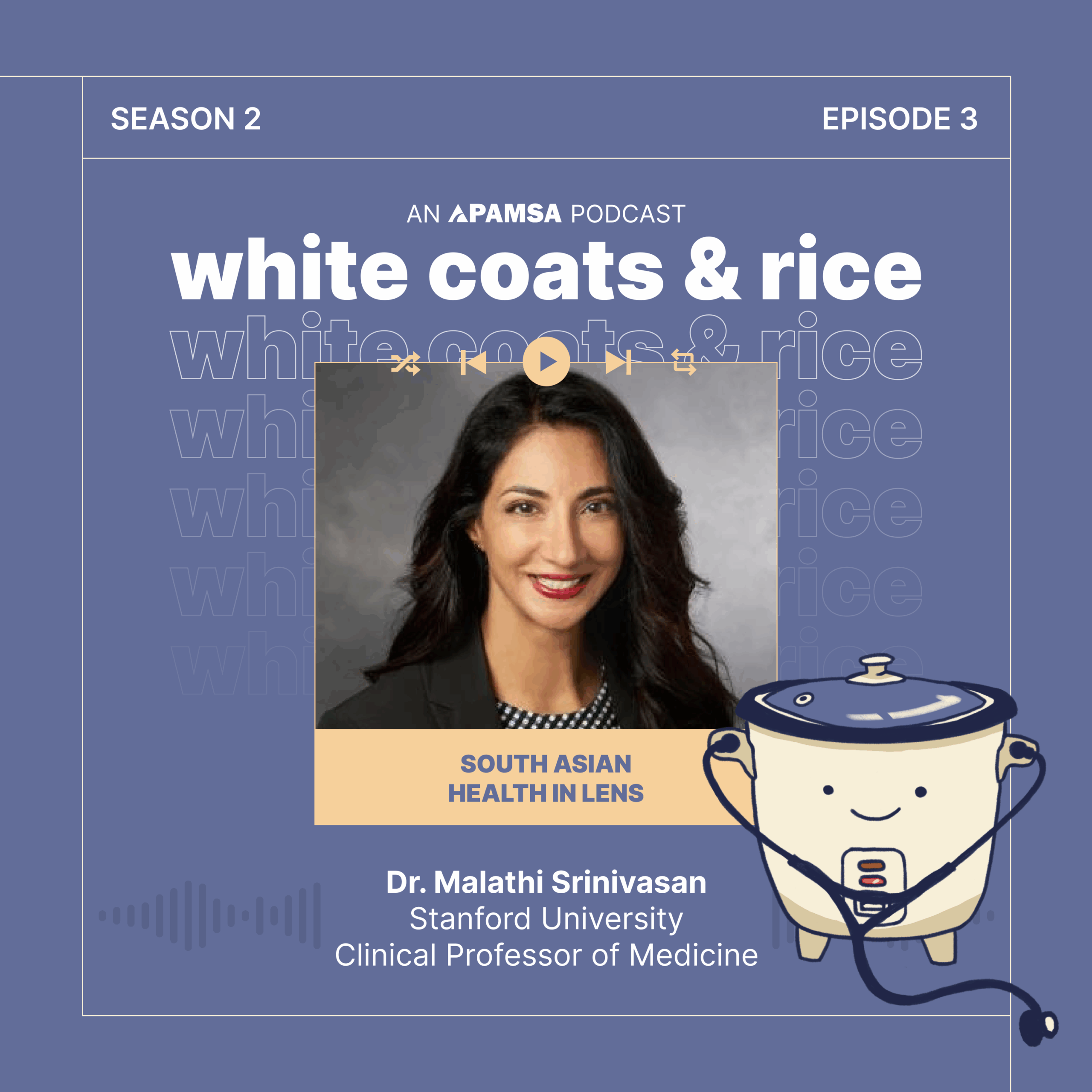
South Asian Health in Lens: Dr. Malathi Srinivasan
Dr. Malathi Srinivasan is a Clinical Professor of Medicine at Stanford University and Associate Director at the Stanford Center for Asian Healthcare Research and Education (also known as Stanford CARE). Dr. Srinivasan brings her skills as an educator, physician, health services researcher, and entrepreneur to shed light on crucial topics in South Asian health, including crucial health trends, preventative health for South Asians, and Stanford CARE’s efforts in researching Asian health.
Listen here:
YouTube
Spotify
Apple Podcasts
This episode was produced by Nikitha (Nikki) Sheth and Grace Kim, hosted by Nikitha (Nikki) Sheth, and graphic by Callista Wu.
00:00 Introduction
01:27 Dr. Srinivasan’s early life and immigrant childhood
04:23 Discovering identity and path to medicine
07:15 Journey into Asian health research
09:03 Common misconceptions: the model minority myth
13:41 Lifestyle choices for South Asian health
18:50 Pharmacogenomics and South Asian patients
24:17 Nutrition, diet myths, and healthy adjustments
37:17 Screening guidelines for South Asians
40:50 Building trust and rapport with South Asian patients
47:37 Opportunities to get involved with Stanford CARE
51:18 Advice for South Asian medical students
54:19 Finding supportive mentors
58:28 Audience question: relying on professors in residency
01:01:09 Closing
00:00 Introduction
Nikitha: Hi everyone, welcome to APAMSA White Coats and Rice’s new series South Asian Health in Lens, or SAHIL, where we delve into critical topics in South Asian health ranging from advocacy to cultural competency with distinguished health care leaders. My name is Nikitha Nikiseth, first-year medical student and third year in the University of Missouri Kansas City’s six-year BA/MD program, and the current vice president of UMKC APAMSA and member of the South Asian Committee here at National APAMSA. And I’ll be your host for our SAHIL series.
For today’s episode, we’ll be speaking with Dr. Malathi Srinivasan, who is a clinical professor of medicine at Stanford University and Associate Director at the Stanford Center for Asian Health Care Research and Education, also known as Stanford CARE. She also serves as Director for the Stanford CARE Scholars Program and Stanford Implementation Sciences Fellowship. Dr. Srinivasan is active in the Stanford Humanities and Arts Program and brings her skills as an educator, physician, health services researcher, and entrepreneur to shed light on crucial topics in Asian health. Let’s welcome Dr. Srinivasan. Dr. Srinivasan, thank you so much for joining APAMSA White Coats and Rice and for being our first guest on our South Asian Health in Lens series. Let’s start off with talking a little bit about yourself and your journey, and how it’s led you to become the Associate Director of Stanford CARE.
01:27 Dr. Srinivasan’s early life and immigrant childhood
Dr. Srinivasan: Niki, that’s such a pleasure to be with you here today. And thank you to you, your audience, and to APAMSA for inviting me. I’m so excited to share with you a little bit about things having to do with South Asian health today. And if you had asked me when I was a young girl growing up in the Chicago suburbs if one day I would be a clinical professor at Stanford working in South Asian health and in Asian health, I would have completely not believed you. Because my parents, like many other people in the United States who are Asian, had immigrated from India to Canada and then to the United States when I was a very young child. So I was actually born in Canada and I grew up in the Chicago suburbs. My brother was born when my dad was doing his postdoc at Notre Dame. And we had a very interesting immigrant childhood. In the sense that we had faced in this white collar, blue collar area that we grew up in a lot of overt discrimination when I was growing up. People didn’t really, hadn’t seen a lot of people who were South Asian and they didn’t really have a good cultural base. There’s a lot of prejudices that were held over about what it meant. To be not white in America. So when I was growing up, there was a lot of issues surrounding being bullied because of ethnicity, being called dothead, and other types of things in a questioning and Midwestern environment. But at the same time, that was counterbalanced by a very rich expat and immigrant culture. Of all of our friends and families with whom we would interact. So the home life was very rich with culture and great foods and science and music and art at a very elevated level. And then the outside culture was a Midwestern area where we were, you know, generally grossly misunderstood and in many cases actively discriminated against. You know, my parents had been PhDs in Canada. My mom was a nuclear physicist and my dad was a radiation chemist. So, you know, our friends and family were sort of along those lines. And when I had gone to high school, you know, my parents had dressed me up like a young South Asian girl, which meant like a pigtails with ribbons in my hair, which you can imagine didn’t go over particularly well when people were trying to be cool and trying to be styling. By the time I had gotten to college and was really finding my own voice at our state school, University of Illinois in Champaign-Urbana, I was really beginning to understand what it meant to have two identities. And being bicultural was a wonderful experience and also a scary experience because there was no navigation pathway. And there at the time there weren’t that many Asians and certainly South Asians in the United States, you 5.4 million people that we have right now.
04:23 Discovering identity and path to medicine
Dr. Srinivasan: So I went to medical school at Northwestern and then did most of my training in the Midwest, including after my medicine residency. I did a three year research fellowship that was focused on health services research as well as on medical education and had joined the faculty at UC Davis. And there I was doing a lot of work around education, asking questions about how do you train a great doctor? How do you build programs that are going to help physicians and allied health professionals all around the world train clinicians better and make them more compassionate, make them better decision makers. And so my early work at UC Davis was focused both on medical education as well as on health services research, which is how we deliver care. And I was teaching internationally a lot with one of my colleagues, Dr. Michael Wilkes, who he and I would go to different countries and we would teach about capacity building around education and educational leadership. And then through my work in Asia became much more interested, certainly in Asian health. And at the same time, as we were growing up, a lot of our family friends began having problems. They develop breast cancer more so than I would say in other groups. They develop cardiometabolic diseases, started having heart attacks. Early my grandfather died when he was around 60 of a heart attack, which given how active he was and the fact that he was eating a very good South Indian diet, which we thought was terrific for him, but was very surprising. And so when I had moved in 2018 from UC Davis to Stanford and joined the faculty, there were a couple of colleagues who have become fast friends who had started the Stanford Center for Asian Health Research and Education. And the goal of the center was to be able to improve the health of Asians everywhere. And you might say, well, that sounds pretty ambitious. And it is a very ambitious goal. And what we’re trying to do is take aggregated Asian data within the United States and then disaggregate it so that we can actually understand what’s happening with the health of Asians. Now, you might say that seems like pretty much of a no-brainer, right? Asians are 60% of the globe. There are 67% of the US population right now. But there are only 0.17% of NIH funding, and this is with prior NIH funding. We’re not quite sure what’s going to happen with funding given priority changes now federally. But it’s a very understudied group of individuals and we know that there’s differential health risks. So when I had joined Stanford and Dr. Latta Palaniippan and Dr. Bryant Lynn had started Stanford Care, I had joined to teach within a very small research program that they had started for undergraduates and we grew that program up into the current Care Scholars Program.
07:15 Journey into Asian health research
Dr. Srinivasan: Where we’re doing a lot of training around precision medicine for Asian health and training about 24 young people per year and also doing work with the team science fellowship that we built to support the Care Scholars Program. And so, you know, the pathway, and at the time when I was growing up, there was no such thing as Asian health research. In fact, there was a lot of work around African American health and Latino health and LGBTQ health, Native American health, and minoritized populations that didn’t really have a voice. But there wasn’t so much about South Asian health and or about other Asians comprising the big six, Chinese, South Asians, Filipinos, Koreans, Vietnamese, et cetera. So the opportunity to be able to do work in this area was not there. And as a health services researcher who had training on understanding how to think about vulnerable populations, it was something I never thought I would be able to do. And it was really an honor to be part of the center and now to be associate director, one of the associate directors of the center.
Nikitha: It’s truly inspiring to hear your story because I have a similar situation where I’m daughter to Indian immigrants. I grew up in the Chicago suburbs and to hear about the adversity that you faced while growing up in that situation and getting more involved in ways to bring more light to these issues and kind of the lack of awareness that Asian health trends are certainly prominent and should be addressed and cared for as many as the other minorities and other health trends. So I sincerely appreciate the work that you do. Just kind of.
09:03 Common misconceptions: the model minority myth
Nikitha: Leading into that, you recently led an insightful discussion on Asian health in America, and that delved into the model minority myth of Asians, as well as differences and causes of death across several groups of Asians, as well as mental health. So what have you found to be common misconceptions about the South Asian community and South Asian health?
Dr. Srinivasan: Well, I think we should start with what the model minority myth is and how it came to be. The model minority myth is this idea that one group of immigrants or a population is so much better than all the other groups. And in fact, that they’re a model because they’re so hardworking, they don’t speak up, they put their heads down and are successful. And what that does is several things. Now that sounds great, sure, you are the model minority, everybody wants to be like you, but that’s actually not true. But the model minority myth is used as a wedge to be able to set one group against the other. And by obscuring differences that are within a group, it actually leads to people ignoring important issues that happen for all of the people within the groups. For instance, the Asians generally, and Indians and Chinese people, Chinese groups in particular, are often held up as model minorities. If you are a South Asian, even though the South Asians generally may have a high overall income compared to other groups within the United States. There’s about 10% of people who are below the federal poverty limit. If you are South Asian, one in five people, 20% of individuals have mental health concerns like a depression or anxiety. And we don’t even know the rates of schizophrenia or some of the other important psychiatric disorders. It means that people then become, are not asked about issues around their health or mental health or problems that are very important to the community. And because of this, they also don’t seek help and they don’t end their stigma against being able to show your concerns. Right? So in many Asian cultures, you’re really taught that you have to present yourself in a certain way that is a very polished and together, but in essence, even if you are going through individual and personal struggles, because of the stigma associated with mental health disorders and with other health conditions, you may not actually seek help. And so that leads to things having to do with increased rates of depression, especially among older Asian adults who may have also language issues and with abuse and neglect or social isolation. There’s not a lot of pathways for things having to do with intergenerational conflict. South Asian youth who are suicidal might actually not present by saying, oh, I’m depressed. They might just have academic difficulties or have risky behaviors or just have a stomach ache or a headache. And so the issues around being a model minority where everyone expects you to be perfect show up in lots of ways that actually are detrimental to health and well-being of the entire group. So rather than personalized care and using a precision medicine approach, these stereotypes actually lead to these things that people may consider a positive stereotype actually lead to very negative consequences.
Nikitha: Yeah, absolutely. I think the model minority myth definitely needs to have more attention in how it can feed into negative thoughts and feelings and misconceptions around especially Asian subgroups where that may cause people to not feel like it’s worth bringing up very important health problems. Like you said, a lot of research still has to be done on a lot of different trends like psychiatric disorders and other treatments that should be worked on to bring more light into what Asians may go through and their health trends. And yeah, those misconceptions are definitely some things that we want to tackle in the South Asian health in land. I do appreciate the work you do with Stanford Care because I think it does help push us towards more knowledge and that knowledge is something that we can utilize to bring a lot of advocacy to these problems. And with the work that you do, you recently published an article on the association of sleep duration and cardiovascular disease among Asian Americans. And it highlights how suboptimal sleep duration had a higher relevance of cardiovascular disease.
13:41 Lifestyle choices for South Asian health
Nikitha: So in addition to sleep, what are some lifestyle choices South Asian Americans can consider to promote heart and metabolic health? Because like you mentioned, it’s pretty common in the family to hear of someone having either hypertension or diabetes. I know definitely people in my family suffer from it and I’m sure it’s a very common instance. So to bring more light to this type of lifestyle, what are some different choices that South Asian Americans could consider so that they’re able to promote those aspects of health?
Dr. Srinivasan: Yeah, so I want to spend a moment on sleep. You probably know that the American Heart Association has recently, about two years ago, has adopted sleep as the eighth healthy lifestyle step. Poor sleep and poor quality sleep is considered as a bad or risk factor as smoking. And the other thing of course is that sitting is the new smoking also because we know that exercise dramatically changes your cardio metabolic risks. South Asians have about twice the heart disease risk and about twice to two and a half times the diabetes risk as someone who is non-Hispanic white. If you can imagine India over, say, the last 10,000 years has gone through periods of feast and famine, of low water resource, of time where there was a lot of food scarcity. And the same way that in Africa, if you had specific mutations that made you less likely to die of malaria, namely having sickle cell disease, with oxidative stress, these cells become sickles, and then it’ll kill a parasite also. There was a survival advantage to being able to someone who stored fat and who was able to not and because fat is a food storage that lets you release sugar when there’s no food. Okay. So what has become a survival advantage in times of food scarcity is now a survival disadvantages when you come to longevity. So the that paradox is really important. And one of the things that you’ll notice is that there’s also something called the obesity paradox, where you have people who are actually normal weight. And if you look at them, they look just like a normal, healthy person. But in fact, they are metabolically unhealthy and they are metabolically obese. And because South Asians in particular store fat around their organs and it’s called visceral fat. And for the same body mass are going to have less muscle. We actually have much higher rates of heart disease and diabetes. And in fact, it’s a combination of cardiometabolic health where you have fat deposition in your liver, around your organs, you don’t build as much muscle, and muscle, believe it or not, is actually a major component of your metabolic health. And because South Asians don’t build as much muscle, and most Asians don’t in comparison to non-Hispanic white, and you build muscle really until your 30s and kind of your 40s, and then it’s harder to keep, and then you start to lose it after that. can actually, and having low muscle mass later on in life is one of the biggest predictors of whether or not you age healthily and whether or not you’re gonna die. Because people have falls, are unable to, they get hip fractures. So this combination and also fat, excuse me, muscle uses glucose independently of insulin. And so if you have someone who is unable to process and store sugar in the most healthy way, if you can actually reduce your blood sugar by having more muscle, you do better. Okay, so there was a study called Masala that was produced, that was published in 2010, which is the mediation of atherosclerosis in South Asians living in America that had really shown the higher incidences of cardiometabolic disease in Indians. And so in fact, it’s so bad that the World Health Organization and the Indian Ministry of Health have reclassified what it means to have a healthy weight for people who are Asian. And if you are Asian, whereas the body mass index, which is a measure of how tall you are compared to how much you weigh, if you take a look at that, the body mass index of 25 is considered the upper limits of normal for someone who’s Caucasian or Hispanic or African-American, but it’s actually 1.5 points lower for people who are South Asian and Asian. So at every point in time, whether you’re thinking of obesity at a BMI of 30 or morbid obesity at a BMI of 40, because of our differences in cardiometabolic health, the numbers are 1.5 less. So it’s really important for us to have an understanding of the foundations of this and also understand that there’s pharmacogenomic differences that are also driving how we treat these issues.
18:50 Pharmacogenomics and South Asian patients
Nikitha: Could you delve into the pharmacogenomics because I think that’s also a really critical topic to kind of delve into to provide more context on that foundation.
Dr. Srinivasan: Right. So in every country where people have grown, have lived for tens of thousands of years in a specific location, there will be variations from what’s studied. I want to make two points. The first one is that Asians in general and South Asians in particular do not participate in very many research trials. If you take a look at the number of people who are Asian in the world, it’s about 60%, the number of people who are participating in clinical trials is about 10%. So all of the decisions that are made about Asian health are for the most part done with non-Asian data. When it comes to genomics. So there was a study in 2016 that was a meta-analysis of about 2,500 studies that looked at genomic data for 35 million people, so including people from China. Only 19% of all of the genomic data is done on Asians. So what that means is that you have a mission aggregation, an extrapolation of data from other populations to the Asian population. And what does that mean for South Asians? Well, we know a lot of stuff, right? So already what we do know is that there’s, let’s just kind of stay on cardiovascular issues since we’ve been talking about that. If you take a look at things like metabolism of drugs for treating heart disease and heart attacks, or someone who’s had a stint, you might use a medication called Plavix, which is, you the generic is clopridogrel. And if you’re Asian, a South Asian you are more likely to bleed if you’re given Plavix. And why is that? It’s because you have something called a gain-of-function mutation. And what that means is that a particular enzyme, I, without getting too technical, the enzyme name for those of you, since there’s a pre-medical audience here who might care, is CYP2C19-star-17, okay? I know that’s a mouthful. But that gain-of-function mutation takes a protigrel, which is a prodrug, and translates it into its active form. And because that enzyme system in the liver is more active, you make more of it. So you’re going to be more likely to bleed because it’s an anticoagulant, right? So if you have a medication that we use for atrial fibrillation called warfarin, you actually need to have less of a dose because you’re going to be more likely to bleed because there’s an enzyme system called V-Core C1, which is different in Asian Americans and in South Asians. And you should be giving someone a different dose than you would because you’re going to be more likely to bleed. If you look at statins, which we use to be able to treat high cholesterol, then you also want to, it’s important to know that statins aren’t metabolized as well for people who are South Asian. And in fact, you need less of it because you might actually have more side effects. So for people who are South Asian, for all of you blood and cardiologists out there, if you have a South Asian patient, start at a lower dose and then ramp up slowly and monitor for side effects. And if you start getting side effects, back off on the dose and you can add second and third drugs like Zetia or the PSK9 inhibitors. But it’s important to kind of think about these differences. And that’s the first point. The second point is that in many cases, we actually don’t even know why we’re having differential outcomes. Breast cancer rates are increasing significantly in South Asian women. And when you do genomic profiling against the things that we know are hereditary breast cancers for people who are Caucasian, like the BCARA 1 and 2 genes, they may not have those. But when they do whole genome sequencing, we have things that are in that same area which people are calling variations of unknown significance, right? So there are variations that may be very common in South Asians, but we actually don’t know what they mean because they haven’t been studied. So it’s very important for people who are South Asian and people who are Asian in general to join clinical trials so that we contribute their genomic data so we can begin to understand what’s happening in our populations.
Nikitha: Yeah, definitely. And learning more about the foundation of why these trends are what they are, rather than just knowing that they exist, I think is crucial, especially for aspiring physicians, that they can gain more perspective and kind of awareness from that pharmacogenomics, just so that they have more understanding going into when they treat these patients. I think what you said about statins also resonated with me a lot because it’s such a common form of treatment but something as simple as a statin you have to consider the nuances when you have a South Asian patient because it may not present the exact same way they may have more side effects and so the dosage has to be adjusted accordingly so that is really important to know so I appreciate you mentioning that and.
24:17 Nutrition, diet myths, and healthy adjustments
Nikitha: With those lifestyle choices as well. So knowing that foundation is really helpful. So with the building muscle might also help. So I know oftentimes we just say that exercise is great because maybe with diabetes that tends to be the trend if they’re more obese. But when it comes to Asians and South Asians, that’s not always the case. They may be a smaller frame but still have diabetes just because of those environmental aspects and the genomics. And so things like maybe building muscle might be helpful to consider in addition to what they may consider as other exercise like walking and simpler exercises like that. So it’s good to know that maybe building muscle is another thing to keep in mind for those lifestyle choices.
Dr. Srinivasan: Nikitha, you’re so correct. And in fact, Dr. Palaniapin had done a study called Strong D. So it was a strength training versus cardiovascular training program. Take a look at what happened to people with diabetes. And in fact, strength training for South Asians was more important than cardiovascular exercise to address diabetes. And I think it’s in large part because of the visceral fat issue and then the building of muscle issues with sarcopenia that we talked about. There’s a lot of other things that people can do also to be able to improve their sleep. And some of it is the standard advice that you’re going to get. So, you know, make sure you’re paying attention to your sleep. You know, don’t smoke. Ideally, we used to think that some amount of alcohol was safe in terms of long-term health, but we know now that really, you know, all alcohol is bad alcohol for your health. And so if you’re going to drink, you know, just make sure that you’re being very moderate and use it as something that’s occasional, not every day. We could talk a lot more about diet and fats too. I know a lot of people are always asking me about what cooking oils to use and.
Nikitha: How to think about their food choices. Yes, that would be a great thing to touch upon because it is something that’s quite common with cooking. At least from my perspective, I would hear from family members or family friends that the amount of cooking oil is playing a big role, but they don’t really know how to adjust things. They’ve just kind of heard a lot of bits and pieces here and there, but don’t know what to do with it to help improve their health. So definitely talking about that would be wonderful.
Dr. Srinivasan: Indians and Asians love to eat. And in fact, I don’t know about you, Nikitha, but my fondest memories are of our family gatherings and everyone, you know, cooking together and eating together. And in fact, much of our conversation would usually center on what we had eaten, what we were eating and what we were going to eat. And the deliciousness of the foods is unsurpassed, I think, amongst all of the Asian groups. And of course, I’m very biased. But if I could have my mom’s gulab jamun every day, I’d be very, very happy. So what does that mean for our health, though? So knowing what we know about cardiometabolic health in South Asians, the things that we have to know about are sugars and fats, right? So we have our energy comes from either carbohydrates, which can be simple, complex or fibers, proteins, and then also from fats. And so I’m going to touch briefly on all three of these. So let’s kind of talk about the protein issue. So for people who are vegetarian, which many South Asians are, finding adequate protein is a little challenging. And you have to be pretty meticulous about making sure that you’re having balanced protein so that the essential amino acids that you need come from both legumes as well as from grains. And when you’re choosing grains, you want to choose more complex carbohydrates, which take a little bit longer for your body to digest and metabolize into sugar. For proteins, the general recommendation is that you want between 0.8 to say maybe two grams of protein per kilogram. It depends on how much you weigh. And I would encourage all of the APAMSA students who are listening to this podcast to really go out and take a look at food labels because I think that getting familiar with food labels is very important. So every plant or food group has all of the essential amino acids. It’s just the proportions of them and having them available to you in a way that’s useful, that’s important. And so if you’re a vegetarian and you have either eggs or milk products, it becomes much easier because there’s both protein supplements that you can take as well as, you know, dolls and excuse me, as well as eggs and milk that are available to you that have complete proteins. But if you’re vegan, then you have to be a lot more careful with your protein intake. So, you know, just please become a little bit more educated about that and then read your food labels and think about how you can get the right amount of protein. And it should be about 30 grams per meal. You know, usually less than about 20 grams per meal. The protein is not necessarily going into building muscle. It’s often just used and or stored as fat. So we don’t have a form of protein storage. We only have a form of carbohydrate storage and carbohydrates, of course, are stored as fat. And so all the excess protein that you eat, if you eat a lot in a meal, is just going to get converted to fat if you’re not going to be using it right away. The carbohydrates, as I’d mentioned, come as simple, which are just things like sugar, like glucose, fructose, and other simple sugars, or things that are more complex carbohydrates that are longer chain sugars, and then things that are fibers, which are really fairly either soluble or insoluble. the insoluble fibers are the ones that are used by bacteria to be able to support your metabolism in your GI tract. What’s important about carbohydrates is carbohydrates are metabolized, are digested by your stomach and by some of the enzymes in your intestine, and then they’re absorbed. And when you think about people who have diabetes, the rate at which those sugars are absorbed into your blood system in the intestines and the baseline amount of blood sugar, of sugar that you’re making from your liver are the two things that determine your blood sugar level. So when you’re eating, what you want to do is try to reduce the spike by slowing down digestion. And that can be done by several things, by having fats and complex carbohydrates, like salads and things, at the beginning of your meal. So salad with a really good salad dressing, having vinegar, which will slow down about two tablespoons or so, which will slow down your gastric emptying. So again, going back to that really great salad at the beginning of the meal, and then having more complex carbohydrates, which your body has to work harder to digest. And so a carrot that is baked has a different glycemic index, which is kind of a rate of if you have 100 grams of carbohydrates, how fast does your blood sugar rise? The, you know, an hour or so, the type of food and the food composition becomes very important and the order in which you eat also becomes important. So understanding that about carbohydrates that you can actually choose things that are lower glycemic index, meaning how fast the sugar is absorbed and how much your blood sugar spikes when you have that type of food, right? So a glycemic index of 100 is if you have like 100 grams or so of glucose and what happens to your blood sugar. But a baked potato has a glycemic index of 110, whereas a broccoli is gonna have a glycemic index of maybe 20. So in general, we wanna try to keep most of our foods having a glycemic index of less than 55. And then when it comes to things having to do with fats, there’s a lot of misconceptions about dietary fats. In our blood, the good cholesterol is called HDL and the bad cholesterol is called LDL. South Asians also have a higher incidence of a very bad type of lipoprotein called lipoprotein A. And if you don’t know if you or your family have it, you should get checked out. And the things that drive up the bad cholesterol, the LDL, are saturated fats and trans-saturated fats. Things like the seed oils are actually not that bad for you. And there’s a lot of villainization of individual food groups that comes from a lot of food misinformation. And the seed oils in general are just fine, even if they are refined at a slightly higher temperature. When you cook, you’re also cooking at a slightly higher temperature. The so things that we love that make our food really, really tasty, like ghee and clarified butter or a coconut oil are actually really bad for your health. They will drive up the bad cholesterol and make you more prone to having heart disease. And the good fats are things that are liquid at room temperature, which are the omega-3 and omega-6 fatty acids. The omega-3s are anti-inflammatory, and they’re found in things like nuts, avocados, fish, and also canola oil and a lot of the seed oils. So there’s things like omega-3s are really important for you in terms of your brain health as well as your cardiovascular health. And so paying attention to the types of fat is really important, less so than the amount of fat, although we tend to, because our food is so delicious, eat a lot of it. And so I would just say that, you know, the amount of total fats that we eat, especially saturated fats, should be reduced. There’s a couple other food groups that you should be careful about, particularly in South Asian food. One of them is milk products. We use a lot of yogurt and cheese, particularly in the northern part of India. And cheese. And milk products are very inflammatory, and they contain some sugars and things like that that are just not great for your gut health. In general, I don’t really recommend milk products, although if you can take it, it’s just fine. We use a lot of rice, as you know, and white rice has a very high glycemic index. So if you can, try to have more either brown rice or you can have white rice, but eat a lot of protein and vegetables and fat with your white rice to try to slow down the absorption of the sugars into your bloodstream. The other thing is that we love potatoes and we love a lot of root vegetables that tend to have higher glycemic index and can cause that sugar spike. So, you know, don’t eat those things in isolation. I wouldn’t eat a huge pile of potatoes, but if you’re eating a small amount of potatoes, eat some vegetables and eat some protein, like chickpeas and other things, along with it so that you don’t get that sugar spike. And then try to have more salads and leafy greens and things like that as well as fruits and vegetables in your diet. So in general, I think that the rules of thumb are eat in the right order. So that means vegetables, protein, and then carbohydrates last. That will help you with a glycemic load, not just with the glycemic index of a particular food group. Two, reduce the amount of saturated fats that you eat and increase the amount of healthy fats that you eat, especially things like the nuts and the avocados. Three, don’t eat so much rice. Four, try to incorporate some kind of strength training exercise in your life, even if it’s just walking a lot with, you know, a very light weight, but it’s important for you to get out there and get some exercise.
37:17 Screening guidelines for South Asians
Nikitha: Yeah, definitely. I think the diet misconceptions, I think that’s a big thing because people have just heard what they should do, but they don’t really know why they’re doing it. Like you mentioned with the rice, people know that white rice isn’t that great, but they don’t really know that they should eat something alongside it to help with that absorption, like you mentioned. And just understanding that foundation, I think is really helpful. You also mentioned, since a lot of the South Asian population are not studied in clinical trials, what are some recommendations for routine screenings for South Asians, especially when we talk about things like breast cancer, heart disease, and those cardiometabolic issues? What are some things that people should keep in mind in terms of screenings?
Dr. Srinivasan: Right. So in general, I think you should still follow the standard guidelines. So for cholesterol, for diabetes, for hypertension, all of those things you should follow the standard guidelines. So your family doctor is going to start checking you for some of these things around age 40 or so. Now, if you are a South Asian American, you might want to start thinking about it earlier in your 30s. And especially if you’re a male, you might want to consider doing a calcium score, a coronary calcium score, which is a scan of your arteries to see if there’s any plaque deposition, just as a way of being able to get a baseline on where you’re at and whether or not you might want to consider going on a statin earlier than you would otherwise. The other thing is that, you know, there’s no official recommendation, but I would highly recommend for South Asians to get their lipoprotein A measured. Now, this is not a routine lab that your doctor will be ordering for you, but it’s an important risk factor that’s been implicated. And so I would ask your physician to order it just for your own purposes, right? It’s not part of the standard lipid panel. So when you get your cholesterol panel, you’re going to get an LDL and HDL and a triglycerides and a total cholesterol, but you’re not going to get the lipoprotein A. In terms of breast cancer, there’s still a lot of debate on how often you should be getting a mammogram, whether it should be yearly or every two years, and what age to start. But in general, I would say to you that the best rule of thumb is a woman should probably get her first mammogram by age 40 and then do it yearly after that. And if you have a family history, you might want to start in your 30s. And that’s something you should probably talk with your doctor about. But the earlier the better in terms of diagnosing breast cancer, particularly because rates are increasing in South Asians, as well as in other women in the United States. In terms of mental health, it’s very important to ask your doctor if you’re having any issues with mental health. If you feel down or blue or if you’re having a lot of anxiety and you’re not able to sleep, it’s really important for you to be able to talk about those things. You know, we don’t really have a cultural base that makes it easy to talk about some of our mental health issues, but it’s important to be able to talk about it with a professional. So I would just say that for all of our listeners and all of you, particularly young people who may be listening to this podcast, if you’re having those issues, please go and seek help. A physician, your physician, is your ally in this case.
40:50 Building trust and rapport with South Asian patients
Nikitha: Building trust and rapport with South Asian patients. That is something that, like you said, can be very difficult at times, just due to the cultural nuances and some of those stigmas that we mentioned that may be prevalent. So how do you approach building trust and rapport with your patients, especially when you encounter some of those topics that may be deemed sensitive?
Dr. Srinivasan: Well, I think the first thing that a physician, a health care provider, can do is to just ask a patient what’s important to them. So, you know, when you go into a room, if I ask a patient, you know, what’s a family life like? What do you do for fun? How do you have fun? What are your hobbies? What are you interested in? And I try to learn about the people who are in my waiting room. I try to, you know, greet them in a way that, you know, I show them that I’m interested in their culture, you know, maybe ask them, you know, what’s your family background? And when they tell me, I’ll say, oh, you know, what’s your language? And I’ll try to find some words in their language and try to do that. And you can just see patients light up when you’re interested in them as a person and not just as a medical problem. So I think that that’s the most important thing to do. You know, for many South Asians, we’ve come from countries and we’ve been, you know, in the diaspora for a number of years where we’ve also had different types of health systems. Some of them are not as patient-centered and you’re not used to a doctor asking you, you know, what’s wrong with you? Or, you know, how are you feeling? It’s more of a very professional and formal relationship. And so I think that for many people who come from that environment, it’s a little bit jarring to hear someone ask about your personal life. But in general, I think the vast majority of our patients really appreciate that. And it’s important for them to know that you are a partner in their health. You know, there’s a lot of issues that we see in our health system in the United States, but one of the beauties of our health system is that patients are supposed to be partners in their care and their doctor is supposed to be an advocate for them. And that’s something that may be a little bit different from where people have come from and their personal upbringing. In terms of culture, I think that, you know, it’s just really important to kind of be sensitive, know that, you know, we, you know, that patients may not want to talk about their mental health issues in front of their family. If you are seeing someone who is, say, a young woman, and she comes to the office with her parents, and you want to be able to ask her about, say, reproductive health issues or about her mental health, you might just ask the patient to step outside for a moment and just ask her questions in a private way. And, you know, that might be seen as a little bit of a cultural taboo, but I think that it’s important to kind of find a way to navigate these types of issues and just do so with a lot of grace and dignity. And know that it’s okay to ask patients about some of these things. And then if they don’t want to talk about it, then you can just step back and say, okay, well, if you change your mind, I’m here for you and I would be happy to discuss some of these things with you. And I think that that shows a patient that you’re an advocate for them and that you’re an ally for them. And that you’re also respecting them and their privacy and their personal issues. But I think it’s important for us to kind of remember that as doctors, our duty is not just to our patients, but it’s to the health of the entire community and that we’re supposed to be asking people about things that we know are important to their health and well-being. And just being able to find a way to introduce it so that it’s not a taboo subject. I mean, it’s not normal in our culture. You know, we don’t just sit down with a family and say, oh, you know, how are you feeling? And you know, what’s going on? And, you know, are you having problems in school? And, you know, you can do that in a kind of a friendly way, but a lot of these things are considered private subjects, especially around things like fertility issues and mental health issues. But a doctor’s job is to just ask about them. And sometimes just asking about it gives a patient license to talk about something that they might have on their mind that they don’t know who to talk about. And you’re giving them an opportunity and an opening to be able to talk about it. And so I would say just, you know, lean into it. Don’t be afraid.
Nikitha: I think that’s such a great approach because I think it can be so difficult when you’re in a situation as a physician and you have a patient that may have family members that accompany them. And you’re in that situation where you’re not sure how to have that conversation where you might be asking about more private issues. But what you said about asking the patient to step outside for a moment, I think that is a wonderful approach because it shows that you’re being accommodating and you’re providing the best care possible that may be needed for that situation. So I appreciate you mentioning that.
47:37 Opportunities to get involved with Stanford CARE
Nikitha: Just kind of going into our next question, since you are also a professor, I think it’s important for a lot of our listeners who may be undergraduate students to hear about opportunities that they may have with you at Stanford Care. I know you mentioned the scholars program, but what are some other ways that students can get involved with you?
Dr. Srinivasan: Well, I think that, you know, we always are looking for research projects. If you have, if you are a young person who is listening to this, and you have ideas for research, we have a number of different faculty that are interested in projects ranging from the arts and humanities to health services research, to data science and to the hard sciences. So we have a lot of interest. The best thing to do is to just email one of us and ask us about opportunities to participate in our research. Now, that being said, we get a lot of emails. So I would say that it’s important for you to be pretty specific about what you’re interested in. You know, it’s not helpful to say, you know, I’m interested in working with you on anything. You should probably say, you know, I’m very interested in working on a project having to do with say, South Asian health or maybe with breast cancer or with diabetes, whatever your particular interest might be. And that would be helpful. The other thing is that we have a program called the Care Scholars Program. We’re going to be having our fifth class next summer. It is an intense summer program that you can get a research project, a mentor, get a lot of professional development, and also get some stipend support as well as a journal club. And a lot of other activities. So that’s another way that you can, you know, apply for that particular program.
Nikitha: Perfect. So I do appreciate you mentioning that because it’s always great to have more opportunities to get involved. So I appreciate you mentioning that.
Dr. Srinivasan: You know, for many of your listeners who are pre-med, I think that what you can do is start getting involved in research projects at your home institution. Now, I will say that a lot of people think that, you know, the most important thing is to do a research project with someone who has a big name at a big name school. And I would say that that’s not always the case. If you have a professor who’s an educator or a health services researcher at your home institution, and they’re really, you know, well funded and they have some project that’s kind of big, that can be a really great way to get involved in research and show some publications that you might have. You know, some of the projects are a little bit smaller at smaller institutions, but they can be a wonderful learning opportunity.
Nikitha: And just kind of getting the ball rolling with that. I think that’s a very valuable advice because like you said, you don’t always have to go to a prestigious institution to get that kind of experience. You can get that at your home institution, and sometimes the professors at your home institution are a little bit more accessible, and you’re able to connect with them better to build a stronger relationship and a stronger mentorship.
51:18 Advice for South Asian medical students
Nikitha: And you also, since you are a clinical professor and you also have a lot of experience with students, what would be your advice for South Asian medical students, especially those who may be interested in a career in academia, like yours?
Dr. Srinivasan: I think it’s always great to find a mentor. And a mentor doesn’t always have to be your professor. A mentor can be someone that you, you know, that you admire in terms of their career pathway or their personal life. I have been very fortunate in my career to be able to find a lot of mentors who’ve been so supportive to me and who’ve been, you know, really great to ask questions to. And I don’t really know that a career in academia is for everyone. In terms of a career in academia, I think that a lot of it is just luck. It’s about being in the right place at the right time. But I think you make your own luck, especially if you, you know, continue to do hard work. A lot of the academic medical centers that are out there, like Stanford, like you know, Northwestern and UC Davis and things like that, you know, are very supportive of students of all backgrounds and all ethnicities and all genders. And I think that if you are a student and you’re looking for, say, a particular medical school or a particular residency program, you should look for places that support diversity, equity and inclusion because they will also support you as a person and as a medical student. So if you’re looking at a residency program or a medical school, I would say look for those things. Look for people who have been, you know, in that institution, whether they’ve been there for a year, two years, or three years, and find out what their experience has been like, because you can be, you know, you can say, oh, you know, this institution is so supportive, and then you get there and you find out that, you know, there’s not a lot of, you know, people who are of your background, or there’s not a lot of support for people from different backgrounds. And so it’s always good to be able to find, you know, someone who can advise you in those spaces.
Nikitha: I would agree. So I think mentorship is crucial in a lot of different aspects of our career, so I appreciate you mentioning that. I’m going into medical school myself, and so I definitely appreciate that advice in terms of what I should look for in my mentors.
54:19 Finding supportive mentors
Dr. Srinivasan: Well, one of the things about mentorship that is always surprising is that you can have multiple mentors, right? So you might have a mentor who’s at your home institution, and then you might have a different type of mentor that you have at your academic center. That can be more of a personal mentor. And sometimes you may need a mentor that can provide more career-oriented advice that may not be available within your institution, that may be more of a personal mentor that may be a family friend that you can reach out to, or that’s maybe more of a personal friend that you have as a mentor. I think a lot of people think that, you know, they need to have one mentor who can serve as an advisor, as a friend, as a guide, and as a research mentor, and that’s not necessarily true.
Nikitha: Right. And you may have different people who may serve different purposes and may serve to guide you in different ways. And I think that’s why it’s so important to build a strong professional network so that you can have different people you can reach out to for different aspects of your life.
Dr. Srinivasan: And as I said, you know, you are a professional, but you’re a person first. And so it’s important to find people who can support you both professionally as well as personally. And so, you know, you might be a medical student or a pre-med student at your university and find, say, a professor who’s interested in your career goals, but then you may also have, say, a close friend or a family friend who’s already gone through that process that can kind of help you with some of the personal issues that come up with being a medical student.
Nikitha: That is a wonderful point. And I think that brings up the idea of a sponsor, which is someone who goes out of their way to advocate for you.
Dr. Srinivasan: Right. And sponsorship is something that is, you know, it’s very important. And in fact, I would say to you that, you know, for people, especially from minority communities that, you know, it’s really important for you to be able to find someone that can sponsor you and go out on a limb for you.
Nikitha: I appreciate you touching on that because I think that’s a very important aspect of networking and building professional relationships. In addition to that, what would be your advice on finding a supportive mentor? So how can students kind of approach that?
Dr. Srinivasan: So I think, you know, first of all, you know, start, as I’d said, at your home institution, and don’t be afraid to go up to a professor and just kind of express your interest. And as I’d said, you know, in this conversation already, you want to be specific about what your interest is, right? You don’t want to just go up to them and say, you know, oh, you know, I’m really interested in your career, which is also fine, but, you know, I would just kind of say that, you know, you should have, you know, something a little bit more specific in mind so that you have some sort of an opening that you can engage with the professor about. And as I said, you know, a lot of the faculty are very open to these discussions, right? And I think that, you know, a lot of people are also shy. And if you don’t know someone who’s a physician or a professor, it may be a little bit intimidating to go up to someone and ask about these things. But in general, I think that most people will take the time to answer a well-formulated question or a kind of a direct question, you know, to give a lot of good advice. So, you know, and I would also say that, you know, just as you’re in life, you want to try to be as supportive and nurturing to others as others have been to you.
58:28 Audience question: relying on professors in residency
Nikitha: Awesome. So we have one audience question. So this is more tailored to medical students who are in their fourth year, going into residency. So the question asks about how much you can rely on the professors in your residency. So Dr. Srinivasan, you have so much experience. What would be your opinion on this?
Dr. Srinivasan: Well, as I said, a lot of it is about finding a mentor, finding a professor in your residency that is going to, you know, have some interests that are similar to yours. So if you’re interested in research, if you’re interested in patient care, if you’re interested in education, you know, go up to a professor and just say that you’re interested and ask them what the opportunities are at their home institution for that. You know, I don’t really know that there’s a good way of being able to say that, you know, this program has this amount of support. You kind of have to do your own research by asking students who are in the programs already about what their experience has been like and how much the faculty are available to them.
Nikitha: I would agree. So I think it’s important to not just look at the program on paper, but also look at the faculty as well as the students who are currently in the program to get a better feel of the culture of the program. And I think it’s also important to not just rely on one person, but rely on different people as mentors. And finding a mentor outside of the institution can be a good resource that can be more tailored to what you want to discuss or talk about, whether it’s something that’s more applicable to the institution’s program versus something that’s more personal and career oriented. So I definitely agree about that.
01:01:09 Closing
Nikitha: All right. So thank you so much, Dr. Srinivasan. That was everything that we wanted to cover. And so thank you so much for taking the time to discuss so many critical topics. I think it’s so important for people of any background to learn more about South Asian health and how nuanced it can be when it comes to the different health trends we see, but I really appreciate how you touched upon the why behind some of them and like how our culture and our environment, both in the Indian subcontinent and South Asia in general, to being immigrants, how different things can kind of factor in to what we see on paper and how some things we’ve yet to discover and different trends that we’re still working towards. Why the research is so important. So thank you so much for taking the time today. I really appreciate it.
Dr. Srinivasan: Thank you, Nikitha. And thank you to APAMSA and to your audience for letting me share some of these ideas. It’s really been an honor to be with you.
Nikitha: To our listeners, we hope you enjoyed today’s episode and learn more about the beauty and nuance that is South Asian health in America. Don’t forget to tune into the rest of our series and until next time, take care. Thank you.


Women in Medicine Conversations: Dr. Monica Soni
Dr. Monica Soni is one of the youngest Chief Medical Officers at Covered California, a board-certified practicing Internal Medicine physician, and a leading voice for innovation, equity, and representation in healthcare. As a Black and South Asian woman, she is redefining what care looks like by leading with empathy and advancing a more inclusive, accessible, and community-centered system. In this episode, we discuss her own journey and work as well as her advice for rising physicans.
Listen here:
YouTube
Spotify
Apple Podcasts
This episode was produced by Eujung Park and Kevin Gaw, hosted by Eujung Park, and graphic by Callista Wu.
00:00 Introduction
01:09 About Dr. Monica Soni
02:54 Meet the patient
06:29 Navigating the patient interaction
08:26 Intersectionality of identity
11:24 Medical school experience
13:56 Covered California
15:50 Working with the community
18:30 Barrier to accessing communities
20:10 Balancing physicianship with other responsibilities
22:07 How can we integrate into the community
25:18 Scarcity mindset
26:58 Optimism
30:09 Beyond Covered
34:02 Expanding outside of California
36:15 Advice to younger POC women
37:57 What keeps you grounded?
38:59 Mentorship (Creating a healthy mentee-mentor role or relationship)
43:55 Closing remarks
46:35 How to connect
47:27 Closing
00:00 Introduction
Eujung Park: Welcome everyone to our APAMSA Podcast. From round table discussions of current health topics to recaps of our panels with distinguished leaders in the healthcare field to even meeting current student leaders within the organization. This is White Coats and Rice.
My name is Eujung Park, third-year medical student at University of Arizona College of Medicine – Phoenix, and the current Women in Medicine Director here at APAMSA and I will be your host today.
Hi, welcome to another episode of White Coats and Rice. My name is Eujung Park. I’m the Women in Medicine Director for the National Board of APAMSA. And today we have a very special guest, Dr. Monica Soni. I’ll now ask Dr. Soni to introduce herself and tell us a little bit about herself as well.
Dr. Monica Soni: Wonderful. Thank you so much for having me. I’m Monica Soni. I am a practicing internal medicine physician and also chief medical officer at Covered California, which is California’s state-based marketplace or California’s Obamacare, depending on what term you’re most familiar with. I’m really happy to be with you today.
01:09 About Dr. Monica Soni
Eujung Park: That’s amazing. Thank you so much. And so just kind of before we get into your work, we’d love to know more about you. Could you tell us kind of a little bit about your journey and what initially first sparked your interest in medicine and how did that path kind of lead you to where you are today?
Dr. Monica Soni: Of course. You know, I’ll have to confess that my dad was extremely encouraging of a path in medicine, as I’m sure many folks’ parents are. But I’ll say even as early as being in high school and volunteering in the emergency rooms, I started to get curious about some of the differences I was seeing for folks’ care experience. In particular, I remember I grew up in Los Angeles and so I was working in an emergency room in Los Angeles and, you know, there were folks trying to get by with broken Spanish to, you know, folks they were caring or not using interpreter services. And you can immediately just see the difference in outcomes, experience, and treatment planning when there are these barriers based on context, culture, background. And that piqued my interest.
And so when I went to undergrad, I studied cultural anthropology or medical anthropology, which again is sort of this broader lens of how’s the world we grow up in, the context we’re immersed in affect our perspectives and our life trajectories. So those were very informative experiences for me and I think have continued to build on some of those early exposures in terms of how my career has unfolded and what continues to drive me.
Eujung Park: That is really cool. I know a lot of people going into medicine don’t have that extensive background, especially knowing that cultural roots and anthropological roots of like what’s going on in society. So that’s really excellent and cool to hear.
02:54 Meet the patient
Eujung Park: Just talking a little bit more about your own personal journey, I know that you are both Black as well as Asian, which is a very powerful as well as underrepresented identity in medicine. How do you feel that intersection shaped your experience in the healthcare system, both as a provider and a leader?
Dr. Monica Soni: I think it’s been extremely influential in terms of, I’ll start with being a provider or a practitioner. I think I’m extremely sensitive to what it is like to navigate our health systems as an immigrant. I’m really sensitive to what it’s like to try to navigate if English is not your language, your dominant language. I think my mom is very into alternative non-Western health traditions. I was telling some folks a story of how actually the summer before I was going to medical school, I was trying to get all my paperwork in and my vaccine titers. And so I asked her, like, hey, where’s my documentation? She said, I’m not sure where it is. So I went to get titers to make sure that I had everything fully vaccinated. I found out she had not fully vaccinated me, actually. And so I was in my 20s getting my full series of polio and measles and mumps and rubella again. And that is not that she’s an anti-vaccine. It’s just I really hadn’t needed antibiotics until I was 30. I hadn’t been engaged in more traditional Western care. And so I think I bring a lot of that into primary care. I’m very kind of open to whatever care model folks are interested in.
And then I also think I’m hopefully empathetic to folks that are skeptical of a health system that maybe hasn’t treated them with respect or dignity or kindness. And then conversely, those that maybe are overly trusting of the system and where they might need to be advocating for themselves more or pushing a little bit harder, frankly, against sometimes their health care practitioners. So I hope that’s what I brought from my lived experience into the exam room or bedside. Even when you’ve got folks that might be angry in crisis, aggressive, I try to always bring that lens of, you know what, folks have a lot that’s going on. I’m here to be of service in any way that I can. And then I think as a leader, similarly, that curiosity has been a guiding principle in terms of not assuming I understand the answer to a particular challenge. I think a lot of folks have made assumptions about who I am and what my background is. And really asking folks first and trusting that people know their own selves, bodies, and communities, and that that in and of itself is a valuable data source with as much validity as a peer-reviewed journal article. And so trying to really ground myself in that first-person experience and narrative, even as a leader.
Eujung Park: That’s so amazing to hear. I hear a lot of the things that you talked about are very much reflected in APAMSA’s own kind of initiatives, saying that we want to make sure we’re respecting a lot of people come from different cultural backgrounds, have different approaches to medicine, both like maybe more traditional versus more modern, all that different intersections of treatment. And I’m just curious, it sounds like you’re doing such an amazing job of meeting the patients where they want to be treated. How do you start that dialogue and I guess how does that play out in like a patient interaction for you?
06:29 Navigating the patient interaction
Dr. Monica Soni: Yeah, some of it is very, it’s almost so simple it sounds ridiculous. You know, I’m sure you and your listeners know this, but there’s been all these studies about how we, particularly physicians, don’t even let patients or family members speak uninterrupted for a few minutes before we jump kind of in front of them. We stand instead of sitting down to be at eye level. We are looking at the computer instead of at least first engaging. And so some of it is that very simple nonverbal. I always walk in and introduce myself to everybody in the room and ask what’s the relationship between everybody in the room so that they have the opportunity to tell me themselves. I make sure that anyone in the room that the person I’m treating wants those folks to be in the room. So a lot of permission. I always sit down. If there’s not a chair, I squat, frankly, because I think it’s better than standing even in the hospital. And I will say that I’m someone who believes in the physical touch. So I shake hands. I’m making eye contact, all of that. And so immediately within seconds, you’re creating an environment that is intimate. It’s personal. It’s clear that it’s safe. And then I have found so far in my career that that allows the dialogue to be much more bi-directional and feel trusting and open. And I chart and I type and I do all those things, too, because you got to get through your day. But I try to angle the screen and my chair so that they can see what I’m doing and there’s no secrets. And if they ask me a question, I let them look at their labs themselves so that the computer is a part of the experience versus something that’s pulling me away from the interaction.
Eujung Park: Yeah, that sounds like really helpful and practical advice, just how to orient yourself in the room. And I love what you talked about, like physically getting on the patient’s kind of eye level and making sure that we’re not as physicians. There’s kind of that complex that can come above that. We’re like going to be taking care of someone, but really it’s a two way conversation. So that’s really awesome to hear.
08:26 Intersectionality of identity
Eujung Park: So just kind of going back a little bit on your personal journey as well, we kind of touched about like how your background played into why you have such good two way conversations with all of your patients. Do you feel as though that at any point your identity posed additional barriers that other people may have not ever seen or experienced? And how did you navigate that?
Dr. Monica Soni: Certainly, you know, I think you alluded to this, but we all have intersectional identities, right? I identify as a woman. I’m of color. I have an ethnic last name. Earlier in my career, I was young appearing, less young appearing as the years have gone on. And I’m also, frankly, like pretty outgoing. And so I’m not always that like serious in an exam room or, you know, at the board table or whatever you might call it. And so there’s a lot of perceptions that people have based off of any of those identities, let alone all of them, you know, compounded. And then I think, you know, to your point about potential barrier that folks might not have seen, you know, I think socioeconomic barriers are really substantial. The journey from, you know, high school to college to medical school to residency and potentially beyond in training is an expensive one. And even if you come originally from means, that has strain on life. And so I do think that plays out in some complicated ways that don’t always get acknowledged or sort of honored as the socioeconomic barriers along the way. So yeah, so I think all of those things together and you never know which of your identities folks have a positive reaction to or potentially a less positive reaction to. And so frankly, that has, I don’t do the brain calculations anymore of those things. I try to be myself in whatever space that I have access to. I do think about who the audience is, of course, because we’re all multifaceted and you don’t talk to your siblings the same way you talk to your grandma, but that’s still you. Both of those identities are still you. It’s still showing up as yourself. And so of course, there are different components of myself that might show up in different environments.
Eujung Park: Yeah, that is very powerful. I think, again, we all are facing different points of intersectionality. And so I really like that last point where you mentioned just because we approach different conversations a little differently doesn’t mean they’re any less genuine. And so being able to navigate how people want to recognize you and where you are is really important there. Thank you.
11:24 Medical School Experience
Eujung Park: And so is there anything else about your journey that you’d like to share?
Dr. Monica Soni: You know, I felt once I got to medical school, I thought medical school was so hard. I mean, the first two years maybe in particular, I mean, the clinical years are hard in a whole different way. But when I finally got to the clinical years, I was like, OK, at least this is what I thought I was going to be doing and what I, you know, at least you get to be with patients and be by the bedside. I don’t think I could have done anything in medicine. I really think I was made for primary care. I’ve, of course, worked in the hospital as a hospitalist and non-teaching service for most of my career as well. But my identity is really as a primary care doc.
And it was hard in medical school. At the time, I was a Harvard med undergrad, excuse me, Harvard med student. There was not a focus on primary care. It’s different now. But at the time, I was told and I quote, “Oh, you’re too smart to go do primary care. Like you should really do a specialty,” very undermining to that experience. There was not even a family medicine rotation that we all were required to go through. So really, there wasn’t an institutional commitment to primary care. And so I found a, you know, a mentor who worked at a community clinic. I had to take two trains and a bus to get there to be able to spend time there. But so formative. And it showed me like, yes, there is a space for me in medicine that I think I can have a career in.
And when I went to UC San Francisco, San Francisco General Hospital for my primary care residency in internal medicine, I was like, ah, I found my people. Like they think holistically, that’s kind of an anthropological undercurrent of the way that environment and politics and all the things shape us. Like that was very present and acknowledged and researched in an academic way too. And so I just, I started to, over time, find that what I wanted to do for my career, that there was a space for it.
Eujung Park: Wow, that is really interesting. I had no clue that it’s been such more of a recent development in the primary care field. Just like I know many med schools nowadays are trying to make sure that people get appropriate exposure because it is so fundamental. It’s normally people’s first exposure or interaction with the healthcare system. So that’s amazing that you were able to kind of find your own path and your own mentorship into this career.
13:56 Covered California
Eujung Park: And so kind of jumping off that point a little bit, I’d love to talk about Covered California, if you wouldn’t mind telling us a little bit about it, how did you get into it? Kind of just the basics.
Dr. Monica Soni: Yes, Covered California is an amazing institution. I’m very grateful to be where I am today. So as I shared in my opening, Covered California is California’s state-based marketplace. It’s the only place where folks can go to get financial assistance to purchase their own health coverage. And that really came out of the Affordable Care Act. So there, of course, was Medicaid expansion and then the creation of the marketplaces. California, maybe unsurprisingly, was eager as soon as, before even the law was passed to be able to offer this to Californians. And again, it’s folks that are, because of where they, their employer doesn’t offer them coverage or maybe they’re not low income enough to qualify for Medicaid, we are there to be intermediary, bridge coverage, whatever folks might need.
And we had an amazing year. I always like to celebrate the things that we can celebrate. You know, for 2025, yes, we hit record levels of enrollment. We hit nearly 2 million folks on Covered California’s exchange with expansions in every community that you can think of. So a lot to celebrate there. And I will say we’re a very interesting marketplace. So we are what we call active purchasers. So we negotiate with our health plans on price. We make sure that our health plans are delivering access, quality, equity. We can really hold their feet to the fire to make sure that they’re achieving those outcomes. And I really just love how diverse and interesting my role is and what my day-to-day is. It’s extremely different depending on which day you catch me on. So yeah, that’s sort of my role. And I do think about everything from affordability to access to equitable outcomes.
15:50 Working with the community
Eujung Park: Well, first of all, congratulations on such a successful past year. That is so amazing to hear just the reach that this program has and how many people that you’ve been able to help with your program. I guess for you, because you’ve been able to reach so many different communities like you’ve mentioned, what partnerships or innovations do you feel like have been the most effective in addressing the different social determinants of health and how have you been able to expand your reach so far?
Dr. Monica Soni: Yes, I would say equity has been in our DNA from the beginning. So our mission statement from over a decade ago included to reduce disparities. And that shows up in every department. So from our communications team to marketing to how we standardize benefits for folks, appreciating that health literacy can be very challenging in what is a very complicated healthcare sector. It’s really in everything that we do. And I would say the community partnerships are really an integral part of that. We have had such phenomenal community consumer advocate groups who from jump, from the beginning, we’re like, look, this is how it needs to show up. We want to look at your materials. What’s the script going to say? And that is not just co-creation. It’s true power sharing. We take the lead of the folks that are representing the communities that we want to serve. And just some specific examples:
- I’ve gone to Black communities on Sundays and the churches.
- I’ve gone to the health fairs.
- We do all sorts of cultural celebrations.
- Most recently, the Asian Pacific Community Fund and also Asian Inc. were partners in thinking about how do we package information in an accessible way to, again, continue to disseminate to the folks that we want to serve.
So this is like, it’s probably the most important thing that we do is really that listening, power sharing, co-creation, and the cyclical nature of it. You’re never one and done. You’re always bringing it back to folks to get input and to iterate.
Eujung Park: Wow, that’s really great. I mean, honestly, just again, I feel like it’s this dialogue of making sure you’re empowering the people that you’re working with. And so also you guys seem like just from the root upwards, like you are diverse in like who you guys are, and then you’re able to capitalize on that and expand to all your individual communities and have like true connections with each of them. So that is just honestly so wonderful to hear.
18:30 Barrier to accessing communities
Eujung Park: And kind of playing on that role a little bit, do you feel like there have been any barriers, I guess, in connecting with certain communities or I guess like any systemic barriers with reaching out to communities?
Dr. Monica Soni: Of course. I think we’re a government agency still. And so there is, you know, uncertainties, skepticism that of course I think is getting worse under the current circumstances. There’s a lot of questions about what our intentions are and if our intentions are good or otherwise. So I think we know that we continue to have gaps in coverage. We know that there are communities mostly of color who could qualify for help and services who choose not to avail themselves of them. Some of that is because healthcare is still expensive and we continue to try to tackle that. But I do think some of it is also that truly we have not connected with folks in the ways that we need to be connecting with them. And so we continue to be boots on the ground and try to again, listen and see if there’s anything that we can do that might help convince folks that we actually are some organization that’s here to open doors and achieve health and wellness. And like you said, we learn, we pivot, we grow. And if we didn’t get it right the first time, we come back again and try again.
Eujung Park: Yeah I mean, I love that as well. You know, you’re just always making sure you’re listening to the people and their obstacles, and I can’t imagine all the difficulties under the current circumstances that you guys might be facing, but we’re rooting for you on this side as well.
Dr. Monica Soni: Thank you.
20:10 Balancing physicianship with other responsibilities
Eujung Park: Sorry, not going to pivot too much into that, but I guess also just in your own life, I know that you’re still a practicing physician and you’re still doing a lot of work. How are you able to balance your physicianship as well as your high-impact administrative roles, and do you feel like these roles conflict or complement each other, or I guess where does that balance kind of lie for you?
Dr. Monica Soni: For me personally, it is extremely complementary. I love patient care. It is what I thought I would be doing for my entire career, and even though I’ve moved into these other roles and opportunities, I feel completely dysregulated if I’m not seeing patients. It grounds me. It makes me better and smarter. It puts things into scale and perspective. Pretty much my whole career, I was about, you know, probably 40% direct patient care and then other responsibilities. This is the least I’ve ever done. I’m just in clinic on Fridays, and that feels too little to me, frankly, just because it’s so critical, I think, certainly from a skills perspective, but even from a listening growth perspective to be there and see the implications of policy or see what folks are really worried about as you are solutioning in a different space. You can’t always fuse the voices together, although you wish that you could. So I find it extremely complementary. I love it. I think it’s – I encourage it for all people, right? I think if you’re not interested in being a full-time practitioner, I would still say to have a lion’s share of your week or a meaningful portion of your week still be in deliberative care is – it’s the way. I think it makes both the administrative and the direct patient care side. You’re better at both of them for being informed about the whole ecosystem.
22:07 How can we integrate into the community
Eujung Park: Yeah, and that makes total sense. Do you have – I know many of our listeners are kind of in that pre-physician era, you know, med students, pre-med students. And I guess as we go through our journey, we’re just trying to make sure how our careers are going to develop. Do you have any advice for people who not necessarily are in administrative roles but how to get involved in helping the community? Do you have any advice on that point?
Dr. Monica Soni: Yes. Well, I feel like all of you all are – you all are our future. I have a lot of hope. I have a lot of hope that you all are going to help us course correct. And I would say a big portion of that is following your passions, right? If your passion is in communication, if your passion is in research, if your passion is in advocacy, all of those things can live in a healthcare framework. I think they’re all complementary. Healthcare is a gigantic beast of an industry, and so all of those skill sets are super important. You are busy, and self-care is incredibly important. So I think thinking about what’s something I can take on that has a clearly defined scope, that I know that I have time in my week or my month to be able to dedicate maximally to it, and just take that on. And then lean into the opportunities that present themselves there.
I remember when I was in med school, we were doing case-based learning, and I feel like my med school is really going to drag me after I do this podcast. They’re going to be like, stop talking about us. But nonetheless, it was case-based learning, and you’d read a case, and it’d be pretty reductive or a little bit overly indexing on some stereotypes, right? It was always a diarrheal illness for a developing country, and it was always the veteran that had alcohol disorder, and it was that kind of stuff, or it was violent. And so me and a couple other classmates were like, gosh, it would be great to just modernize this a little bit and add some more nuance. And so we channeled our energy, and we went to the faculty and we said, could we help you? Could we create a group of students to help rewrite some of the cases? Not less the clinical pieces, although, of course, that was really interesting to go to learn and read about why was it structured this way? What’s the prevalence? What’s the incidence of some of these diagnoses? But especially through the cultural lens, and I’m grateful that we had faculty that said yes to that, and so we rewrote the cases so that we felt like they were much more sensitive and, like I said, modernized. So that was like an early example of it was self-contained. It wasn’t a huge thing. We weren’t foiling the ocean, but it helped us feel empowered from a very early stage in our journey, we’re change agents, which is what I know a lot of folks want to be.
Eujung Park: That’s really inspiring. And don’t worry, I feel like med schools always get a little bit of shade from their alumni because it’s always a very tough time. But that’s a really inspiring story, though, just like even at any stage of your training, you’re able to kind of just connect with your community and really try to bring about any change about what you’re passionate about.
25:18 Scarcity Mindset
Eujung Park: I know for our listeners of this podcast is a lot to do with our identity and making sure that we’re not misrepresented or trying to combat stereotypes, which is very important. And so kind of with your work with the administrative sides and just all of your work that you’ve done in your career, what are some misconceptions that people have about health care reform or equity work that you’ve noticed?
Dr. Monica Soni: Fantastic question. You know, I think I would say the scarcity mindset, right, that we believe that you have to take something away from one group or one part of the pie to give it to somebody else. There are always tough decisions to be made. I’m not arguing that we have limitless resources. I already said health care is extremely affordable. It’s impacting folks’ lives and a lot of times in negative ways when there’s financial pressures. But I do think an acknowledgement that we already have a system of haves and have-nots and that is how the American health care system is structured. And I would argue that health care reform and frankly even equity is about instead of sort of letting the chips fall where they’re falling or having them fall on racial or ethnic lines or socioeconomic lines, could we not have a rational, you know, values-driven, holistic care framework that’s really about the right care at the right time and the right place? And that is really what we’re all striving for. If we could think on that, then I actually think there’ll be less of this idea of infighting or that we’re taking something away from somebody.
26:58 Optimism
Eujung Park: And in your current work, do you see any shifts towards that more value-based health care system or is that something we’ll be looking forward to more in the future?
Dr. Monica Soni: What a good question. Well, I think from a financial perspective, sort of, you know, I think there’s an idea that from a true financing, potentially moving away from fee-for-service to more sophisticated models. But I think from a values, you know, driven, no, I don’t think so. I don’t think that we’re actually thinking about what does the American population care about and making sure that we are delivering on that. That does not feel like the direction we’re currently heading.
Eujung Park: And in your own Covered California, do you think that you’re able to initiate that at all or is it kind of one of those obstacles that are just going to constantly be overcoming for a little bit?
Dr. Monica Soni: Oh, I feel empowered. I’m an optimist. I’m an optimist and I’m a hopeful person. And, you know, I’ll name one of the biggest challenges, of course, that we’re newly facing is the, you know, the reconciliation bill, which just was signed, you know, over the last couple days. And we know for us, the numbers are very stark. We, you know, I’ll just give you some specifics. There’s probably 112,000 Californians who, you know, are lawfully present immigrants that would have their tax credits and their cost sharing stripped away. 112,000, like almost immediately. It’s a lot of folks. We’ve already needed to start the retraction of services and support for deferred action for childhood arrivals or DACA recipients. We were just given authority to do that last year, and now it was taken away. You know, these are critical policy pieces that have allowed us to, again, focus on access, focus on quality. Think about affordability, right? We don’t always connect those two things, but frankly, to have a large, stable risk pool of folks that you are insuring drives costs down. It does. And when you do anything that destabilizes, that introduces uncertainty, costs go up. And I think we’re already seeing that that’s starting to happen. So I think it’s a mix, right? We are always going to do everything that we can do at Covered California to maintain the progress that we have made, to remain true to our mission and our vision, which is to improve the health of all Californians. That is our vision. But there are some serious headwinds that I think we are vocal about. We’re researching, we’re writing about, we’re advocating in the ways that we can so that folks know, right, what are the implications of policy decisions that are being made.
Eujung Park: And I think, again, like you guys are doing fantastic work. I guess just a little bit more of an optimistic note, and you guys are really sticking to your initiatives.
30:09 Beyond Covered
Eujung Park: And do you guys have any, I guess, plans or next steps that we should be looking forward to in the coming years or anything?
Dr. Monica Soni: I’ll share a little bit about what I would consider an innovative and exciting program that’s both been implemented and we’re continuing to grow. We’re calling it Beyond Covered by Covered California. And like I said, we’re an active purchaser. So we can really hold our plans to very high standards for quality and hold them accountable for achieving them. So we’re in our second year of a program called the Quality Transformation Initiative. It’s big money on the line for our health plans if they don’t hit nearly just a few quality measures:
- Diabetes control.
- Blood pressure control.
- Colorectal cancer screening.
- Childhood immunization.
And we had some plans that were unsuccessful. And so we had about $15 million to decide how do we actually improve the health and wellness of our population. It was very exciting to be able to spend $15 million. And we took it to our enrollees. We asked them. We cold-called them. We sent surveys out to thousands of folks who responded and said, what would make a difference in your life? And we heard about the real financial pressures that folks are experiencing, that almost half of folks that we support said they didn’t feel like they had enough money to make ends meet. And they were worried about the next 12 months. That’s pretty staggering.
Folks told us that they were making tradeoffs between picking up a medication and food, between child care and transportation. These are impossible decisions for households to make. So when we heard that that was kind of front of mind for folks and they were unable to manage their chronic conditions because of that, we decided to take some of that $15 million and put it back in the pockets of our enrollees. So we have given folks reloadable cards to buy groceries and food for folks that have chronic conditions and are food insecure. We are funding for all of our babies, two and under, child savings accounts. Again, really talking about that there really is no health if you can’t think about wealth acquisition too, particularly for low income folks. So really out of the box ways to get dollars back into the pockets of our enrollees. So that’s been enormously successful. Our folks who have been receiving those grocery support cards have already spent over a million dollars on groceries, which is awesome. And we’re, you know, it’s 10,000 plus people who are getting some new support for some of these programs. So we’re continuing to grow that, study that, learn from it, thinking about how you disseminate that and scale. So yeah, that’s a bit of a silver lining, I think, amongst other challenges that we’re facing.
Eujung Park: Yeah, I mean, that sounds like an incredible initiative and it sounds like it’s been super successful with being able to reach out and actually help individuals, not as patients, but as a person, which is very, very impressive. And I guess, just in your terms, I know it’s kind of a newer program, have you seen any differences that Beyond Covered has been able to have on how people are adherent to, I guess, their health care or is, or I guess, like, are they more open to getting health care? Have you guys seen a change in mindset at all with the program?
Dr. Monica Soni: We will learn more. We were really, you know, I guess, scientists at our core. So we embedded within the program some randomizations. We have sort of a comparison arm, not a placebo, but a comparison arm. And we have baseline surveys, midpoint surveys, and final surveys, as well as we’ve got claims to do quantitative analysis too. So I think in a few more months, we’ll have some early indications of How do behaviors change? Did it reduce stress and allow more space for health-seeking behaviors? So much, much more to come. We only launched actually in the beginning of this year. So just early signs that things are going well, but we’re hoping for a more rigorous evaluation in a few more months.
34:02 Expanding outside of California
Eujung Park: Yeah. I mean, super early program and we’re really excited to hear about the results as well. So hopefully that all goes well. And I guess because you’ve been able to set up this really successful program and all these initiatives within California, what recommendations would you have for someone trying to set up a similar program in other states or other regions?
Dr. Monica Soni: Great question. You know, Covered California, we know we’re not the biggest fish in the pond. And so a lot of what we try to do is just that: innovate, study, write it up, disseminate it, help others scale. So there’s a few pieces that I think are worth exploring and that others could carry forward:
- This idea of using your role as a purchaser to have more accountability for health plans. I think if health plans are an important part of our healthcare ecosystem, they are not just doing payment of claims. In a lot of states, a lot of places, they’re capitated. They get a large amount of money to be able to help manage a population. Well, are we getting the outcomes that we want? So that’s one piece is really high accountability for health plans for a broader set of responsibilities.
- The other part that I think should and could be scaled is, you know, healthcare is also hyperlocal. So like listening to your own folks, listening to what folks are telling you they need, and then thinking about how do you deliver on those needs creatively.
I have to say, I kept our legal team extremely busy with all of the exploration that we did because it was the first time. We had never done anything like this. No other purchasers we know, certainly not at Marketplace, had ever done anything like this. You know, that takes a little bit of boldness, but also just, you know, a willingness to be creative and think a little bit outside of the box. So that maybe that’s the third piece is maybe not taking, it’s less not taking no for an answer, but finding a creative path to yes.
Eujung Park: Yes, I love that. So the accountability, making sure you’re integrating with your local community and just creativity. That’s like some great takeaways, I think, in any career, but particularly in this very dynamic region of like healthcare as well. Okay, thank you.
36:15 Advice to younger women POC
Eujung Park: And so I guess this is just kind of bouncing back for more advice, just because you’re such a well-rounded person. You’ve done so much. What advice would you give to young women of color entering the medical field today?
Dr. Monica Soni: I hope folks are not discouraged. I love my career. I love being a physician. It is extremely rewarding. It is extremely flexible. I’ve done a lot of different things at different stages of my life, and my advice would be go for it. Really, like you are the change agent. You are the future. You don’t need to feel imposter syndrome. Nobody is smarter or better than you. It’s you. It’s you. And I think when you can internalize that, you open up a lot of mental capacity and emotional capacity to do the interesting, hard, innovative thing versus holding a lot of space and energy for second guessing. Nobody needs that. Leave that alone and just lean all the way in. That would be my advice. People sometimes laugh, and I’m like, I just feel so confident. It’s like, yeah, why not? Why not? I guess is sort of what I would say to folks. It’s only you.
Eujung Park: Yes, that’s true. I totally agree. Confidence is definitely a mindset, and it’s encouraging to hear that it doesn’t necessarily have to stem from accomplishments or anything, but it just can start with just a change in your own belief in yourself. So that’s really, really encouraging to hear from someone like yourself.
37:57 What keeps you grounded?
Eujung Park: And then what is something that keeps you grounded or motivated even when the work feels overwhelming?
Dr. Monica Soni: Well, patient care is one component, but I think I would be remiss if I didn’t just talk about my family and my friends who, you know, sometimes there are days that are just hard clinically and non-clinically. And to know that you always have someone to pick up the phones, send a text to. My kids are hilarious. They really make me laugh. My daughter leaves little love notes all over my office, which is like, really, like, will get you through a tough day. And so whatever your community and people look like, chosen or not, you know, not chosen, that I think is what continues to get me going and keep me, get me out of the bed every day and putting my boots on and strapping my boots on and going on to the next challenge.
Eujung Park: Yeah, that’s very encouraging. I know we all need our own support systems as well as this very rigorous type of career in healthcare.
38:59 Mentorship (Creating a healthy mentee-mentor role or relationship)
Eujung Park: And then one of the last things I just kind of want to touch on, I know you mentioned this way back earlier in the interview, and I wanted to circle back, was that you were able to find a really good mentor for yourself during med school. Could you talk a little bit about why you believe that was a successful mentorship and any advice in creating a healthy mentee-mentor role or relationship.
Dr. Monica Soni: I have had some phenomenal mentors and still do throughout my career. My first recommendation would be there’s no single mentor who will fit all of your needs or asks. So at any point in time, and this has been studied, the more mentors you have, actually the more successful folks tend to be from an upward mobility perspective because everyone has a different perspective and you might need Mentor A for this particular issue, but Mentor C for some other challenge. Just like nobody in your personal life can meet all of your needs, nobody in your professional life can meet all of your needs either. So that is what I would say is, collect a lot of mentors and just know you’re using them for a very specific ask or curiosity that you may have.
The second part would be I would be formal about it. I would say I am very impressed by X, Y, or Z. Here’s the skills or the way you’re showing up that is inspiring to me. Would you be willing to be my mentor? Most folks are very flattered by it. They like to be asked, especially if you’re pairing it with a here’s what I’ve witnessed in you and why I’m curious about learning more from you. Then people are like, you know what, this is a good investment of my time. This person has already identified something tactical that they’re looking to accomplish. So first is proliferation/diversity of mentors and two is the like being very formal about it.
And then the last one is just what I said is you don’t age out of having mentors. You know, you can be a mentor and still be a mentee. And I have just had some out of this world folks in my life who I can talk to about anything from family dynamics to complicated interpersonal work situations to policy questions. And again, that like picking up the phone, the ability to pick up the phone has made me a better leader as well as, you know, doctor, frankly.
Eujung Park: That’s amazing. That’s really very practical advice, especially for a lot of med students and pre-med students who are trying to figure out how can they get like practical advice from someone who might offer them some life experience, careers, and everything. I know that that’s really helpful. And I guess kind of branching off that point when you say you’re looking for a diverse round of mentors, where do you tend to look for mentors? And I guess how did you initially reach out?
Dr. Monica Soni: Hmm, see. I will say some are just people I admired, you know, and it’s hard because at first in medical school, you sort of see the same people and so everyone wants the same people. But as you get into the clinical world, sometimes it’s a resident, you know, or it’s a nurse leader or it’s that physical therapist who’s just really lovely by the bedside. And so I would say keep your kind of keep your eyes out for somebody that you just you have almost an emotional reaction to like, wow, like that’s pretty impressive. I like what I saw there. How do I get more of that? And then follow through, right? So don’t be discouraged. People are busy too. So like maybe the one inbound you didn’t quite get the, you know, they weren’t jumping for joy, but I would follow up again and say, you know, again, if you have bandwidth, if you have, I would do an email, you know, probably is the medium that I would prefer because then you can organize your thoughts and communicate in a way that you really want to communicate. You know, here are the reasons why I was really interested in connecting with you. I’m very impressed by X, Y, or Z. Flattery gets you everywhere. And then, you know, would you be willing to sort of be a mentor for me? So yeah, I think that that was it. It was just I saw something in someone. It inspired me. I had an emotional reaction to how they were showing up and that was it. And that’s kind of how I’ve collected my mentors.
Eujung Park: Yeah, that’s awesome. Really great advice. I know one thing as like the women in medicine director were to try to make sure that we’re able to connect people who want to be mentored with maybe people who are willing to mentor. And so just kind of knowing where to look and just having, again, what we kind of talked about, the confidence to reach out and just ask and obviously in a very respectful and flattering way to people branching out is really important.
43:55 Closing remarks
Eujung Park: And so I know we’re kind of closing on to the end bit of here. Is there anything, I guess, that weI haven’t touched on that you would like to talk about?
Dr. Monica Soni: We’ve covered a very broad range of topics, right, from navigating the academic pathway to the importance of mentorship to policy to what you do in the face of adversity to how important and empowering our intersectional identities can be. So we covered quite a lot. I would say maybe my last piece I would communicate is, you know, I am hopeful. I am optimistic and I have a lot of joy in my life. And that doesn’t diminish the challenges that are out there or how hard the path is or how hard the work is. And so I hope that all of the listeners and you all are also finding the joy. You know, what’s the point? If there isn’t going to be joy and laughter and fun, I’m not sure that there really is a point. And some of the toxicity, I believe, I think the studies will show in years that it erodes you inside. It actually makes you sicker. And so I would encourage folks to be joy-seeking as seriously as you are studying and as seriously as you are trying to be clinically excellent. Also be joy-seeking. And if you want your career to feel that way, and it may not, the first thing you land in may not be the right thing, that’s okay. The beauty of a career in healthcare, you can pivot, you can change, you can go do something else, you can titrate hours up or down in your schedule. We’re so lucky that way. So, you know, find the path that is going to bring you both peace and joy.
Eujung Park: Yeah, that’s a completely inspirational last message is just that joy-seeking mindset. Again, right now, like everyone knows in healthcare, it’s very difficult to navigate both personally and career-wise. So just to hear that, you know, there’s never going to be a dead end, but we can always kind of figure out what we want to do with our careers. Really encouraging. So I just want to thank you on behalf of myself and everyone at APAMSA for coming and speaking with us today. It was so great to hear all of your wisdom and all of your experience in your life. And we are so, so grateful that you’re able to join us today.
Dr. Monica Soni: Thank you for having me. I’m grateful to you all. Your careers are going to be rich and full and wonderful. And we’re counting on you. Thank you.
46:35 How to connect
Eujung Park: And then just for our listeners, I know we have a lot of people in California who are interested. Is there any good way that if people who are listening are interested in reaching out and connecting or helping out? Any contacts that you would recommend or anything?
Dr. Monica Soni: Yes, of course. So many folks have poured into me. I’m always happy to be a resource. So LinkedIn is a great place to find me, S. Monica Soni. You can look me up. I think I’ve come up immediately under that. Feel free to connect with me on LinkedIn. And then if you’ve got some specific questions, I’m happy to try to connect you to some specific resources and not just specifics to Californians. If there are other folks that could be of use, just feel free to reach out.
Eujung Park: All right. Thank you so, so much again. And then I think that concludes the session. Thank you everyone for listening in and have a wonderful rest of your day.
47:27 Closing
Eujung Park: And of course to our listeners, we hope you enjoyed today’s episode as much as we did. Don’t forget to tune in next time and until then, take care and keep striving. Catch y’all soon and thank you.

A Conversation with James Chua
James “Jameson” Chua is APAMSA’s 2025-2026 National President and a third-year medical student. In this episode, James shares his vision and highlights serving APAMSA, insight into his premedical/medical journey, and overall life experiences that led him to his current goals, values, and passion for psychiatry.
Listen here:
YouTube
Spotify
Apple Podcasts
This episode was produced by Xueying (Ying) Zheng and Grace Kim, hosted by Xueying (Ying) Zheng, and graphic by Callista Wu.
00:00 Introduction
02:42 How James got involved in APAMSA
08:47 James’s vision for APAMSA
12:47 James’s mother’s story
21:08 Why psychiatry
25:40 James’s identity
31:06 APAMSA highlights and challenges
34:42 Get to know James!
40:20 Keroppi obsession
43:39 Pros and cons of cities James has lived in
45:55 Rapid fire this or that
53:49 Closing
00:00 Introduction
Ying: Welcome everyone to the White Coats and Rice: an APAMSA podcast! From round table discussions of current health topics to recaps of our panels with distinguished leaders in the healthcare field to even meeting current student leaders within the organization. This is White Coats and Rice.
My name is Xueying Zheng or Ying, and I’m a rising fourth year student at the University of Nevada, Reno School of Medicine, and the current Communications Vice President here at APAMSA, and I’ll be your host today.
I’m excited to introduce our guest James or Jameson Chua. He is a third year medical student at Touro University, Nevada College of Osteopathic Medicine, interested in Psychiatry. Born and raised in San Diego, California to Chinese, Filipino immigrant parents, James grew up immersed in the city’s vibrant hip hop dancing.
He later attended the University of San Diego, earning a Bachelor of Arts in biology, while actively engaging with student life through Sigma Pi Fraternity and the Filipino American student organization, as well as the LGBTQIA+ group, PRIDE. After graduating, James worked in an infectious disease research at the Scripps Research Institute. Motivated by his long standing dream of becoming a physician, he went on to complete a Master of Science in Biomedical Sciences at Drexel University, College of Medicine in Philadelphia.
James began his medical journey at Tour University, Nevada. He quickly became active in the student community. He is involved with his local APAMSA Chapter, culinary medicine club, volleyball club, and outside of school, James enjoys cooking, is an avid escape room enthusiast, and watching Ru Paul’s drag race with his shiba inu beagle mix.
James, most recently served as the national Fundraising Director for APAMSA, where he raised 1000s of dollars through creative initiatives and helped unite over 40 chapters during community impact week. As the incoming national president, he is committed to strengthening the connection between national APAMSA and its local chapters, fostering collaboration, cultural pride, and advocacy for the AANHPI community.
Thank you for joining me today, James, how are you doing?
James: I’m doing well. Ying, thank you for that very lovely introduction. I have a lot to live up to with how colorful that all was. When I’m just, you know, your average third year medical student, but how are you doing?
02:42 How James got involved in APAMSA
Ying: I’m doing really great. Thank you for asking. And James, you’re in no way the average student. You’ve done so much for APAMSA, so already, and I’m really excited to talk about everything you’ve done, and kind of the motivations behind all that. With that, can I get into my first question: How and why did you first get involved with APAMSA?
James: Yeah, of course. I feel like this is a tale shared by so many members within the national board or local chapters — you’re looking. I was personally looking for a space where I felt welcomed, where I felt seen, where I felt visible, you know, and that was very evident right away.
I remember growing up, you know, in San Diego, California — that is a very diverse space. But despite that, I remember in elementary school I was one of maybe three Asian kids, the literal only Filipino in my class, right? And that was in San Diego, you know?
And then I remember going into high school. Coincidentally, I was placed in like, I guess this is the story of every medical student, but I was in all honors courses, right, or AP courses. And so in that space, a lot of the students there were Asian, and so suddenly my, like, immersion into my own cultural identity, uh, began to manifest, right?
And then now we’re finally into the college era where I knew my Asian identity really mattered. Because, you know, like, I went to the University of San Diego. And for those of you who aren’t familiar with that particular undergraduate University, it’s not UC San Diego, which is the Tritons, which has the amazing research but like research facilities in the building that kind of looks upside down, kind of like a triangle. And it’s not San Diego State, which is commonly regarded as the party school. No, it’s neither of those. It’s the private Catholic school, the one on the Hill that is known for its campus.
With that being said, though I remember being at that school since it was a private institution, a lot of the student body there is predominantly affluent, or to get straight to the point, a lot of them were white, you know, and so being the only Asian amongst, you know, 1000s of students, not only Asian, but being a part of a minority, it didn’t really click with me until I once had one of my friends from high school come to visit me.
And she was like, Yo, I can’t wait to meet all your friends and see how you’re doing, and blah, blah, blah. And then I remember we were like, all out, and then we were having a good time doing what college students do. And then I had, like, a private time with my best friend from high school, and she was reflecting, and she was noticing how, like, she was like, James, it’s interesting, like, your friend group. And I’m like, Oh, why? And then she was like, they’re all, like, so tall and so pretty. And in the back of my head, I’m like, oh, so I fit in right? Like, I’m six foot, I imagine.
But then she followed up with and they’re so white, and then it made me think about, like, the tokenization of my existence, of my identity and how I fit in, and so forth. And then that’s when I realized, like, it really does matter to me being around like other people who share, like, cultural experiences and such.
And so that’s why, when you’re talking about my, you know, college experiences and what I was involved with, that’s why I was so active in the Filipino org or the queer org, you know, USD pride organization. And so that was just a very long winded way of saying that when I wanted to be in medical school and eventually, you know, be a leader, one of the things that did mad matter to me is my cultural identity.
And so more specifically, I remember at Tour University Nevada, immediately seeing the local chapter of APAMSA and wanting to be involved in it, you know. And I was hearing, I was attending all the events and stuff, and I immediately joined, like, the local chapter leadership.
And one of the first events that was hosted was a sort of like a residency panel, sort of situation, like speak to current physicians how to be successful in medical school type of panel. And at that space was Dr Kevin Riutzel, the National President of APAMSA, I believe, from 2013 to 2016 and a former Touro alum. And he was talking about his time about on national APAMSA and the importance of, just like, being in tune with your cultural identity and how that really shapes your outlook on your patient community, and just like overall experience within medicine.
And that’s what prompted me from going from the local chapter to the national organization, you know, and so that’s ultimately why it’s to be in touch with my roots as much as possible, because, you know, I remember I was once a part of, I was once a medical scribe somewhere in that long history lesson, I was also a medical scribe, right?
And being able to serve in a clinic as a medical scribe for a community that was predominantly all, you know, marginalized communities or minority communities, seeing the way that, you know, the physician I was scribing for the way he interacted with these people, coming from that sense of cultural competency, you know, that is what inspired me. And like that is what I want to continue to foster within myself and challenge myself to grow, you know, and I feel like there’s no other space within medical school that will, like, really allow you to do this, other than an affinity based org.
And if you’re trying to, you know, improve your cultural competency about, you know, the AANHPI experience. There’s no better org than APAMSA.
Ying: Thank you, James, that was really insightful to not only your background, but some of the motivations that I’m sure a lot of our audience members share, that sense of wanting to belong in a bigger whole and to, you know, increase our overall cultural competency, as well as do something more for our community, and that kind of leads into our next question.
08:47 James’s vision for APAMSA
Ying: So you started first as a member, and now you’re the National President, and for our listeners, traditionally, the National President role is filled by someone with more Executive Board involvement. As the national Fundraising Director last year, James was a part of the National Board instead of the Executive Board.
But of course, he had a vision. He wanted to implement certain things within APAMSA, and that really drove him to become National President. So James, can you highlight what your vision was for APAMSA when stepping into this new role?
James: Yeah, absolutely, I think so. Yeah, jumping from fundraising director straight into the national presidency was like essentially unprecedented, other than Kevin Riutzel, right? And from what he told of me for his personal experience, it was that it was only directors running for the National presidency role at that time.
But for me, like what drove my particular vision for what I want to do with the organization, or what we can all do together, is all predicated within my work as a fundraising director. I remember thinking like I came in with such like guns a blazing, essentially. Like I remember hosting a Valorant tournament right away, working with comms to launch all of these social media posts. You know, I remember working with membership and Health Affairs to launch Community Impact Week. And then it made me really understand the full capacity of what an individual director can do.
And so that’s why I wanted so desperately to become the national president, because I wanted to empower our directors to recognize, like, all of the power that they have. You know, just as a medical student, and what they can do to inspire other students of a similar caliber. You know, all it takes is just that, like, one bout of inspiration to completely change your outlook on medicine, your outlook on advocacy, and all of the like. You know, like, that’s exactly what Kevin Riutzel did for me when he was at that panel.
And so that’s what I really wanted to push for as the national president: to keep inspiring our medical students, our AANHPI medical students, and just medical students in general, to want to make a difference, especially as it pertains to health equity.
And for me, more specifically, like one of the sort of main goals as a national president, is to really foster a sense of collaboration, a sense of solidarity, not just within the national board, but also outside peer organizations. Because if the mission of APAMSA is to, one, start off with AANHPI health and improve AANHPI health outcomes, you know, and AANHPI cultural competency, right? But ultimately it’s under the banner of we are fighting for health equity.
And so with that being said, collaboration is at its core of what we are all hoping to do at APAMSA. And so that means partnering with other organizations that share that similar mission. For example, LMSA, SNMA, MSP, just a bunch of other organizations that I highly encourage our listeners to learn more about, you know.
But in essence, these are all examples of peer organizations that share the mission of health equity. Because when we really get down to the root of what is health equity, it doesn’t just stop with us as Asian Americans or AANHPI individuals. Health equity will not be achieved until we advocate for all communities. And that’s why I really want to push our organization to work with others so we can all uplift one another in this like wild world.
12:47 James’s mother’s story
Ying: Thank you so much. James, I wanted to follow up regarding after you were freshly elected as National President, all of our presidents are have to give a essentially an acceptance speech, and yours was particularly memorable at that time, you brought up your mom. Can you share about that story a little bit and how she has inspired you towards your medical journey?
James: Yeah, absolutely. So I remember I was very worried at the national conference about creating an acceptance speech. So I essentially did not, but I let my heart sort of guide the way.
And I thought about what really inspired me to want to become the national president. What inspired me to want to become a medical student or physician in general? And that was my mom.
You know, like for so many children of immigrants, you have that very — it’s essentially that tough love sort of experience, you know, where like you probably won’t hear, “Oh, I’m so proud of you,” but you will get a plate of cut-up fruit or something, you know, as you’re studying.
For me, that was sort of my experience. Very tough love from my mother. But she was always so, so supportive of me throughout my entire journey. And I remember I may not have ever heard, you know, like, “Hey, I’m proud of you,” or “Good job,” but I did eventually hear how proud of me she was.
And that stemmed from — you know, it was around my second year of college, during my premed experience, arguably one of the most critical times of a budding physician’s journey, right?
With that being said, my mom, she passed away due to lung cancer, you know, which was a really — as you can imagine — very challenging time, as a medical student or as a premed student, as a college student for me. I remember thinking, do I take a leave of absence? Do I ask to postpone all of my tests, all of my finals?
And I remember there was something very particular about this whole experience, aside from the very traumatic experience that is losing your mother. I remember we found out what was happening around the beginning of December. It was essentially like a complete 180 — like she wasn’t able to speak, she wasn’t able to do anything. And we weren’t sure why, and we immediately took her to the emergency room.
And that’s when they told us the prognosis and how they were like, “Your mom probably only has like six months to a year to live.” And I was like, “Okay, that’s kind of wild.”
And I remember wanting to help so badly, you know, like there was something — I wish I could do anything as a premed. And I remember my first thought was like, after she was just situated and she had to be admitted into the hospital, I went back to school because I was living on campus at the time. And I didn’t know anywhere else to go but my research lab, because I know nobody else was gonna be there at like 7 p.m. at night.
And so I went into my research lab and oddly enough, there was someone in there and it so happened to be my PI, right? Dr. Valerie Holman, an immunologist, a parasitic immunologist specifically. And she was shocked to see me there — but more so, I was shocked to see her there. Because what is a PI doing there that late at night? Regardless, she was asking me, “What’s up?” because she was surprised to see me there, and so forth.
And I was telling her what happened. And then she was like, “They told you six months or like a year?” And I’m like, “Yeah.” And then she was like, “I know you’re not asking, but I’m just gonna be honest with you. I would be surprised if she made it to the start of the next semester.”
And the next semester was going to be the end of January, right? And this was the beginning of December.
And that honesty really shaped the way I saw medicine, right?
It’s about being authentic to the patient’s loved ones — not giving them a sense of false hope.
And she was right, because my mom ended up passing away less than about two to three weeks later, on Christmas specifically. And ever since then, I’ve always wanted to fight to do something more to help her.
You know, I remember after graduating, I was contemplating still going into medicine. Like, that was always innate in me, but I was like, maybe I should pursue research first and do a PhD. Go somewhere in that route — study more about cancer.
So I ended up not in an oncology lab or anything based like that. It was an infectious disease lab or an immunology lab — so slightly different. And they really inspired me. And they were like, “You are really great at research, but you should really just go back. If you’re worried about not getting into med school, you need to do a postbac or whatever. We’re here to support you.”
But the way your mission — like your personal ethos and your outlook on the world — it’s so rooted in wanting to help people. And that’s why you should become a doctor.
Eventually it really clicked with me. Because at first I was like, “Oh my god, I love research so much, I guess I’m becoming a doctor.” I had two options: I could become like an MD/PhD, or I could become a pathologist who’s definitely just in a lab space the whole time.
But then I realized I want to really cater my skills toward what could have helped my mom and what could have helped so many people like her. And so when I think about specifically lung cancer — yes, I could become an oncologist. But more specifically, why wait to get to that stage?
We can talk about preventative measures, you know, and talk about how nicotine addiction is so rampant within the AANHPI community, especially with people of our age, like the Gen Z/millennial age. And that ultimately leads into potentially addiction-based medicine or the psychiatry of it all. And that’s what made me really want to go into psychiatry — to help that particular audience amongst many other things.
But ultimately, if I look back — going back to the core of it all — my mom and wanting to help her. If there was some sort of intervention like that, you know — and you and I are medical students, and I’m also in the middle of dedicated, so we know all about the different modalities to prevent, like, to ameliorate addiction in that way — that could have helped her be here with us today.
But there are so many layers to this experience that are so complex. And so it requires interventions from all fronts. But ultimately, with my skill set, with the way I look at things, it ultimately led me down this particular path that we’re here today.
You know, so — medical student, future physician, hopefully future psychiatrist, but also current national president of APAMSA — it’s all connected.
Ying: It is, it is definitely all connected.And I just want to give you some praise about your storytelling. You managed to sum up such a big and challenging chapter of your life and really showed how it drove you to where you are today. And it’s such a personal and inspirational story. So I thank you for that.
21:08 Why psychiatry
Ying: That kind of leads to our next question of “Why psychiatry?” But more specifically, I wanted to know — now that you are a medical student and you’ve kind of dived deeper into what psychiatry is — what are your thoughts so far?
And has what you initially expected or your initial feelings of it kind of changed or grown?
James: Yeah, I was — okay. So like I said, I was interested in pathology. After I realized that I was going to a DO school and MD/PhD was completely off the table, I was leaning toward pathology and psychiatry. And with the particular way my institution teaches pathology — you know, histology, all of that — I realized like, yes, I do really love this stuff, but it wasn’t for me.
But then eventually I had my psychiatry professor, and I have never felt more inspired by a professor and his approach to medicine — his philosophy of medicine. That is what really pushed me in that direction and how you can help people through the lens of psychiatry.
You know, I remember — like, to be honest, medical school is — like, I’m sure our listeners will know firsthand how hard medical school is. But for me, first-year medical school, for my particular institution, it’s all systems-based, but it’s the physiology of it first. And then in our second year, that’s when we learn the clinical application.
So the entire first year there was no psychiatry. But the second year, when we finally did have psychiatry in the clinical application of it, that sort of was the light bulb moment for me in medical school. And it really made me think like, wow, I really do understand things. And everything from that point on was smooth sailing. And that really just stems from having a professor who just was so inspirational, you know?
And so that’s why I’m still going down this route — because of that bout of inspiration. And so it essentially just solidified what I wanted to do.
And I remember one of the special things at my medical school is the way we approach in-person learning or TBLs — like team-based learning. For this particular block for psychiatry, what we did was he would record a simulated patient — like a psychiatry appointment visit. And he was able to pick up all of the little cues — from appearance, from speech — all of those things that would be part of the MSE. Is he able to pick up on those nuances?
That made me realize like, oh, I have a real knack for this. Because ultimately — like, you may not be able to tell, our listeners may not be able to tell — but I’m a particularly shy person. So that is why I hosted the podcast last year — because I could just let our interviewees yap, and I could be like, “Great topic, great idea,” blah blah blah.
And so similarly, in the nature of psychiatry, you can only be as successful as you can allow the patient to open up and to divulge their inner secrets. And that stems from having the ability to create a safe space where somebody feels comfortable enough to do that. You know, maybe not even a safe space — I would rather describe it as a vulnerable space.
Because you’re going to be allowing yourself to explore trauma, and that’s not really safe.
You know, it’s heartbreaking. But ultimately that allows for true healing — being able to recognize those things and move forward. And it’s all of these things that I really got a good grasp from just learning about it in my psychiatry didactic block.
Ying: Okay. Yeah, that makes a lot of sense. And I’ve told you before that I commend anyone that is interested or wanting to pursue psychiatry due to just the amount of patience one has to have, and also the amount of care to be able to help someone in those vulnerable mental health states and to possibly improve those outcomes.
25:40 James’s identity
Ying: I also wanted to talk about kind of our identity. And particularly for you — you identify as a Chinese, Filipino, and LGBTQIA+ medical student. Can you talk about how this has shaped your approach to medicine and possibly your pursuit in psychiatry in the future?
James: Yeah, absolutely. When I think about the intersectionality of being both queer and AANHPI, it wasn’t enough to just be one marginalized identity — I had to be two.
But ultimately, when it comes down to it, it’s my sort of love for my own identity and being able to recognize that there are probably so many other individuals like myself who share those same lived experiences — that need essentially one, somebody to go to, or some sort of role model, or some sort of visibility.
You know, like anecdotally — going back — I remember these two intersecting identities. That is sort of why — this is I guess super tangential, but there’s a point in my life — and for our listeners who may not just be listeners but maybe watching the video component — they can tell that I have a really nice setup on the video screen.
And that is because I was once a streamer on Twitch. And I wanted to create a space for people to feel welcome, for people to feel at home — especially queer-identifying folk or AANHPI folk. That was rooted in my entire personality.
And similarly, that is what drove me to want to shift the culture of APAMSA — to be more welcoming for all different identities and how they may intersect, and so forth. And now that sort of leads to psychiatry.
As we’re aware, especially for AANHPI folk — and we can just start with AANHPI folk, especially children of immigrants — the discussion of mental health is completely swept under the rug. If you were to say like, “Oh, I’m sad, I’m depressed,” or whatever — it’s just like, “Oh, just don’t.” That’s the kind of response you may get from your immigrant parent.
But that’s what I want to particularly tackle — the destigmatization of mental health.
Because imagine what a difference I could make for even our parents, who may not recognize the importance of mental health.
And even more so alarming — the disproportionately high rates of mental health issues for the queer community.
And that’s especially another very vulnerable group that I would love to serve.
And so being able to figure out how I can best serve both of them — that would be my dream as a psychiatrist. To open up some sort of dedicated helpline, some sort of clinic that caters to both of these identities. That’s what I would particularly love to do one day.
And I think about — like, there was one person that I was friends with in college. They are both queer and Asian, but they’re also trans. And that experience — hearing firsthand from them, all of their experiences with just their whole lived experience — like, I can’t even sum it up into words.
But if there was anything I could do to help them, because of how much they struggled with their own identity — how much we could help them just integrate better. But that all stems from — I don’t know how we can help them. But those are the things I want to learn how to do.
And why I’m constantly pushing our LGBTQIA+ director to do really cool events — because I’m going to be the first one to check in or be there. Because I still have so much learning to do. You know, I’m only a rising third year — quite frankly, I don’t even know if I’m allowed to call myself a third year if I haven’t passed boards yet. But the point is that I want to learn.
And I think that’s the beauty of psychiatry — it’s constantly growing. And as we learn more things about all of these different mental health issues, it’s just so amazing that we’re continuously learning how to serve people in new ways and just making people feel safe, making people feel seen. And that’s all I want to do in psychiatry.
Ying: Yeah, and in APAMSA, we have those avenues for our audience and listeners to explore more. We have a Mental Health and LGBTQIA+ Director. Recently, we had June Pride Month, during which we held a lot of activities and events to really just promote representation and increase our cultural knowledge regarding these marginalized communities.
So all really, really important work.
31:06 APAMSA highlights and challenges
Ying: What have been some highlights for you regarding APAMSA thus far, or challenges you’ve encountered with the National Board?
James: Yeah, I mean, like — the whole thing has just been a dream. Regardless of any challenges I may face — like someone texting me in the middle of the night to do something — I am never not grateful for every single day. Because one, this is what I wanted. And two, this is exactly what I dreamed of. So I welcome all of our directors to reach out to me whenever. If there’s anything I can do to help them or empower them or whatever — that is the dream.
However, I do think ultimately one of the challenges that we’re all experiencing is definitely the funding aspect of national APAMSA — the operational costs. And so that’s something always looming in the back of my mind: How can we ensure APAMSA remains sustainable?
However, on the flip side of that — the highlights of the leadership experience so far, I mean truly — I’m not going to lie — it was our Executive Board Retreat over the weekend, which was hosted in Dallas, Texas. And being able to come together as an executive board — that was arguably the highlight so far.
I constantly text — I actually text a lot of you guys on a regular basis — but the person I do text on a daily basis is Steven Lin, our Membership Vice President.
And I think since the Executive Board Retreat, which was only about three days ago, he has since texted me every single day, “Wow, I really miss everybody.”
And I’m like, “I do too.”
But ultimately, being able to come together as the leaders of the leaders of APAMSA to figure out how we can grow this organization, advance it, carry it to new heights — that is what is inspiring to me.
Having your guys’ trust and faith, and me being able to give it directly back to you guys to help inspire all of your directors — that is the leadership experience I wasn’t sure if I was going to have. Especially jumping from Fundraising Director straight into the national presidency, there was a lot of imposter syndrome — something that we all have experienced, right?
But being able to really come together and focus on: What are the needs of APAMSA? What are our goals? And being able to take everybody’s branch goals and incorporate them as the Executive Board for all of national APAMSA — that was the dream.
And so as we progress through the rest of the year, all of the goals that we are hoping to accomplish — that’s what I’ll be fighting for, for all of you guys.
And that will be the ultimate challenge: ensuring all of your dreams, all of the legacies that you want to be left behind, are fulfilled.
Ying: What great highlights and reflections. And as someone who was part of that Executive Board Retreat, I can absolutely say that that was such a productive yet fun and fulfilling experience. And I also grew much closer to several of the people that were able to make it — particularly, like you said, Steven Lin is the one I also now text every day too. So shout out to Steven if you’re listening.
34:42 Get to know James!
Ying: And now I just wanted to do a little bit more of a “get to know you” for the next few questions. So something really interesting about James is that he’s done over 100 escape rooms. That’s such an interesting accomplishment. I just wanted to ask: What keeps you coming back? And do you have a favorite one?
James: Oh, okay. So I think — sort of lens to my whole Twitch streamer experience — I love video games. And the thing about an escape room is that they’re like a video game, but in real life. It requires so much critical thinking, so much pattern recognition, etc., etc. I think that’s why — ultimately a real-life video game — something I truly crave.
I think if you were to ask me what my favorite escape room is — it’s not about the room itself or the puzzles. It’s about the experience I had in there. There was one — oh gosh, I’m going to have to Google it. I don’t even know if they exist anymore, but I think the company — I’m sorry for the keyboard ASMR — but there was an escape room where I’m from, which is San Diego. The company was called Steal and Escape. Not to completely just give them free sponsorship, but hey, if they end up listening — we would love to get a free room, right? But they have a room called “The Lost Expedition.” And for most escape room experiences, it’s a very linear experience. Point A leads to point B, leads to point C. That’s typical. And then usually it’s all lock and key. That’s a very Gen 1 experience for escape rooms. But “The Lost Expedition” — one of the things that makes it particularly special is that all of the people in the room get assigned a role — sort of like national APAMSA.
Everybody has their own job.
With that being said, this experience was particularly memorable for me — easily in the top three escape rooms for me — because this was one of the last escape rooms I did on a single-day five-escape-room marathon before I moved from San Diego to Philly.
Separate from my family, separate from my friends — my first real big move.
And so we did all these escape rooms and I was with all of my loved ones, right? And there was this one part of the room where we realized we were all split up into separate sections. But on the other section, they were like, “Yo, we need gasoline to start this engine to turn on the lights.” I was like, “Gasoline? What?”
And then I was on the other side with one of my best friends from high school. And we were looking around the room, feeling for everything, looking for everything, and we saw a gasoline canister, right? And we picked it up and it was really heavy and shaking — like we could feel the liquid inside. And we were like, “Huh. Is this what they’re looking for?”
Then we found a hole in the wall, and then we found a tube. And we were looking at the tube, looking at the gas canister. And I was asking — we were like, “Oh, is it a metaphorical thing?” So we pretended to pour it in. And then suddenly we hear the voice in the sky — the game master.They were like, “It’s not metaphorical. You actually need to pour the liquid.”
And then me and my partner in the room — my best friend — we were like, “Oh my god.”
We could not — like, she and I — we could not stop laughing for a solid three minutes.
And then our friends on the other side of the room were like, “Why are you and your best friend laughing so much? We need to move on!”
And so that was one of my favorite experiences. And that is why I keep going back to escape rooms — to find that sense of wonder, man, I guess, that I truly have not found anywhere else.
That’s sort of the reason why I was so insistent on the Executive Board doing an escape room together — to build that sense of teamwork, to build that sense of camaraderie. And I got to witness all of your leadership styles come out.
Special shoutout to Katrina, our Strategy Vice President. She really shone. She really was one of the standouts for me because I remember during the room, toward the end — we were running out of time and we were all getting so stressed, right? But I saw her — I saw her like, “Let’s get down to business” POV. And I was like, “Wow, this is like a real medical student taking charge — not wanting to fail.”
And so I really hope that in the near future we can continue to do more escape rooms together.
I think — spoiler alert — that’s one of the things we have planned for the National Board Retreat. And we can definitely all come together again in the future — potentially for National Conference when the Executive Board is all in the same place.
But love escape rooms. Real-life video game.
Ying: That’s such a fun story. Thank you for sharing that. And not to advertise, but we are making a video to kind of show our audience what the EB Retreat was like. So that will be releasing — or maybe has already been released — on YouTube by the time this podcast episode comes out. So if you’re interested in seeing us all scramble our heads during the Executive Board Retreat and try the escape room, please check out our YouTube video.
40:20 Keroppi obsession?
Ying: And another question — for the people who are watching and seeing your room, you have some Kuropis. Is that how it’s pronounced? Can you tell me a little bit more about it?
Is it an obsession? Is it just something you like to collect? Tell me more about it.
James: Yeah, it’s just like one of those quirky things. I think it’s just nice to have an identifiable thing. I remember growing up, all of my friends were such huge Sanrio fans, and Kuropi is one of those mascot characters from the brand, right? And with that being said, I remember — I talked so much about my mom earlier — but my mom was a huge fan of Kuropi. My big brother was also a huge fan of Kuropi. I don’t know why, but ultimately it sort of just trickled its way down to me. So it’s just one of those feel-good characters.
And also, I guess, really quirky fun fact — and shows what a Kuropi stan I am — is that his dad canonically is also a doctor. I don’t know, I just think that’s really cute. I don’t think any other Sanrio character has any physician in their lineage. So that especially lends to why I’m a big fan of this little frog guy.
But ultimately there’s nothing deeper to it. It’s just also sort of nice — like whenever I do see one, it’s like, “Oh, I should add that to the collection.” Unfortunately, I can’t move my camera right now, but I have a whole pile of them in my room. It’s a little bit scary because they all have these big eyes and they’re all staring at me, but it’s very cute.
Ying: Yeah, if you had to estimate, how many do you have?
It’s not that many. When we really analyze it, it’s not that many. It’s about, like, maybe 20.
Which sounds like a lot. But I think — also, let me be clear — I’m a huge fan of stuffed animals.
For those of you watching the video component — this thing right here — for any of you that may have been to the arcade Round One, I’m a huge claw machine aficionado.
Like, you guys have no idea — I used to go after every single test in medical school.
After every single test when I was in my postbac in Philly, I’d just drive or walk to Round One and spend like an hour or two just playing claw machines as a self-care activity. And so I’ve just amassed a collection of plushies that I usually give away. Especially because claw machines are very rigged.
But the point is that if I ever see some family and a little kid who’s wasting all their parents’ money, I’ll always give them my collection of plushies that I have on my person.
Because usually when I walk out, I’m walking out with like four or five of them at a time. And it is quite embarrassing being this old, but it is just a hobby. I just love a good arcade game — love video games of any shape or form. But yeah.
Ying: I love arcades too, and I can definitely resonate with that feeling or the high of being able to even get a claw machine item.
Those are very difficult, so if you’re good at them — and it sounds like you are — that is amazing.
43:39 Pros and cons of cities James has lived in
Ying: And then a little bit back to your background — you’ve lived in San Diego, Philadelphia, and now you’re in Nevada — Las Vegas, Nevada. What are your favorite and least favorite things about each of these places?
James: Okay, really quickly.
San Diego — perfect weather. Hate driving. Philly — love being in a walkable city. I crave that so much. On the flip side, I hate the summers. I can’t stand the humidity. I’m not built for that.
I remember there was this one summer when I was in Philly for my postbac — I remember just hanging out outside, and then when I came home, the next day I was just covered in mosquito bites. And I had no idea. But that’s just one of the trials and tribulations of being out and about in such a humid environment, I guess.
And then as for Vegas — I can tell you what I don’t like, and that’s the summer heat.
But what I do like is how it’s being developed. It reminds me of SoCal a lot, with its very ever-growing Asian community. And most recently, they just laid the official groundwork to establish a Filipino Town — which means a lot to me. Yeah, I don’t know what I particularly love about Las Vegas, but it is just a really cool vibe. And I think ultimately, since it is growing so rapidly — developing so rapidly — I can definitely see myself laying roots here.
And if a program director is listening for psychiatry, I would love to stay in Vegas — or anywhere. Happy to go anywhere — hopefully a big city. But yeah.
Ying: And if a program director is listening — we all, as APAMSA, vouch for James.
He’s a great, great person and going to be a great resident. So we hope you can achieve your ultimate goal, James.
45:55 Rapid fire this or that
Ying: And so next round, we’re going to do some rapid-fire questions — some more “get to know you” — and feel free to offer a quick elaboration, or if not, we’ll just move on to the next question, okay?
James: Okay.
Ying: Coffee or tea?
James: Tea. I was the one — again for context for listeners — I was the person who developed the framework of the one-on-one, like the conversation with the intro, the middle section, and the rapid-fire questions. So I recognize we are supposed to be quick about it, but the reason why I don’t drink coffee is because when I was preparing for the MCAT, I would drink like, let’s say, a shot of espresso or two to chug through the day. And then as I kept getting closer to my exams, I was like, “Okay, maybe three shots of espresso.” And then when it got to the day of the actual exam, I went to Starbucks and I got like a quad in my drink, and I chugged it right before my exam and I had such intense palpitations and nausea that I had to cancel my exam. So now I try my best to not drink coffee — hence, tea.
Ying: Okay, that makes sense. And we also recommend not forcing lots of espresso in your coffee — that’s a lot. Morning or night?
James: Morning. I was going to say I like morning. I get up about 3:00 a.m. every day, so morning.
Ying: Okay, can you tell us more about the 3:00 a.m. routine?
James: Yeah. No, I just like the quietness and peacefulness of the morning. I like the dawn, essentially. I like being able to — I get up that early so I can go to the gym and it’s especially quiet. And then I really enjoy as soon as I step out of the gym, I can see the sun rising on the horizon. And I think that’s a really beautiful, peaceful time where the day isn’t started yet.
And by that point it’s like 5:30 or so, right? And I can get my day started super early, which means I can also end super early. So I’m usually done studying from 6 to 3, which is about nine hours of productivity — which is more than I should be doing. So that’s usually my everyday schedule, and the rest of the afternoon I can work on APAMSA stuff or personal stuff.
Ying: What is your favorite comfort food?
James: Oh… I think like a good grilled cheese. I don’t really know. Comfort food implies ease of access or a really rapid thing. So for me, it’s really easy to always make a grilled cheese.
If you’ve never made a grilled cheese — or if you have — I highly recommend using mayonnaise instead of butter to toast each side. The mayonnaise will change the game. But I think, for accessibility and whenever I’m sick, tomato soup and a grilled cheese always sound great. Yeah, that would be my answer. The other answer I had in mind was mac and cheese. Either way, I’m severely lactose intolerant.
Ying: Both very cheesy answer choices. And I’ll have to try the mayonnaise hack. What is your dream vacation destination?
James: They always joke that when you get to our age — gang, we don’t need to age ourselves — but the point is that when you get to our age, whenever you go on Instagram or social media, all you see are your friends probably going to one of two places: it’s probably Italy or Japan.
I went to Japan, and I think there was a period — I just went in January — my point being is that I literally think about Japan almost every single day. Most recently, it’s like every other day, but I’ll always be texting somebody like, “Man, I miss Japan.”
Ying: I would miss Japan too if I got a chance. Who is your favorite RuPaul’s Drag Race queen?
James: Okay, easy answer: the winner of Season 5 and — I guess spoiler — All Stars 7, but that was like three seasons ago. Her name is Jinkx Monsoon. She’s from Seattle. She’s described as more of a campy queen — for those of you who may be familiar with that term. Now that I think about it, I don’t even know how to define camp aside from the original — I think her name is Susan Sontag. Yes — she’s an American writer. But camp is described as a failed seriousness in her essay “Notes on Camp,” which inspired the Met Gala theme of 2019. I could be wrong about that as well — let me double check that — “Camp: Notes on Fashion.” Yeah, 2019.
With that being said, Jinkx Monsoon is such an advocate in the queer community. And that’s what I look for in a queen. You know, especially all of our identities — as marginalized communities, as physicians, whatever it may be — it is so inherently political. And drag itself is such a beautiful art form. And art inherently should be political — it should have meaning. And that’s what I like — that she applies that lens to all of her performances.
Ying: Favorite quote or mantra that you live by?
James: This is one of those questions I wish I had the prompt for. I think for me, the mantra I usually live by is — gosh, I’m going to butcher this — but it’s like: “Leave the world in a better place than you found it.” That’s how you should be living life. And that’s what I hope to do as a physician. That’s what I hope to do as national president of APAMSA — to just make it a better space for everybody, to help it grow, you know?
Ying: And just as a kind of left-field question — what is your favorite branch of APAMSA?
James: Oh, that is a hard question… I should say the executive branch. No, but genuinely — that’s like trying to pick a favorite kid. The point being is that there are so many directors in every single branch that I get so inspired by. It’s hard for me to just pick one because everybody’s work is so, so important.
Like, when you think about a cog machine — if you take out one singular cog, the machine will no longer function. So that’s why I don’t have a particular favorite branch of APAMSA. Everybody’s work is so well integrated with one another that we need each other to succeed. And that’s what I really want to continue fostering within APAMSA.
So whenever you have a singular idea, it’s so much better when we can come together and collaborate with one another. Just like the theme of the Executive Board Retreat — it was all about working with one another. And that’s what I want to leave behind when it comes to the legacy we’ve all built — just fostering a better sense of family, a better sense of collaboration within the National Board. You know — something like home. So yeah — no favorite. Haha.
Ying: That makes sense — given that if you did choose a favorite and it was not Communications Branch, I absolutely — haha — just kidding.
53:49 Closing
Ying: Thank you so much, James, for sharing your journey, your vision, and your energy with us today. It’s been an absolute joy to really get to know the person behind the National President leadership title. And we really can’t wait to see what is ahead for you and for APAMSA under your presidency. With that, any last final notes or thoughts for our audience?
James: I just — thank you so much, Ying.
Well first, thank you Ying for inviting me to the pod. It is so nice to see it continue to grow.
As for our listeners, I will say — we have so many things planned for you guys on the horizon.
Whether it’s all of the regional conferences, the new hepatitis conference being transformed into the HEAL Summit — if you want to learn more, contact the Health Affairs Vice President.
And then finally, our National Conference, which — I’ll give you a little preview — it will be toward the end of February. The date is sensitive, but the location is not — and that is UCSF, University of California San Francisco School of Medicine.
And ultimately, I hope you guys will all be there so I can personally greet you and meet you — because I love meeting the folks of APAMSA — the leadership, the members, everyone.
And yeah — just thank you for continuing to support APAMSA, and I hope we can all grow and learn together.
Ying: Thank you to all our listeners for tuning in to Whitecoats and Rice.
Be sure to follow us on social media @NationalAPAMSA and stay connected with APAMSA for more episodes, updates, and community stories.
Until next time — take care.
Women in Medicine Conversations: KAN-WIN
KAN-WIN is a culturally specific nonprofit organization based in the Chicago area that serves Asian immigrant and Asian American survivors of gender-based violence. In this Women in Medicine Series episode, Abbey Zhu from KAN-WIN discusses the services KAN-WIN provides, challenges that AANHPI survivors of violence face, and how health care providers can learn and provide trauma-informed care for their patients.
Listen here:
YouTube
Spotify
Apple Podcasts
This episode was produced by Anne Nguyen, Eujung Park, and Ashley Tam, hosted by Anne Nguyen, and graphic by Callista Wu and Claire Sun.
Time Stamps:
00:00 Introduction to Women in Medicine Conversations: Abbey Zhu from KAN-WIN
00:55 Introduction to Abbey Zhu and KAN-WIN
02:21 Unique Challenges for AANHPI Survivors of Violence When Seeking Support
06:11 How to Start Conversations with the Community
11:32 Creating a Safe Space for Patients
15:18 Recommended Trainings to Learn Trauma-Informed Care
17:55 Misconceptions About Trauma and Its Impact On Patients’ Health
21:19 Policies to Improve Trauma-Informed Care
24:42 How to Connect with KAN-WIN
25:47 Wrap Up
Full Transcript:
00:00 Introduction to Women in Medicine Conversations: Abbey Zhu from KAN-WIN
Anne: Welcome everyone to a new episode of the Asian Pacific American Medical Student Association Podcast. From roundtable discussions of current health topics to recaps of our panels with distinguished leaders in the healthcare field, to even meeting current student leaders within the organization, this is White Coats and Rice. My name is Anne Nguyen and I am the Women in Medicine Director at APAMSA. I’ll be your host for today. Today we’ll be meeting with Abbey Zhu from KAN-WIN as part of our Women in Medicine Series in the APAMSA Podcast. In this podcast, we dive into topics ranging from experiences as an Asian American Native Hawaiian Pacific Islander (AANHPI) woman in medicine, to broader topics like women’s health advocacy. Abby will be sharing with us today about KAN-WIN’s mission and their work in working with domestic violence survivors and other survivors of violence within the AANHPI community.
00:55 Introduction to Abbey Zhu and KAN-WIN
Anne: Hey everyone. So we’re here today with Abbey from KAN-WIN. Abby, could you go ahead and introduce yourself first and a little bit about KAN-WIN?
Abbey: Yes. Hello, my name is Abbey. My pronouns are she/they and I’m the community engagement team lead at KAN-WIN. And KAN-WIN is a culturally specific nonprofit organization based in the Chicagoland area, serving Asian immigrant and Asian American survivors of gender-based violence. So what that looks like is we serve survivors of domestic violence, dating violence, sexual violence, and we have direct services available for them. So that includes legal advocacy, counseling, general wraparound case management, but we also have a super robust community engagement and outreach and education team. So we’re doing both the immediate crisis intervention work, but also trying to lay the foundations for a lot of community and social change so that hopefully we can equip all community members,
regardless of whether or not they’re working for a domestic violence agency with the skills, knowledge, and confidence to be able to support and advocate with survivors of domestic violence.
Anne: Thank you for sharing about KAN-WIN’s mission. It sounds like you all do a lot of great work within the community, especially with different multifaceted approaches, like you were saying.
02:21 Unique Challenges for AANHPI Survivors of Violence When Seeking Support
Anne: I was wondering if you could share with us some unique challenges that Asian American, Native Hawaiian Pacific Islander survivors of trauma and violence face when seeking medical or psychological support, especially because KAN-WIN has such a strong, culturally responsive focus.
Abbey: Yeah, I forgot to mention this during the intro, but at KAN-WIN, our staff speak Korean, Mongolian, and Mandarin Chinese, and we were actually founded by Korean Advocates in 1990. So this is our 35th year anniversary of serving clients in the Chicagoland area. But related to that, right, because we’re doing both the direct service work and doing the community outreach and education work, just getting a general pulse on how the community’s doing, kind of what victim-blaming attitudes they might be internalizing, and then also just the fears that survivors themselves might face in like coming forward, asking us for help, even identifying as a survivor. I think especially in a lot of immigrant communities, a lot of our communities are very tight-knit, right? We depend a lot on each other because obviously the United States is not an incredibly welcoming space for immigrants, an incredibly welcoming space for people of color. It’s so beautiful, the ways that we’re able to build these strong communities, but at the same time, because of how tight-knit they might be, there’s a really strong fear of gossip, or there might be a really strong fear of folks stepping, “stepping out of line,” and so there might be a lot of silencing or shame in identifying as a survivor of domestic violence. I think one of the most prominent issues that KAN-WIN has been addressing since our founding is even identifying or naming something as violence. When people immigrate to the US, after they get to the US, there’s so much structural, systemic, and also interpersonal violence that people might feel like they have to normalize or be okay with to literally just survive. So I think the biggest challenge is what someone might perceive as normal, actually naming it as violence and being like, “This isn’t okay.” And I think for a lot of people, too, they might have grown up in families where there wasn’t mutual respect between parents or there might have been power dynamics between parents or power dynamic between parents and children. And when there is a power dynamic, then violence might be seen as justified, right? So I think our biggest challenge has been going out into communities, doing a lot of education around healthy relationships, not just like, “How do you identify domestic violence?” but like, “How do you actually build a healthy relationship with the person you’re dating, the person you’re married to, parents and children?” And how do we talk about things like consent not just in the terms of like sex and dating, but also between family members and trying to change the norms around how we are in relationship with each other, especially while dating or within the family, and really, really pushing for that like, norms change at the community level, not only so that we build those healthy communities and families and relationships that we want to see everywhere, but also so if someone does experience violence, that they’re able to identify it, name it, and not have any fear around disclosing to people.
Anne: Yeah. Yeah, I think that because this is such a sensitive topic, a lot of the time you want to make sure that you cultivate a safe space for that person to come forward themselves and be willing to put themselves forward in a way that, like at their own pace, everything like that.
So I think like you were saying big issues are like just starting the conversation in the first place and then getting a sense of what that person even thinks is normal or what they’re like potentially minimizing in their lives.
06:11 How to Start Conversations with the Community
Anne: I was wondering for KAN-WIN, because you were talking about education and community outreach for y’all, how do you guys get people to be receptive to your efforts, or how do you start these conversations in the first place?
Abbey: Yeah, that’s such a good question. And I think it’s something we continue to try to figure out. I mean, at KAN-WIN, we have a multilingual advocacy team as well as community engagement team. So we work together, but we’re also separate departments. You can think of us as separate but partner departments. And for our multilingual advocacy program, they are people who are bilingual, so fluent in an Asian language and also fluent in English. And they explicitly do education and outreach to immigrant communities where people might not be speaking English as their first language. So we have a Mandarin Chinese speaking advocate, a Korean speaking advocate who also does a lot of targeted outreach to Korean faith communities, so Korean Christian communities, and then we also have a Mongolian advocate.
And I think it helps so much, obviously to be able to do things in language, so much of our values are also embodied in our language and that– being able to have someone who can translate and interpret so skillfully is really important. And then also I think, depending on like what generation immigrant you might be, that also is going to change your lived experience, your values, and the way that you move through the world. So I think having that team is so, so helpful because they’re generally targeting older folks, first generation folks, people who don’t speak English as their first language, and really just laying the groundwork for, okay, like, hey, like a lot of the things that you’ve experienced in life are really, really messed up. Like, a lot of them can change and can be different, especially for future generations. And on the community engagement team, we’re mostly English speaking, we have a youth and young adult organizer who explicitly does education and outreach to Asian American high school students. We focus on college students, and then also like professional to professional training, like certification training, sexual harassment training, bystander intervention, etc. But what we’ve been trying to do is try to also do more, just like intergenerational dialogue. So actually, this past February, our youth and young adult organizer, our faith advocate, our Korean speaking faith advocate, and then also members of our direct service team did a whole month of workshops and programming with Korean churches. So they did workshops on teen dating violence because February is teen dating violence awareness month. And they did workshops just for the parents specifically, just like what they should know about teen dating violence, how to support their children, how to maybe identify as well. And then for the teens themselves, our youth and young adult organizer and an art therapist on staff did workshops around boundaries, consent, basically how to maintain healthy relationships. Think about healthy relationships, both within the context of family but also dating. And an art therapy workshop that kind of also helps facilitate, ‘How do I want to set up boundaries? What kind of boundaries do I want to enforce’, etc, etc. And they also created a brochure so that parents and children could have a dialogue with each other. And so this very targeted intergenerational outreach I think was super well received. I mean it’s something that parents will always be worried about. They don’t want their children to be facing violence right. Then for children, empowering them to be able to keep themselves safe and then also set the foundations for the types of relationships that they want to have was so, so helpful. And I think like we want to keep being able to do that into the future because I think parenting workshops have been super helpful, especially among first gen immigrants, people who don’t speak English as their first language and our multilingual advocates have done consent and parenting workshops so often. And we want to be able to keep developing that and keep creating conversations between generations, just that we can like really clearly emphasize that there are folks in the community who are thinking about this who recognize that mental health is a really big issue, that creating healthy relationships is really difficult within immigrant families. And how do we start doing that, start saying like, some of these things that might have been seen as normal are actually not okay. And how do I know that other people also have my back and are going to support me and trying to create a different or better future for all of us.
Anne: I think that you brought up really great points about like the very targeted interventions because you know, this is– these are like issues that affect many people of like many different backgrounds within the same community. I like the work that you did with the Korean communities and things like that because it’s just you’re really utilizing something that is like a sense of a support system for people who are going through things and then by partnering with them, you know, you can create a much stronger and safe space for people to talk about things.
11:32 Creating a Safe Space for Patients
Anne: I think for us as future health care providers that learning how to build and create the safe supportive space is something that we’re always keeping in mind when we talk to patients. I’m just wondering if you had any tips for how clinicians or health care providers can navigate these conversations about difficult topics like violence, especially maybe in terms of language so we can approach care without actually traumatizing or just kind of like accessing the situation when we meet patients who we think might be going through something.
Abbey: Oh, that’s such a good question. And like my first instinct to answer that question is just like to be curious about your patients to ask questions that might not just be directly related to their symptoms of where they’re coming in to seek care for, but genuinely being curious about
patients’ lives and getting the context for why this person came in, in the first place. And I think just having longer conversations with someone reveals so much, especially for domestic violence survivors or really anyone who is a survivor of like racialized violence or economic violence etc. Right? What, beyond like the medical care that can be provided, maybe I can refer someone to a social service organization that could provide economic financial assistance or housing assistance rental assistance, if someone’s worried about insurance or like paying for their health care, and giving them information about Medicaid or other affordable health care options in your city or in your state. I think with domestic violence. I’m sure I’m quite sure almost every state has their own version of what might be called “40 hour training”. And that’s basically just a really intensive training where you get trained on how to identify domestic violence, identify dynamics of domestic violence, how to support survivors, and basically also how to treat survivors in a– as much as possible trauma informed way. And I know the word trauma informed is such like an amorphous like bubbly word, like what does that actually mean? But to me it really just means recognizing and acknowledging that no one ever faces violence, whether it be domestic violence whether it be medical violence again like economic violence, racial violence etc. None of that happens in a vacuum, and like understanding on a deep level that the world that we live in is so unjust and so many different ways. And so when someone comes to me because they’ve experienced violence in some way or another, recognizing that it’s never just on the interpersonal level but there are so many reasons why that person experienced violence and why they’re here today, and like trying my best to be able to be able to understand the context in which the violence happened and not just like the manifest– maybe the physical manifestations of violence in the current moment. So I think just being curious, asking questions, and trying to get as much context as possible and then if you have the time, and you can get your workplace to pay for it because it’s usually so expensive, getting 40-hour-trained is super super helpful in just getting a deeper understanding of what domestic violence looks like and how to specifically support survivors.
Anne: Yeah, I think that, what you were saying about the training and figuring out the context it’s all so important and something that we need to keep in our minds constantly. Someone might not be coming to you to tell you their whole backstory but then if you kind of like make a space, elicit information, you can, you know, then gather that context and really help them to the fullest.
15:18 Recommended Trainings to Learn Trauma-Informed Care
Anne: I’m really interested in the 40-hour-training that you were talking about I was wondering if you could tell us more about that or other resources and training that you would recommend medical students and other clinicians within this– working with this community who want to improve their ability to provide trauma informed care.
Abbey: Yeah, so the 40 hour training is specific to Illinois. In Illinois, if you want to work with domestic violence survivors in a one-on-one setting so work at a domestic violence agency, volunteer for a hotline, volunteer for a shelter etc. So if you’re looking to get 40 hours of training first before you can start working with those survivors. Basically it’s just a law that’s like we want to make sure that folks working with survivors are not going to retraumatize survivors. In New York or in other states, yeah, quite confident that there are probably other training requirements for y’all, but generally domestic violence agencies or organizations will host 40-hour-trainings throughout the year, you can register for them. So some of them are all online some of them might be 20 hours of self paced learning 20 hours of in person training, but it is a really really great way to get really really in the weeds of just dynamics of domestic violence, legal options for survivors, medical options for survivors, and also like history of the anti-violence movement as well. So it’s really like kind of like foundational training for you to be able to expand your knowledge of how to support survivors of gender based violence, intimate partner violence.
In terms of other trainings I think really just any professional trainings that you can register for that deepen your knowledge of anti bias work, just anti racism, just any trainings where you can learn more deeply about the structures and systems of our world and how they impact people on the individual level and how that’s going to impact the way they show up when they come to a hospital or when they come to a clinic or when they come to the doctors. I think there are so many really amazing organizations who provide and do trainings on that, because, again, like we grow up in a world learning so many narratives about so many different people. And so there’s a lot of stuff for all of us to unlearn, because our brains are wired to think in very specific ways and we might not even be noticing, that we’re thinking or behaving and therefore acting in a way that is actually really harmful towards other people. So yeah, those are my recommendations.
17:55 Misconceptions About Trauma and Its Impact On Patients’ Health
Anne: On that topic, then, what do you think are some common misconceptions about trauma and how it can impact patients health and well being just so we will know to look out for what we want to unlearn and things like that.
Abbey: Yeah, I think, in the context of domestic violence, the biggest misconception is that the only thing that counts as domestic violence is physical violence, so people might only be looking for physical signs of injury, whether that be bruises like choke marks around the neck broken
or whatever. But what we know as folks working in the anti-violence movement as people serving survivors of domestic violence is that domestic violence is so much more than that. It could look like sexual violence, including sexual assault, it could look like tampering with someone’s birth control forcing someone to have a child if they don’t want to have a child, it could look like emotional abuse, psychological abuse, financial abuse, not letting someone get a job, not letting someone have their own bank account, and like that doesn’t manifest physically
right but all of that trauma, even if it is like “psychological” is going to show up in the body in different ways. So a lot of our survivors might be like, “Oh, like, I’ve had chronic stomach pain for months”, and like that’s stomach pain obviously is a manifestation of like the abuse and violence that they’ve been enduring, but it shows up as this like body problem that might feel like, “where did this come from?” and also like, oh, at the same time like “that’s just a stomach ache”, right. But as y’all know, as medical professionals, as medical students, all of the violence, even if it isn’t physical, is going to show up in our bodies in different ways, whether that’s mental health difficulties or issues, whether it’s chronic pain, chronic stress, high blood pressure, headaches right? Thinking about that and then also thinking about how you never really, “completely heal” from trauma. It’s always going to stay in the body in some way or another might show up as PTSD again, might show up as chronic pain, but just like getting rid of the idea that like, things can be “fixable”, but rather empowering survivors giving them the tools, the empathy and the space to decide for themselves what they want their healing journeys to look like. And also being really honest with survivors. I think that’s something that we repeat over and over again is that we’re never going to over promise to survivors when we do legal advocacy right? Applying for a restraining order or order of protection– when we help clients apply, we’re not going to say like, “you will be able to get this for sure” right? We’re going to be like “hey we’re going to help you get this, it’s ultimately up to a judge”. And I feel like in medical context, it’s a similar thing of like “we’re going to do our best to address this and work through this together”. But again, right like there’s no guarantee that it’s going to be over or gone completely.
Anne: And so after sharing about that I do think that, like you were saying, it’s really easy for people to get caught up with these kind of “classic or typical expectations” of what like a survivor would look like. So just being like very open minded to know how people might come in with different experiences and then being honest with them I think would definitely help a lot in terms of you know how to catch people while they’re, you know, in a place where they might need help.
21:19 Policies to Improve Trauma-Informed Care
Anne: So I was also wondering if you could tell us if there are any policy or changes that you think would improve trauma informed care in medical settings as well.
Abbey: Good question. I think in an ideal world, and if there were enough resources and enough time because I know y’all are also so overworked. Every medical professional if not to get 40-hour-trained but at least to get basic domestic violence or intimate partner violence training so that they’re able to identify domestic violence survivors or if someone discloses to them, like, knows what they need to do to be able to refer that survivor to the resources or services that they might need. And then I also think just increase partnerships between domestic violence organizations and hospitals, or like medical groups. I know that there are a lot of domestic violence agencies in the Chicagoland area who have partnerships with certain hospital or medical groups in the Chicagoland area where those hospitals provide
reduced cost or just like no cost care to survivors if they were to come into the hospital requiring care after experiencing domestic violence. I also know that there are really strong referral networks so if a survivor, if someone comes into the emergency room after having experienced really severe physical domestic violence, a nurse has the knowledge and knows who to call, and can know how to speak to the survivor and ask, “Hey, like, do you want me to call a hotline with you?”. And then, since they have that like referral network and those partnerships with these DV organizations, then also medical staff know who to call. And I think also, this is more like a policy level unless on like an individual medical professional level but ensuring federally like nationwide that all people have affordable health care. And so that people aren’t afraid to ask for care. I think that is one of the biggest barriers as well like “Oh, how am I going to pay for this if I were to go in to ask for testing, screening, medication, etc”. And a big part of our advocates work at KAN-WIN too, is trying to find as much as possible, state or government assistance for our survivors because a lot of our limited English speakers or might be low income or don’t have a lot of financial independence because of the abuse that they’ve been enduring so short answer to all this is just more, more just policies for all people and then also stronger partnerships and collaborations between the medical field and domestic violence field.
Anne: Yes, I totally agree with all of that like just like the stronger partnerships like I mentioned before working within the community I think it’s so powerful, because you know like, if y’all like KAN-WIN have a great network with people that you know are seeing survivors with clients, then you know, having medical groups partner with you guys really just capitalizes on that sense of trust and can really more effectively like help you all with your mission and like approach people who are survivors of violence in a way that’s familiar to them, safer for them. And then, in addition like you were saying with the policies, especially the financial aspect that you were mentioning, I think that’s huge, just removing that burden kind of opens up a whole new world, or it makes it so that people aren’t afraid to ask for help if they need it.
24:42 How to Connect with KAN-WIN
Anne: And then, just kind of as a last question, I was wondering if you could let listeners know where they can hear more about KAN-WIN’s work. What are ways for them to get involved and any exciting kind of new services or programs that you guys are doing.
Abbey: Yeah, so best way to stay updated on our work is to follow our Instagram. Our handle is @KANWINChicago, all one word, no spaces or underscores, and our website is KANWIN.org And you can subscribe to our newsletter there, our website also regularly updates like news and updates. So, great way to stay updated on the work we’re doing.
25:47 Wrap Up
Anne: Great, thank you so much for speaking with me today, sharing with us, you know more information about how to interact with survivors of violence, especially the tips on trauma informed care and culturally responsive methods. I think this was a great conversation, I learned a lot, I hope that the people listening learn a lot too. Yeah, thank you again so much for meeting with us and sharing today.
Abbey: Of course, thank you so much for having me and coordinating this, it was an honor.
Personal Statement and ERAS Workshop
In this episode, Dr. Grace Kajita, Dr. Indu Partha, and Dr. Sreekala Raghavan share their expertise on crafting a compelling personal statement and navigating the ERAS application process. They discuss key strategies for standing out in a competitive residency cycle, common mistakes to avoid, and what program directors are really looking for. Tune in to hear their practical tips, real-world insights, and thoughtful advice on helping your story shine – whether you’re applying yourself or mentoring the next generation of physicians.
Listen here:
This episode was produced by Annie Nguyen and Ashley Tam, hosted by Tanvi Chitre and Mason Zhu, and graphic by Callista Wu and Claire Sun.
Time Stamps:
0:00 Introduction to White Coats & Rice: An APAMSA Podcast
1:16 Introduction to Drs. Grace Kajita, Indu Partha, and Sreekala Raghavan
3:15 Mastering Letters of Recommendation with Dr. Indu Partha
10:50 Telling Your Story Through ERAS Experiences with Dr. Sreekala Raghavan
23:26 Crafting a Personal Statement with Dr. Kajita
30:46 How Should I Approach the “Hometown” Section?
33:09 How to Use Program and Geographic Signalling
35:53 Virtual Open House Etiquette and Post-Event Follow-up
39:58 Potential Red Flags in Applications
44:18 Letters of Recommendation – What to Consider and How Many to Get
48:54 How to Find Virtual Open Houses for Internal Medicine Residency Programs
51:04 Should I Mention Subspecialty Interests in My Personal Statement?
54:33 Event Outro
55:14 Closing
Full Transcript
0:00 Introduction to White Coats & Rice: An APAMSA Podcast
Annie: Welcome everyone to the 10th episode of the Asian Pacific American Medical Student Association Podcast. From roundtable discussions of current health topics, to recaps of our panels with distinguished leaders in the healthcare field, to even meeting current student leaders within the organization – this is White Coats and Rice. My name is Annie Nguyen, a postbac at Stanford University, and a member of the Leadership Committee here at APAMSA. I’ll be your host for today!
In this special workshop episode, we’re joined by three incredible physicians—Dr. Grace Kajita, Dr. Indu Partha, and Dr. Sreekala Raghavan—to dive deep into the art and strategy behind crafting a standout personal statement and mastering the ERAS application.
Whether you’re prepping for residency applications yourself, or mentoring students who are, this episode is packed with invaluable advice, real-world insights, and actionable tips to help your story shine. From dos and don’ts to what program directors are really looking for, our panel covers it all with warmth, honesty, and unmatched expertise.
Today’s episode was moderated by Tanvi Chitre, a medical student at the California Health Sciences University and Mason Zhu, a medical student at the Georgetown University School of Medicine. Both are members of the 2024 Leadership Committee.
1:16 Introduction to Drs. Grace Kajita, Indu Partha, and Sreekala Raghavan
Tanvi: Welcome to our Personal Statement workshop. We’re so glad to have you here. And, um, we’re really glad to have our three amazing speakers who will be answering all your questions and sharing all their knowledge about the residency process. And this workshop is brought to you by the National APAMSA Leadership Committee. So hope you enjoy! So our three speakers are Dr. Grace Kajita, Dr. Skreekala Raghavan, and Dr. Indu Partha. And they’ll be talking about different aspects of the residency application and also doing a Q&A with everyone at the end. Doctor Raghavan, if you wanted to introduce yourself.
Dr. Raghavan: Yeah. Thanks so much. Um. I’m Skreekala Raghavan, I am an associate program director for internal medicine residency at Mount Sinai Morningside in West, which is in New York. I’m excited to be here and joining you guys today.
Tanvi: Thank you for having– for coming. And Dr. Partha.
Dr. Partha: Hi, everybody. I’m Indu Partha. I am also an associate program director for our internal medicine residency program here in Tucson at the University of Arizona College of Medicine. I’m super excited to be here, and I’m thankful to the organizers for putting on this event.
Tanvi: Great. We’re so glad to have you. And finally, Dr. Kajita.
Dr. Kajita: Sorry I had a little trouble unmuting there. Hi, everyone. It’s nice to meet you all. I’m Grace Kajita. I am the program director for the internal medicine residency program at Montefiore Medical Center, specifically the Wakefield Track. And for those of you who don’t know where we are, we are actually in the Bronx, New York. Thanks so much.
Tanvi: Perfect. Thank you all. So this, um, is the little snapshot of what we’ll talk about in this presentation. We’ll cover letter of recommendations, experiences, and the personal statement. And then lastly is the Q&A.
3:15 Mastering Letters of Recommendation with Dr. Indu Partha
Tanvi: So we’ll start off with Dr. Partha for the letters and rec.
Dr. Partha: All right. Thank you so much Tanvi and Mason and Reanna for the invitation. And I’m super excited to talk to you guys about letters of recommendation, I think. Um, a couple of things I’d like to go over is when to ask for these recommendations. Um, who to ask for the recommendations and what to ask them, um, to actually do for you. So I think one of the hardest things for any student is just the anxiety that is related to asking somebody for a letter of recommendation, and I wish there was a way I could tell you that, you know, this is an easy thing. I think depending on different people’s personalities, um, and their interactions with their faculty and attendings, um, it can be easier for some, harder for others. But I want to reassure all of you guys that from a faculty standpoint, we all recognize when it is, um, time for applications to be turned in, we understand and know that our students are going to need letters of recommendation, um, from us. I think those of us in internal medicine especially, is one of the core clerkships are quite, um, used to having students approach us. So I don’t think you need to worry that this is a shocker to an attending that you’re going to be asking, and so at least feel a little bit reassured in that, you know, why is it important to ask the right people and make an effort to get a good letter of recommendation is, truthfully, you really want it to be a personal and non generic letter. Um, yes, letter writers are doing a lot of letter writing during application season. Um, but there are ways and I’ll go over some of those tips that I can offer you to help you create a more– personalized letter for yourself. Because in this day and age of AI, I think more and more letter writers are incorporating AI to help them write these letters. So what is it that we, as the folks asking for letters, can do to help improve our success? One of the biggest things, though, I would advise you all, is be mindful of who you’re asking for a letter. Um, make sure that this is someone who has seen you, you know, perform your best. You want to set yourself up for success, and it’s totally appropriate when you’re first meeting an attending on a on a clerkship that you know you need a letter from is just a straight up at the end of your first day to say, you know, “doctor so-and-so, I would really like to get a letter of recommendation from you at the end of this week because I’m applying for residency and XYZ– what would you recommend or what would you like to see for you to feel comfortable writing me a very strong letter of recommendation?” Um, and that’s going to be a clear ask. You kind of want to make it, um, apparent to your writer that you’re going to ask for a letter. You want them to know what you know. If you’re applying into internal medicine or surgery or what type of residency program you’re applying to. And once you take that next step and reach out with a letter in follow up. You can most certainly be a little prescriptive on what your hopes are of what they would like, what you would like them to focus on. For instance, you might have one attending who really saw you at your best in your interactions with patients, in your clinical care. You might have another attending who you’ve done research with, who can really speak to your scientific prowess, and another one, perhaps, who you did some type of procedural elective with, who can speak to your technical skills. So it’s perfectly okay and appropriate to ask each letter writer to focus on perhaps a different aspect of your skill set to highlight for your future programs to review. So, you know, you’ve settled with doctor So-and-so that they’re going to be willing to write you a letter, so when you write them a formal request via email, it’s helpful to be ready with all the information that they would need from you. And this is that kind of helpful information. You want to send your CV. You want to send a personal statement so they understand all that you have done already, what your personal statement and your ideology is. I know you guys will be getting some good tips here on what to include in that personal statement. Um, what I tell my students to include or residents when they’re applying for fellowship is, um, do you have evaluations that are from other rotations, from other classes that speak to how well you’ve done? All of that information can help show your letter writer what a well-rounded student you are. And I would include all of those. I would be very clear on what your deadline is. I would I need this letter to be submitted to ERAS by whatever my tip would be to put that deadline a week or so before your actual deadline, so you’re not scrambling towards the end. Um, perhaps ask them if it would be okay for you to send them periodic reminders. A lot of letter writers truly want to do right by their students, but just are so busy that they would actually appreciate getting some, um, reminders. And lastly, I would encourage you to provide some answers to some questions that I’ll review over to help you, um, personalize your letter. If I could get the next slide. I didn’t want to over text this, so I’m going to read these off, and you guys, if you feel like this could be of help and, you know, note them down. Um, I want to credit Dr. Kimberly Manning for, um, this idea. I’ve used it a lot for my letters that I’ve written, and it’s really helped me, uh, create some personalized letters. What I would do is when you write to your letter writers, you can tell them, you know, my mentor suggested I provide you some of these answers to help you in your letter writing to make it easier for you. Um, and the questions I have for my students answer is: “what are your strongest attributes and what are you most proud about yourself? Um, What have you done that could set you apart from other applicants? How would your peers or teammates describe you? What would you want to make sure the programs know about you and your candidacy? And then this is an optional one – what hardships, um, if you’re open to sharing, have you experienced that might cause you to be misunderstood? Again, totally optional and different students have different experiences. And lastly, three words you would like to see in your letter in support of your candidacy.” Um, if you provide answers to this and send it to different letter writers, just a reminder, please change your answers for each letter writer so they’re not all writing the same letter for you. But I have found utilizing my students answers to be very helpful for me personalizing their letters. Um, my last thing I would say is this isn’t the time to be humble. Utilize impactful words and language and be clear about what you’re proud of and what you have done. Um, this isn’t the time to, uh, sort of downplay your skill set, because this is your chance for your letter writers to advocate on your behalf. Thank you very much.
Tanvi: Thank you so much, Doctor Partha, for all of that.
10:50 Telling Your Story Through ERAS Experiences with Dr. Sreekala Raghavan
Tanvi: Next we have experiences from Doctor Raghavan.
Dr. Raghavan: Thanks so much again. Thank you for having me here. This is you know, the section about experiences in ERAS has changed over the last number of years. And so I think the way that programs have been using this section has evolved over time. And so I anticipate a lot more questions will come up than just what I’ve answered here. But what I’m really going to talk about. Um, before the Q&A at the end is what should you really include in your experiences? What should you consider leaving out? Um, and in that ERAS section, what are the most meaningful experiences mean, and how do you select which ones they’re going to be? And then what– you know, what are really– what are what’s really being sought, uh, in that impactful experiences session, which is different than most meaningful. So, you know, you can probably guess that they’re looking for different experiences that you’ve had in, uh, in the ERAS- in this ERAS section, and that includes a bunch of pre-selected categories that you can select through, uh, the ERAS application itself. I’ve kind of highlighted some of them and combined some of them a little bit here, but a lot of them are the activities that you’ve taken on potentially as clubs or extracurriculars while you’ve been to medical school. Um, a lot of folks talk about the work that they’ve done. As it’s become increasingly popular to take time between medical school and residency, and some folks may have worked as a scribe or done their certification to be an EMT and worked as, uh, as an EMT, even customer service roles and and roles that are not directly related to medicine and the medical field are, you know, can highlight a lot of really amazing things about you, characteristics that you have or skills that you’ve built while doing that job. Um, and so these are kind of the, the larger areas that you want to talk about. Some particular things for– I’m not sure exactly sure who is in the audience– so just to point out, uh, for folks who either took a lot of time off between, um, college and med school or you’ve had a little bit of a, um, like you don’t have a standard 4 year timeline for medical school, you want to be sure to use your experiences to really build in the timeline. So this very often applies to folks who are going to medical school outside the US and uh, and coming to do residency in the US, where they may have graduated medical school some time ago also, and have some years, um, in between. So if they’ve done clinical experiences in the US as observerships or, um, any externships, hh, they should definitely list– you should definitely list all those experiences because as a, you know, on the program side, what I really want to know is what’s been happening during all of this time in between and what how are you learning and growing and changing and then kind of beyond that, um, what you’re really using this section to do is to highlight who you are. What are you passionate about? Um, you know why medicine, right? So you’re going to talk about why your particular field, why you went into medicine in general, um, in your personal statement. But this is where you kind of highlight all the activities that led up to that, the kind of evidence behind all the, uh, the larger statements that you make in your, in your personal statement. And when I’m reviewing experiences, I really want to know what you’re passionate about. So then, you know, you’ve done quite a lot of things, I’m sure, over, over the last number of years. So how do you decide which are the ones that you’re going to include? You can only include ten, and you can only mark three of those ten as your most meaningful experiences. So I would you know, when you’re really thinking about which those ten are, you want to highlight things that highlight that passion, right. And you want to choose things where you’ve really shown some sort of a commitment. You certainly want some if you have had leadership positions, for example, these folks, lovely folks who are running this workshop today as part of APAMSA leadership. So highlighting that, um, type of, uh, work that you’re doing through– or service that you’re doing rather– um, through your activities is really, uh, a way to, to separate yourself, right, to, to show how unique you are, uh, in your application. Hobbies? Also, I don’t have it as a separate section here, but hobbies do fall into this experiences section. Sometimes, uh, hobbies or work or significant activities, especially for medicine before your life in medicine, um, matter. So if you were, um, like a concert violinist for a bunch of years before you really got to this point, it highlights a lot about who you are– dedication, um, different skills that you build, um, potentially around problem solving, around dependability. Um, and so all of those characteristics that you want to show, if you want to show that those are the things that you’re strong in. And these activities can help you to highlight that. Um, this is not a CV. Uh, and so just to remember that, uh, you really want to pick these, these things that highlight exactly what– what helps you stand out from the, uh, larger pool of applicants. So then how do you move into selecting your most meaningful three? Answering those questions that, um, that I mentioned a little bit earlier, like: “Who are you? What are you most passionate about? And which were the activities that helped you grow the most?” That’s also really, um, impactful when I read it. Not impactful in the ‘Most Impactful’ on the experience that I’ll talk about a little bit later. But, um, when I’m reading an application and I see that, uh, somebody has a clear theme in the things that they’ve found to be meaningful, that they’ve really grown a lot, um, participating in particular activities. It helps me feel out whether this is somebody who’s going to thrive in my residency program environment or, um, not maybe enjoy taking care of the particular population that we take care of, um, or not, or want to focus on some of the additional opportunities that exist within my program. So I’m really looking, not just for somebody who qualifies kind of on paper as like a top student. I’m looking for somebody who really wants to train with me and wants to be in the environment that my residents are in. They’re going to have a great time and learn a ton of medicine and be great at the end of it. So those are, you know, the showing your growth through your meaningful experiences, I think is a really great way to highlight who you are and how you fit in your particular, um, learning environment.
Dr. Raghavan: So what do you not want to include? Um, this is not a place to list and to have an exhaustive list of every single thing you’ve ever done. Um, some of the questions that often come up are, should I include things I’ve done in college? Yeah. I mean, if you did something for four years in college, you showed a real commitment to it. You had a leadership position in it, or you did something for a while between, um, between college and medical school. These are all things that you can include. So just the actual timing of it. Like the number of I mean, the year in which you started doing something is not or determines if it’s a really old activity. But if you volunteered for someone or something for three months in your freshman year of college, that does not go in your experiences section because it doesn’t really speak to who you are now as you apply for residency. Looking into like something that you participated in at one time, if that one thing was, you know, something that was really, really meaningful to you because it challenged you in a particular way and you grew, you could make a case for including something like that. But typically you want to– you want to show that you were really passionate about something and that it made an impact on you. This is not a place to list your abstracts and your manuscripts. There’s a separate research session for that, but that question does come up quite a lot when you list your research experiences, what you’re listing is what you learned through participating in research, not the abstract that came out of it, not the manuscript that came out of it, but what were you working on? What was your role? And so that was one of the other things not to include– if you really don’t remember what you did in a particular activity, it probably didn’t mean so much to you. So don’t put that down there. You will, you know, anything on your ERAS application is fair game in your interview. And so if you put down something that you’re not prepared to talk about, um, interviewers can be surprised and feel like, oh, even though you highlighted this was one of your 10 activities and you can’t really talk about it, they’ll question the veracity of the statement also. And so you don’t want to get caught out on that. And then again, not just that you don’t remember your role, but that you can’t describe the activity or the experience in detail because when questions about experiences come up, it’s often, you know, “what did you learn from that experience? How did you grow? What challenges did you face?” And you need to be able to describe all of those things to be able to to really show your passion and show how you stand above the crowd. And then finally, you don’t want to overlap everything with your personal statement or with the content that you go over, uh, typically with your student advisor that goes in your medical student performance evaluation or your MSPE. If they’re all exactly perfectly aligned, you just have a lot of repetition in your, uh, in your application. So you want to, you know, use this as an opportunity, this section as an opportunity to highlight other things about your commitments.
Dr. Raghavan: And so then the final question that really comes up about, um, about this section is that there is a separate question about impactful experiences. So meaningful is the meaningful experiences that you highlight, which are three of your ten experiences are the things that you know you really want to show that you are passionate about. Impactful experiences, not everybody will necessarily have to answer to know, what the question is really asking is whether you had any real obstacles during, you know, during medical school or potentially at a time before medical school kind of leading into your career as you start. Um, and so if there was something that really impacted your journey and maybe made, uh, made that distance traveled greater if there. You know, very commonly we see, uh, personal illness stories in this, uh, in this section, you may see, um, other kind of, uh, socioeconomic difficulties of getting into, um, a particular track or into medicine, um, listed in, uh, in the Impactful experiences section. But, uh, by and large, most students are not actually filling out this, um, this section because you don’t– this is not a standard section that we expect to see something in. This is a way to explain something that may have affected your– your path as you were on, you know, on your way to where we meet you, um, and that you had to overcome. And so it helps, uh, it helps us to see who you are a little bit differently, and how you arrived at the place that you are at and understand, you know, what hardships you really had to, had to kind of go through. Um, and then just to remember that you don’t have to explicitly state that your impactful experience, uh, had, you know, had something to do with your meaningful experiences. But if you overcame a particular challenge and then you volunteered for a foundation that helps folks, um, overcome such a challenge, or you have a leadership position and something like that, it’s clear to kind of see that, um, as a full circle without having to necessarily, uh, list it out in your application.
Tanvi: Thank you so much for that comprehensive look on how to figure out what, um, experiences to include.
23:26 Crafting a Personal Statement with Dr. Kajita
Tanvi: Um, finally, we have Doctor Kajita with the personal statement.
Dr. Kajita: So I am super lucky because I’m following two really excellent speakers who really have said so much about what makes the foundation of a personal state. And you’re going to see a lot of themes repeated in what I’m about to say. The personal statement for some reason has, at least in my experience, turned into this somewhat painful exercise that everyone leaves until the very end just before they submit their application. Because it feels big. And I want to let you know that you don’t need to do that. You can start it right away. You can work on it in bits. It doesn’t have to be painful, you just want to get started. The second thing I want to say about it, that I’ve learned in my experience, from talking to people who are applying largely for fellowship, that I think people feel that there’s some sort of way that you can read the mind of the person who’s going to be reading your personal statement and sort of craft something for that person. Note that this is a personal statement. This is about you. And honestly, all of us who are reading a personal statement really just want to know about you and know about what you care about and know why you’re here. So don’t feel that there is an absolute formula or that you’re trying to quote “game the system”. Write your personal statement about yourself using many of the tips that have already been discussed. And so when I say make it personal, do all the things that Dr. Raghavan just said about what you want to include and keep it simple. You really don’t need to include everything about your life, as long as it’s all really about you and in your voice. One of the things that we tend to do is we tend to be a little bit modest. Please give yourself credit for what you’ve done. You’ve made it this far. You are all really impressive people. Be proud of that. Share that. We want to, we want to know about that. And when giving yourself credit. This is not about itemizing all of your accomplishments. This is about really saying something about yourself, particularly maybe what you’ve been proud of, what has brought you to medicine. Don’t repeat your your CV. And because you want this to be in your own voice, do not. Please do not use ChatGPT or AI. This is a whole new frontier. They’re probably going to be better rules about how to use it in the future. It’s okay if it doesn’t sound like classic literature. This is you again. Be honest and don’t stretch things to make it sound more impressive, because that’s how– so the Olympics are on. You can say, I played soccer in college, but you don’t have to turn it into. I was on the Olympic stage, right, because someone’s going to ask you about it, right? Only include stuff that you can really talk about. It’s okay. On the same note, to not have too much stuff in there. This is about quality stuff. Okay. It doesn’t have to be two pages. In fact, you want to keep it one page. You want to keep it tight. You want someone to read it. For typos and proofreading and for how it’s phrased right? If your reader is a friend, maybe it can be honest with you and faculty and say, this is kind of boring, you’re kind of trying too hard. That’s okay. That’s why you’re going to give yourself time at the beginning, because it’s like crafting any good, any good essay. It’s going to take multiple rewrites, but don’t be intimidated by it. You can all do it. You all done statements like this before.
Dr. Kajita: Now some people have some questions about how to format your personal statement. What do I start with? Is there any one way to do it? There really isn’t. I usually tell people. Um, you can start with an anecdote if you like, but we are always– thank you for your advancing the slide. Um, and that’s often what people do, and to a point where it’s almost become a formula, but it can be a positive. It’s a good way to start. Maybe that’s not where you end up, but the classic to the point that as readers, we sometimes kind of all, um, laugh or in a kind way, mind you? Oh, this is familiar. We know where this is going. Phil and the family member had a heart attack. Ended up in the emergency room. You did CPR on the field? They- they survived. And this is why you want to become a doctor? Okay, that’s great, but it’s not necessary. Some of you have never had this kind of crisis. You may have other reasons. Do you not feel that you have to fit things into a formula. Similarly, I get asked this a lot and I see it done well sometimes and not so well. Think about whether or not you want to start your essay with a quote from Doctor William Osler, because it’s a medical quote– don’t do it to impress us. Do your quote if it’s something that really means a lot to you, okay. And the quote doesn’t have to be a famous person, but we’re also used to seeing the quote that my grandfather said, fill in the blank. That you should become a doctor. Okay. You don’t need to do that either. Okay. It means a lot to you, and you can tell a story. Which includes things about why you are the right person for this particular residency. Go ahead. Okay. The reason why I say maybe or maybe not on this slide is because I put it out there and then have someone look at it and see if it seems genuine. Okay? Because this again, it’s about you. Please do not recycle your med school applications. Okay? I see people do this, and you’re already so much more impressive by the fact that you’ve gotten into med school and you’ve done all of these things. You’re not the same person. Not just in accomplishments, but in your insights and your personality. You’ve grown. Please don’t recycle the old application. Finally, some people have asked, well, I really want to stand out. I want to do something different. People try to do things like write essays in iambic pentameter. One wrote an essay about, um, going to Shake Shack. Okay, this is a real essay. Okay. It was a remarkably successful essay, but that doesn’t mean that it’s the best essay for you. It might be entertaining, but it might not be what the program director is looking for you. Remember, this is a representation of you, and we’re not looking for fireworks– were looking for you. So please, if you are an amazing writer, you have a talent for it, go ahead. You know, this is one of those things that you want to include in your experiences or really makes you stand out. Be my guest. But it’s not necessary. Use good judgment about these things. And always, always. A lot of people want to help you succeed, and we are a friendly audience, so please, please don’t be afraid to share your work before you submit it. And that’s all I have to say.
Tanvi: Thank you so much. Um, the personal statement is always a huge obstacle to overcome in these applications, so your advice is very helpful.
30:46 How Should I Approach the “Hometown” Section?
Tanvi: Um, next we have some FAQs. Um, first, what to write for hometown. Um, if anyone wants to address that.
Dr. Partha: I might just speak up only because, um, I think between me, Doctor Kajita and Doctor Raghavan, I am from a program in a relatively smaller town and a less populous state. So the only advice here I would have is, you know, we don’t need ten different hometowns of every place you have ever lived. However, where this can be somewhat useful for programs like mine and Tucson where yes, we do kind of look through and see what an Arizona connection might be because, you know, we want applicants who are really serious about coming here is if you did not go to undergrad or medical school in a particular state or location, that’s a bit smaller, but you do have some connection, like maybe you did live here, you know, between birth and sixth grade, I, I think that can be helpful to signal to a program in a smaller location that, hey, I actually do have some connection to Arizona. So me living in Iowa right now, applying to Tucson isn’t as crazy as it might look. Even though I went to undergrad in Michigan and medical school in Chicago, and I grew up in Iowa, that’s where my permanent address is. So sometimes the hometown, if it’s a legitimate connection to a place, might be a great way to sort of slide in a little bit of an indication to a program in a less popular location or city or state that you do, in fact, have a, uh, a connection, a personal connection to that place.
Dr. Kajita: So if I could add a comment to that. People have lots of options. You can fill in more than one hometown. But going back to the whole issue of is it meaningful? Remember, if someone’s going to ask you about your hometown potentially. So make sure it really is a substantial connection to that town, and not just the two months you spent there on vacation with your family because you want to impress someone.
33:09 How to Use Program and Geographic Signalling
Tanvi: Um, next, is it useful to apply to many more programs than number of signals you have as an applicant? Um, and geographic versus program signaling. Thoughts?
Dr. Raghavan: I think this. Um, so all three of us happen to be from internal medicine. Um, and so the I think the answer to this question really varies based on the specialty that you’re applying into, um, in internal medicine, it’s typical to apply to many more programs than the number of signals that you have. Um, most folks are applying pretty broadly, you know, whether that’s in a particular geographic region or not, or if they’re just applying widely around the country. That’s um, that’s very normal in internal medicine, in other, um, in some really competitive fields. Uh, a lot of programs actually, uh, do look really mainly at the folks who have signaled them. So I know in dermatology this is a significant, um, way that folks try to limit the number of applications that they’re reviewing. Um, and so a lot of dermatology programs, especially in very populous cities, um, do use the signals as a way to essentially say, these are the folks that I’m going to really review first. Um, they may continue to review after, um, but if they fill their number of interview slots with folks that have signaled them, those are going to be folks that are really getting that preference in a, in a very competitive field. Um, and then geographic versus program signaling again in very, very competitive, uh, fields. I think program signaling really carries the strength over geographic signaling. Whereas, um, in fields like pediatrics, family medicine, internal medicine, um, there are or kind of larger number of programs, um, geographic signaling carries a significant amount of weight, because if there are a large number of programs in a particular field, in a particular, uh, area, you may not be able to signal all of the programs in that area, even if you’re very interested in living in that particular area. And so programs that have, uh, or specialties that have a lot of programs in a particular, um, area may use geographic signaling even maybe preferentially over program signaling. Um, and then finally, the competitiveness, I guess, of the actual program itself also determines, to some degree, the answers.
35:53 Virtual Open House Etiquette and Post-Event Follow-up
Tanvi: Okay. Thank you for that. And finally, um, what is good etiquette for attending virtual open houses? Maybe doctor Kajita, if you wanted to take that one.
Dr. Kajita: Sure. And I’m sure the people will have some opinions on this. I think the main thing is that you are present, that you are courteous to not just the faculty, but your colleagues. I found that at some open houses, it it turns into a little bit of a competition to impress. Just if you have a question, ask. And certainly, um, collaborate with the– your co-participants because you’re going to be seeing a lot of each other on the interview trail. It’s important that you can start some of these relationships now. Um, do all of the appropriate things that you do on a zoom call and all of those things in terms of muting and not muting, not having a lot of noise in the background, those kinds of things that you would do in any type of meeting. I’m not sure what specifically this question was addressing Reanna. I think you were the one who brought it up. Is there anything in particular that we can answer for you?
Reanna: I was curious more along the lines of like, reaching out to programs after you attended an open house, or what’s the etiquette there? Because I know contacting programs, you don’t want to contact them too much, but if something’s meaningful. Like how do you approach that?
Dr. Kajita: Okay, that’s a great question. Um, my answer to that is I, I don’t mind at all, and I appreciate a short thank you. Um, however, I would prefer that once you thank me. Thank you, thank you. That, you know, you don’t need to continually send more thank yous. I’m interested in this. I like this so much about your program. A simple thank you is more than enough for me. And I’m curious as to what the other faculty think.
Dr. Partha: Yeah, I would agree. And I would say, etiquette wise. Um, the thing to remember is, granted, there might be a lot of people on line, but, um. You can be remembered both for being positive and for being negative. You know, some of the residents who are online definitely give feedback. Oh, this one student was really, you know, whatever XYZ either positive or negative. So if you’re really serious about a program and are showing up to the open house, I would say bring your A game, know about the program, be a little bit ready with some really good specific questions to indicate, hey, I’ve really looked at your website and know about your program. Um, and those are ways to kind of set yourself up a little bit so that, um, if like a chief resident is online, there’s no faculty, that chief might say, oh, there was, you know, a student named Reanna. She really seemed very interested and super excited and polite and, um, you know, we’d love to have her versus, oh, gosh, there was this one student who all they were concerned about is how many vacation days they’re going to get. And what’s the days off? Um, and so just realizing that what you’re saying can often really help or sometimes, unfortunately, um, be negative for you.
Dr. Raghavan: I also want to highlight that it’s a little bit of a first-date situation and you are also assessing the program. Right? This is usually your slightly more extended way to hang out with some of the house staff or people currently in the program and get a sense of if these are people you want to spend a lot of hours in somewhat stressful situations with. And you want to– certainly you don’t want your questions to focus on the schedule and vacations, that’s usually included on the website or materials on your recruitment day, but really get to know what connects people in the program and showing that level of interest, so showing that you know a lot about the program for sure but showing a level of extra interest of what would it really be like to be in this program also can get noticed as a passion for that program.
39:58 Potential Red Flags in Applications
Tanvi: Okay, perfect, so last we have about 15 minutes left and we will do the Q&A session now. I think Mason and Reanna have been combining all the questions together so if you want to tell us the first couple questions.
Mason: Sure, I will bring those questions up. Thank you all of submitting your questions, we may not get to all of them but we will try to prioritize the ones that apply to most of the people. We got a question, I think it goes along the lines of what not to do that Dr. Raghavan mentioned about some of the open house etiquette, but for application reviewers, what are some of the common red flags that you will see on someone’s personal statement or their ERAS application overall?
Dr. Raghavan: I’m just going to say that if there is something that makes you stand out in a particular way, like you had to repeat something or you know there’s going to be a statement about something that is not the most positive in your MSPE which typically, medical schools now allow you to see even if you can’t edit– that should be explained somewhere. A red flag for me is not that actual thing, the repetition of a clerkship or something like that, the red flag is not knowing what happened and potentially– as a reviewer, I think, maybe the student didn’t realize this was significant and didn’t use it as a learning opportunity. But I want to see that there was reflection about it, that particular experience.
Mason: All right. Thank you. Dr. Kajita or Doctor Partha, anything to add?
Dr. Partha: I would definitely, um, emphasize what Dr. Raghavan mentioned. Yeah, you definitely want to see an explanation. And I don’t know that this would be a red flag, but perhaps something. Um, I think both to what? Uh, Dr. Raghavan and Kajita reviewed over what is meaningful experiences. If you know, someone just has a list of volunteer activities and they’re each just one day for two hours, and that’s what fills their application. Um, again, like I said, not a red flag, but perhaps, you know, this person might be stretching for experiences and working on quantity over quality, so it might just dilute the competitiveness of an application.
Dr. Kajita: I would agree with both those. And the only other thing which isn’t obvious is having a lot of mistakes right? On your– on your application. If you, you know, it’s a it’s an important thing to you. And if it feels like maybe you’re not paying attention or you’re not as careful as we would hope you would be if there were a lot of typos, grammatical errors, spelling errors. You spelled your own name incorrectly. I’ve seen that before. I would worry a little bit about that. So just. That’s an easy one. Just be careful.
Dr. Raghavan: The one random thing and I feel kind of silly saying this, but, um, see what your picture is saying about you? Like, is it a just a nice– nobody is looking for an expensive fancy picture, but, you know, do you have a nice expression on your face? Is your hair combed and are you looking put together? Um, for the most part we see great pictures. But every so often we do see pictures that kind of grab our attention. And that might not be really the way you want to grab a reviewer’s attention is by a picture that’s kind of, um, standing out for being a little too dramatic, or somebody just threw something on and and took a picture.
Mason: Great, great. Thank you. It sounds like, you know, be forthcoming, be honest with your application. And also double, triple check your your work.
44:18 Letters of Recommendation – What to Consider and How Many to Get
Mason: And we received another question, a couple questions regarding the letters of recommendation. Uh, one of the questions was just asking, what type of letter writer– what type of letter writers are recommended? Uh, if you have a research mentor versus clinical versus your clerkship director, and kind of what’s the recommended number of letters to get.
Dr. Partha: I mean, most oftentimes you’ll need three letters of recommendation. One of them might be your, you know, chair letter from your department, different schools. What have different people? Um, writing that letter in our, um, institution, it’s our IM clerkship director, and it’s co-signed by the the chair. Um, I would say most certainly you want somebody who’s going to be in, in your field that you are applying to. So if you are applying to surgery, you need a surgeon. If you’re applying to medicine, you need someone in medicine. Um, you definitely want to look for people who are going to be able to write a good quality letter, not someone that was, oh, they’re super well known in their field, but I worked with them for two days. Um, so for the sake of that, you don’t want somebody to give you, like, a one paragraph meaningless letter just because they’re a star in the field. So you really want to look for, um, quality letters and then from the specialty that you are applying to. And if you don’t have all the letters from that specialty, usually it’s going to be helpful to have, you know, folks who’ve had more of your core clerkship experiences who have spent a little bit more time with you. Um, but if you’re really passionate about research and that’s what your career is, um, going ahead towards, obviously I would definitely have your research mentor letter speaking to your skill set there.
46:13 Letters of Recommendation for Sub-I Rotations and Visiting Students
Mason: Great. Thanks. And, you know, just to piggyback off that question, someone else asked. Kind of relating to quality of letters for fourth year med students who are doing sub-Is and they’re rotating at your institution. If they don’t feel like they’re getting a lot of time with the PDs. Um, should they still try to ask the PD, or should they try to focus their attention and ask the attending that they spent more time with?
Dr. Kajita: I tend to be a fan of the person who knows you better. I mean, a PD letter– PD is also just so you know, they’re cautious, right? Because you know, they know sometimes that their letters carry some weight. And so unfortunately sometimes those letters hopefully the PD would be frank about saying that, you know, I think someone else might write you a better letter, but the person who knows you and has seen what you can do in your sub-I in an actual clinical setting, that’s great. I think for myself, if it’s a strong, um, faculty letter from your sub-internship.
Dr. Raghavan: I think that’s great. I would say the other part of that, and I agree with Dr. Kajita completely, is that in certain specialties that are smaller, a lot of folks will really a lot of the faculty will know each other from around the country because they network at conferences. And, you know, they’ve spent a bunch of time in that area of expertise. And so if they see a letter from someone that they know, even peripherally, they may reach out to that person and, and ask like, oh, what was it really like to work with this, this candidate that I’m really interested in? Um, and if the response is like, well, I got asked for this letter, I didn’t really know the person that well, um, that’s not so great. And it’s much better to have a letter from somebody who’s going to really, you know, stand in your corner and talk about why you’re the right candidate.
Dr. Partha: I might just add two for the student to double check what the culture is in that program. Because I know for us, like our PD does not write letters for visiting sub I’s. I mean, she will write them if she’s there attending, but if they’re rotating, you know, with me she’s not going to write a letter. So, um, versus students thinking that’s the culture and what they need to do, they should kind of check ahead of time what’s traditionally done or expected, but completely agree with Dr. Kajita and Dr. Raghavan, to ask the person you’ve worked with, not the person who has the higher job title.
48:54 How to Find Virtual Open Houses for Internal Medicine Residency Programs
Mason: Great. Thank you. Um, you know, we have three of you amazing PDS and APDs and, um, you’re all in the internal medicine, uh, area. So we have a couple questions that are a little more tailored to the IM residency. Uh, we had a question asking what the best way to find the virtual open houses for IM programs.
Dr. Raghavan: So there might be kind of different definitions of this, because there are the kind of meet and greets when you’ve applied for a program. So that’s going to come directly from the program and be highlighted to you. Um, otherwise, you know, different programs that have virtual open houses for larger groups of folks in a particular area from a particular background or, um, particular set of interests. Um, those will usually come out through interest groups, advertising to interest groups, or advertising to student advisors, or sort of through your medical school. Um, I know at Mount Sinai where I am, the way that, um, the programs really have a kind of pre, uh, before we’re– we’re able to see, um, IRAs before you guys finish, uh, submitting all your ERAS applications our virtual open houses are advertised to medical schools around the country to their to advertise to their students, um, so that they can join and see what our programs are all about. And we usually do kind of a combined, uh, virtual open house across specialties. And then we break out into breakout groups so that folks can meet those in their specialty.
Mason: I just did a quick search on Google and it seems like, you know, for internal medicine programs, they might be specific to the school. So, um, you might, you know, uh, you know, might have some luck finding the specific programs you’re interested in and then seeing if they have an open house. Um, I know some specialties, like anesthesiology they have and like a central hub that lists all the open houses. So I would think that might also be helpful as well.
51:04 Should I Mention Subspecialty Interests in My Personal Statement?
Mason: Um, another question for kind of internal medicine, but also subspecialty related in your ERAS or personal statement, should you include your interest about these subspecialties? For example, if you have a passion in, uh, cardiology or any of the other subspecialties.
Dr. Kajita: I’ll take the first crack at this one. Um, I think that that there are there are a group of people who know from day one what they want to be, and that’s great. And there are people who don’t know or think they know and change their minds. So when I read a personal– certain personal statements for residency and they come in wanting to do cardiology and then they change their mind, that’s okay. I think the more important thing is, is it a coherent personal statement that talks about them and why they want to do cardiology particularly? Right. 50% of them who come to me change their minds, but I don’t– the personal statement was still great. So, um, I think that some people worry that they will be pegged in a way that, oh, we don’t have those kinds of we can’t support that particular interest, or we have too many people who want to become this particular thing. So, uh, but you don’t know if this is a program you’re interested in, think about that as well. What is this program like? You also want to think about when you write your personal statement. In some ways, that may also help you think about which programs you’re most interested in and how you rank them, because sometimes that also helps to define what your future career goals are. So I would say there’s no sorry, I’m so ambivalent about everything, but there’s no hard and fast rule about that as long as it’s honest and it’s you.
Dr. Raghavan: I will note that sometimes programs use, um, specialty interest information to, um, like, if they have resident buddies that they pair you up with after the match. So when those kinds of shared interests to say, hey, you know, I’ve got a second year who’s also interested in cardiology, I’ll help you out. And so if you’re really, you know, very interested in that sort of match up, um, and it makes a difference to you and how you transition into residency, it could be helpful. But then there are definitely programs, probably not the majority of PDS that I know. Certainly when I was doing my own recruitment as a PD I didn’t use specialties to say like, I’m not going to, you know, rank this many people who want to go into cardiology or GI or something. Um, but there are definitely programs that do use that, um, that type of criteria where they want to have a mix of folks in their class. Somebody wants to go to pulmonology and someone going to allergy and not a class that’s like split into GI, cards, and heme onc.
Dr. Partha: Let’s keep in mind that when you interview on that personal statement, your program does not want to hear all about you being a future cardiologist. But first, why you’re going to be an amazing internal medicine resident for them. So just watch how you sell yourself, because that could be off-putting. If your whole interview is about your passion for cardiology when you’re not applying for a fellowship at that moment.
54:33 Event Outro
Mason: All right. Thank you very much. Um, it looks like we’re about to approach the 9:00 mark eastern time. Um, so that’ll be our last question. But, um, you know, first of all, we want to thank Dr. Kajita, Dr. Raghavan and Dr. Partha for coming and speaking about the IRAs and personal statement and really helping us neurotic third and fourth year med students and aspiring physicians kind of, um, get their bearings. Um, I believe, uh, our panelists have also agreed to share their emails or contact information. So, you know, if you have any lingering questions or interests, you can feel free to reach out to them as well.
55:14 Closing
Annie: And that’s our latest installment from the Leadership Committee. If you have a specific topic or specialty you’d love to hear more about, please let us know. You can reach us at professionaldev@apamsa.org. We hope you enjoyed today’s episode as much as we did, and don’t forget to tune in next time! Thanks everyone!